
VXLAN data plane
An edge node wraps the original frame, untouched, in VXLAN: an envelope inside another envelope. Two identity fields ride in the VXLAN header, the VNI and the group policy ID, and the outer IP header runs RLOC to RLOC, so the underlay never needs an endpoint address. A Layer 3 VNI maps to a VRF and a Layer 2 VNI to a VLAN broadcast domain.
By Arif, founder of Daveth · Updated
The full 7 min walkthrough is in Daveth Pro (Network). See what the plan opens
What this page answers
What does the VXLAN header carry in SD-Access?
The VNI, which carries the packet's virtual network membership, and the group policy ID, the source's scalable group tag. The original frame inside is untouched. Read it in “Working outward”
What is the difference between a Layer 2 and Layer 3 VNI?
A Layer 3 VNI maps to a VRF for Layer 3 overlays; a Layer 2 VNI maps to a VLAN broadcast domain. Both isolate each virtual network's data and control plane. Read it in “Working outward”
Why does the SD-Access underlay not need endpoint routes?
The outer IP header is addressed RLOC to RLOC, edge loopback to edge loopback, so the underlay only routes between those addresses. Read it in “What goes on the wire”
What goes on the wire
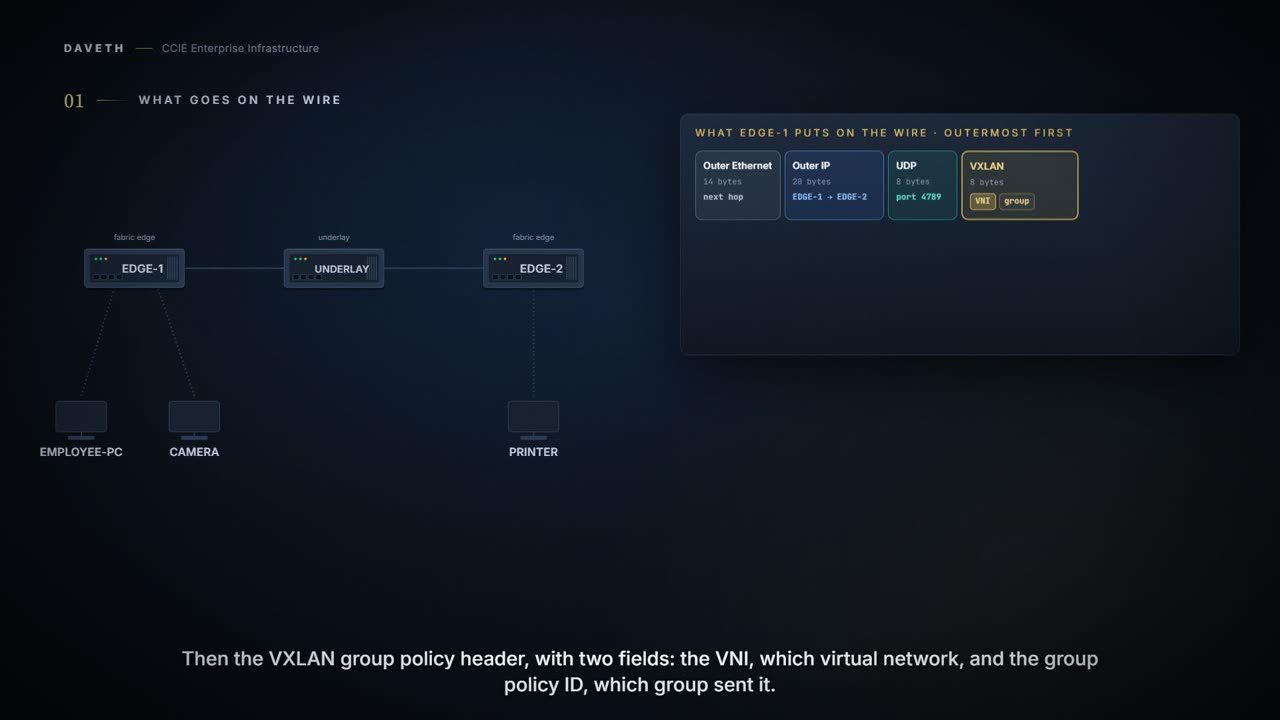
The last lesson ended with an edge node holding an RLOC and a packet to send. This is what it puts on the wire, outermost layer first:
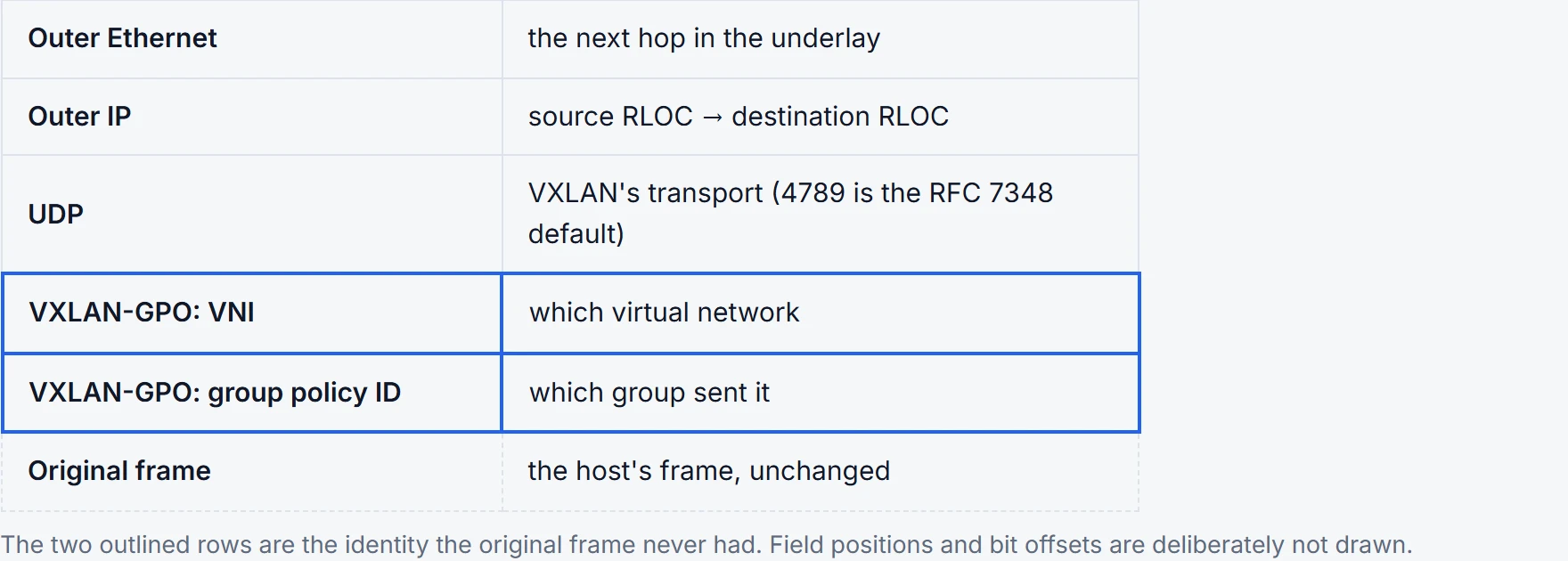
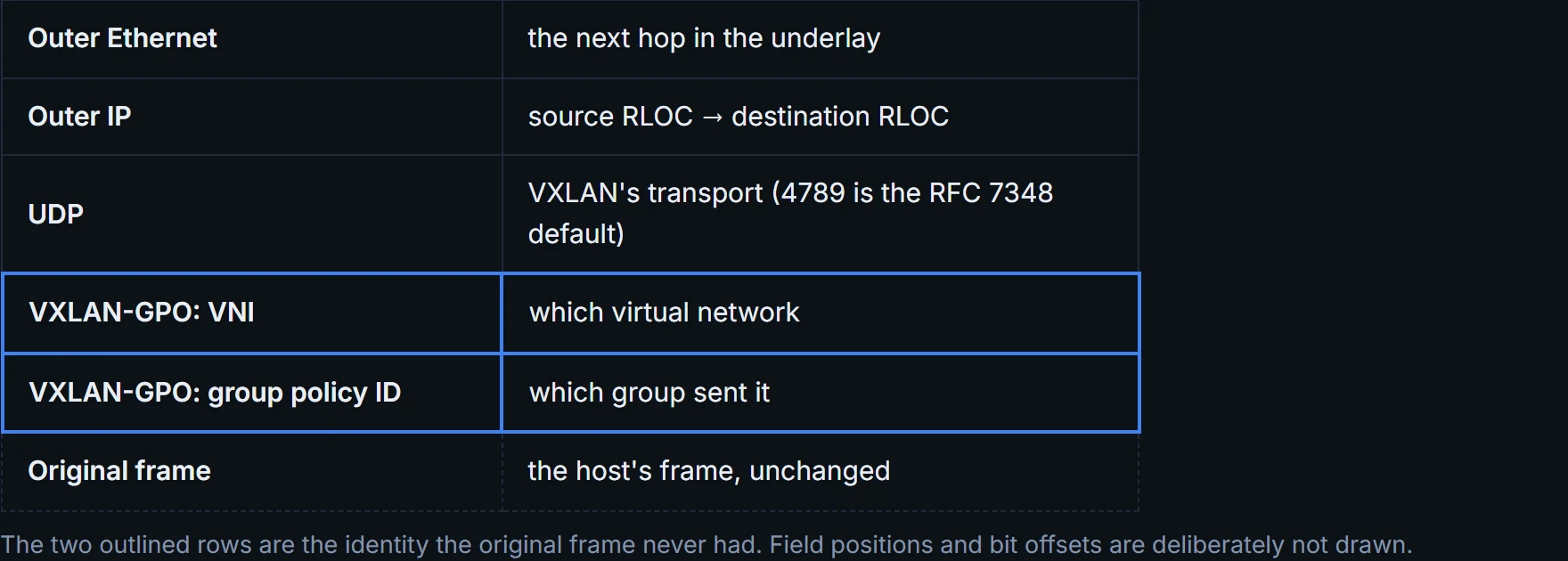
Look at three things, in this order. The original frame is untouched. Two identity fields ride in the VXLAN header. The outer IP is RLOC to RLOC, which is why the underlay never needs an endpoint address.
That stack is an addressed envelope inside another addressed envelope. The inner one is already written, already correct, and nobody touches it. The outer one is addressed to a courier depot rather than to a person, and the couriers move it on that address alone, which is why they never need to know the name inside.
The envelope stops being useful at the far end, because a courier never opens anything and the far edge always does. It strips the outer addressing, reads two identity fields that no real envelope has, and only then decides whether to deliver. Those two fields are the whole reason this is not just a tunnel.
The SD-Access fabric uses the VXLAN data plane to provide transport of the full original Layer 2 frame and additionally uses LISP as the control plane to resolve endpoint-to-location (EID-to-RLOC) mappings. Tunneling encapsulates data packets from one protocol inside a different protocol and transports the original data packets, unchanged, across the network. Within a fabric site, unified policy is both enabled and carried through the segment ID (group policy ID) and VXLAN network identifier (VNI) fields of the VXLAN-GPO header.
Read that as a trade, because that is what it is. The underlay now has to route exactly one kind of address, RLOC to RLOC, and it is a small and stable set. In exchange it learns nothing whatsoever about what is inside, which is the point rather than a side effect: an underlay that cannot see endpoint addresses cannot be broken by an endpoint moving.
Working outward
The VNI
One line of recap: a virtual network in the fabric is a VRF, with everything you already know about VRFs. The VNI is how that membership travels with the packet instead of being implied by an interface:
The Layer 3 VNI maps to a virtual routing and forwarding (VRF) instance for Layer 3 overlays, whereas a Layer 2 VNI maps to a VLAN broadcast domain, both providing the mechanism to isolate the data and control plane to each individual virtual network.
The group policy ID
This is the field that makes SD-Access more than a tunnel. It carries the group of the source: not the destination, not the path. Who sent it.
The SD-Access fabric replaces 16 of the reserved bits in the VXLAN header to transport up to 64,000 SGTs using a modified VXLAN-GPO (sometimes called VXLAN-GBP) format The SGT carries group membership information of users and provides data plane segmentation inside the virtualized network.
Whose group? The format the design guide describes is draft-smith-vxlan-group-policy-04, and the draft answers:
Group Policy ID: 16 bit identifier that indicates the source TSI Group membership being encapsulated by VXLAN.
The outer header
Outer IP from one RLOC to another, over UDP. Where does 4789 come from?
As shown in Figure 1, VXLAN encapsulation uses a User Datagram Protocol (UDP) transport. IANA has assigned the value 4789 for the VXLAN UDP port, and this value SHOULD be used by default as the destination UDP port.
So 4789 is the RFC's default; the design guide does not name the port. And all of it costs space:
At a minimum, these extra headers add 50 bytes of overhead to the original packet.
Those bytes are real and they are not optional. Every one of them comes off whatever the original frame was allowed to be, so a fabric built on links you did not raise the MTU on will work beautifully for small traffic and fail on exactly the transfers people notice. Raise the underlay MTU before you go looking for anything cleverer.
And keep 4789 in its place while you are here. It tells the receiving node how to read what follows, and that is the whole of its job. It says nothing about who sent the frame and nothing about whether the frame is allowed. Those answers are in the two identity fields, not in the transport.
Continue the lesson
The whole lesson, with its drawings and its questions. 6 more sections after the ones above.