
Transit handoffs
The border hands traffic off to something, and for every handoff the question is the same: do the VN and the SGT cross, and by what? End-to-end policy needs the transit to carry that endpoint context. An SD-Access transit keeps VXLAN between sites, so both cross natively. Toward Catalyst SD-WAN, each VRF is handed via a VLAN to an SD-WAN edge subinterface, usually one SD-WAN VPN per VN.
By Arif, founder of Daveth · Updated
The full 6 min walkthrough is in Daveth Pro (Network). See what the plan opens
What this page answers
What must a transit carry for end-to-end SD-Access policy?
The endpoint context: the VRF and the SGT. A transit that cannot carry them breaks segmentation or group policy at the border. Read it in “The property that decides it”
How does SD-Access hand off to SD-WAN?
Each VRF is handed off via a VLAN to an SD-WAN edge device subinterface, usually with one SD-WAN VPN per SD-Access VN. Read it in “Toward SD-WAN”
The border has to hand off to something
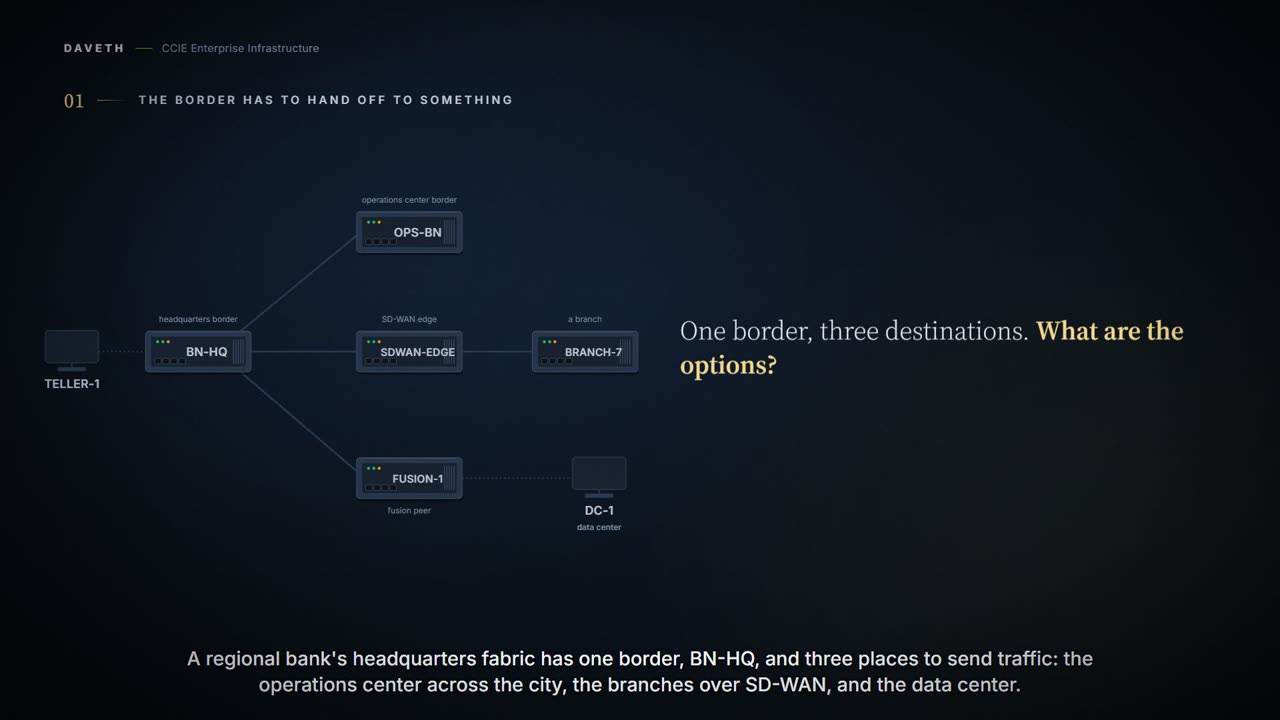
A regional bank's headquarters fabric has one border, BN-HQ, and three places to send traffic: the operations center across the city, the branches over Catalyst SD-WAN, and the data center. What are the actual options for each handoff?
Plain words first. The border is the switch where traffic leaves the fabric. A handoff is what the border passes traffic to. A VN is the fabric's virtual network, a VRF; the SGT is the number for the user's group. The multisite lesson (2.1.c.ii) showed the SD-Access transit keeping both in the header and the IP-based transit dropping the group.
The blueprint names three transits: SDA, SD-WAN and IP. One Cisco page names the same three:
In general, a transit network area exists to connect to the external world and there are several approaches for external connectivity such as IP Transit, SD-Access Transit & SD-WAN Transit. The SD-Access 1.3 solution in Figure 1 supports provisioning of the following fabric components
Read the second quote: that page was written for SD-Access 1.3. The current pages describe it differently:
There are two distinct types of transit networks available in an SD-Access fabric, SD-Access transit and IP transit to connect Distributed Campuses and an external network.
Collected here, in this course's layout: what each page calls each of BN-HQ's handoffs.
handoff to   SD-Access 1.3 guide  current design guide and profile
ops center   SD-Access Transit    SD-Access transit
branches     SD-WAN Transit       IP-based, to an SD-WAN peer
data center  IP Transit           IP-based transit
Look at the SD-WAN row: a transit type of its own in the older guide, an IP-based handoff to an SD-WAN peer in the current ones. Know both names for the exam, and reason from what actually crosses.
Renaming the arrow on a diagram does not add anything to the packet. The same traffic leaves the same border the same way it did before somebody rewrote the guide. If you learn the names and not the behaviour, a version change will make you think the technology moved.
The property that decides it
To provide end-to-end policy and segmentation, the transit network should be capable of carrying the endpoint context information (VRF and SGT) across the network.
Endpoint context means two things: the VN and the SGT. So for every handoff, ask: which of the two cross, and by what? Bandwidth and cost are separate conversations.
A parcel handed from one courier to another is the shape to hold here. The address on the front is understood by everybody in the chain, because an address is the one thing every courier reads. The handling labels are different: they only mean something to a courier who was set up to read them, and the next one in the chain may never have been.
So VN and SGT are not a pair that travel together by default. The VN is the address and it gets across every handoff on this page. The group is a label, and it crosses only where somebody built something to carry it. Three destinations, three arrows, and no permission to assume the three behave alike.
Where the parcel stops: a courier who cannot read a label can phone ahead and ask. Nothing here asks. The label either arrives or it does not, and a device that never receives a group has no way of knowing one was ever attached.
Before reading on, guess for each of BN-HQ's three handoffs whether the teller's group will arrive.
SD-Access transit
In an SD-Access transit, packets are encapsulated between fabric sites using the VXLAN encapsulation. This natively carries the macro (VRF) and micro (SGT) policy constructs between fabric sites. In contrast, SD-Access Transit provides Campus/LAN like connectivity between fabric sites and maintains endpoint context or end to end segmentation across sites. SD-Access transits are exclusively used in SD-Access for Distributed Campus.
Computed from the state: what crosses to the operations center. No command prints it in this form.
to        VN RETAIL crosses by       SGT 30 crosses by
OPS-BN    fabric VXLAN               fabric VXLAN
Read the row: fabric VXLAN for both. The operations center is in the same city on direct fibre, the kind of location the multisite lesson quoted the design guide recommending for Distributed Campus.
Toward SD-WAN
The branches are on Catalyst SD-WAN. How does the fabric hand traffic to it?
This connectivity may be a MAN, WAN, or internet. The WAN could be MPLS, SD-WAN, or other WAN variations. Border node with SD-WAN peer: A VRF is handed off via a VLAN to an SD-WAN edge device subinterface. One SD-WAN VPN is usually configured per SD-Access VN.
By this course's reading, that is an IP-based handoff: the design guide lists the SD-WAN peer among the ways to carry VRFs over an IP-based transit, and each VN leaves on its own VLAN into its own SD-WAN VPN.
Continue the lesson
The whole lesson, with its drawings and its questions. The rest of this section and 4 more after it.