
Multisite remote border
Eleven hotels offer guest wireless, and guests should reach the internet only, through one firewall. A multisite remote border is a centralized gateway for a subset of VNs across multiple fabric sites: their traffic leaves the fabric at the central site. It is per VN, not per site, so staff traffic still uses each hotel's border. And the anchored VN keeps one subnet at every site.
By Arif, founder of Daveth · Updated
The full 7 min walkthrough is in Daveth Pro (Network). See what the plan opens
What this page answers
What is an SD-Access multisite remote border?
A centralized gateway for a subset of virtual networks across multiple fabric sites: traffic for those VNs leaves the fabric at the central site, so untrusted traffic such as guest can be isolated to a firewall or DMZ. Read it in “What a multisite remote border does”
Is the SD-Access remote border per site or per VN?
Per VN. Edge nodes use the site's own borders and control plane nodes for enterprise traffic, and the multisite remote border and its control plane nodes for the anchored VN. Read it in “Per VN, not per site”
Can an SD-Access VN use one subnet across sites?
Yes, when it is anchored at a multisite remote border: the VN is deployed across fabric sites with a single subnet, which conserves address space. Read it in “One subnet across the hotels”
11 hotels, one guest network
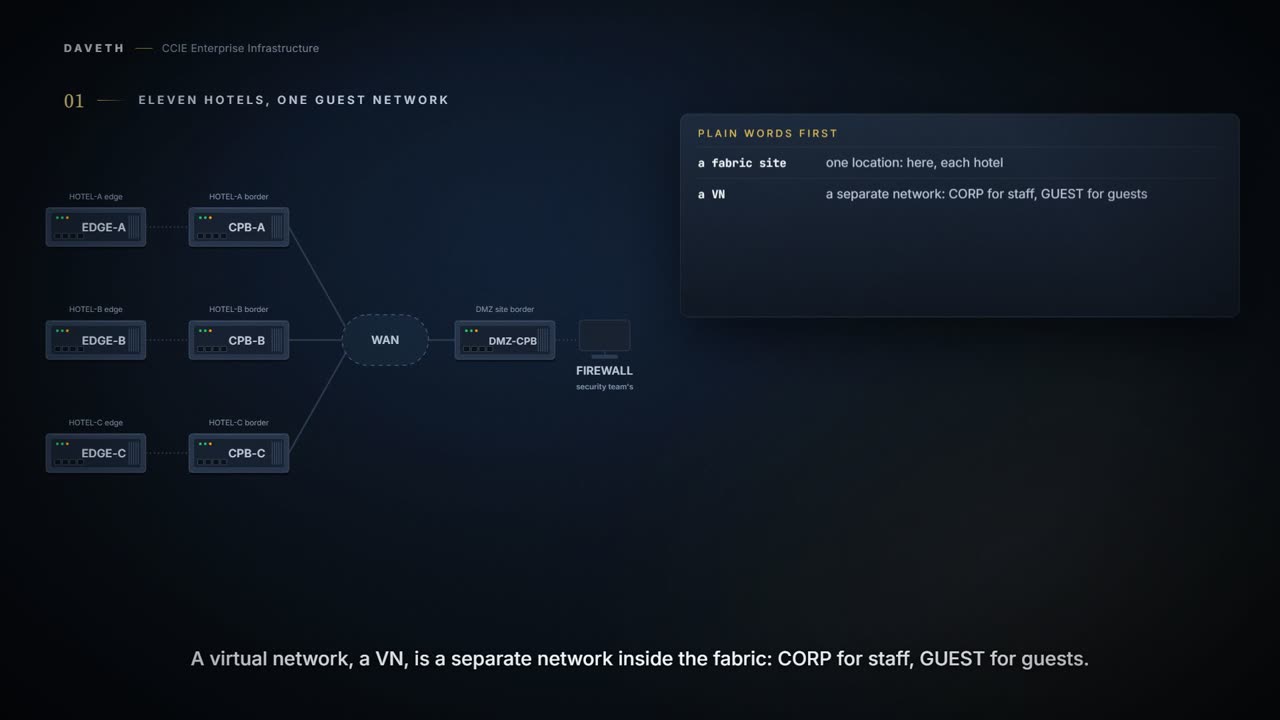
A hotel group has 11 hotels, and every one offers guest wireless. Guests should reach the internet and nothing else, through a firewall the security team owns. Does every hotel need its own firewall and DMZ?
Plain words first. A fabric site is one location running SD-Access; here, each hotel. A virtual network, or VN, is a separate network inside the fabric: CORP for staff, GUEST for guests. A border is the switch where traffic leaves the fabric, and a control plane node is the one that knows where every address lives. A DMZ is the protected zone in front of the internet where the firewall sits.
Eleven firewalls means eleven rule sets that were identical on the day they were installed. Here is how each hotel works today:
Computed from the state, where each VN exits, before any change. No command prints it in this form.
hotel    VN     subnet                          exits at
HOTEL-A  CORP   10.11.1.0/24, 2001:db8:11::/64  CPB-A
HOTEL-A  GUEST  10.61.1.0/24, 2001:db8:61::/64  CPB-A
HOTEL-B  CORP   10.12.1.0/24, 2001:db8:12::/64  CPB-B
HOTEL-B  GUEST  10.62.1.0/24, 2001:db8:62::/64  CPB-B
HOTEL-C  CORP   10.13.1.0/24, 2001:db8:13::/64  CPB-C
HOTEL-C  GUEST  10.63.1.0/24, 2001:db8:63::/64  CPB-C
Read the exits column: every GUEST row leaves at its own hotel's border, next to CORP. The configuration guide describes exactly this starting point:
In a typical case, an endpoint (which could be a guest user) in a fabric site is assigned an Endpoint Identifier (EID) address from the local EID subnet and its traffic is directed through the local border. This adds complexity to the policy enforcement and EID address management for guests across multiple sites.
What a multisite remote border does
Configure a multi-site remote border if you require a centralized gateway for a subset of the Virtual Networks (VNs) across multiple fabric sites. The traffic for those VNs will egress the fabric from the multi-site remote border at the central site. A multi-site remote border enables the fabric network to isolate untrusted traffic to a central location like a firewall or a DMZ (demilitarized zone). For example, if the network has a guest virtual network (VN) that is stretched across multiple sites, all the guest traffic can be tunneled to a remote border at the DMZ, thus isolating the guest traffic from the enterprise traffic.
The pages give the parts names. The VN that travels is the anchor VN; the site it leaves from is the anchor site; every other site carrying it is an anchoring site.
Anchor Virtual Network (VN): A virtual network that exists across multiple fabric sites in a network. The associated IP subnet and segment are common across these multiple sites. Anchor Site: The fabric site that hosts the common border and control plane for an Anchor VN. Anchor Site handles the ingress and egress traffic for the Anchor VN. Anchoring Sites: Fabric sites other than the Anchor Site where the Anchor VN is deployed.
Notice the anchor site handles traffic in both directions, not only outbound.
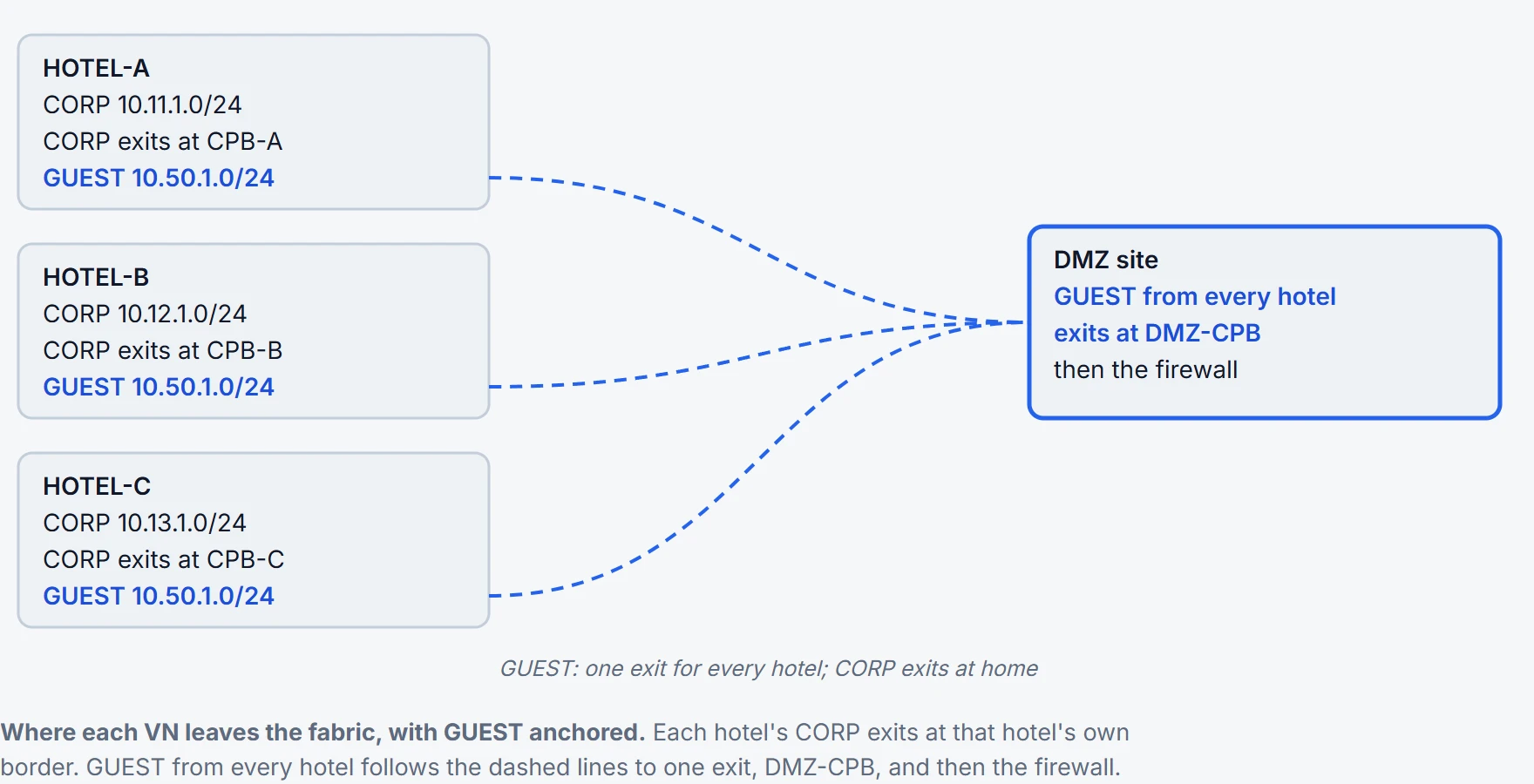
The security team anchors GUEST at the DMZ site, where DMZ-CPB sits in front of the firewall.
Computed from the state, where each VN exits, with GUEST anchored. No command prints it in this form.
hotel    VN     subnet                          exits at
HOTEL-A  CORP   10.11.1.0/24, 2001:db8:11::/64  CPB-A
HOTEL-A  GUEST  10.50.1.0/24, 2001:db8:50::/64  DMZ-CPB
HOTEL-B  CORP   10.12.1.0/24, 2001:db8:12::/64  CPB-B
HOTEL-B  GUEST  10.50.1.0/24, 2001:db8:50::/64  DMZ-CPB
HOTEL-C  CORP   10.13.1.0/24, 2001:db8:13::/64  CPB-C
HOTEL-C  GUEST  10.50.1.0/24, 2001:db8:50::/64  DMZ-CPB
Look at the exits column: CPB-A, DMZ-CPB, CPB-B, DMZ-CPB, CPB-C, DMZ-CPB. Half of the rows moved, and they are the same VN.
Per VN, not per site
So what exactly got moved: the hotels, or the guests?
It is per VN, not per site.
For enterprise traffic the edge node is configured to use the fabric site border nodes and control plane nodes, and for guest traffic the edge node is configured to use the multisite remote border and control plane nodes. In this VN all traffic between fabric to nonfabric must route through the multisite remote border. Any virtual network (not just guest) can be anchored if egress traffic needs to exit the network at a specific location (site).
Read the edge sentence again. The same edge node, at the same hotel, sends CORP to its hotel's border and GUEST to the remote border. HOTEL-B doesn't use the remote border; only HOTEL-B's guests do.
Eleven hotels sharing one shuttle terminal, while the staff at each hotel go on parking in their own car park. Nobody moved a hotel. Guests leave by a shared arrangement and staff leave by the local one, and the two happen from the same building on the same morning.
That is the sentence to carry into the rest of this page: a remote border moves a virtual network, not a site. Ask which VN you are following before you ask which building it is in, because the answer changes per VN and not per hotel.
One subnet across the hotels
Look at the subnet column in the second reading: 10.50.1.0/24 at every hotel, where it used to be three different subnets.
This allows you to deploy a VN across multiple fabric sites but have a single subnet across all these sites. Preserving the subnets across multiple fabric sites helps in conserving the IP address space.
How can one subnet live at eleven hotels at once? The configuration guide puts its addresses in one place:
Configure the EID prefixes of the Anchor VN only on the control plane node at the Anchor Site. The control plane node of the Anchoring Sites should not be configured with the EID prefixes of the Anchor VN.
Computed from the state, which prefixes each control plane holds, with GUEST anchored. No command prints it in this form.
control plane  holds
CPB-A          CORP 10.11.1.0/24, CORP 2001:db8:11::/64
CPB-B          CORP 10.12.1.0/24, CORP 2001:db8:12::/64
CPB-C          CORP 10.13.1.0/24, CORP 2001:db8:13::/64
DMZ-CPB        GUEST 10.50.1.0/24, GUEST 2001:db8:50::/64
Notice CPB-A, CPB-B and CPB-C: CORP only. GUEST's prefixes are on DMZ-CPB and nowhere else. By this course's reading, that also means the firewall's guest rules name one subnet, not eleven, which is the policy complexity the configuration guide says local guest subnets add.
What about Layer 2 between the hotels? The configuration guide's own example anchors a Layer 2 instance at the anchor site as well, and neither page describes how Layer 2 traffic behaves across sites, so this lesson doesn't claim it.
Continue the lesson
The whole lesson, with its drawings and its questions. 4 more sections after the ones above.