
Macro segmentation
Some groups on a campus should never reach each other at all, whatever any access rule says. Macro segmentation puts them in separate virtual networks, and a virtual network is a VRF: complete Layer 3 isolation, with no inter-VN communication unless there is route leaking. That is stronger than VLANs that share one routing table. And shared services still need a deliberate path, usually a fusion device.
By Arif, founder of Daveth · Updated
The full 6 min walkthrough is in Daveth Pro (Network). See what the plan opens
What this page answers
What is macro segmentation in SD-Access?
Using virtual networks, which are VRFs, to isolate large domains such as employees, guests and IoT devices, each with complete Layer 3 isolation and no communication between VNs unless routes are leaked. Read it in “The guarantee, and why it is not a bigger VLAN”
Why is a virtual network stronger than a VLAN?
Two VLANs whose SVIs sit in the same routing table can route to each other. Virtual networks are separate VRFs, so no path exists between them unless someone leaks one. Read it in “The guarantee, and why it is not a bigger VLAN”
How do SD-Access virtual networks reach shared services?
Through deliberate route leaking, usually on a fusion device outside the fabric, a router, Layer 3 switch or firewall that performs inter-VRF import and export. Read it in “Unless you built it”
What actually needs separating
List what is really on a campus network:
- employees
- contractors
- guests
- IP cameras
- door controllers
- HVAC
- point of sale
- building management
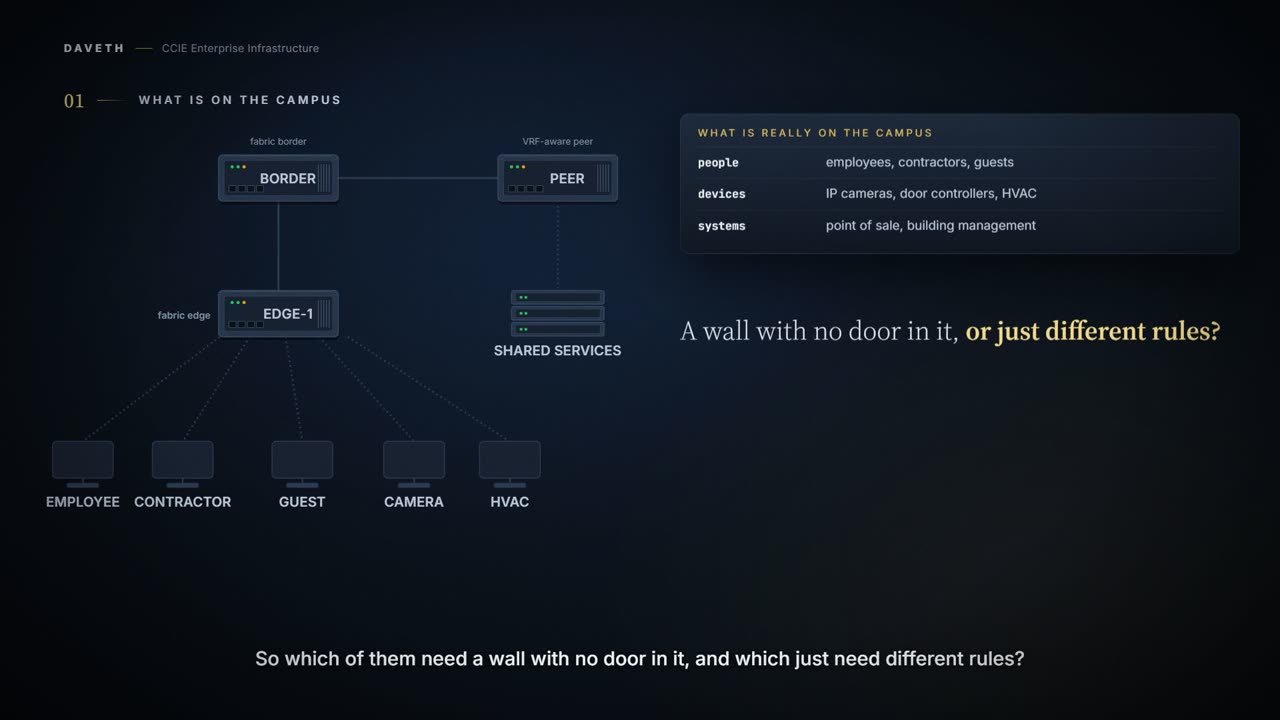
Some of those should never reach each other. A compromised camera has no business seeing a finance workstation, whatever any access rule says. Which of them need a wall with no door in it, and which just need different rules?
The wall is macro segmentation, and it is the coarse cut. The finer rules come in the next lesson.
The containment model
One line of recap, because the guarantee rests on it. A virtual network is a VRF:
Virtual networks provide the same behavior and isolation as VRFs. Layer 2 overlays are identified with a VLAN-to-VNI correlation (Layer 2 VNI), and Layer 3 overlays are identified with a Virtual Routing and Forwarding instance (VRF)-to-VNI correlation (Layer 3 VNI or instance ID in LISP).
Three virtual networks: CAMPUS, GUEST and IOT, on one edge node. The crosses mark paths that do not exist.
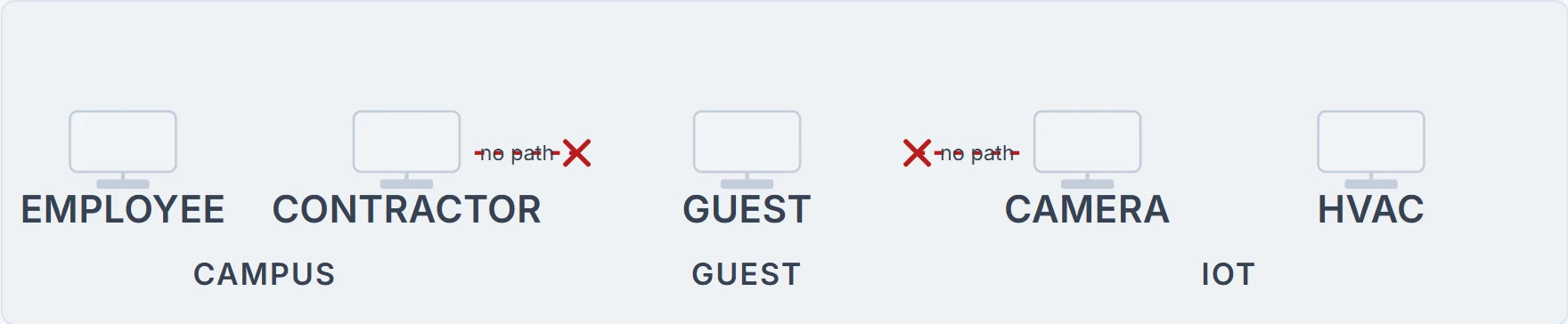
Look at what the crosses mean. Not a filtered link: a path that does not exist, because the groups share no routing table and there is nothing to filter. It is documented of every overlay:
Two classes in one school keep separate exercise books, and neither class's notes end up in the other. Nothing is stopping them. There is simply no book in which both sets of notes could appear, and that is a far stronger guarantee than a teacher promising to watch.
The exercise book stops there, because a pupil can carry a book into the other room and a route cannot walk anywhere. Every crossing on this page is one somebody configured, which is the next section.
Each Layer 3 overlay, its routing tables, and its associated control planes are completely isolated from one another.
And that has a consequence you will meet before you meet the theory. Two hosts sit on the same edge node, in the same building, on adjacent ports, and they cannot reach each other. Now go looking for the reason. There is no deny counter, no dropped-packet log and no rule to read, because nothing is being denied: the lookup simply has nowhere to go. What separates them is the absence of something, and absence leaves no evidence. If you are ever staring at a reachability problem inside a fabric with nothing to show for it, check which virtual network each side is in before you check anything else.
Notice EMPLOYEE and CONTRACTOR share CAMPUS. The guide treats users (employees, contractors, etc.) as one domain, and the difference between them is handled inside the VN:
Within each VN, micro-segmentation provides a second, finer layer of control between specific roles and device types
The guarantee, and why it is not a bigger VLAN
Here is the whole guarantee, in one sentence. Read it to the end:
Macro-segmentation uses virtual networks or VRFs to isolate large domains such as users (employees, contractors, etc.), guests, and IoT devices (cameras, HVAC, etc.), with each VN providing complete Layer 3 isolation and no inter-VN communication unless there is route leaking.
Complete Layer 3 isolation, unless there is route leaking. Hold on to both halves; the second is where designs go wrong.
Why is that stronger than VLANs? Two VLANs whose SVIs sit in the same routing table are routed to each other as soon as both SVIs are up. Keeping them apart takes a filter, an ACL that somebody maintains. Two VNs have separate routing tables, so there is no route between them to filter in the first place.
Guests show it most plainly:
Guests, by the nature of VRFs and macro-segmentation, are automatically isolated from other traffic in different VNs, though the same fabric nodes are shared for guest and nonguest users.
Unless you built it
So if every VN is sealed, how does anything get an address? DHCP and DNS are not inside every VN:
Most networks need some form of shared services that can be reused across multiple virtual networks rather than hosting them inside every VN.
Someone has to connect each VN to them, on purpose. The deployment guide names the device that usually does it:
A Fusion device is basically an external Router, L3 Switch, or Firewall which is located outside of the SD-Access Fabric and performs basic inter-VRF route leaking (import/export of routes from one VN to another VN) in order to allow communications between VRFs or between one VN/VRF and the Global routing table (GRT).
The design guide gives the options, and route leaking on a peer is not the only one:
The use of a VRF-aware peer directly attached outside of the fabric provides a mechanism for route leaking of shared services prefixes across multiple networks, and the use of firewalls provides an additional layer of security and monitoring of traffic between VNs. Alternatively, SD-Access LISP Extranet can be used to enable access to shared services or internet resources external to the fabric, eliminating the need for traditional BGP-based route leaking between VNs.
Continue the lesson
The whole lesson, with its drawings and its questions. The rest of this section and 3 more after it.