
Layer 2 border handoff
During a migration, a host on the fabric and a host that cannot move yet share one subnet and find each other by broadcast. A Layer 2 border handoff connects the fabric and a nonfabric network at Layer 2, with VLAN translation at the border, so both sides use the same subnet and switching domain. For a routed fabric segment, the border becomes the traditional VLAN's default gateway.
By Arif, founder of Daveth · Updated
The full 7 min walkthrough is in Daveth Pro (Network). See what the plan opens
What this page answers
What is an SD-Access Layer 2 border handoff?
A Layer 2 connection between the fabric and a nonfabric network, with VLAN translation at the border node, so a fabric segment and a traditional VLAN share the same subnet and switching domain. Read it in “What a Layer 2 handoff connects”
Where is the gateway with a Layer 2 border handoff?
For routed SD-Access segments, the anycast gateway SVI is provisioned to the handoff and the border node becomes the default gateway for the traditional VLAN. Layer 2 VNs have no anycast gateway. Read it in “Two kinds of segment”
The fabric contradicts itself, on purpose
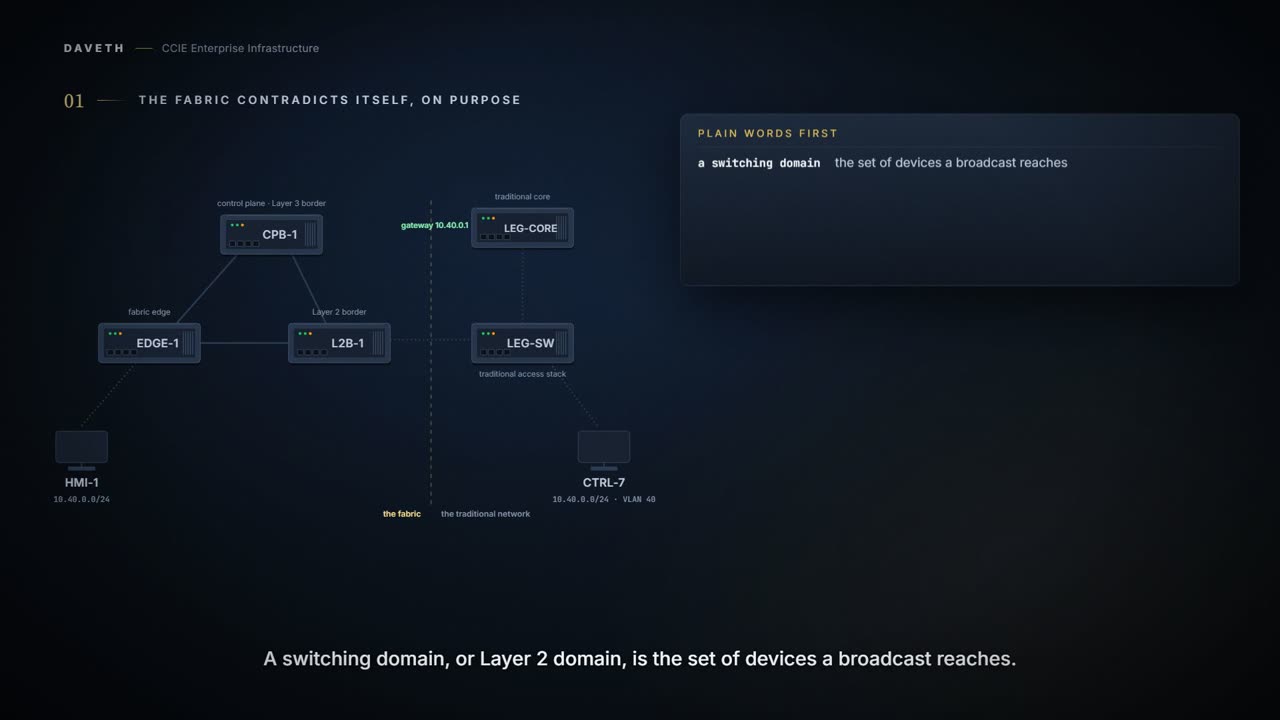
A dairy plant is moving its network into SD-Access. Its cold-store controllers and the operator screen that watches them share one subnet and find each other by broadcast. The screen, HMI-1, has already moved onto the fabric. The controller, CTRL-7, can't change its address or move yet. How do they keep talking?
Plain words first. A switching domain, or Layer 2 domain, is the set of devices a broadcast reaches. A VLAN is one such domain on traditional switches. A gateway is the router address hosts send off-subnet traffic to. The traditional network is the plant's old switched network, outside the fabric.
Computed from the state, where the two hosts are, before any handoff. No command prints it in this form.
host    side                  subnet         shares a switching domain
HMI-1   fabric, EDGE-1        10.40.0.0/24   no
CTRL-7  traditional, VLAN 40  10.40.0.0/24   no
Read the last column: no, and no. By this course's reading, a subnet split between the fabric and a traditional VLAN is two separate switching domains, so HMI-1's broadcasts never reach CTRL-7.
The fabric spent every lesson so far getting rid of Layer 2, and then shipped a door marked Layer 2. The design guide says why the door exists:
When a traditional network is migrating to an SD-Access network, the Layer 2 border handoff is a key strategic feature when endpoint IP addresses cannot change or endpoints must reside in the same Layer 2 switching domain.
What a Layer 2 handoff connects
Layer 2 border handoff provides a Layer 2 connection between the SD-Access fabric and a nonfabric network, allowing hosts in both to communicate at Layer 2. Layer 2 border nodes provide Layer 2 handoff of overlays, or a combination of Layer 2 and Layer 3 overlays, to external domains. The Layer 2 border handoff allows the fabric site and the traditional network VLAN to operate using the same subnet and switching domain. Communication between the two is provided across the border node with this handoff that provides a VLAN translation or a VLAN extension between fabric and nonfabric. Cisco Catalyst Center automates the LISP control plane configuration along with the VLAN translation and the trunk port connected to the traditional network on this border node.
Notice the third sentence: the same subnet and the same switching domain, on both sides.
So the plant provisions a Layer 2 handoff on L2B-1, its Layer 2 border, toward VLAN 40 on the traditional access stack LEG-SW.
Computed from the state: the two hosts with the handoff in place. No command prints it in this form.
host    side                  subnet         shares a switching domain
HMI-1   fabric, EDGE-1        10.40.0.0/24   yes, with CTRL-7
CTRL-7  traditional, VLAN 40  10.40.0.0/24   yes, with HMI-1
Look at the last column now: yes, with each other. One subnet, one switching domain, across the fabric boundary.
It is an exception, not a design.
Two kinds of segment
What is on the fabric side of the handoff matters, because it decides where the gateway lives.
Layer 2 handoff can connect either routed SD-Access segments (segments with an SVI anycast gateway) or Layer 2 VNs (no SVI anycast gateway) to traditional nonfabric VLANs. For routed SD-Access segments, the anycast gateway SVI is provisioned to the Layer 2 handoff and the border node configured with the Layer 2 handoff becomes the default gateway for the VLAN in the traditional network. Any SVI with the same IP address present in the traditional network must be disabled. For SD-Access Layer 2 VNs, the fabric Layer 2 switching domain is bridged over the Layer 2 handoff toward the traditional network.
Computed from the state: the two kinds of segment, in this course's layout. No command prints it in this form.
segment                               traditional VLAN's gateway
routed segment (SVI anycast gateway)  the Layer 2 border node
Layer 2 VN (no SVI anycast gateway)   outside the fabric
Read the gateway column. A routed segment brings its gateway to the border; a Layer 2 VN leaves it outside. The plant's segment is routed, and LEG-CORE had been VLAN 40's gateway for years:
Computed from the state, who answers for 10.40.0.1 on the traditional side, right after the handoff. No command prints it in this form.
traditional side  gateway 10.40.0.1       note
VLAN 40           L2B-1 and LEG-CORE      two gateways
Read the note: two gateways. The guide's rule is that the traditional SVI with the same address must be disabled, and the team shuts it:
Computed from the state: the gateway after LEG-CORE's SVI is shut. No command prints it in this form.
traditional side  gateway 10.40.0.1       note
VLAN 40           L2B-1                   one gateway
And multicast between the two sides?
Multicast is supported across the Layer 2 handoff, allowing multicast communication between the traditional network and the SD-Access network.
And Layer 2 flooding?
Is this the same thing as the Layer 2 flooding setting from 2.1.b.iv? No. Flooding is about how broadcasts behave inside a fabric subnet; a handoff is a connection out of the fabric. But the guide ties them together in two places:
Migration use case: A Layer 2 border can bridge a traditional switching domain with the SD-Access fabric by providing VLAN translation between SD-Access segments and nonfabric VLANs. Gateway outside the fabric: Extends a fabric Layer 2 segment using a VLAN‑to‑VNI mapping, which places the segment default gateway outside the fabric and enables Layer 2 flooding for the segment. For OT, IoT, and building management systems (BMS) migrating to SD-Access, the Layer 2 border handoff can be used in conjunction with Layer 2 flooding.
Notice the gateway-outside use: it turns Layer 2 flooding on for the segment. And for plants like this one, with controllers that rely on broadcast, the guide pairs the two deliberately. They are different features that are often switched on together.
Continue the lesson
The whole lesson, with its drawings and its questions. 4 more sections after the ones above.