
LISP and BGP control planes, host onboarding
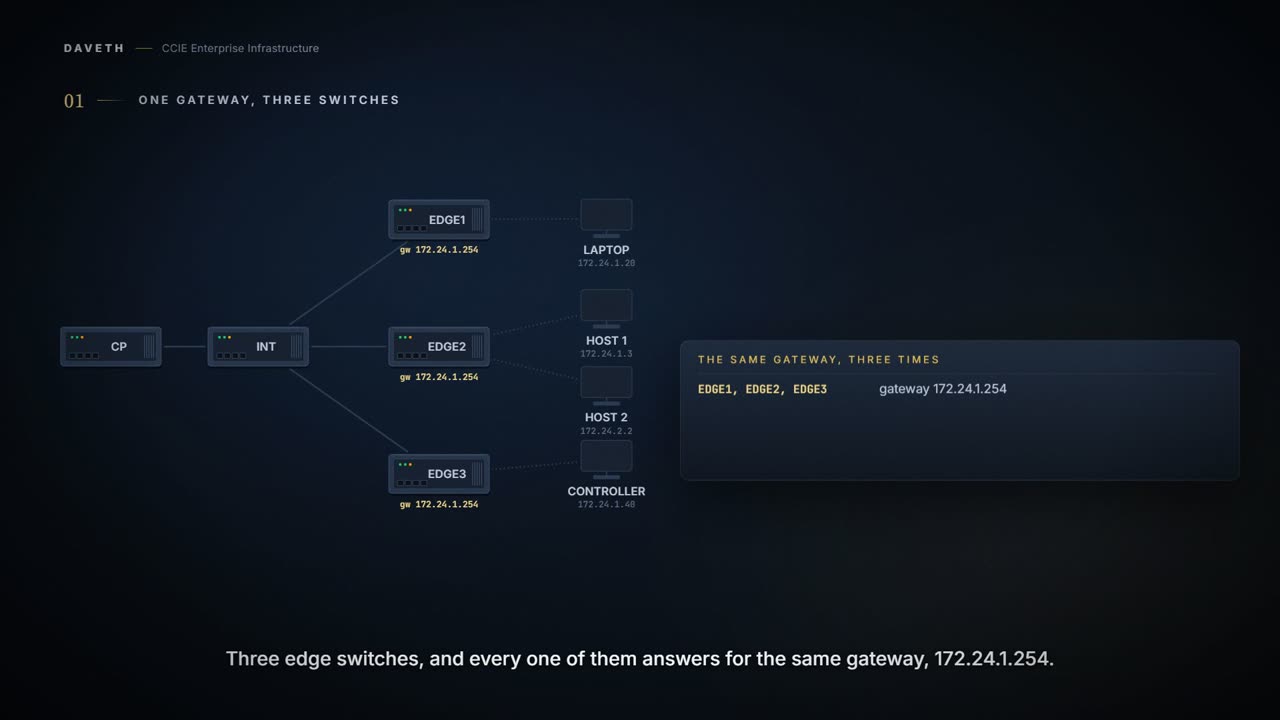
Every edge switch in the fabric has the same gateway SVI, same IP and same MAC, and that is not a duplicate. An edge node learns a host when it transmits, records it as an EID and registers it with the control plane node against its own RLOC, a loopback in the underlay. Sending to a host takes two questions: where is it, and how to reach that RLOC.
By Arif, founder of Daveth · Updated
The full 7 min walkthrough is in Daveth Pro (Network). See what the plan opens
What this page answers
What is the difference between an EID and an RLOC in SD-Access?
An EID is an endpoint identifier, the host's address treated as an identity. An RLOC is a routing locator, the edge node's own loopback in the underlay, which ordinary routing knows how to reach. Read it in “Stage two: one device is told, and it is not on the path anything will take”
Why is there no host route in the SD-Access edge routing table?
Where an endpoint is comes from the control plane node, not the routing table. The edge asks it for the endpoint's RLOC and keeps the answer in the LISP map-cache; show ip route vrf will not show it. Read it in “The command you will reach for, and what it will tell you”
How does SD-Access onboard a host?
The edge learns the endpoint when it transmits, registers it with the control plane node, and the onboarding workflow authenticates it, classifies it, assigns a scalable group and associates it to an IP pool and virtual network. Read it in “Stage three: known, located, and still not allowed to be anything”
The same gateway address, on three different switches
Every edge switch in this fabric has the same SVI for a given subnet. Same IP. Same virtual MAC. A host plugged into FE2067 and a host plugged into FE2069 both use 172.24.1.254 as their gateway, and both get an ARP reply from the switch they are actually attached to.
That should be a duplicate-address incident. Every campus instinct you have says so. It is not, and the reason it is not is the whole of this page.
State 1 One site, one gateway address, three copies of it
If the gateway is everywhere, how does anything know which switch a host is actually plugged into?
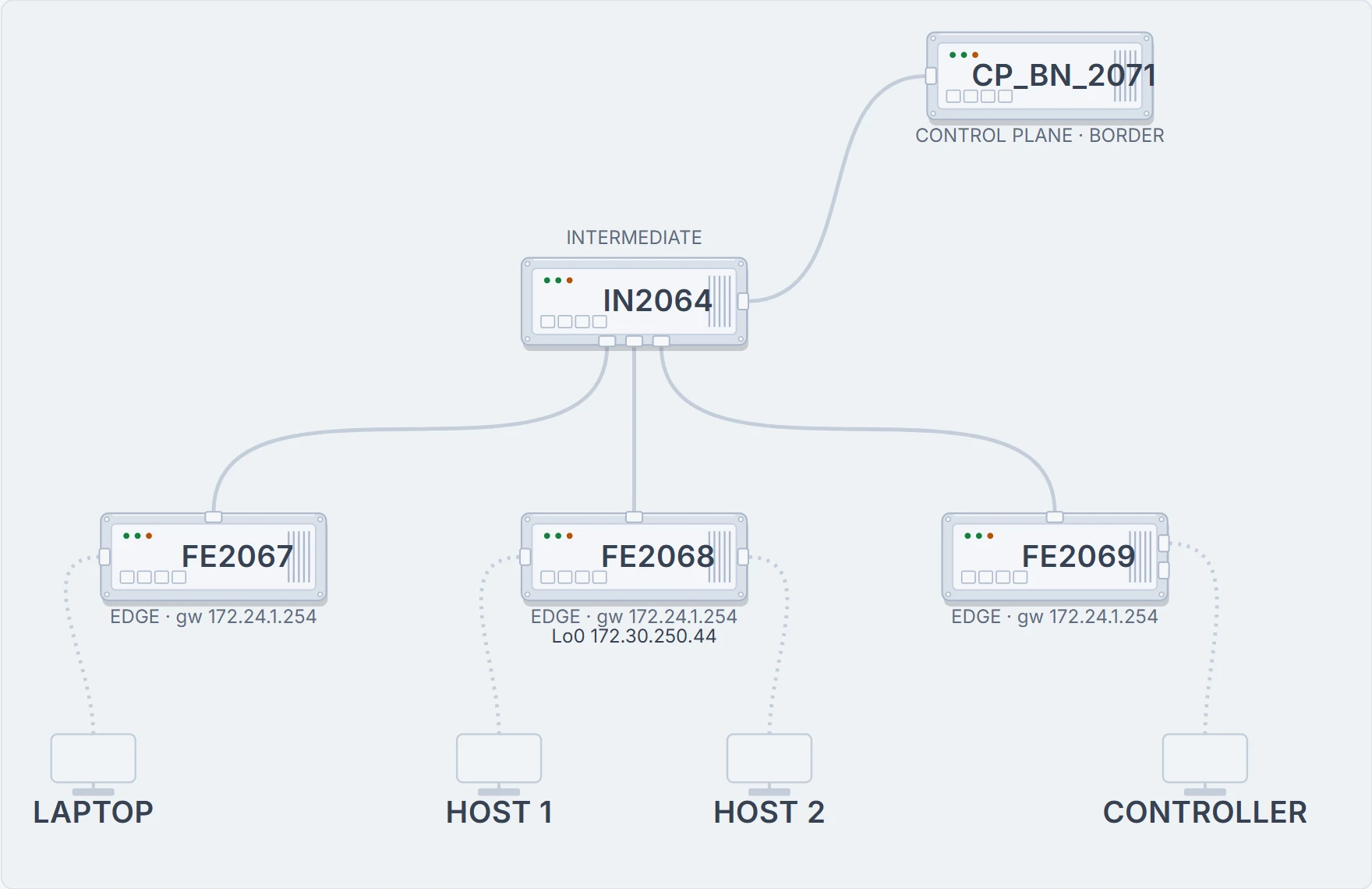
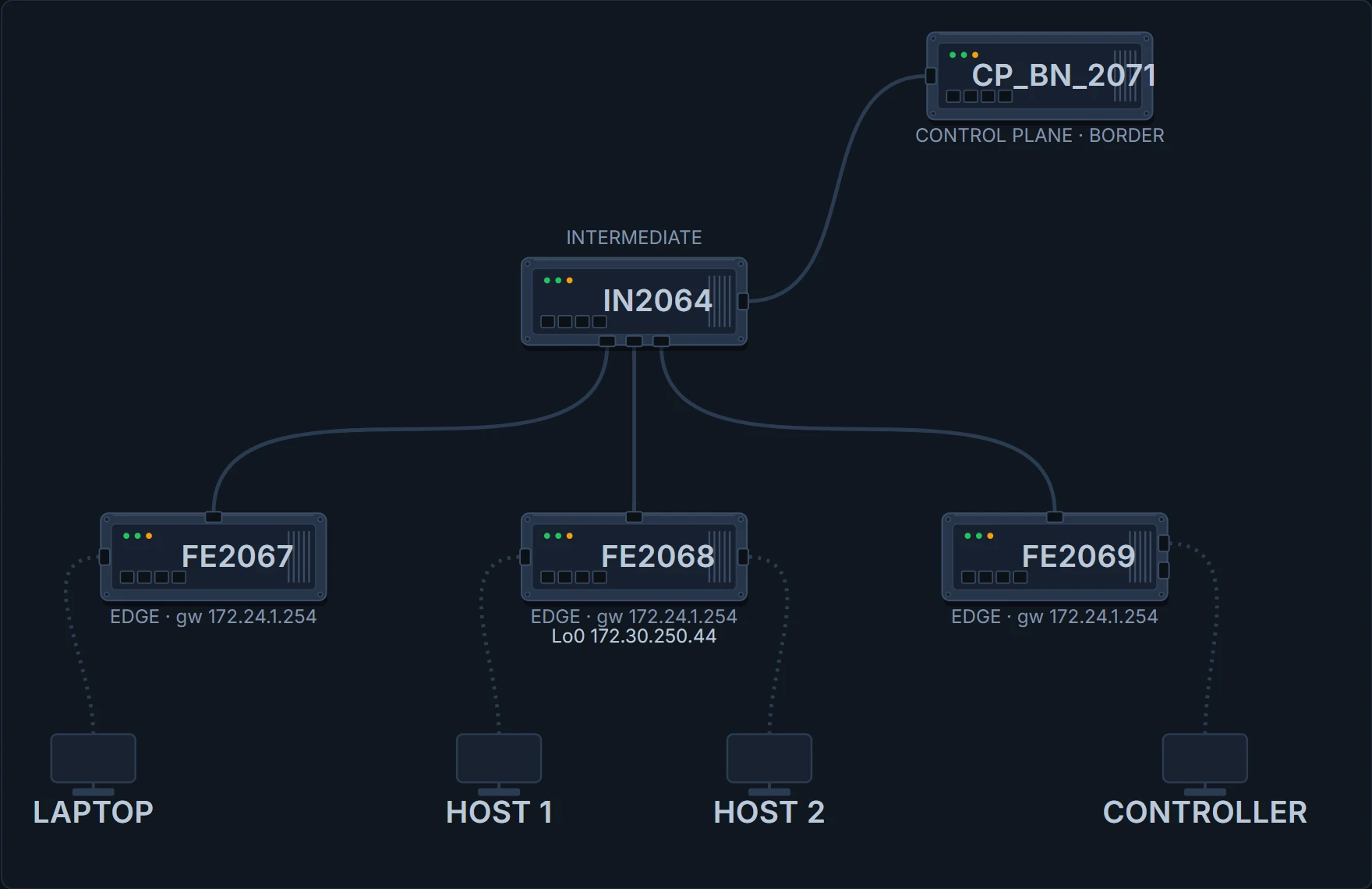
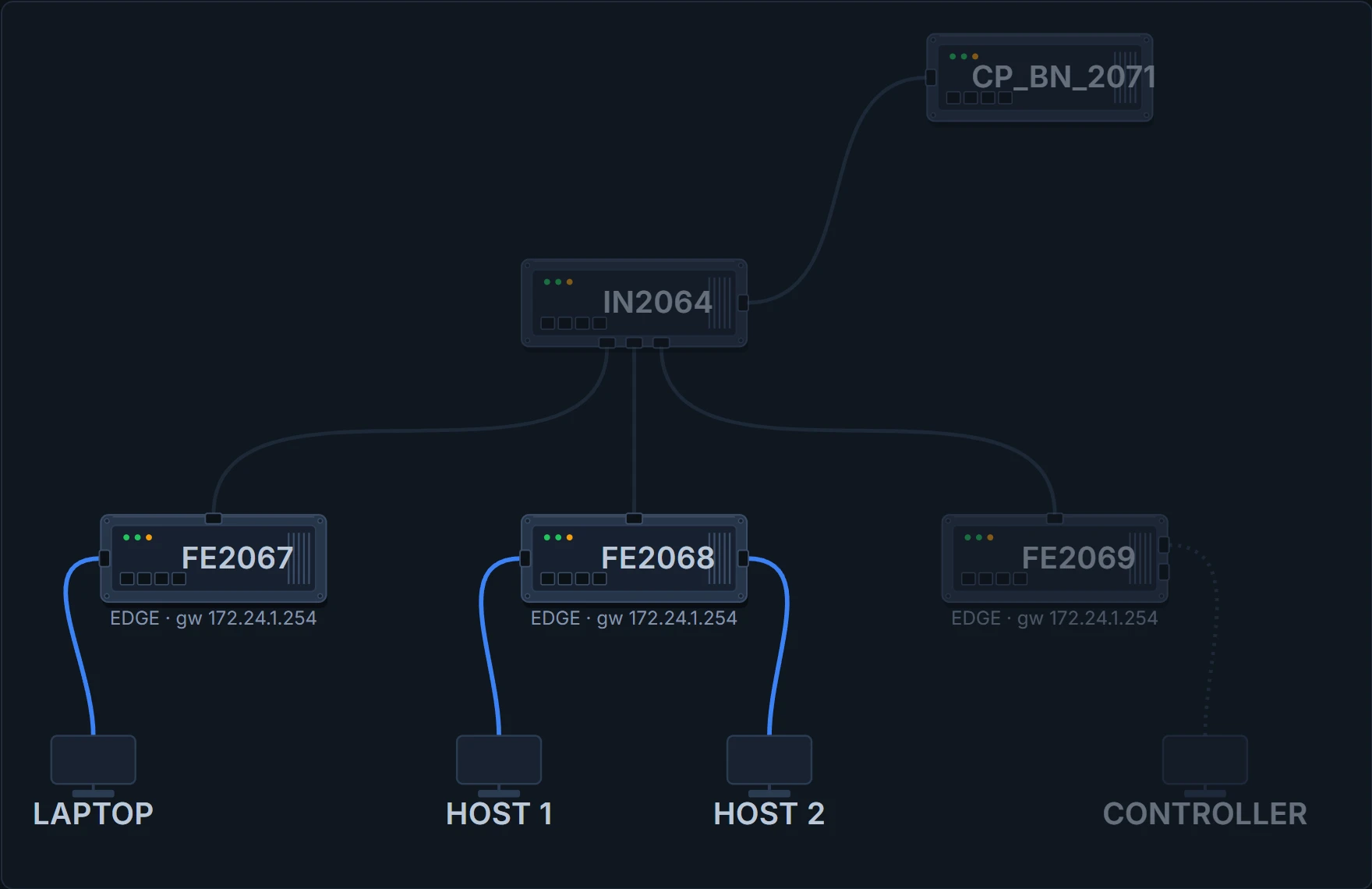
Five switches. Three of them are edge nodes, where endpoints plug in. One is an intermediate node, which does nothing but forward. And one is the control plane node, which in this design is also the border.
Now a question worth committing to an answer on. A host on FE2067 sends a packet to an address that lives somewhere else in this fabric. What does FE2067 look at to decide where to send it?
Most people say the routing table. That is the right answer almost everywhere else in networking, and it is the wrong answer here. Everything you know about routing still holds: it just does not apply to the endpoint's address.
Stage one: the switch finds out a host exists because the host says something
Before anything can know where an endpoint is, some device has to learn that it exists at all. Three things have to happen, in order, and they produce different evidence in different places. An endpoint can complete one and fail the next.
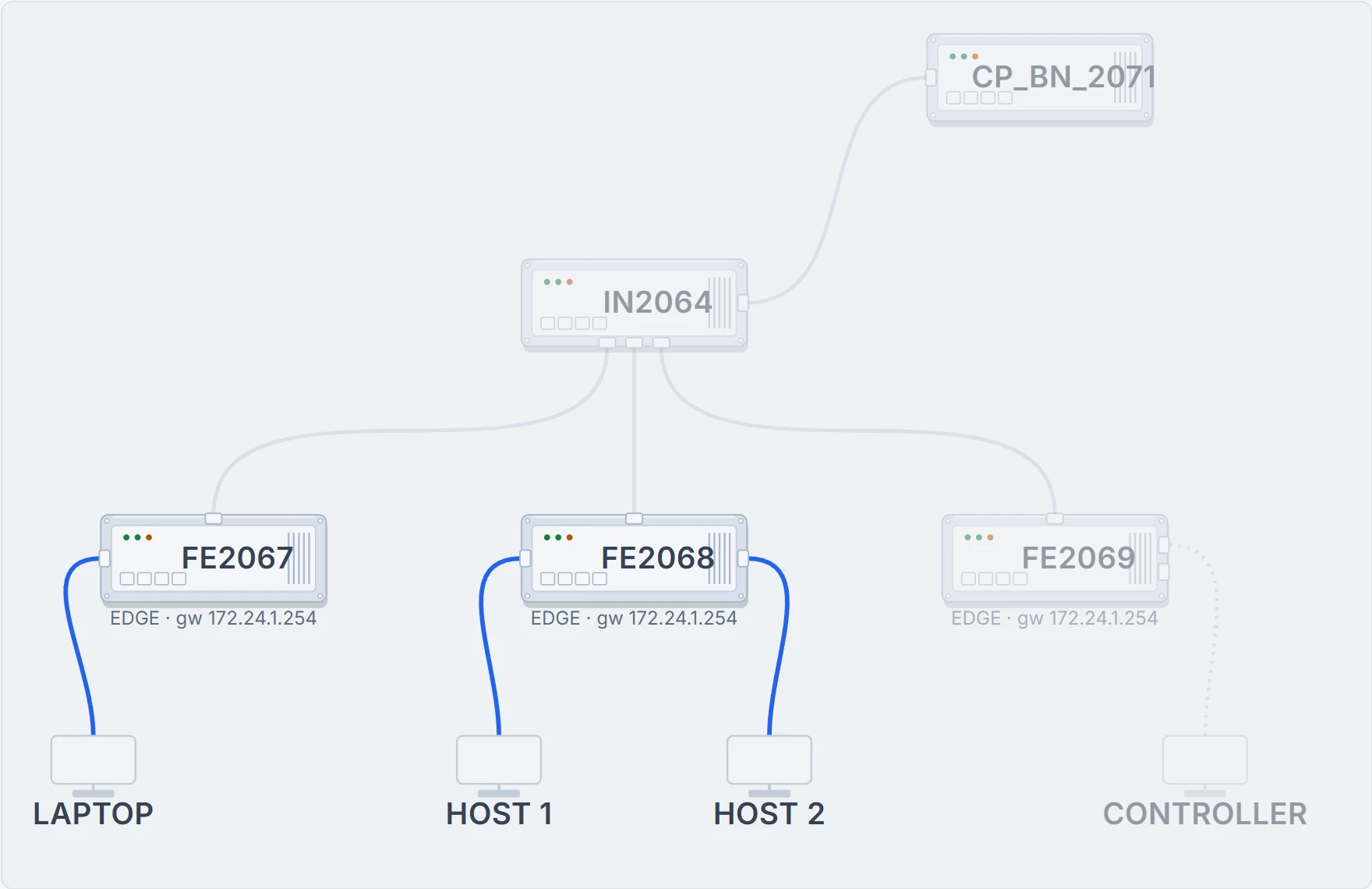
The switch finds out an endpoint exists because the endpoint transmits: an ARP, a DHCP discover, any frame at all. Device tracking picks it up and the MAC address table populates; the troubleshooting document says the fabric devices register what gets learned locally by Device-Tracking.
State 2 Three of four devices have spoken
Three endpoints are known and one is not. Which device is the reason?
FE2068# show device-tracking database vlanid 150
Network Layer Address     Link Layer Address     Interface  vlan  State
ARP  172.24.1.3           0050.5693.8930         Gi1/0/1    150   REACHABLE
! address, MAC, port, VLAN: the switch has physically seen this endpoint
Proves: this edge node has seen the endpoint and holds a binding for it.
Does not prove: that anything else in the fabric knows about it. This is one switch's own knowledge of its own port.
What is quoted and what is computed. The output above, and three more below, are condensed from captures in the LISP VXLAN troubleshooting document. The device names, the endpoint addresses, the locator and the instance ID are that document's. The layouts are shortened: the document prints more columns, header lines and fields, including a locator table with reachability lines under each map-cache entry, and this page keeps only the lines it reads. Everything the document does not print (the underlay, the intermediate node, the other locators, and two endpoints this course added so there is somebody to send and somebody to move) is this course's own, rendered in the same shortened layouts.
Stage two: one device is told, and it is not on the path anything will take
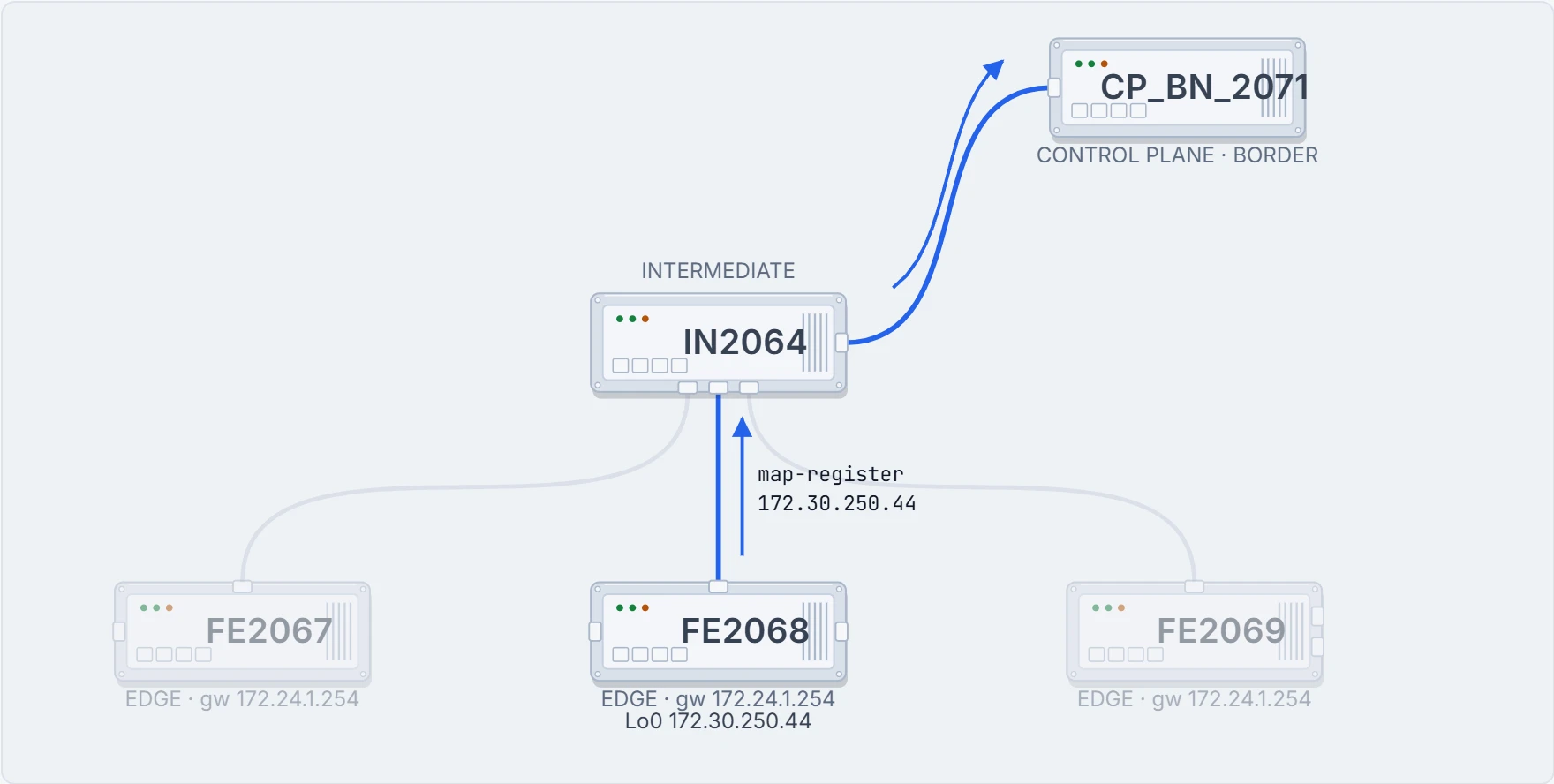
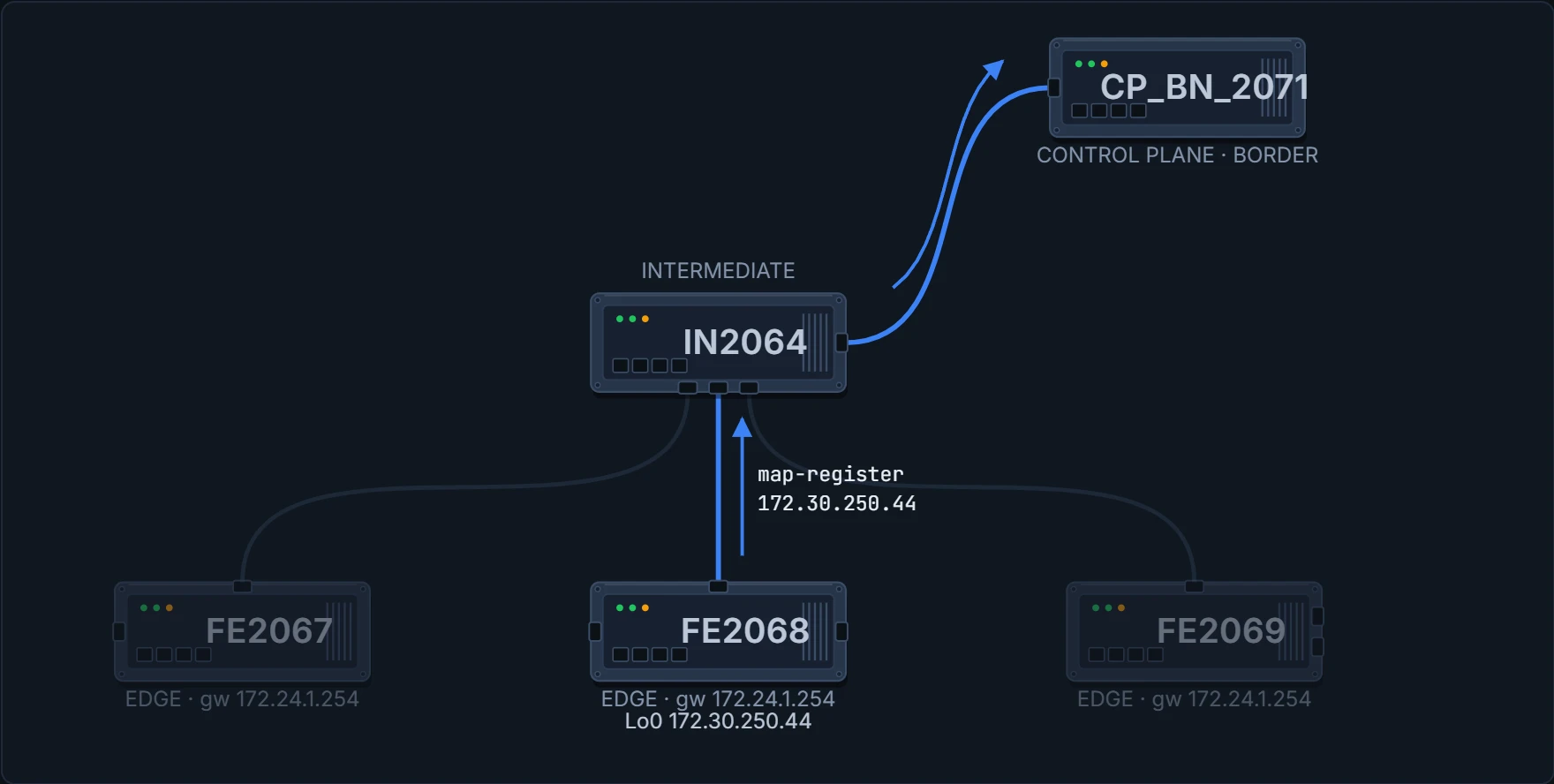
Having learned it, the edge node does two things. It records the endpoint locally as an EID: an endpoint identifier, which is just the host's address treated as an identity rather than as a destination in a subnet. Then it registers that EID with the control plane node: this endpoint is behind me, and me is 172.30.250.44.
That second address is the RLOC, the routing locator. It is the edge node's own loopback, and it is an ordinary address in the underlay that ordinary routing already knows how to reach.
State 3 Registration
Where does this information travel, and where does it stop?
FE2068# show lisp instance-id 4099 ipv4 database
LISP ETR IPv4 Mapping Database for LISP 0 EID-table vrf
Fabric_VN_1 (IID 4099)
172.24.1.3/32, dynamic-eid Fabric_VN_Subnet_1_IPv4
! one endpoint, filed as a dynamic EID
Locator: 172.30.250.44  Pri/Wgt: 10/10  State: reachable
172.24.2.2/32, dynamic-eid Fabric_VN_Subnet_2_IPv4
Locator: 172.30.250.44  Pri/Wgt: 10/10  State: reachable
! the same locator as the line above: two identities, one location
Look at the locator on both entries. Two different endpoints, in two different subnets, and the same RLOC, because they are behind the same edge node. That is the EID and RLOC split doing its job: identity and location are separate, and many identities share one location.
And at the other end of the transaction:
CP_BN_2071# show lisp site 172.24.1.3/32 instance-id 4099
EID-prefix: 172.24.1.3/32 instance-id 4099
State: complete   ! complete: the mapping system holds this endpoint
Proxy reply: Yes
TTL: 1d00h
Locator: 172.30.250.44  State: up  Pri/Wgt: 10/10
! and it was registered from this locator
So the fabric does not advertise the host anywhere. One device knows where the host is, and one device knows who to ask. The control plane node runs both halves of that: map-server, which accepts registrations, and map-resolver, which answers queries. Same node in SD-Access, two jobs.
Proves: the endpoint exists in the mapping database, registered from that locator.
Does not prove: that any other node has ever asked for it, or that a single packet has moved. It also does not prove policy placed the endpoint correctly.
Stage three: known, located, and still not allowed to be anything
The endpoint exists and the fabric knows where it is. It still does not know what it is allowed to be.
The onboarding workflow authenticates the endpoint, classifies it, assigns it a scalable group, and associates it to an IP pool and virtual network. Unpack that against what you already have: authentication is where the identity service evaluates the endpoint and returns an authorisation result, and part of that result is the group tag. The IP pool and virtual network decide which VN the endpoint lands in: here, Fabric_VN_1, which is the macro-segmentation boundary.
So stage three decides both halves of the segmentation model: which virtual network, and which group.
Why does that matter for troubleshooting? Because an endpoint can be learned, registered, reachable, and placed in the wrong virtual network, or given a group that denies everything it needs. Stages one and two look perfect while nothing works. The evidence for stage three is not in any of the commands above.
Two questions, two sources of truth, two ways to fail
Now the laptop on FE2067 sends to 172.24.2.2. FE2067 asks the control plane node where that endpoint is, gets back an RLOC, and then, and only then, works out how to reach that RLOC, which is a completely ordinary routing problem.
State 4 Both questions, leaving the same switch
Two arrows leave one device. What is different about where each of them goes?
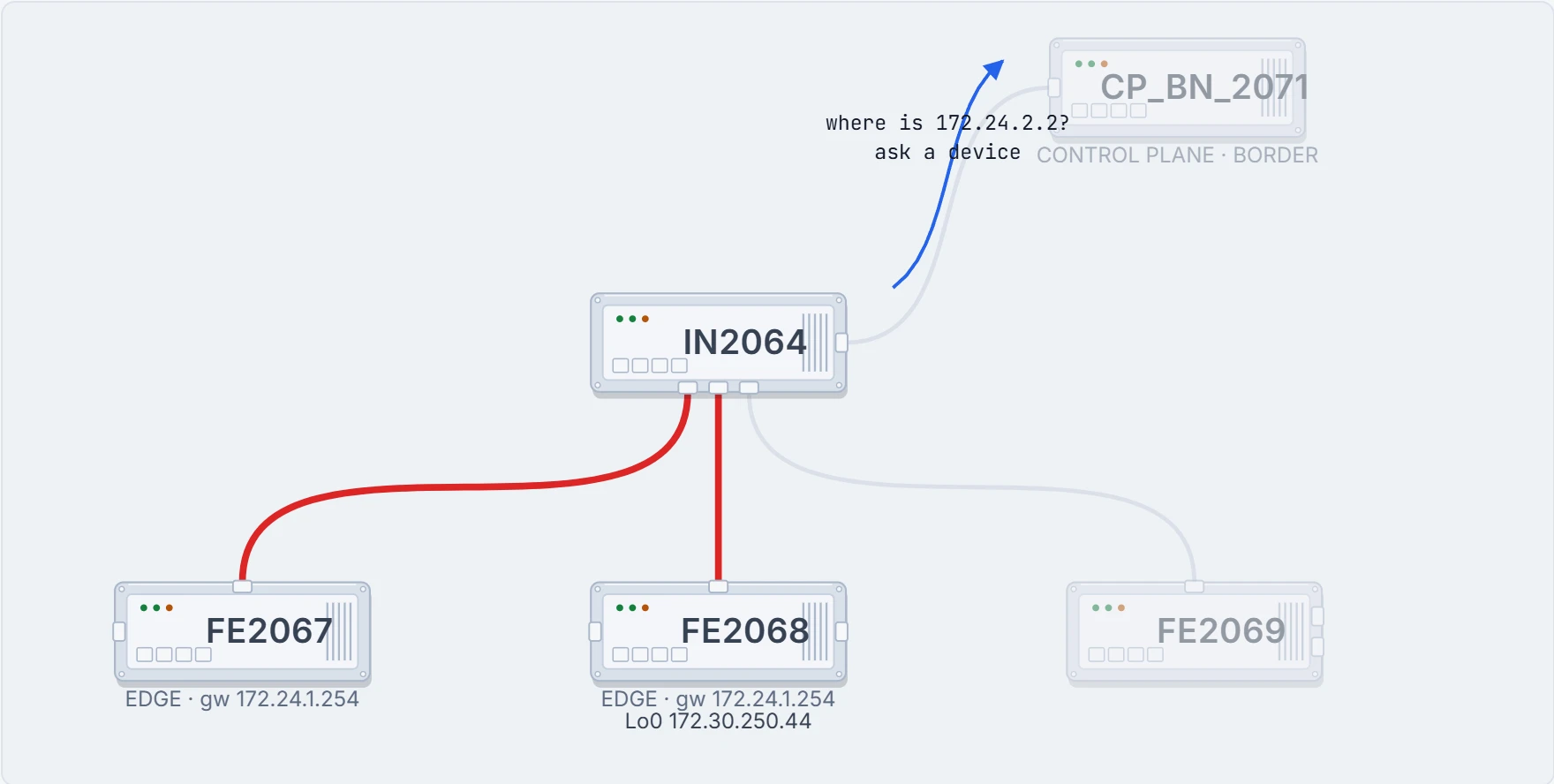
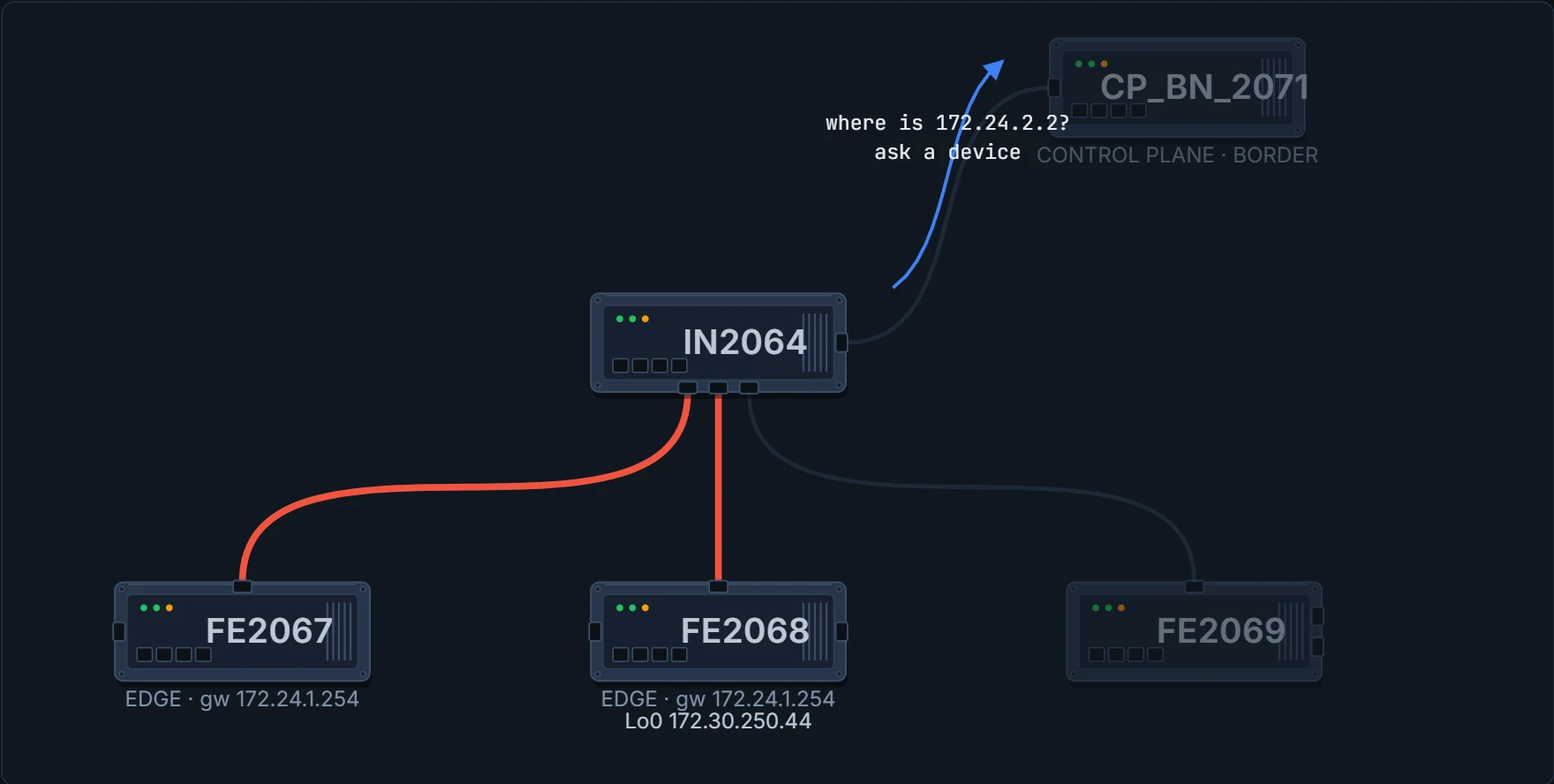
Question 1 has nothing to do with the routing table. Question 2 has nothing to do with the endpoint. Neither one can answer the other's question, and, this is the part that matters operationally, either can fail on its own.
So did question 1 get an answer on FE2067?
FE2067# show lisp instance-id 4099 ipv4 map-cache
172.24.2.2/32, uptime: 00:00:00, expires: 23:59:59, via map-reply, complete
! via map-reply, complete: this node asked, and was answered
Locator: 172.30.250.44  State: up  Pri/Wgt: 10/10
! the locator it was given
Proves: question 1 got an answer on this node, and the answer is cached until it expires.
Does not prove: that the path to 172.30.250.44 works end to end, that return traffic resolves, or that policy permits the flow. complete describes the mapping, not the path to it: the locator has its own State, read separately.
The command you will reach for, and what it will tell you
Is there a route to 172.24.2.2 on FE2067? You will run this to find out, because it is what you run everywhere else:
FE2067# show ip route vrf Fabric_VN_1
Codes: C - connected, L - local

      172.24.0.0/16 is variably subnetted, 2 subnets, 2 masks
C        172.24.1.0/24        is directly connected, Vlan150
! the anycast gateway subnet, and nothing endpoint-shaped at all
L        172.24.1.254/32      is directly connected, Vlan150
There is no host route. There was never going to be a host route. The switch printed you a routing table; the answer is not in it, and this is the moment the fabric gets misdiagnosed. No route, therefore broken, therefore reprovision the edge node from Catalyst Center. That may even clear the symptom, and it destroys every piece of registration evidence on the way.
The forwarding table is a different matter, because the mapping has already been pushed into it:
FE2067# show ip cef vrf Fabric_VN_1 172.24.2.2
172.24.2.2/32
  nexthop 172.30.250.44 LISP0.4099
  ! the mapping, in the forwarding plane, pointing at a locator
And then, separately, the ordinary question:
FE2067# show ip cef 172.30.250.44
172.30.250.44/32
  nexthop 172.30.100.1 TenGigabitEthernet1/1/1
  ! no LISP involved: this is a loopback in the underlay
Two commands, two tables, two questions. the published troubleshooting flow treats them as consecutive, separate steps, which is the clearest possible confirmation that they are separate problems.
What the packet actually does
State 5 One packet, end to end
How many devices on this path know anything about the endpoint?
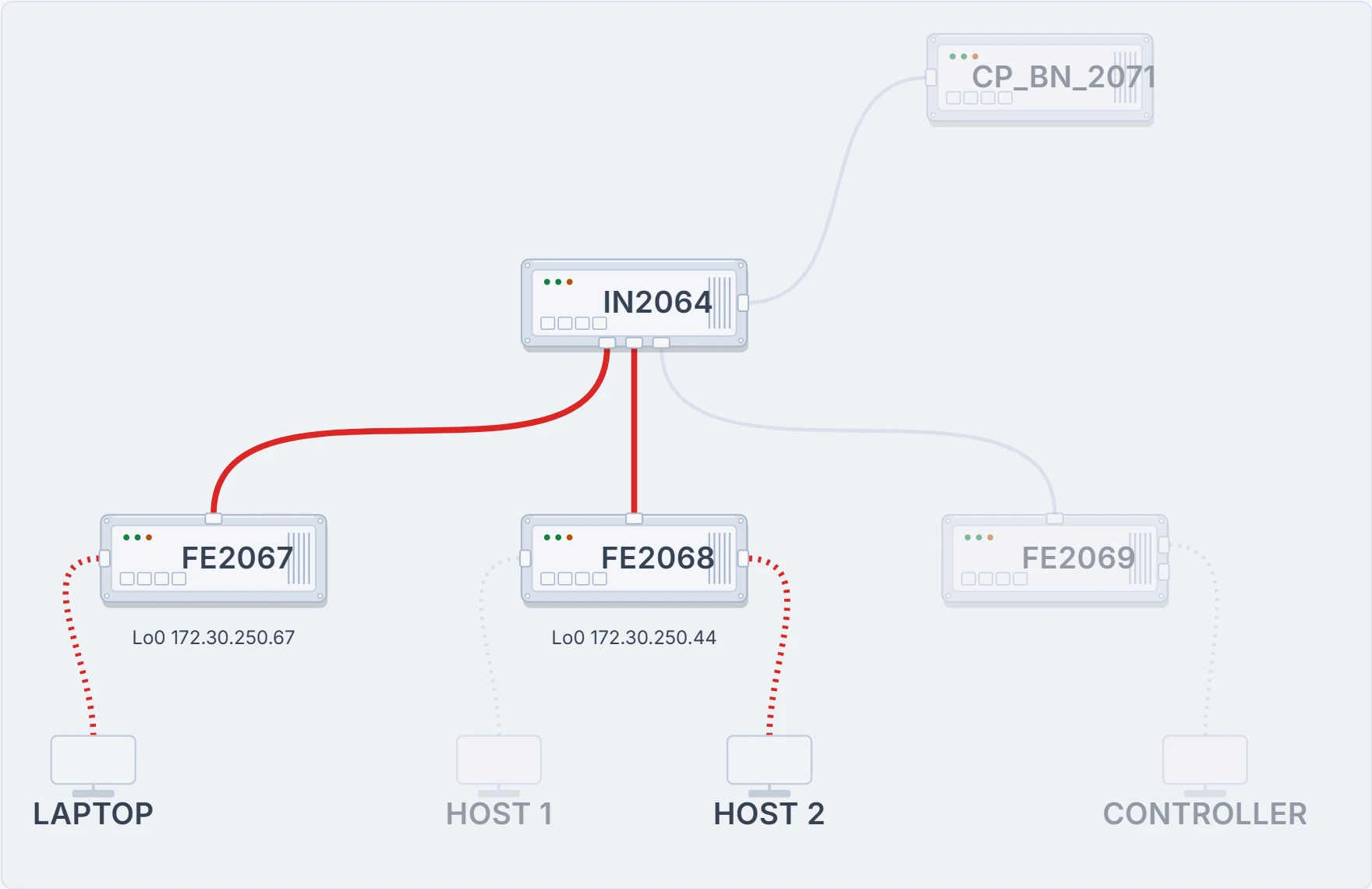
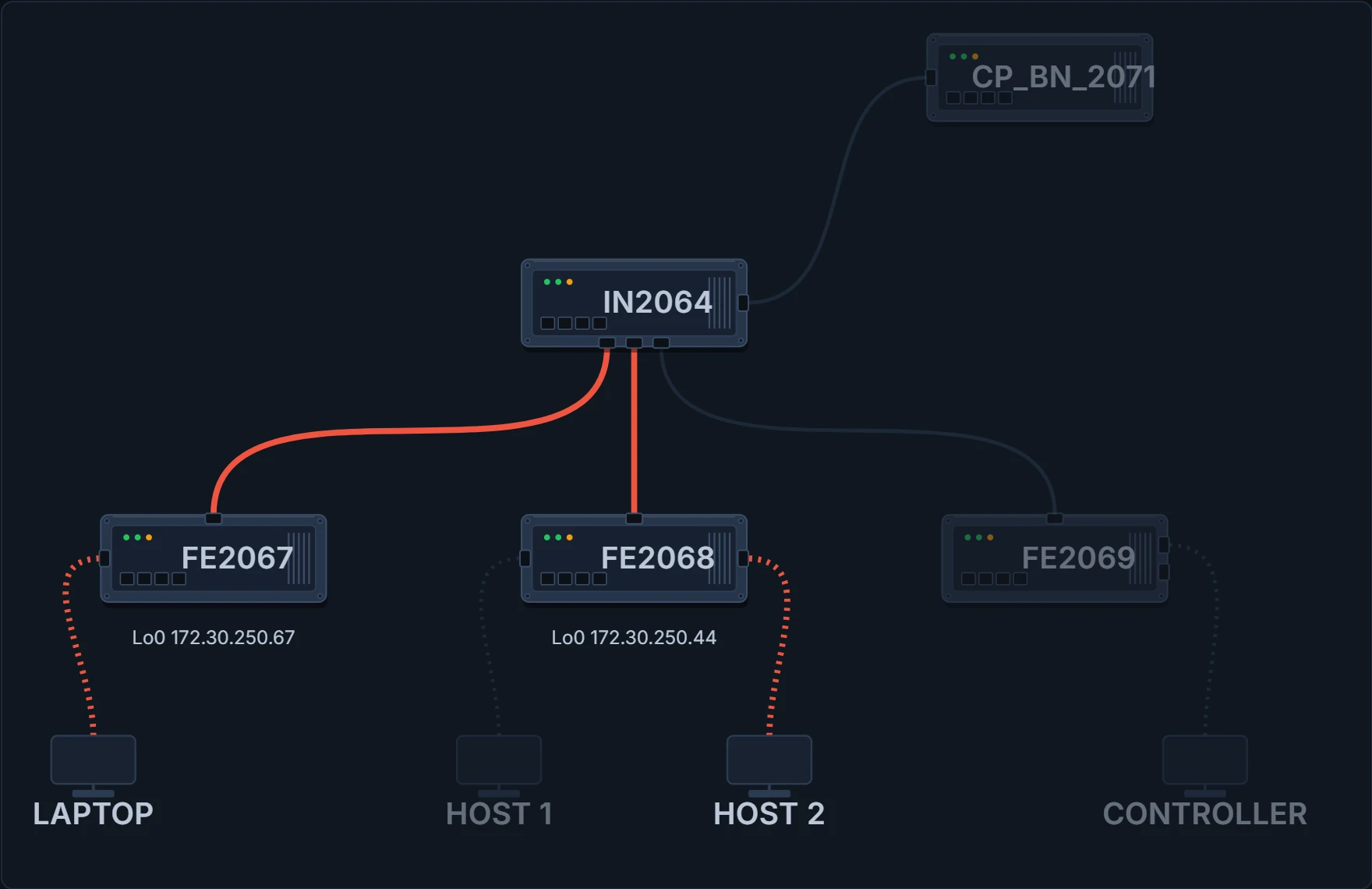
Two: the switch the endpoint is plugged into, and the switch that asked where it was. IN2064 in the middle reads an outer header addressed to a loopback, finds it in an ordinary routing table, and forwards. It has no map-cache, no LISP state, and no idea an endpoint is involved.
That is what separating identity from location buys. Everything between the two edge nodes only ever has to know how to reach a loopback, which is a problem the underlay was already solving before the fabric existed.
What wraps the packet on the way there is the VXLAN data plane, and it is the next topic rather than this one. Here it is enough to see that the outer destination is 172.30.250.44, a switch, and the endpoint's own address is inside, untouched.
Three failures, one symptom
Now break something. The link between IN2064 and FE2068 goes down, and the laptop sends to 172.24.2.2 again.
The mapping can be perfect while the RLOC is unreachable. From the endpoint, those look identical: traffic does not arrive.
So what does FE2067 hold for 172.24.2.2 now?
FE2067# show lisp instance-id 4099 ipv4 map-cache
172.24.2.2/32, uptime: 00:00:00, expires: 23:59:59, via map-reply, complete
! still complete: the mapping is right, and it keeps its expiry
Locator: 172.30.250.44  State: down  Pri/Wgt: 10/10
! no route to this locator, so it is not used
This course's rendering. The fields are the troubleshooting document's. The document prints a "Last route reachability change" line under every map-cache locator, and RFC 9301 says an ITR in the underlay routing "can determine that an RLOC is down when no Routing Information Base (RIB) entry exists that matches the RLOC IP address". down is RFC 9301's word; which word IOS XE 17.9 prints in that State column is not verified.
Proves: the mapping is still held and its locator is not usable from this node.
Does not prove: why. The next question is the routing one: is there a path to the locator at all?
State 6 One question answered, one unanswerable
Which of the two lookups is broken, and which command tells you?
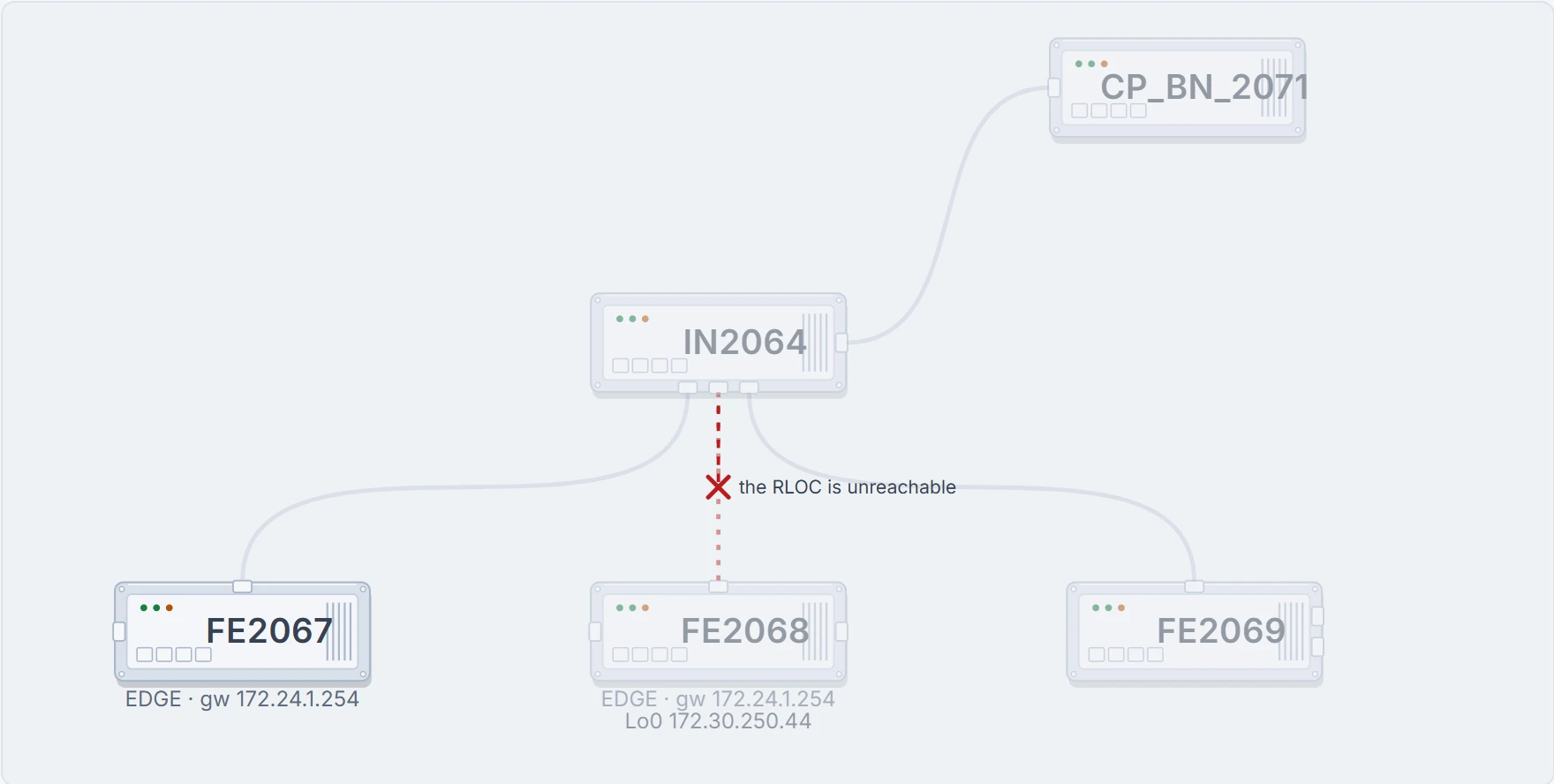
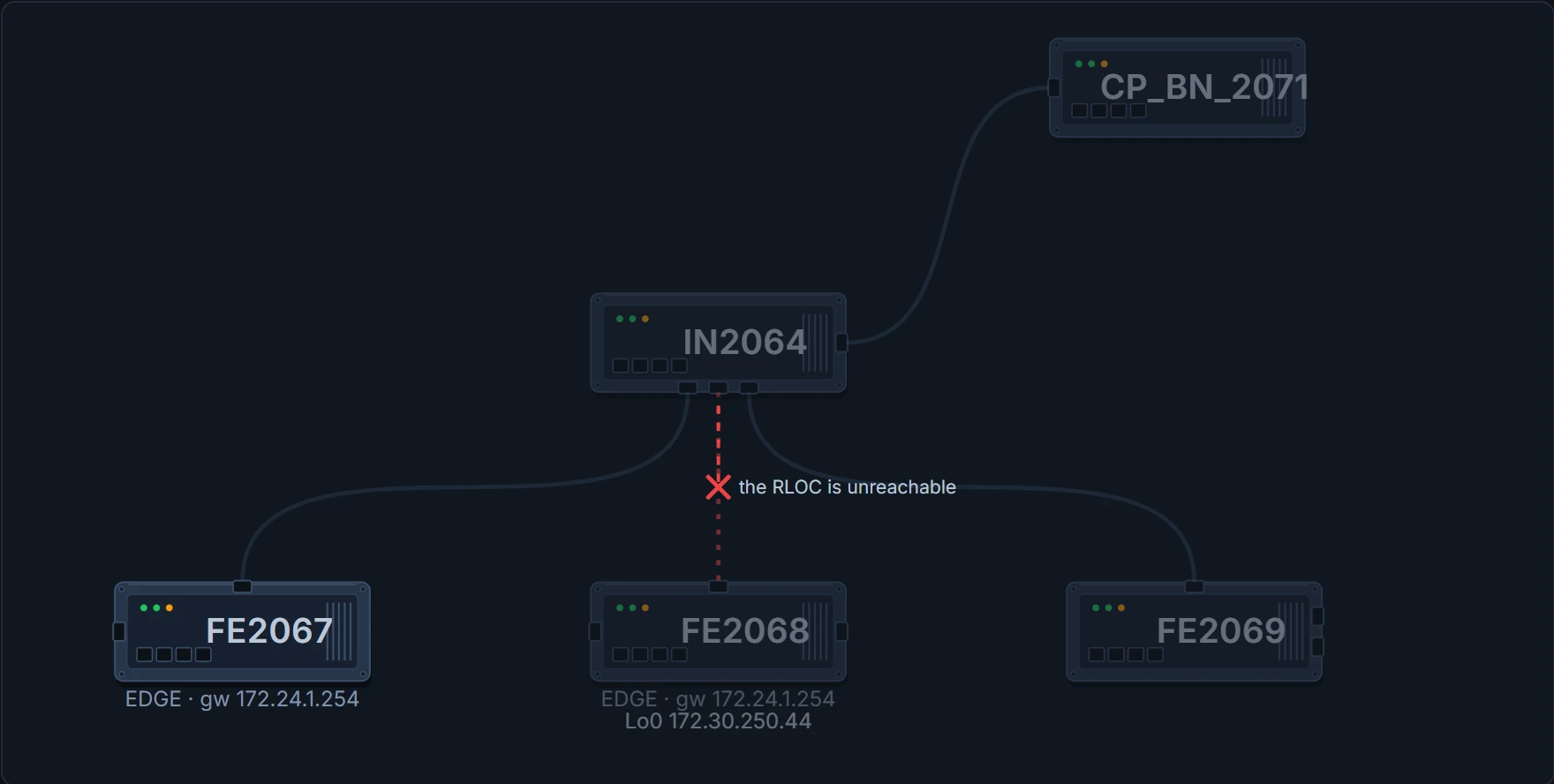
Three distinct root causes produce the same complaint, and each one is answered on a different device:
| What broke | Where to look | What you see |
|---|---|---|
| Never registered | Control plane node, show lisp site | No entry, or not complete |
| Never resolved | Ingress edge, show lisp … map-cache, show lisp session | No entry; session may be down |
| RLOC unreachable | Ingress edge, the map-cache locator, then show ip cef <RLOC> | Mapping complete, locator not up, no underlay path |
Notice that each row lives on a different box. This is why ping the gateway, it works, so the fabric is fine is worthless: the gateway is local, and it proves nothing about any of the three.
Work them in that order. Registration first, because if the endpoint was never registered, nothing downstream can succeed and every other command is noise.
And when all three are healthy? Then you have a useful negative: the control plane is healthy: stop looking at it. The fault is somewhere neither question covers: policy, the data plane, or the host. Being able to rule the control plane out quickly, with evidence, is worth more under exam time pressure than being able to find one specific fault. Most of troubleshooting is elimination.
Continue the lesson
The whole lesson, with its drawings and its questions. 5 more sections after the ones above.