
Multisite design and transits
Inside a fabric site, the VN and the user's group travel in the VXLAN header. Between sites, Catalyst Center automates the border configuration through a transit. An SD-Access transit keeps VXLAN end to end, so the VRF and SGT cross natively between sites. An IP-based transit decapsulates to native IP, and SGT tags are not copied into the IP headers.
By Arif, founder of Daveth · Updated
The full 7 min walkthrough is in Daveth Pro (Network). See what the plan opens
What this page answers
What is an SD-Access transit?
The construct that defines how Catalyst Center automates border node configuration for connections between fabric sites, or between a site and the world outside, over a MAN, WAN or the internet. Read it in “What a transit is”
What is the difference between an SD-Access transit and an IP-based transit?
An SD-Access transit keeps VXLAN between sites, so the VRF and SGT are carried natively. An IP-based transit de-encapsulates to native IP, and SGT tags are not copied from the VXLAN to the IP headers. Read it in “Across the IP-based transit”
The question from two lessons ago
The VXLAN lesson (2.1.b.ii) ended on a question: when traffic leaves the fabric and the header comes off, what happens to the group identity? Here is the answer.
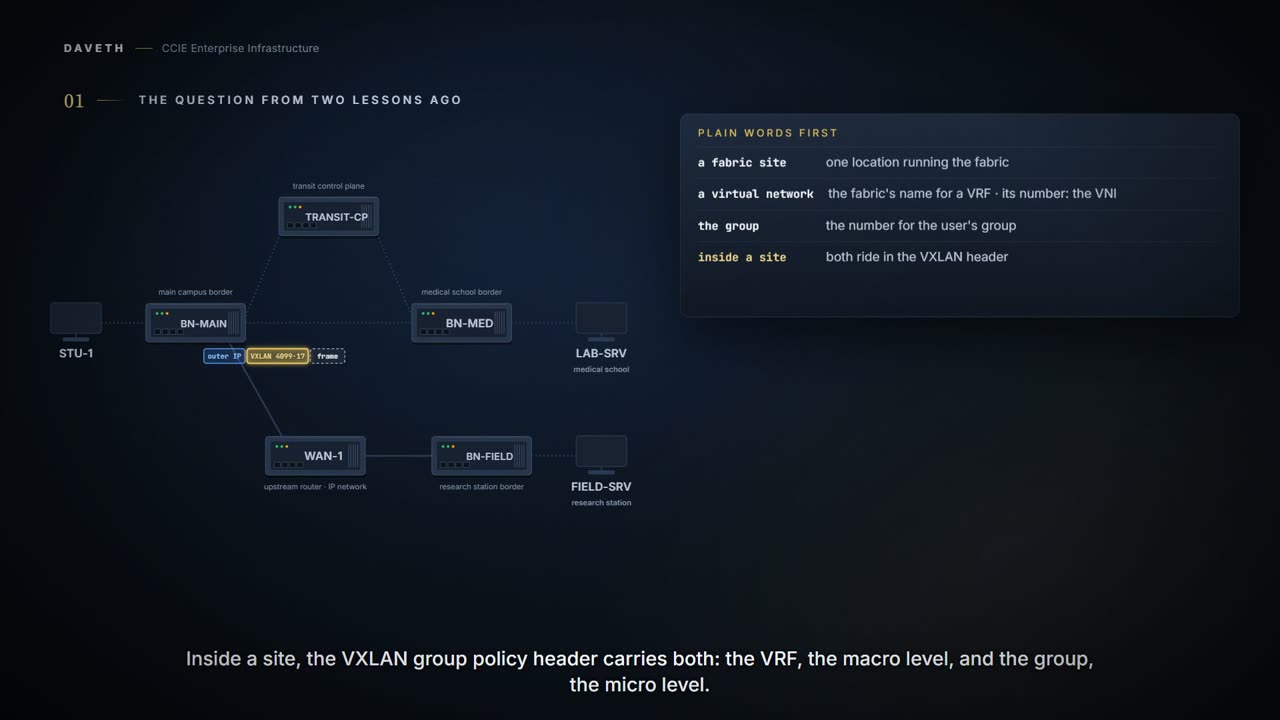
Plain words first. A fabric site is one location running SD-Access. A VN, a virtual network, is SD-Access's name for a VRF, and its number in the header is the VNI. The SGT is the number for the user's group.
Within a fabric site, unified policy is both enabled and carried through the segment ID (group policy ID) and VXLAN network identifier (VNI) fields of the VXLAN-GPO header. This allows for both VRF (macro) and SGT (micro) segmentation information to be carried within the fabric site.
Inside a site, identity travels in the header. So the real question is what a crossing between sites does to that header.
Take a university. Its main campus and its medical school are across the city on direct fibre; its field research station is far away across a leased WAN. A student laptop, STU-1, in VN CAMPUS and group STUDENTS, sends to a server at both. Does the far end still know STU-1 is a student?
What a transit is
Transits are an SD-Access construct that defines how Cisco Catalyst Center will automate the border node configuration for the connections between fabric sites or between a fabric site and the external world. This connectivity may be a MAN, WAN, or internet. The WAN could be MPLS, SD-WAN, or other WAN variations.
Notice the two jobs in one word: a transit connects fabric sites to each other, and it connects a fabric site to the world outside. And read the second quote again: this guide names SD-WAN as a kind of WAN a transit may cross. An older SD-Access 1.3 guide also calls it a transit, and the transit handoffs lesson (2.1.e.i) reconciles the two.
The guide describes two kinds of transit, and the difference this lesson follows is what each does to the header.
Across the SD-Access transit
SD-Access transits are exclusively used in SD-Access for Distributed Campus. In this model, the same control, data, and management plane is used end to end, interconnecting multiple fabric sites. In an SD-Access transit, packets are encapsulated between fabric sites using the VXLAN encapsulation. This natively carries the macro (VRF) and micro (SGT) policy constructs between fabric sites. With SD-Access transit, the same encapsulation method used for data packets within the fabric site is used for data packets between sites. This allows unified policy information to be natively carried in the data packets traversing between fabric sites in the larger fabric domain.
An SD-Access transit needs something first: a transit control plane node, here TRANSIT-CP. It is the directory the sites use to find each other's prefixes.
And because it is drawn in the middle of every diagram, say the other half out loud: traffic does not go through it. A travel desk books your route and does not ride the bus with you. It is asked where a prefix lives, it answers, and the packet then takes whatever path the underlay has. Nothing detours via that node.
Where the travel desk stops: you book a trip once and this directory is consulted per lookup. Which matters when it is unreachable. Sites that already know each other's prefixes keep working, and it is the next thing that needed looking up that fails.
They are required only when using SD-Access transits. Border nodes (with external border functionality) connected to the SD-Access transit use LISP map-register messages to inform the transit control plane nodes of the aggregate prefixes associated with the fabric site. Must be IP reachable by every fabric site external border node. Must match the control plane architecture of connected fabric sites; for example, LISP Pub/Sub fabric sites can only connect to a LISP Pub/Sub SD-Access transit.
Now suppose BN-MED has no route to TRANSIT-CP yet. What does TRANSIT-CP hold for the two sites?
Computed from the state: what TRANSIT-CP holds while BN-MED has no route to it. No command prints it in this form.
site            aggregate prefix  border   registered
main campus     10.10.0.0/16      BN-MAIN  yes
medical school  10.20.0.0/16      BN-MED   no
Read the medical school row: not registered. By this course's reading, the main campus then has no mapping to steer the medical school's traffic by, so nothing crosses the SD-Access transit toward it yet.
Add the missing route, and BN-MED registers.
Computed from the state: what TRANSIT-CP holds once BN-MED can reach it. No command prints it in this form.
site            aggregate prefix  border   registered
main campus     10.10.0.0/16      BN-MAIN  yes
medical school  10.20.0.0/16      BN-MED   yes
So what does STU-1's packet carry on its way to LAB-SRV?
Computed from the state: STU-1's packet on its way to LAB-SRV. No command prints it in this form.
point       encapsulation  VNI   SGT  note
inside A    fabric VXLAN   4099  17   VNI and group policy ID in the VXLAN-GPO header
in transit  fabric VXLAN   4099  17   same encapsulation between sites
inside B    fabric VXLAN   4099  17   VRF and SGT carried natively
Computed from the state: the data path to the medical school. No command prints it in this form.
SD-Access transit: STU-1 > BN-MAIN > BN-MED > LAB-SRV
TRANSIT-CP on the data path: no
Look at the SGT column: 17 all the way. And look at the path: TRANSIT-CP isn't on it.
The transit control plane node is used only to publish or distribute fabric prefixes between different fabric sites and is not in the data path of traffic sent from one site’s border node to the other site’s border node.
Across the IP-based transit
Now the same student sends to FIELD-SRV at the research station. The main campus border reaches it through an IP-based transit to WAN-1. Before you read on, decide whether SGT 17 arrives.
Packets are de-encapsulated from the fabric VXLAN into native IP. Once in native IP, they are forwarded using traditional routing and switching modalities. With IP-based handoffs, SGT tags are not copied over from VXLAN to IP headers.
Computed from the state: STU-1's packet on its way to FIELD-SRV. No command prints it in this form.
point       encapsulation  VNI   SGT  note
inside A    fabric VXLAN   4099  17   VNI and group policy ID in the VXLAN-GPO header
in transit  native IP      -     -    de-encapsulated; SGT not copied
inside B    not modelled   -     -    not carried by the transit
Continue the lesson
The whole lesson, with its drawings and its questions. The rest of this section and 4 more after it.