
Single-site campus design
A fabric site is not a building: it is a logical construct in Catalyst Center, so two buildings can share one site and one building need not have its own. A site has three roles: the mandatory control plane node, border nodes to reach outside, and edge nodes to connect endpoints, each with a LISP session to every control plane node. Up to six control plane nodes are supported.
By Arif, founder of Daveth · Updated
The full 7 min walkthrough is in Daveth Pro (Network). See what the plan opens
What this page answers
What is an SD-Access fabric site?
A logical construct in the Catalyst Center UI, not a building: two buildings can sit in one fabric site, and a separate building does not automatically need its own. Read it in “What is a fabric site?”
What are the roles in an SD-Access fabric site?
The control plane node, which is mandatory; border nodes, which connect to destinations outside the fabric site; and edge nodes, which connect endpoints. Each edge node has a LISP session to every control plane node. Read it in “What is in one?”
How many control plane nodes can an SD-Access site have?
Up to six control plane nodes are supported in a fabric site, and fabric wireless changes the count. Be clear whether a limit counts roles, boxes or endpoints. Read it in “How big can one get?”
What is a fabric site?
A fabric site is not a building. It does not care where the architect put the front door.
Which matters both ways round, and people usually only learn one of them. Two buildings can sit inside one fabric site. And one building does not automatically earn a site of its own just for being a separate address.
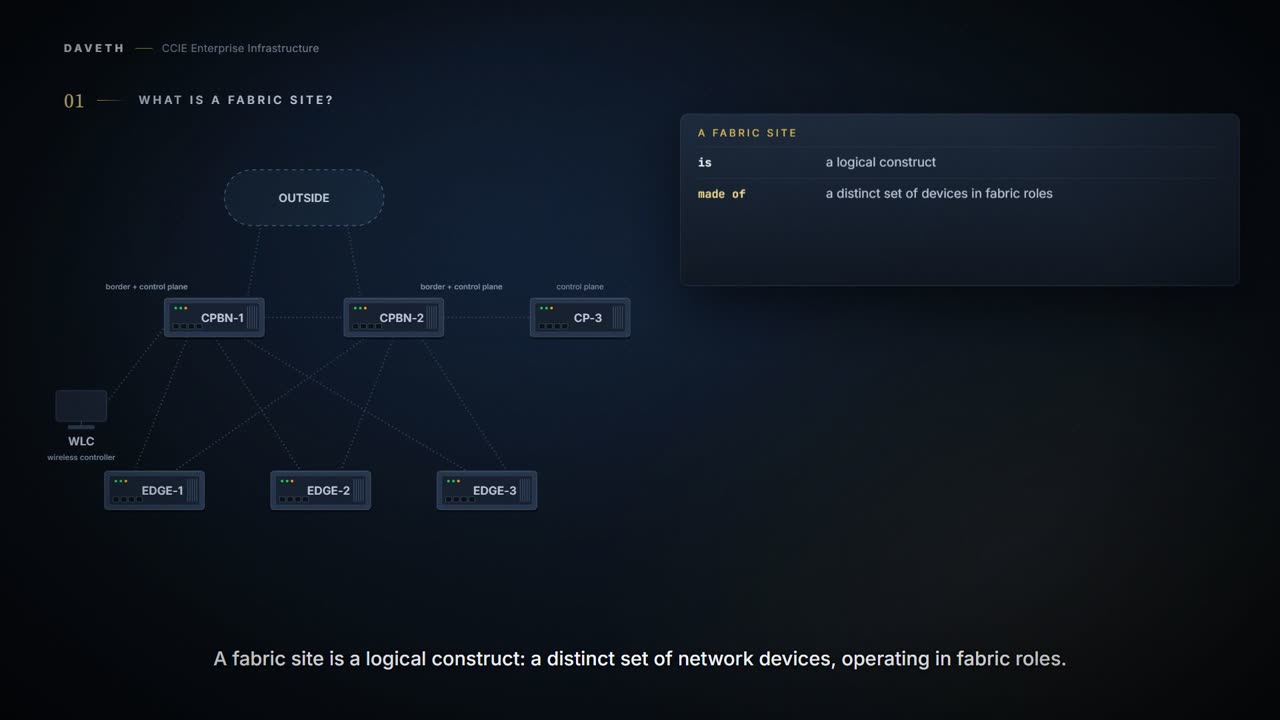
A fabric site is not a building. The design guide's definition does not mention one:
A fabric site is a logical construct in the Catalyst Center UI that consists of a distinct set of network devices operating in fabric roles.
And the validated profile says where one can sit:
A fabric site can cover a single physical location, multiple locations, or only a subset of a location as well.
Notice that the design guide also, in another section, calls a site a location that has its own border node, control plane node, and edge node. Read the second half of that sentence: what makes it a site is the set of roles it holds, not the walls around it.
A fabric site is a location that has its own border node, control plane node, and edge node.
What is in one?
Three roles, each taught on its own in earlier lessons, in one picture for the first time:
The site in this page's walk: two switches that are each border and control plane node, and three edge nodes.
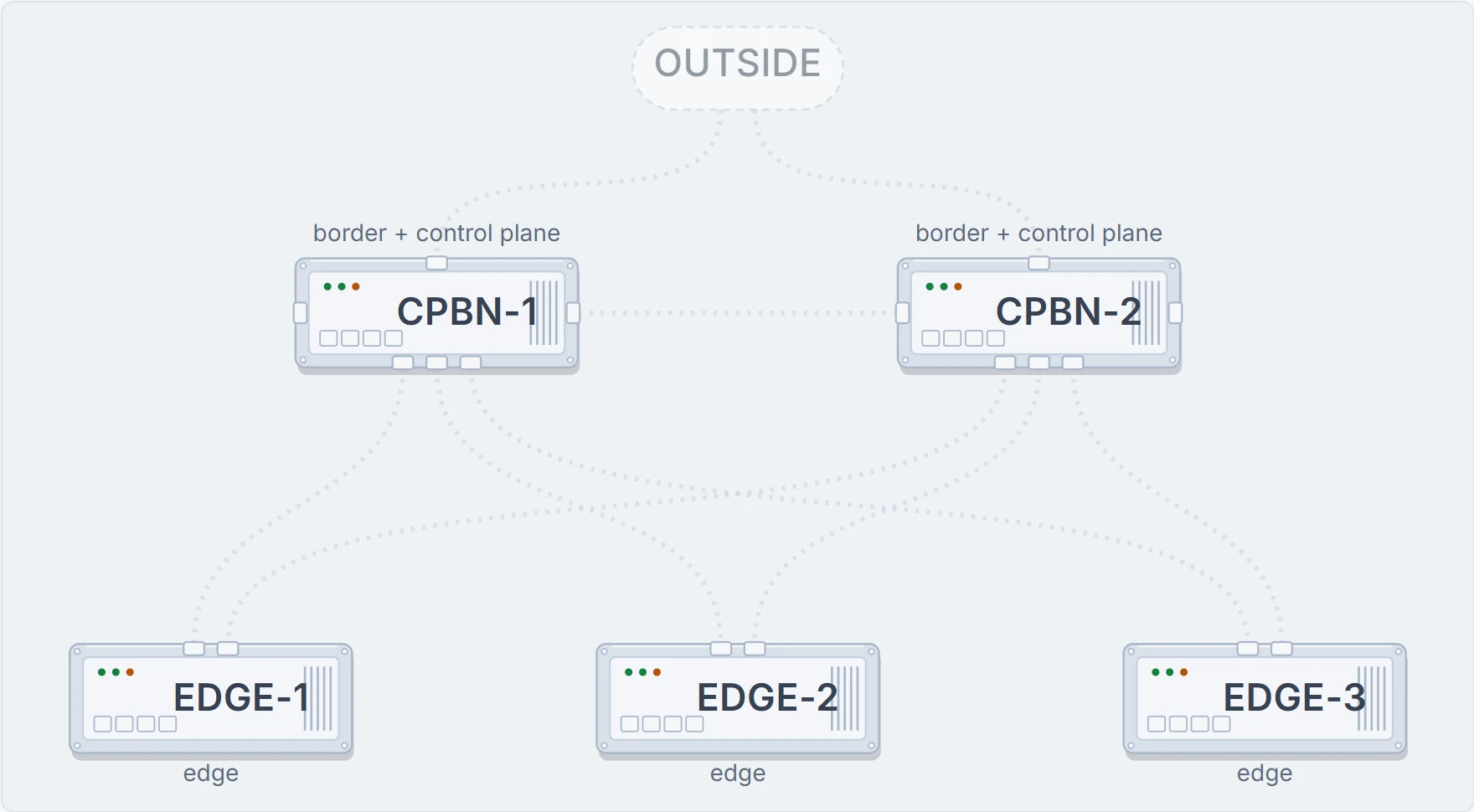
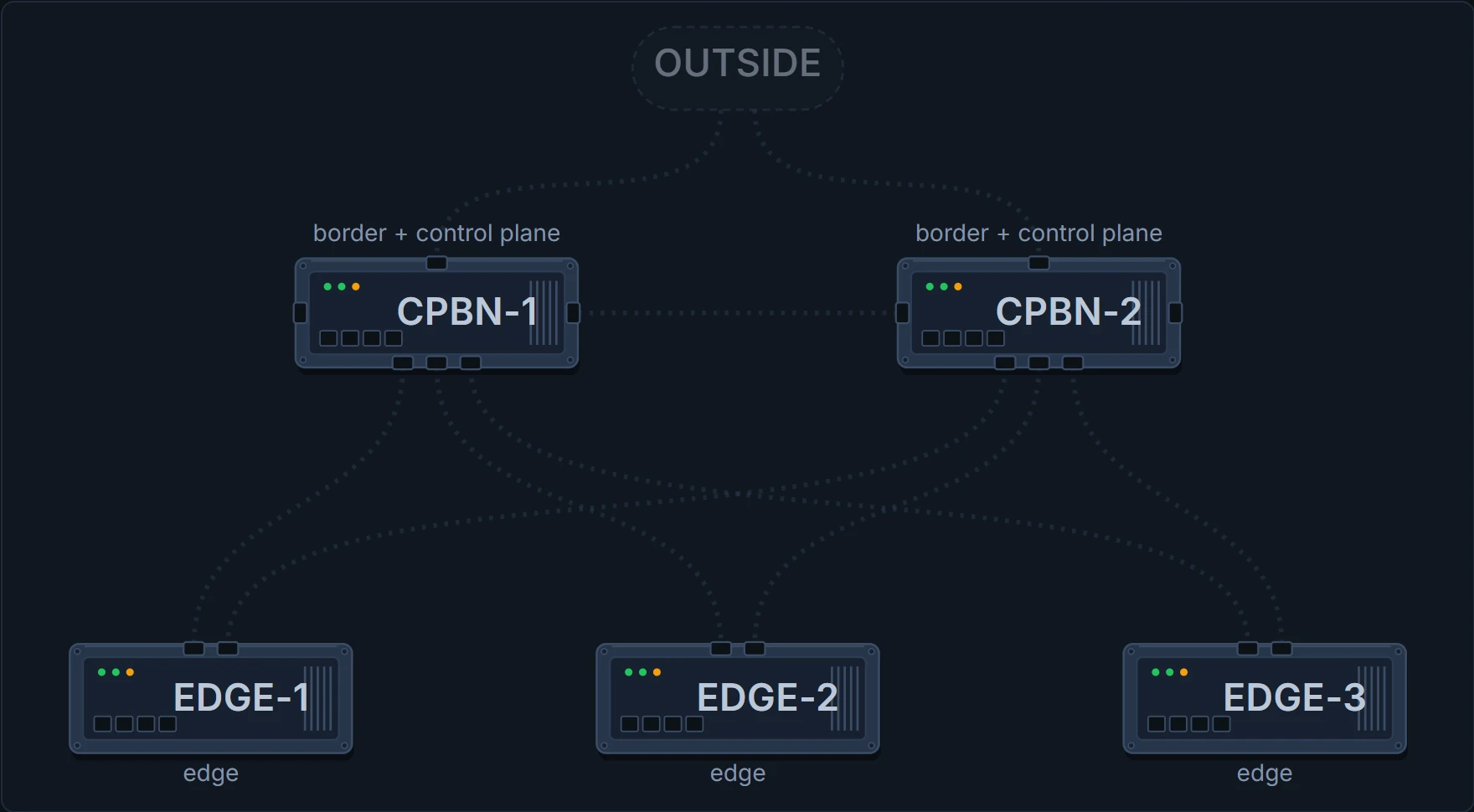
The control plane node is a mandatory component. A border node facilitates communication to destinations outside of the fabric site. An edge node is required to connect endpoints.
How do they hang together? Each edge node talks to every control plane node:
Each edge node has a LISP session to all control plane nodes. The registration of EID happens through LISP Registration messages that get send to all configured control plane nodes.
How big can one get?
First be clear which thing you are counting: roles, boxes, or endpoints. They are three different shopping lists, and the numbers below do not all answer the same question. Counting switches when the limit is on endpoints is how a design passes review and fails in the building.
Control plane nodes. The validated profile's figure, before wireless enters the picture:
Up to six control plane nodes are supported in a fabric site.
Now add fabric wireless, and look at what the design guide says about the controller:
Watch which limit is doing the work here, because it is not the one people assume. A third control plane node can have all the room in the world in its own tables and still never hear the wireless news. Buying more boxes does not widen the pipe that tells them things.
The Cisco WLC can communicate with a pair of control plane nodes within a fabric site. If a fabric site deploys more than a pair of control plane nodes, the client context information may not be updated with all control plane nodes. Therefore, we recommend that you restrict the number of control plane nodes to a pair within a fabric site when using fabric-enabled wireless.
That is the reason behind the number. The walk shows it: with CP-3 as a third control plane node, the wireless client W1 reaches CPBN-1 and CPBN-2, and CP-3 is left without it. The guide states the limit, with a qualifier worth keeping:
A fabric site with SD-Access Wireless can support a maximum of two control plane nodes for nonguest (enterprise) traffic, as discussed in the Wireless Design section.
For non-guest (enterprise) traffic. A design sized to six on a wired site does not survive fabric wireless unchanged: go back to a pair.
Border nodes. The limit is on one kind only:
A fabric site can support a maximum of four external border nodes. There is no limit on internal border nodes, other than the maximum number of fabric devices per site as listed in the Catalyst Center data sheet.
Endpoints. The ceiling belongs to the controller, not the fabric:
Catalyst Center scales between only 25,000 to 100,000 endpoints (25,000 for DN3-HW-APL 32-core appliance, 40,000 for DH3-HW-APL-L 56-core appliances, and 100,000 for DN3-HW-APL-XL 112-core appliances).
So which appliance was bought is a design input. And treat every one of these numbers as current documentation, not something to memorise: the design guide itself says of its site-size tables,
The numbers are used as guidelines only and do not necessarily match specific limits for devices used in a design of this site size.
Continue the lesson
The whole lesson, with its drawings and its questions. 4 more sections after the ones above.