
Extended nodes
Extended nodes carry the fabric into places an enterprise does not usually put switches: the loading bay, the quay, the plant floor, the noncarpeted spaces. You do not configure one by hand. It is onboarded only through the automated workflow, and only after a factory reset. Whether it becomes a policy extended node depends on licenses, its own and its extended node neighbour's.
By Arif, founder of Daveth · Updated
The full 11 min walkthrough is in Daveth Pro (Network). See what the plan opens
What this page answers
What is an SD-Access extended node?
A switch that extends the fabric into noncarpeted spaces such as loading bays, car parks and plant floors, so endpoints there join the fabric's virtual networks under the same management as everything indoors. Read it in “What an extended node is, and what it is not”
How is an SD-Access extended node onboarded?
Only through the automated workflow, and only after the device has been reset to its factory default configuration and powered on. A switch already staged has to be wiped first. Read it in “You do not configure one of these”
What decides whether a switch becomes a policy extended node?
Licensing: a device is onboarded according to the license of its extended node neighbour and its own, not a setting chosen in the workflow. Read it in “The license next door decides what you get”
Four cabinets and no second cable
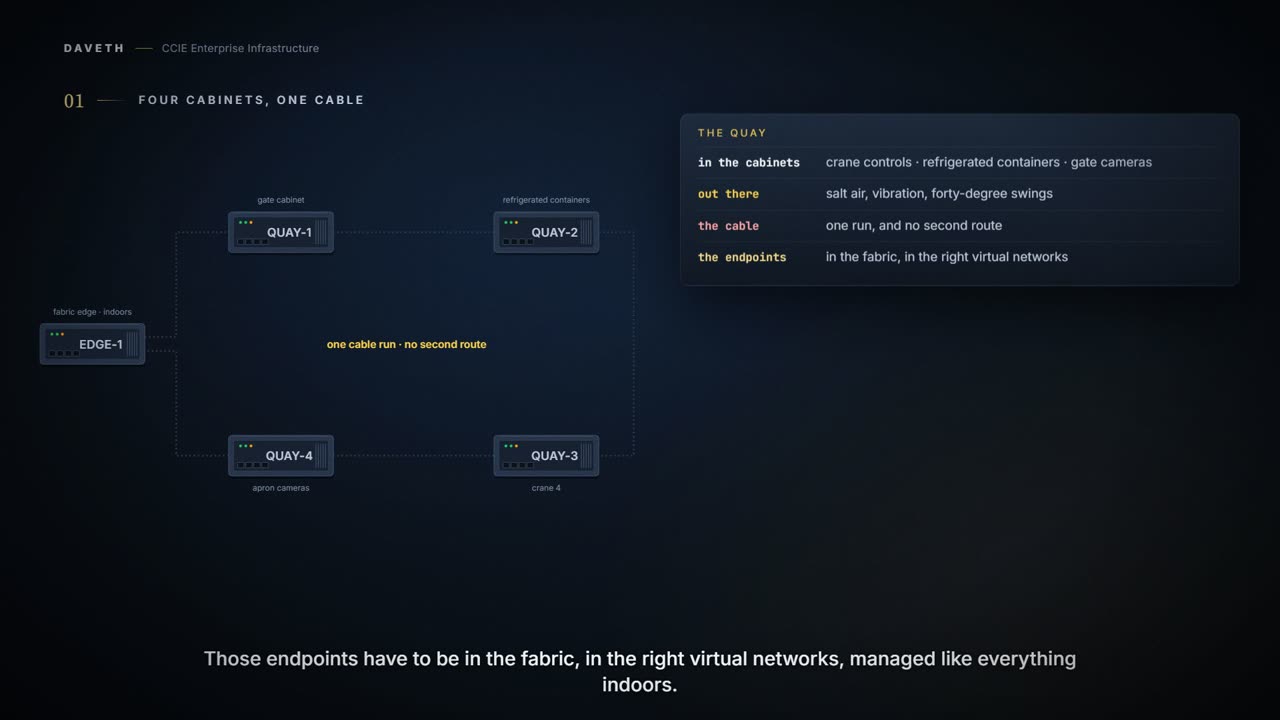
A container terminal has crane controls, reefer monitoring and gate cameras in weatherproof cabinets down the apron. The cabinets are salt-air, vibration and forty-degree swings, and the cable between them runs along the quay and back to the comms room, because there is no second route and digging one costs more than every switch on the quay put together.
Those endpoints have to be in the fabric, in the right virtual networks, under the same management as everything indoors. And you are not putting a campus access switch in a cabinet on a quay. So what goes out there, and what does it cost you?
What an extended node is, and what it is not
Start with what the thing is for. Extended nodes exist to carry the enterprise network into the places an enterprise does not usually put switches: the loading bay, the quay, the car park, the plant floor. The trade calls those noncarpeted spaces, and the name is a good one: nobody laid a carpet because nobody expected anyone to sit there.
Noncarpeted is the industry's word for it, and it is a good one: it names the whole category by the thing those places have in common, which is that nobody put a carpet down because nobody expected an office there.
And here is the line the whole topic sits on. An extended node is a Layer 2 port extension to a fabric edge node, giving the endpoints hanging off it segmentation and group-based policy.
Read that again, because it draws the line this whole topic sits on. A Layer 2 port extension to a fabric edge node. The switch in the cabinet is not a fabric node. It is a port extension to a fabric edge, so it hangs off that edge and the edge is the fabric device; what exactly the edge does on its behalf is not listed on either cited page, and this lesson does not fill it in.
That is the misconception worth killing now: an extended node is reached by the fabric, not part of it. Everything else on this page follows from that.
One thing it does carry, which people assume it does not: multicast. It crosses an extended node perfectly well.
And the other kind, the one this lesson is really about, differs in exactly one respect. A policy extended node is an extended node that also supports security policy within the virtual network.
Security policy within the virtual network. A standard extended node gets your endpoints into the right VN; a policy extended node also enforces group-based policy out there at the cabinet, rather than the enforcement stopping back at the fabric edge. For a carpeted floor that distinction is often academic. For a quay where the entire reason you are segmenting is to keep crane control away from the camera network, it is the whole point.
You do not configure one of these
Before the rules, the mechanics, because they constrain the design more than they look like they will.
An extended node is onboarded only through the automated workflow, and only after the device has been reset to its factory default configuration and powered on.
Only through the workflow, and only after a factory reset. A switch somebody has already staged is not a candidate for onboarding; it is a switch you have to wipe first. That is a sentence worth reading before the hardware arrives on site rather than after, because we'll pre-configure them in the warehouse is a natural thing to plan and a wasted afternoon.
And LACP does not work for extended node onboarding. Not discouraged. Does not work.
Not "is not recommended". Does not work. The supported port-channel mode toward an extended node is PAgP Desirable on current releases, and On for some industrial platforms on earlier ones. If you are used to standardising on LACP everywhere (and most people are, because it is the standards-based one) this is the kind of detail that produces an hour of packet captures before anybody re-reads the page.
One more thing that follows from the rules rather than being stated outright, so read it as this course's inference: the license rule in the next section is written in terms of a device's extended node neighbor, so how a switch comes up depends on the switches beside it, and a run is decided from the fabric edge outward. Hold on to that shape; it comes back.
The license next door decides what you get
Here is the question that matters on delivery day. Four identical industrial switches arrive, all on the same release, all cabled along the quay. Which of them becomes a policy extended node? Before you read on, notice that nothing in that sentence distinguishes one switch from another.
Not which of them can. Which of them does. And the answer is not a setting anybody chooses: a device is onboarded according to the license of its extended node neighbour, and its own.
A device is onboarded according to the license of its neighbor and its own. That is the mechanism, and it has four clauses:
One. If the neighbour holds Essentials, the device is onboarded as a standard extended node: whatever its own licence.
Two. If the neighbour holds Advantage and the device holds Essentials, the device is onboarded as a standard extended node.
Three. If the neighbour holds Advantage and the device holds Advantage, the device is onboarded as a policy extended node.
Four. If the device has more than one neighbour and those neighbours hold different licence levels, the device is onboarded as a standard extended node, whatever its own licence.
Read the fourth one again. More than one neighbor, at different license levels, and the device is onboarded as a standard extended node regardless of its own license. Every node in the middle of a ring has two neighbors. So the fourth clause is not an edge case: on a ring it is the common case, and it can quietly overrule an Advantage license somebody paid for.
The first three clauses each speak of the neighbour, singular, and only describe a device that has one. The fourth covers every other case. That reading is this course's, not something stated outright: they are given as a list with no statement of which wins.
Two more requirements sit alongside the license rule and are easy to miss because they are about a different device. Watch which device each sentence is about:
Both the device and the edge node supporting it must hold the Advantage licence levels before either can be configured as a policy extended node.
And both have to be on the minimum software version: the extended node and the fabric edge in front of it, not just the one in the cabinet.
Both sentences are about the edge node as well as the extended node. The fabric edge has to hold Advantage too, and it has to be on the minimum release itself. A quay full of correctly licensed industrial switches behind an edge node on an older release gets you nothing.
And here is what makes all of this bite rather than being paperwork. A device that is perfectly capable of being a policy extended node, but holds an Essentials licence, is onboarded as a plain extended node.
The capable device comes up as the lesser kind. It is what the automation does rather than a failure: a switch that could have been a policy extended node is onboarded as a standard one because of the license it was bought with, it works, and the difference shows up eighteen months later when somebody asks for segmentation.
What the hardware is allowed to be
Platform lists are the most forgettable content in networking and this one moves between releases. Do not memorise it. Know that the categories exist, know which way each restriction cuts, and check the current page for anything specific. Two rows here are worth carrying anyway, and they are flagged.
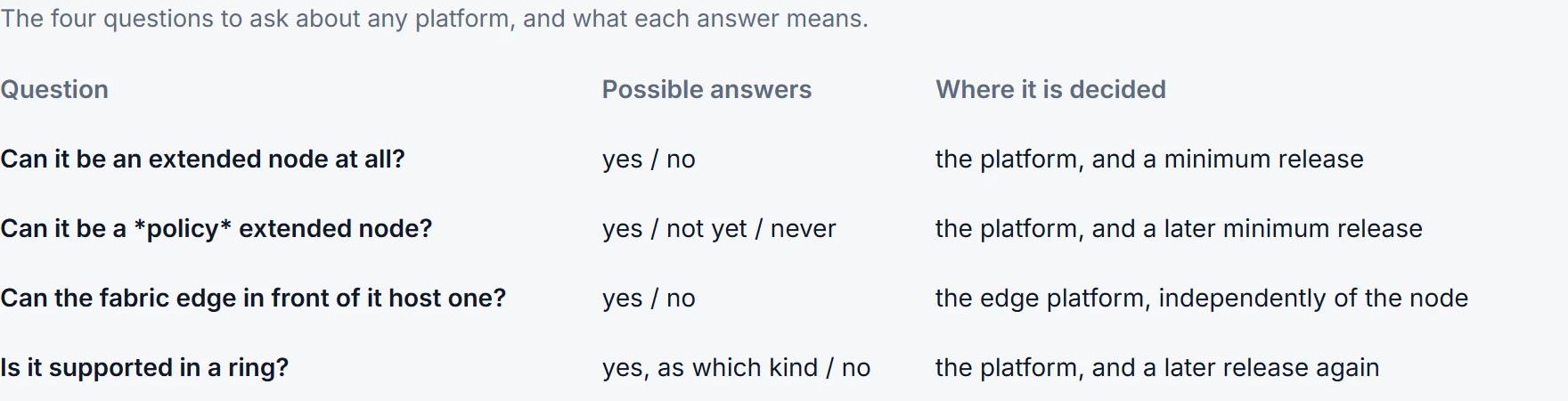
Read the second and fourth answers in the middle column. Not yet and never look the same on a support list and are nothing alike in a design meeting, and the fourth question has its own release floor: a platform can be a perfectly good extended node and still not be allowed in a ring on the release you are running.
Some platforms are on a permanent exclusion list, and that is the distinction worth carrying out of this section. They are not waiting for a release. They will never be policy extended nodes, and no amount of licensing or upgrading changes it.
A ring built from excluded platforms is not becoming a policy extended node ring for any amount of licensing, on any release. If policy enforcement at the cabinet is a requirement, that is a hardware decision made at purchase, and it is made once.
The third question is about the wrong end of the link entirely. Some fabric edge platforms support extended nodes and some do not, and that is decided by the edge, not by what is in the cabinet.
Some platforms configured as a fabric edge do not support extended node devices at all. Not the reduced kind, not the policy kind: none. That is a restriction on the switch indoors, discovered because of the switches outdoors, and it is exactly the sort of thing that gets found after the cabinets are mounted.
One more, for completeness rather than emphasis: supplicant-based extended nodes, sometimes called authenticated extended nodes. These receive an 802.1X supplicant configuration and are onboarded only after a complete authentication and authorization: rather than onboarded first and trusted afterwards.
Authenticated before onboarded, rather than onboarded and then trusted. And note the same trap as before: the fabric edge in front of one has its own platform requirement, which is not the same list as the one the node itself has to be on, the 9200 is excluded as an edge, not as an extended node. Those are two different lists and merging them is an easy mistake.
Continue the lesson
The whole lesson, with its drawings and its questions. 4 more sections after the ones above.