
Manual underlay
The fabric overlay carries users; the underlay must give it a routed network. Routed access with point-to-point links avoids STP and EtherChannel. Every loopback 0 RLOC needs a /32 and a /32 route: reachability between RLOCs cannot use the default route. APs need a specific route to the WLC. VXLAN adds 50 bytes and sets DF, so a campus-wide MTU of 9100 keeps frames from being dropped.
By Arif, founder of Daveth · Updated
The full 5 min walkthrough is in Daveth Pro (Network). See what the plan opens
What this page answers
What are the SD-Access underlay requirements?
A Layer 3 routed access network with point-to-point routed links, loopback 0 RLOCs with /32 masks reachable by /32 routes rather than a default route, a specific route to the WLC where APs connect, and an MTU that allows for VXLAN's 50 bytes. Read it in “What the underlay is asked for”
Can SD-Access RLOCs use a default route?
No. Reachability between loopback RLOCs cannot use the default route; each must be reached by a /32 route. Read it in “A route to every RLOC, and which kind”
What MTU does SD-Access need?
VXLAN encapsulation adds 50 bytes of overhead and sets the DF bit, so a 1500-byte packet will not fit a 1500-byte link. A campus-wide MTU of 9100 is recommended. Read it in “The 50 bytes”
What the underlay is asked for
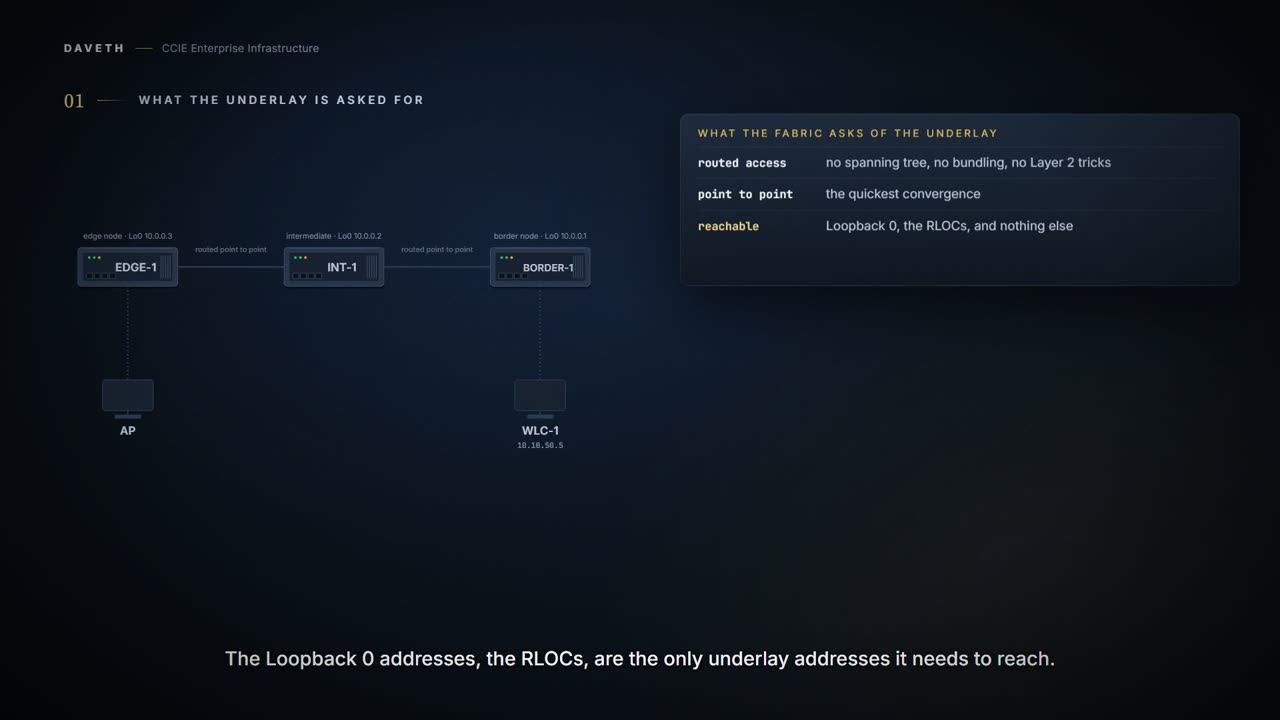
The overlay carries the users. What does the fabric need from the network underneath it?
Whether using LAN Automation or deploying the network manually, the underlay networks for the fabric have the following general design requirements: The use of a Layer 3 routed access network for the fabric provides the highest level of availability without the need to use loop avoidance protocols such as Spanning Tree Protocol (STP), interface bundling techniques using link aggregation technologies such as EtherChannel, or Layer 2 redundancy technologies like StackWise® Virtual. Point-to-point routed links provide the quickest convergence times because they eliminate the need to wait for the upper-layer protocol timeouts typical of more complex topologies.
The RLOC interfaces, or Loopback 0 interfaces in SD-Access, are the only underlay routable addresses that are required to establish connectivity between endpoints of the same or different subnets within the same virtual network. End-user subnets and endpoints are not part of the underlay network; they are part of the overlay network.
Notice how small that is. The Loopback 0 addresses are the only underlay addresses the overlay needs to reach, and the user subnets are not in the underlay at all.
Small does not mean optional, and that is worth fixing in place before the rest of this page. Everything clever in the overlay is standing on this. A fabric cannot route around a missing piece underneath it any more than an upstairs room can work around a broken staircase.
A route to every RLOC, and which kind
Loopback 0 interfaces (RLOC) require a /32 subnet mask. These addresses can also be propagated throughout the fabric site. Reachability between loopback addresses (RLOCs) cannot use the default route. They must use a /32 route. The loopback addresses assigned to the underlay devices need to propagate outside of the fabric to establish connectivity to infrastructure services such as, DNS, DHCP, and AAA.
Does EDGE-1 meet that for BORDER-1's RLOC?
Computed from the state: EDGE-1's route to BORDER-1's RLOC. No command prints it.
destination   route held    forwards  requirement
10.0.0.1      10.0.0.1/32   yes       met (/32)
Now INT-1 summarizes the loopbacks as 10.0.0.0/24. EDGE-1 can still send a packet to 10.0.0.1. Is the requirement met?
Computed from the state: with the summary. No command prints it.
destination   route held    forwards  requirement
10.0.0.1      10.0.0.0/24   yes       not met (/32 required)
By this course's reading, no: the guide asks for a /32 route, and a summary is not one. Ping and traceroute answer a different question from the one the guide sets.
And if EDGE-1 held only a default route toward INT-1?
Computed from the state: with only a default route. No command prints it.
destination   route held    forwards  requirement
10.0.0.1      0.0.0.0/0     yes       not met (/32 required)
Look at the requirement column in both. The forwards column says yes each time; the guide names the default route by name and the /32 by length.
The route to the WLC
APs connect to EDGE-1, and EDGE-1 reaches WLC-1 through 10.10.50.0/24. Does the RLOC rule carry over?
Connectivity to the WLC should be treated like reachability to the loopback addresses. The access points (APs) cannot use a default route in the underlay to reach the WLCs. A specific (nondefault) route to the WLC IP address must exist in the global routing table at each switch where the APs are physically connected. This can be a host route (/32) or summarized route.
Computed from the state: EDGE-1's routes with a summary to the WLC. No command prints it.
destination   route held    forwards  requirement
10.0.0.1      10.0.0.1/32   yes       met (/32)
10.10.50.5    10.10.50.0/24 yes       met (/32 or summary)
Read the last sentence of that quotation again. For the WLC, a summarized route is enough and a default is not; for an RLOC, only a /32 is.
The 50 bytes
VXLAN encapsulation adds 50 bytes of overhead and sets the IP DF (don’t fragment) bit. Enabling a campus-wide and branch-wide MTU of 9100 helps ensure that Ethernet jumbo frames can be transported without being dropped inside the fabric. At a minimum, these extra headers add 50 bytes of overhead to the original packet.
What happens to a 1500-byte packet on a 1500-byte link inside the fabric?
Computed from the state: a 1500-byte link between INT-1 and BORDER-1. No command prints it.
path MTU                1500
1500-byte packet        1550 bytes encapsulated, does not fit, DF set
9000-byte frame         9050 bytes encapsulated, does not fit, DF set
By this course's reading of the DF bit and the guide's without being dropped, it is dropped, not fragmented. The guide gives the smallest MTU that carries it:
A lunchbox that fitted its bag perfectly needs a bigger bag once you put the ice pack in. Nobody measured the lunchbox wrong. Nothing about it changed. It simply is not the only thing in the bag any more, and the bag was sized before anybody mentioned an ice pack.
Continue the lesson
The whole lesson, with its drawings and its questions. The rest of this section and 4 more after it.