
Authentication templates
Closed authentication drops every packet before authentication, DHCP, DNS and ARP included, so a device with no supplicant and no MAB entry gets nothing at all, not even an address to report the problem from. By default 802.1X is tried first, with MAB as a fallback after a timeout. Four templates set what a port allows before authentication: open, low impact, closed and none.
By Arif, founder of Daveth · Updated
The full 8 min walkthrough is in Daveth Pro (Network). See what the plan opens
What this page answers
What does closed authentication do in SD-Access?
It drops any traffic before authentication, including DHCP, DNS and ARP, so an endpoint that fails or cannot authenticate gets no address and no access at all. Read it in “What closed authentication actually does”
What is MAB?
MAC Authentication Bypass: for endpoints with no 802.1X supplicant, the switch offers the device's MAC address to ISE, which decides. By default 802.1X is attempted first and MAB is the fallback after a timeout. Read it in “802.1X, MAB, and the wait between them”
What are the SD-Access authentication templates?
Open Authentication, full access before authentication; Low Impact, very limited access through a port ACL; Closed Authentication, nothing; and No Authentication. Read it in “The templates”
Monday morning
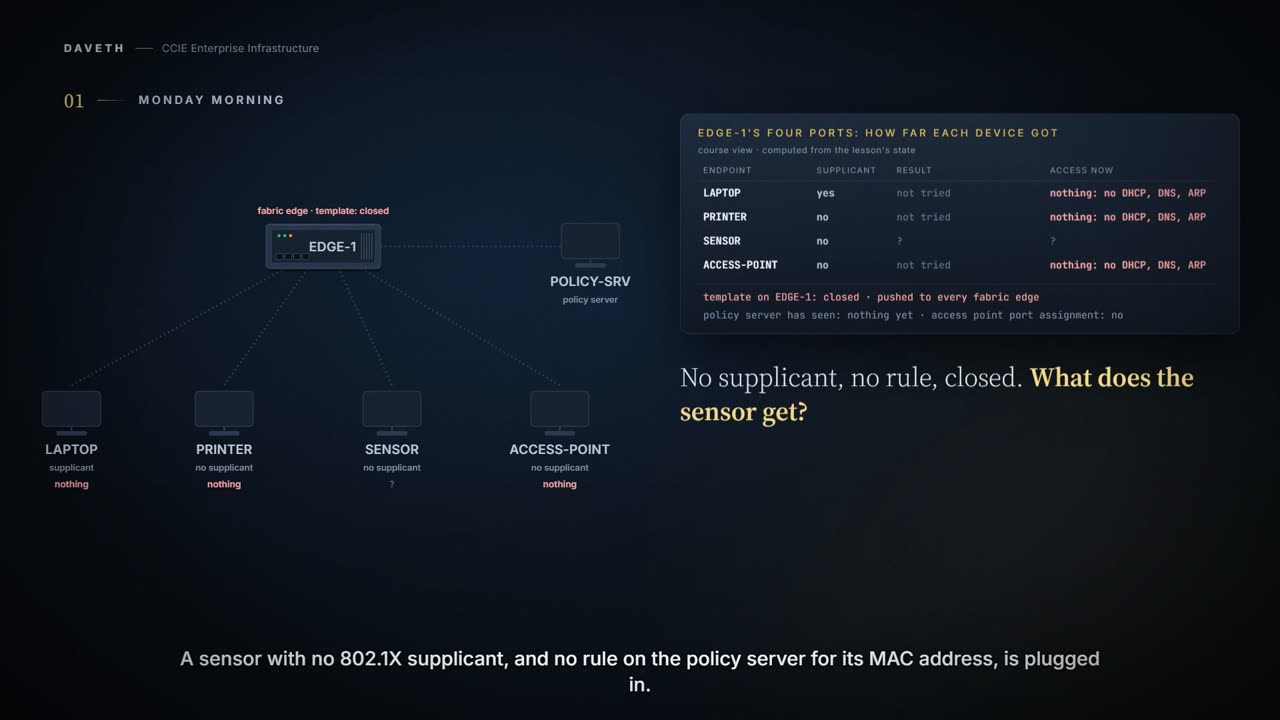
Authentication went live over the weekend, with the closed template. A sensor with no 802.1X supplicant, and no rule in ISE for its MAC address, is plugged in. Predict what it gets before you read the tickets.
The service desk has ninety tickets, all some version of "no network". Not "access denied". Not "please log in". Nothing: ports that look up, devices with no address, users who cannot reach anything, including the page that would have told them what was wrong.
What closed authentication actually does
Any traffic prior to authentication is dropped, including DHCP, DNS, and ARP.
That is the definition, not a side effect. Read it with the consequence attached: an endpoint that has not authenticated cannot get an address, cannot resolve a name, cannot even ARP for its gateway. A device that fails, or has no way to authenticate at all, does not get a restricted experience. It gets nothing, and it has no address with which to tell you so.
The strictest setting fails in the least informative way available: the endpoint that most needs help cannot even ask for an address to ask with.
And it is everywhere at once, because of how the template arrives:
These templates are predefined configurations which automatically push the required configurations to all Fabric Edges.
802.1X, MAB, and the wait between them
Two words to anchor. 802.1X: the endpoint runs a supplicant and proves who it is before the port opens. MAB, MAC Authentication Bypass: for endpoints with no supplicant, the switch offers the device's MAC address to ISE, which decides. It is how printers, cameras and sensors get on at all. The order, from the design guide:
By default, IEEE 802.1X is attempted first, with MAB used as a fallback after a configurable 802.1X timeout. In environments with a high number of IoT clients that lack 802.1X supplicants, SD-Access allows the option of reversing this order so that MAB is used as the primary method with 802.1X as the fallback.
Notice the word configurable. The deployment guide says where: the template's Edit link.
The Edit hyperlink next to the template allows to change the order of authentication methods, 802.1x to MAB Fallback timer, Wake on LAN, and Number of hosts (Multi-Auth vs Single-Host).
So how long is the wait? No page read here states a default. The IBNS 2.0 article's sample configuration sets two timers on its access port, dot1x timeout tx-period 7 and dot1x max-reauth-req 3:
The IBNS article's sample, its access-port interface as printed.
interface TenGigabitEthernet1/0/1
 switchport access vlan <DEFAULT-ACCESS-VLAN>
 switchport mode access
 dot1x timeout tx-period 7
 dot1x max-reauth-req 3
 source template DEFAULT-ACCESS-PORT
 spanning-tree portfast
 spanning-tree bpduguard enable
What do those two numbers count? The 17.9 802.1X chapter defines both: tx-period is how long the switch waits for a reply to its EAP request/identity frame before sending it again, and max-reauth-req is how many times it sends that frame before it restarts authentication.
This course's arithmetic, not a published default: 3 requests, 7 seconds of waiting after each, about 21 seconds before MAB gets its turn. Every device without a supplicant waits that long, every time it connects. That is the design working, and worth knowing before someone reports that the badge readers "take ages".
The templates
Below are four authentication templates available to choose from:
| Template | Before authentication | What it's for |
|---|---|---|
| Open Authentication | Full access | Finding out what is really out there, without blocking it |
| Low Impact | Very limited access, through an ACL on the port | A middle ground while you migrate |
| Closed Authentication | Nothing: DHCP, DNS and ARP included | Where unauthenticated access is unacceptable |
| No Authentication | The guide lists it and describes it no further | See the access-point note below |
A host is allowed network access without having to go through 802.1X authentication. Security is added by applying an ACL to the switch port, to allow very limited network access prior to authentication. After a host has been successfully authenticated, additional network access is granted.
The first three differ in one dimension: what is allowed on the wire before the endpoint has proved who it is. Be careful with "open". It does not mean authentication is off. The design guide's own gloss:
open/monitor (no enforcement, visibility only)
Authentication still runs, and ISE still sees every success and failure. What open removes is the gating. That is why it is a respectable production choice, and why people who call it "no security" miss what it is for.
Continue the lesson
The whole lesson, with its drawings and its questions. 6 more sections after the ones above.