
L2 flooding
By default SD-Access does not flood Layer 2 broadcast or unknown unicast, and other methods handle ARP. That breaks silent hosts, which answer only when prompted by a broadcast. Layer 2 flooding, off by default and meant for small pools, maps the overlay subnet to a multicast group in the underlay. So the underlay needs multicast first: PIM sparse mode and an RP in the underlay.
By Arif, founder of Daveth · Updated
The full 10 min walkthrough is in Daveth Pro (Network). See what the plan opens
What this page answers
Does SD-Access flood broadcasts?
Not by default. SD-Access transports frames without flooding Layer 2 broadcast and unknown unicast traffic, and uses other methods for ARP. Read it in “What a fabric pool does not flood”
How does SD-Access Layer 2 flooding work?
It maps the overlay subnet to a dedicated multicast group in the underlay, and broadcast, link-local multicast and ARP are encapsulated in VXLAN and sent to that group. It is not enabled by default. Read it in “Flooding, one pool at a time”
What does SD-Access Layer 2 flooding need in the underlay?
Underlay multicast: PIM sparse mode on loopback 0 and the point-to-point links, and a rendezvous point in the underlay, configured manually or through LAN Automation. Read it in “The underlay pays first”
What a fabric pool does not flood
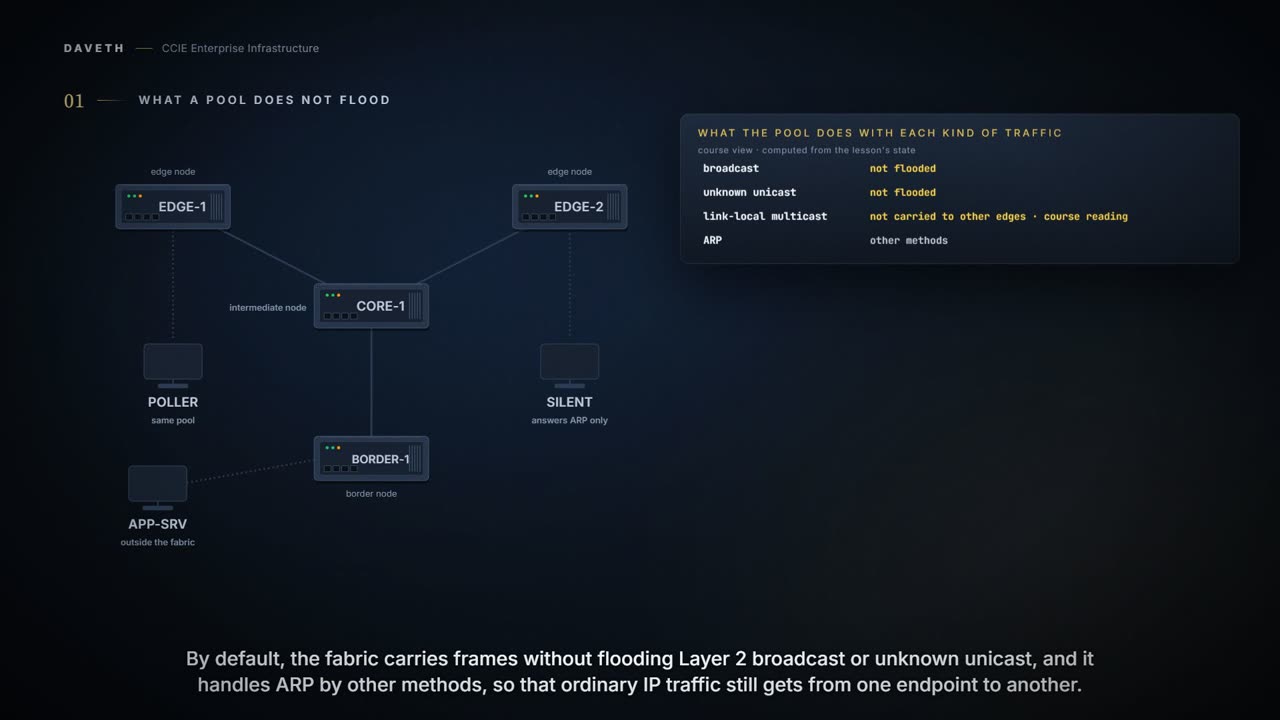
POLLER and SILENT are in the same pool, on two different edge nodes. On an access switch a broadcast from one reaches the other. Does it here?
In traditional networking, broadcasts are flooded out of all ports in the same VLAN. By default, SD-Access transports frames without flooding Layer 2 broadcast and unknown unicast traffic, and other methods are used to address ARP requirements and ensure that standard IP communication gets from one endpoint to another.
Computed from the state: what the pool does with each class, as it ships. No command prints it.
traffic               this pool
broadcast             not flooded
unknown unicast       not flooded
link-local multicast  not carried to other edges (reading)
ARP                   other methods
Look at the ARP row. The guide does not say ARP is dropped; it says other methods handle it. The ARP troubleshooting document counts them, and walks a unicast path and a flooding path:
Within SDA, there are two main methods for ARP resolution within the fabric.
Now the link-local row. The default sentence names broadcast and unknown unicast only. By this course's reading of the guide's Bonjour note, link-local multicast is not carried between edges either:
mDNS can be forwarded over VXLAN by enabling SD-Access layer 2 flooding.
Why build a pool that way?
In the overlay, IP subnets can be stretched across the fabric without the flooding issues that can happen on large Layer 2 networks.
So the default is desirable, not a limitation: a pool can span every edge in the site because nothing floods across it.
A host that only answers
However, certain endpoints respond only when prompted, rather than sending packets at regular intervals. However, some networks need to use broadcast, particularly to support silent hosts, which generally require reception of an ARP broadcast to come out of silence.
SILENT is one of those, and it answers an ARP request and nothing else. What happens when POLLER asks for it?
The silent host itself determines which type of packet triggers it to wake up.
Computed from the state: POLLER's ARP request, no flooding. No command prints it.
request from          POLLER, ARP request
arrives at EDGE-2     no
leaves the port       no
SILENT answers        no
registered            no
By this course's reading, the request stops at EDGE-1: SILENT has never transmitted, so there is no registration for the fabric to resolve it from. The documents describe resolution for registered endpoints and do not print this case.
So the question to ask first is whether the device ever introduces itself. That single fact decides whether this fabric can reach it without help, and it is a question about the equipment rather than about the network.
And a plain broadcast from POLLER, rather than an ARP request? The guide names the other common use for broadcast in a pool:
Another common use case for broadcast frames is wake-on-LAN (WoL) Ethernet broadcasts, which occur when the source and destination are in the same subnet or when a subnet-directed broadcast originates from outside the fabric.
Computed from the state: a broadcast from POLLER, no flooding. No command prints it.
request from          POLLER, broadcast
arrives at EDGE-2     no
leaves the port       no
SILENT answers        no
registered            no
Notice both readings end in no. Nothing is broken; the pool is doing what the default sentence says.
Sit with how that came about, because it is a genuinely awkward standoff. The fabric learns about a host when the host says something. This host has been built to say nothing until somebody speaks to it first. Each side is waiting for the other one to start, and they are both behaving exactly as designed.
And it is the sort of device nobody remembers is on the network. Badge readers, building controllers, the printer on the second floor. They worked for years on a switch that shouted everything at everybody, and the fabric was built specifically to stop doing that.
Flooding, one pool at a time
Layer 2 flooding is a feature that enables the flooding of broadcast, link-local multicast, and Address Resolution Protocol (ARP) traffic for a given overlay subnet. Layer 2 flooding should be used selectively where needed, with a small address pool, and it is not enabled by default.
So what changes on the edges when the pool gets it?
Layer 2 flooding works by mapping the overlay subnet to a dedicated multicast group in the underlay. Broadcast, link-local multicast, and ARP traffic are encapsulated in a fabric VXLAN and sent to the destination underlay multicast group. PIM-ASM is used as the transport mechanism. When Layer 2 flooding is enabled for a given overlay segment, all edge nodes hosting the segment will send multicast PIM joins for the respective underlay multicast group, effectively prebuilding a multicast shared tree.
From elsewhere: the edge configuration for a pool with Layer 2 flooding. The names and notes in it are the document's.
router lisp
 instance-id 8257
   service ethernet
     eid-table vlan 1062
     broadcast-underlay 239.0.17.1
     flood arp-nd
     flood unknown-unicast
The fabric edge node configuration matches that of a standard wired pool with Layer 2 Flooding enabled. The command flood arp-nd is configured bt Cisco Catalyst Center when L2 flooding is enabled in a pool, and the pool is not marked as a wireless pool In reality, flood arp-nd toggles IPDT/SISF rather than flooding itself.
Configuration: what EDGE-2 holds for this pool, in the form this command takes; the VLAN, instance and group are this course's own.
router lisp
 instance-id 8189
   service ethernet
     eid-table vlan 1021
     broadcast-underlay 239.0.17.5
     flood arp-nd
     flood unknown-unicast
Which rows change when the pool floods?
Computed from the state: the classes, with flooding. No command prints it.
traffic               this pool
broadcast             sent to the underlay group
unknown unicast       flooded, per the pool configuration
link-local multicast  sent to the underlay group
ARP                   sent to the underlay group
Look at the unknown-unicast row. The guide's feature sentence names broadcast, link-local multicast and ARP only; this cell comes from the published pool configuration, which carries flood unknown-unicast.
Does POLLER's request reach SILENT now?
If the goal is to wake a silent host from a device within the fabric on the same VLAN as the host, the IP Directed Broadcast feature is not required. Instead, enabling Layer 2 Flooding (in a non-wireless pool) is sufficient to allow the exchange of broadcast packets, subnet broadcasts, or ARP requests.
Computed from the state: POLLER's ARP request, flooding on. No command prints it.
request from          POLLER, ARP request
arrives at EDGE-2     yes
leaves the port       yes
SILENT answers        yes
registered            yes
The underlay pays first
Where does a group like 239.0.17.5 get its tree? Not from the pool.
Overlay features like Layer 2 flooding and native multicast need underlay multicast configuration. A shared tree must be rooted at a rendezvous point, and for Layer 2 flooding to work, this RP must be in the underlay. The RP can be configured manually or programmatically through LAN Automation. In addition, PIM sparse mode is enabled on Loopback 0 and all point-to-point interfaces configured through the LAN Automation process on the devices. If Layer 2 flooding is needed and LAN Automation was not used to discover all the devices in the fabric site, underlay multicast routing needs to be enabled manually on the devices in the fabric site. MSDP should be configured between Anycast-RPs in the underlay. None of the fabric multicast workflows configure underlay multicast automatically.
Computed from the state: the underlay for this pool. No command prints it.
underlay RP           CORE-1
pool group            239.0.17.5
joined by             EDGE-1, EDGE-2
Notice CORE-1 is not in the joined row. It holds the RP and no endpoint in the pool.
What does PIM sparse mode on Loopback 0 look like on an edge?
From elsewhere: Loopback 0 on an edge in a flooding fabric. The names and notes in it are the document's.
interface Loopback0
 ip address 10.47.1.12 255.255.255.255
 no ip redirects
 ip pim sparse-mode <-- PIM must be enabled
And how do you see an edge sending into the group?
From elsewhere: the edge's entry for the group. The names and notes in it are the document's.
Edge-1#show ip mroute 239.0.17.2
(10.47.1.12, 239.0.17.2), 00:02:53/00:00:06, flags: PFT <-- Lo0 interface of Edge-1
  Incoming interface: Null0, RPF nbr 0.0.0.0, <-- Incoming interface Null0 is expected
  Outgoing interface list:
      GigabitEthernet1/0/2, Forward/Sparse, 00:04:40/00:02:45, flags: <-- Outgoing interface Gig1/0/2 faces the fabric underlay
Proves: show ip mroute on the edge proves that Edge-1 has an (S,G) entry for the flooding group with its own Loopback 0 as the source and an outgoing interface toward the underlay. Does not prove: that any other edge has joined the group, or that a flooded frame reached a host.
Hold this apart from native multicast. Both need underlay multicast, and they carry different things:
Multicast packets from the overlay are encapsulated in multicast in the underlay.
Flooding carries one pool's broadcast, link-local multicast and ARP; native multicast carries the overlay's multicast. Native multicast is 2.1.b.v.
Continue the lesson
The whole lesson, with its drawings and its questions. 5 more sections after the ones above.