
TrustSec policy plane
In SD-Access the policy plane is Cisco TrustSec. An SGT is a 16-bit value ISE assigns in an authorization policy when an endpoint connects, applied at ingress. The tag travels in the VXLAN header, so the far side knows the source's group without asking. SGACLs are enforced on egress, at the fabric edge, from a matrix of source and destination groups.
By Arif, founder of Daveth · Updated
The full 6 min walkthrough is in Daveth Pro (Network). See what the plan opens
What this page answers
What is a TrustSec SGT?
A Security Group Tag: a 16-bit value assigned by Cisco ISE in an authorization policy when a user, device or application connects, and attached to its packets at ingress. Read it in “Where the endpoint got a tag”
Where are SGACLs enforced?
On egress: a TrustSec policy filters packets at the egress interface, which in SD-Access is the fabric edge node where the destination is attached. Read it in “Stage three: the decision happens at the far end”
Does a downloaded SGACL override a local one?
Yes. An SGACL downloaded from Cisco ISE overrides any conflicting locally defined policy; the local one applies only while no dynamic policy exists for the same SGT or DGT. Read it in “Downloaded, or typed on the box?”
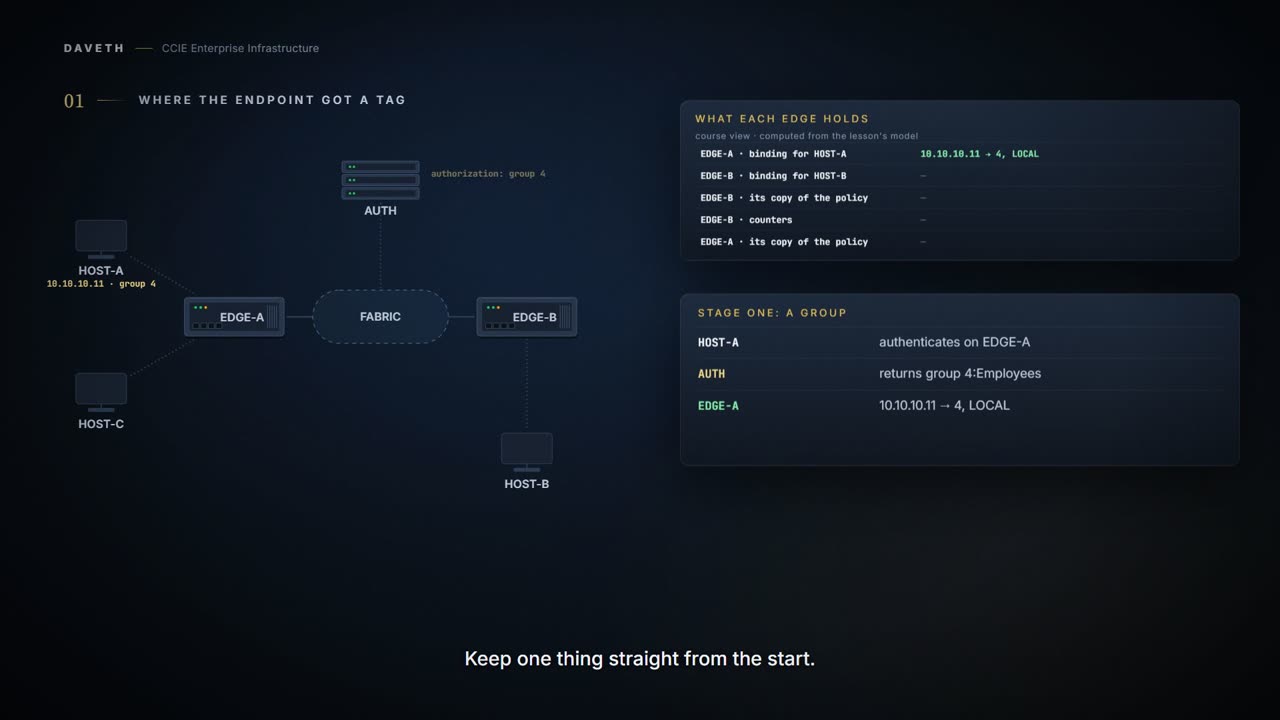
Where the endpoint got a tag
2.1.b.ii put the SGT in the header and quietly skipped something. How did the endpoint get a tag in the first place? In SD-Access the policy plane is based on Cisco TrustSec, and its answer starts at the port:
It is a 16-bit value assigned by Cisco ISE in an authorization policy when a user, device, or application connects to the network. The goal of Cisco TrustSec technology is to assign an SGT value to the packet at its ingress to the network.
That question has three answers rather than one, because a tag is only useful once something also decides what its group may do, somewhere, on some device. Follow it in stages, and keep the stages apart: five terms here get merged by people who meet them all at once.
Stage one. HOST-A authenticates on EDGE-A, ISE returns an authorization result, and part of that result is an SGT. What does EDGE-A now hold?
EDGE-A# show cts role-based sgt-map vrf CAMPUS all
Active IPv4-SGT Bindings Information
IP Address              SGT     Source
============================================
10.10.10.11             4       LOCAL
! Proves which addresses this device holds a group for, and where each binding came from. Does not prove the group is the one anybody intended: LOCAL means an authorization result said so.
One row, source LOCAL. A binding can come from several places, and the device ranks them:
Cisco TrustSec resolves conflicts among IP-SGT binding sources with a strict priority scheme.
LOCAL is the highest of the ways an endpoint's address gets a group in the mapping chapter's list, below only the device's own addresses, and it means:
Bindings of authenticated hosts which are learned via EPM and device tracking.
One term, kept straight from the start. The SGT is a label. It says which group. It does not say what the group may do. That is an SGACL, a separate object that arrives separately. Every troubleshooting step on this page depends on not merging the two.
Stage two: the tag travels
In the policy plane, the alternative forwarding attributes (the SGT value and VRF values) are encoded into the header and carried across the overlay.
The header itself was 2.1.b.ii and is not repeated here. It earns one sentence because it is the hinge for stage three: by the time a packet reaches the far side of the fabric, the source's group is on the packet, and nothing has to be asked.
When the path cannot carry it
Not every device can put a tag in a frame. The protocol for that case moves the binding instead of the tag:
SXP is a control protocol for propagating IP-to-SGT binding information across network devices that do not have the capability to tag packets. It has two defined roles—speaker (initiator) and listener (receiver). SXP is used to carry SGTs across network devices that do not have support for inline tagging or if the tunnel used is not capable of carrying the tag.
Where SXP peerings go in an SD-Access design, and which end speaks, is 2.1.e. Every endpoint on this page authenticates on a fabric edge node, so every binding here is LOCAL and every tag rides in the header.
Stage three: the decision happens at the far end
Here is the part that surprises people. Where is the policy applied?
A role-based access control list bound to a range of SGTs and DGTs forms an SGACL, a Cisco TrustSec policy enforced on egress traffic. Cisco Group-Based Policy filters packets at the egress interface. The filtering usually occurs at an egress port of the Cisco TrustSec domain. access control for wired and wireless traffic is consistently and uniformly enforced at the access layer (fabric edge node).
This course's reasoning, marked: the guides say egress, and at the fabric edge node; that the two meet at the destination's edge node is this course's reading. For HOST-A to HOST-B, the packet leaves the fabric toward HOST-B at EDGE-B, so EDGE-B applies the cell. It needs two groups: the source's arrived in the header, and the destination's is a binding it holds because HOST-B authenticated on it. Both are present at the far end; at the source the pair is not complete, because EDGE-A knows its own endpoint's group and nothing about the destination's.
This course's reading: the decision on one packet
packet              HOST-A to HOST-B
decided on          EDGE-B, where HOST-B is attached
source group        4, from the header
destination group   10, from its own binding
cell applied        from 4 to 10

permitted
The other half: how the policy arrives
Policy enforcement within the Cisco TrustSec domain is represented by a permissions matrix, with source security group numbers on one axis and destination security group numbers on the other axis. Each cell in the body of the matrix can contain an ordered list of SGACLs, which specifies the permissions that should be applied to packets originating from the source security group and destined for the destination security group.
| from \ to | 4:Employees | 5:Contractors | 10:Servers |
|---|---|---|---|
| 4:Employees | the default | the default | Permit IP-00 |
| 5:Contractors | the default | the default | Deny IP-00 |
| 10:Servers | the default | the default | the default |
This is the object being distributed, and it is not the tag. When does a device get it? Two Cisco pages say two things:
Cisco TrustSec downloads the SGACL policies when it learns of a new SGT Exchange Protocol (SXP) through authentication and authorization on an interface, from SXP, or from manual IP address to SGT mapping. Traffic must be flowing for the policy to be present.
The first sentence reads a new SGT Exchange Protocol (SXP) where the rest of it only makes sense as a new SGT, and this course reads it that way. On this page the copy is taken once both are true: the device has learned a group, and traffic is flowing. Which of the two is the trigger is not claimed.
Both halves have to arrive. The tag rides with the packet; the policy does not.
And a pair with no cell?
The default policies are applied when no explicit policy exists between the source and destination security groups. By default, a “permit any” policy is used, so any source–destination SGT pair without an explicit SGACL is allowed.
What does EDGE-B hold once HOST-A is talking to HOST-B?
EDGE-B# show cts role-based permissions
IPv4 Role-based permissions default:
Permit IP-00
IPv4 Role-based permissions from group 4:Employees to group 10:Servers:
Permit IP-00
IPv4 Role-based permissions from group 5:Contractors to group 10:Servers:
Deny IP-00
RBACL Monitor All for Dynamic Policies : FALSE
RBACL Monitor All for Configured Policies : FALSE
! Proves which cells this device holds and the access lists in each. Does not prove that the cell matches the flow you are chasing: that depends on the groups the device holds for its two ends. Does not show whether a cell was downloaded; the details form prints that.
The default, and the two cells into 10:Servers. That the copy holds exactly the cells into groups the device has learned is this course's reading: no page cited states which cells a download contains, and the troubleshooting guide's sample edge prints the default and one cell.
Downloaded, or typed on the box?
A cell can also be configured on the device by hand, and the two are not equal:
An SGACL policy that is downloaded dynamically from the Cisco Secure ACS or a Cisco ISE will override any conflicting locally-defined policy. This policy is in effect as long as there is no dynamic policy for the same DGT or SGT.
So how do you tell which you are looking at? Ask for a single cell with details:
When details is entered, the ACEs of the SGACL of the single cell are displayed.
Not from this scenario: the Catalyst 9400 17.9 SGACL chapter's monitor-mode example
Device# show cts role-based permissions from 2 to 3 ipv4

IPv4 Role-based permissions from group 2:sgt2 to group 3:sgt3 (monitored):
        denytcpudpicmp-10
        Deny IP-00

Device# show cts role-based permissions from 2 to 3 ipv4 details

IPv4 Role-based permissions from group 2:sgt2 to group 3:sgt3 (monitored):
        denytcpudpicmp-10
        Deny IP-00
Details:
Role-based IP access list denytcpudpicmp-10 (downloaded)
        10 deny tcp
        20 deny udp
        30 deny icmp
Role-based IP access list Permit IP-00 (downloaded)
        10 permit ip
Look at (downloaded) on each access list in the details. That word is the proof the policy came from ISE rather than being configured locally, and it is worth more than assuming a push worked because ISE says it pushed.
One thing in that sample is worth noticing and not explaining. The cell lists denytcpudpicmp-10 and Deny IP-00; the details list denytcpudpicmp-10 and Permit IP-00. The two lists differ by one name. This course reproduces the sample as printed and does not account for the difference, because nothing it consulted does.
The whole-matrix form marks a hand-configured cell differently, on the cell's own line:
Not from this scenario: the Catalyst 9600 17.9 command reference's sample
Device# show cts role-based permissions

IPv4 Role-based permissions default (monitored):
default_sgacl-02
Permit IP-00
IPv4 Role-based permissions from group 305:sgt to group 306:dgt (monitored):
test_reg_tcp_permit-02
RBACL Monitor All for Dynamic Policies : TRUE
RBACL Monitor All for Configured Policies : FALSE
IPv4 Role-based permissions from group 6:SGT_6 to group 6:SGT_6 (configured):
		mon_1
IPv4 Role-based permissions from group 10 to group 11 (configured):
		mon_2
RBACL Monitor All for Dynamic Policies : FALSE
RBACL Monitor All for Configured Policies : FALSE
(configured) for a cell typed on the box; (monitored) for one in monitor mode, which counts rather than drops and is a matrix design choice for 2.1.f.ii. The troubleshooting guide's fabric-edge sample prints its cells with neither marker, which is the layout this page draws.
Continue the lesson
The whole lesson, with its drawings and its questions. 7 more sections after the ones above.