
Fabric in a box
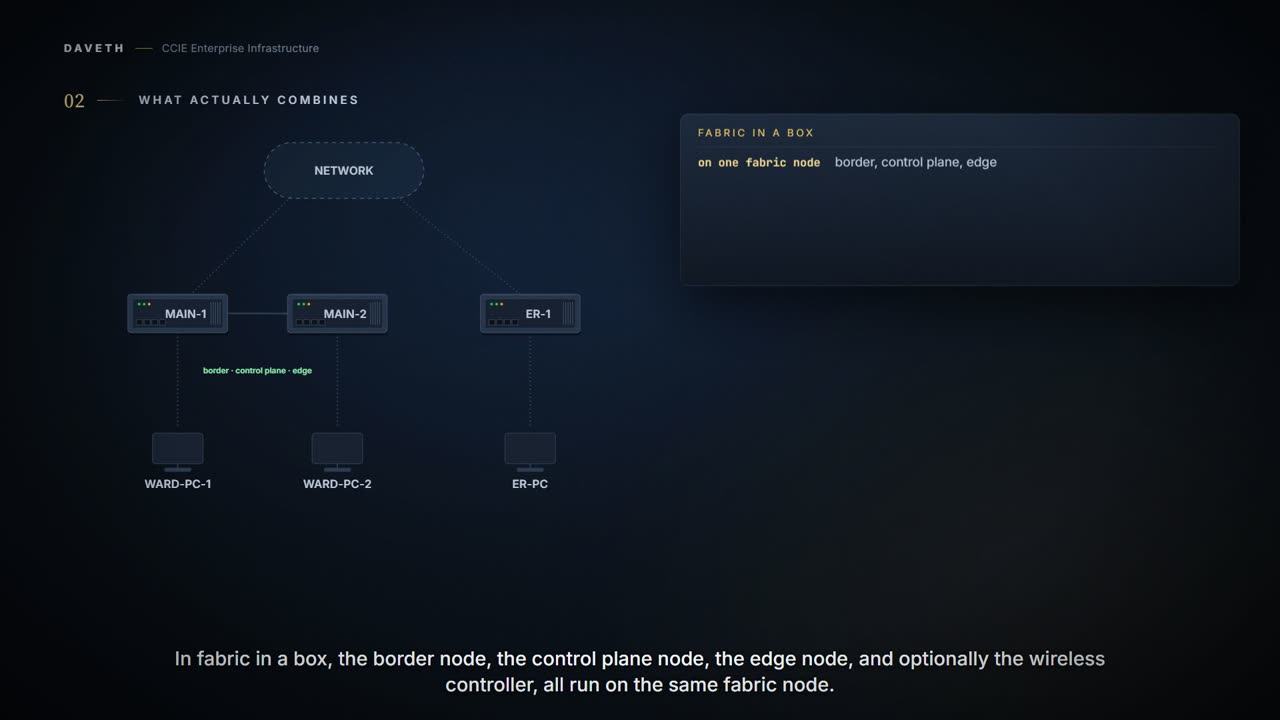
Fabric in a Box runs the border node, control plane node, edge node and optionally the WLC on one fabric node, with all the roles colocated. It is not a cut-down fabric: the same roles do the same jobs on one switch, which suits a small branch. The box can be a single switch, a hardware stack or StackWise Virtual, and that choice decides what failures it survives.
By Arif, founder of Daveth · Updated
The full 7 min walkthrough is in Daveth Pro (Network). See what the plan opens
What this page answers
What is SD-Access Fabric in a Box?
A deployment where the border node, control plane node, edge node and optionally the WLC run on the same fabric node: all fabric roles colocated on one device. Read it in “What actually combines”
How do you make Fabric in a Box highly available?
With StackWise-480 or StackWise Virtual, which combine several switches into one logical switch, or a chassis with redundant supervisors. A single switch survives nothing. Read it in “What you can do about resilience”
Everything you just learned, in one box
The last lesson built a fabric site out of separate roles on separate devices. Now put all of it in one switch. Does a forty-person branch really need three boxes?
It does not. That is Fabric in a Box, and the useful question is not whether it works. It does. The question is what you give up.
What actually combines
Fabric in a Box is an SD-Access construct in which the border node, control plane node, edge node, and optionally WLC are running on the same fabric node. In a Fabric in a Box deployment, all fabric roles must be colocated on the same device.
Notice what that is not: a cut-down fabric. The same roles do the same jobs; they just share one switch. Endpoints register with a control plane node that happens to be local, and leave through a border that happens to be the switch they plugged into.
Which switch can do that? It has to run every role. The validated profile's platform table shows why the Catalyst 9300 is where it starts:
| Platform family | Edge | Control plane | Border | Embedded WLC |
|---|---|---|---|---|
| Catalyst 9200 | yes | – | – | – |
| Catalyst 9300 | yes | yes | yes | yes |
| Catalyst 9400 | yes | yes | yes | yes |
| Catalyst 9500 | yes | yes | yes | yes |
| Catalyst 9600 | – | yes | yes | – |
Read across each row. The 9200 has no control plane or border role, and the 9600 has no edge role, so neither can be a Fabric in a Box on its own. 9300, 9400 and 9500 have every role.
One cell needs the design guide beside it. The guide lists the 9500X among the Catalyst 9000 switches without embedded wireless, so on a 9500X the optional controller is not an option.
The "optionally WLC" in the definition is the embedded wireless controller:
Enabled in Catalyst 9000 devices (EWC on Catalyst 9000) with a wireless subpackage. A maximum of two EWCs can operate within a single SD-Access fabric site. EWC on Catalyst 9000 devices are only recommended in a small branch.
Count the jobs that switch is now holding. Edge, control plane, border, and on the supported platforms the wireless controller as well. Nothing about that is wrong, and it is worth saying out loud, because every one of those roles was taught as a separate device for a reason and they are now sharing a power supply.
What you can do about resilience
The "box" does not have to be one physical switch:
This may be a single switch, a switch with hardware stacking, or a StackWise Virtual deployment.
| Build | What it survives |
|---|---|
| Single switch | Nothing: one device, one failure |
| Hardware stack or StackWise Virtual | Losing a member; the others carry the logical switch |
| Chassis switch | Losing a supervisor or a power supply |
High availability in this design is provided through StackWise-480 or StackWise Virtual, which both combine multiple physical switches into a single logical switch. If a chassis-based switch is used, high availability is provided through redundant supervisors and redundant power supplies.
Read the stack sentence to its end: a single logical switch. That is exactly the limit. A stack survives losing a member. But the site still depends on one logical switch, and anything that stops that switch stops the site.
So be precise about which failure each build answers. A stack covers a member going away. It does not cover the logical switch stopping, and those are different events with different likelihoods; buying the first and assuming you have bought the second is how a resilience plan turns out to have one sentence missing.
Wireless gets the same benefit from the same hardware:
When using the Catalyst 9800 Series EWC with a switch stack or redundant supervisor, AP and client Stateful Switchover (SSO) is provided automatically.
One more form exists, for buildings whose cabling forces it:
Dual Fabric in a Box is also supported, though it should be used only if mandated by the existing wiring structures.
Continue the lesson
The whole lesson, with its drawings and its questions. 4 more sections after the ones above.