
vManage and the management plane
Cisco Catalyst SD-WAN separates orchestration, management, control and data planes. vManage, now SD-WAN Manager, is the management plane: central configuration, monitoring, upgrades, application visibility and troubleshooting, with configuration reaching edges over NETCONF. It does not bring devices into the overlay, which is vBond's job, does not decide where traffic goes, which is vSmart's, and forwards no user traffic.
By Arif, founder of Daveth · Updated
The full 7 min walkthrough is in Daveth Pro (Network). See what the plan opens
What this page answers
What are the SD-WAN planes?
Orchestration, which onboards routers into the overlay; management, for central configuration and monitoring; control, which builds the topology and decides where traffic flows; and data, which forwards packets. Read it in “Four planes, four owners”
What are the new names for vManage, vSmart and vBond?
vManage is now SD-WAN Manager, vSmart is SD-WAN Controller, and vBond is SD-WAN Validator. Read it in “A note on names”
What does vManage do?
It is the management plane: a GUI to monitor, configure and maintain all SD-WAN devices and links, from provisioning and upgrades to application visibility and troubleshooting. It pushes configuration to edges with NETCONF. Read it in “What vManage owns”
Four planes, four owners
Three controllers with confusingly similar names. Which one actually does what? the design guide starts from the split:
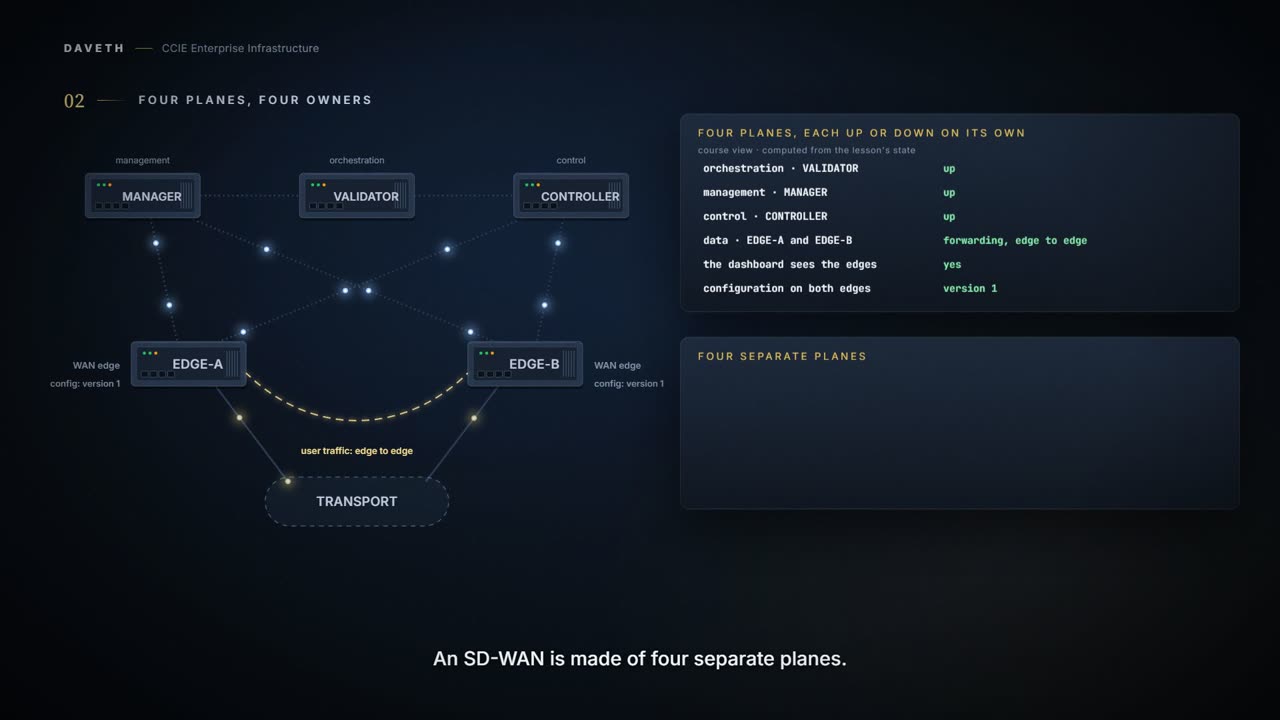
The Cisco Catalyst SD-WAN solution is comprised of separate orchestration, management, control, and data planes. The orchestration plane assists in the automatic onboarding of the SD-WAN routers into the SD-WAN overlay. The management plane is responsible for central configuration and monitoring. The control plane builds and maintains the network topology and makes decisions on where traffic flows. The data plane is responsible for forwarding packets based on decisions from the control plane.
The four planes: VBOND orchestrates, VMANAGE manages, VSMART controls, and the edges carry the traffic between themselves.
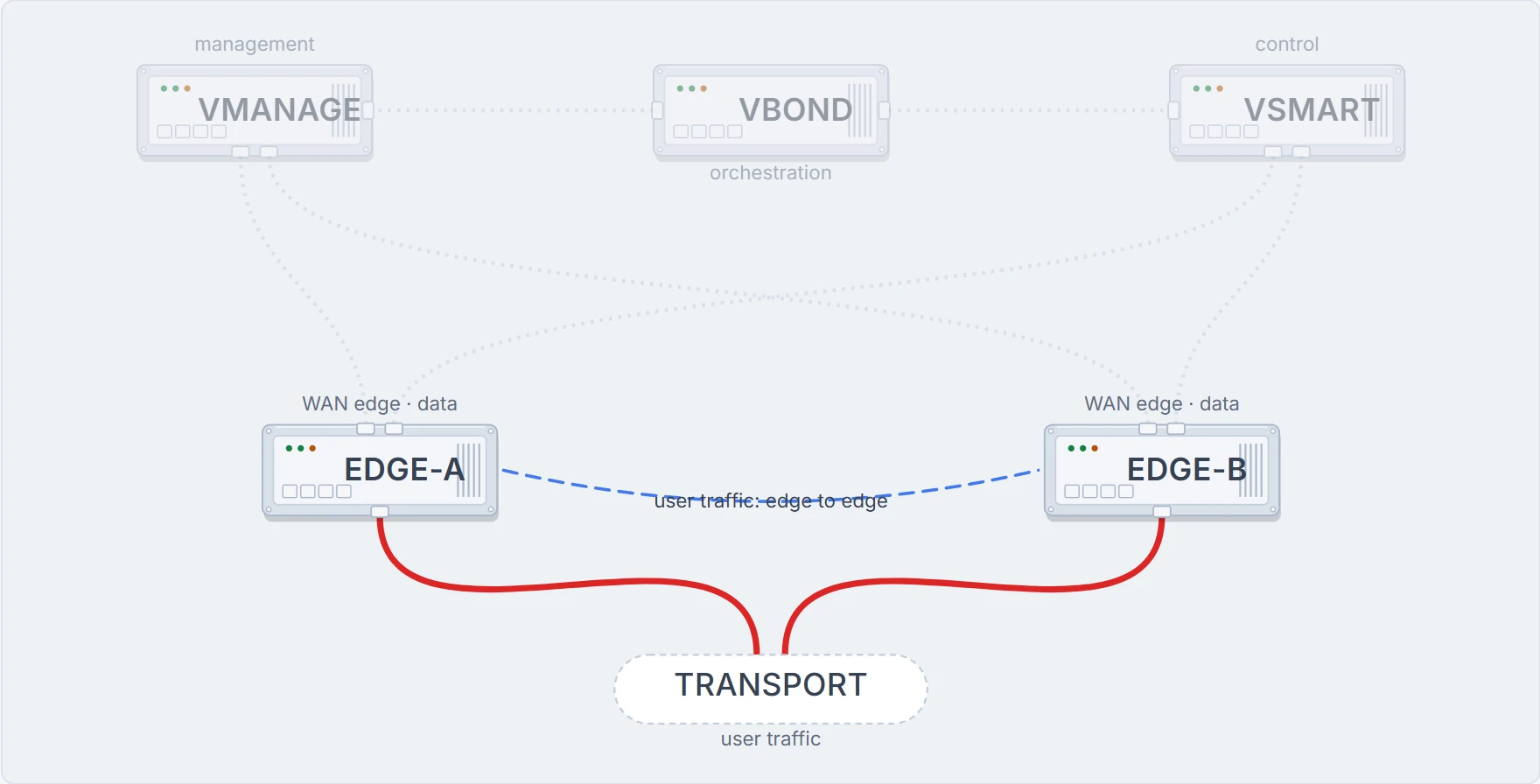
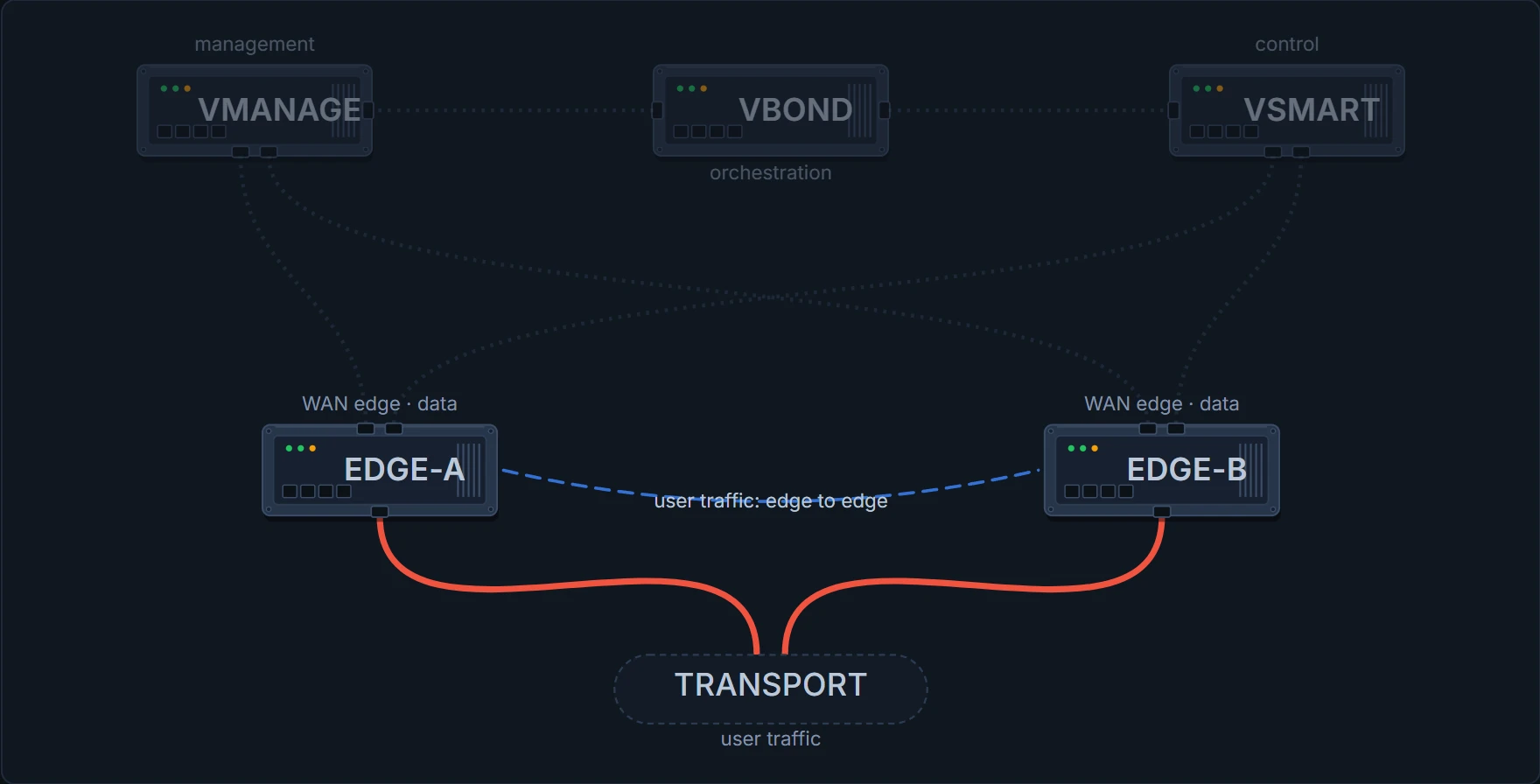
Look at the bottom of that picture first. User traffic goes edge to edge, across the transport. It does not pass through vManage, vBond or vSmart. The edges build those sessions with each other:
These routers (physical and cloud) establishes secure connectivity to all of the control components and also establishes IPSec sessions with other routers in the WAN network.
Almost every SD-WAN operations question starts with the same one: which plane is affected?
A note on names
The blueprint uses the old names, so this course does too. The documentation you will read uses the new ones:
As part of this rebranding, the vManage name has been changed to SD-WAN Manager, the vSmart name has been changed to SD-WAN Controller, and the vBond name has been changed to SD-WAN Validator.
| Blueprint name | Current name | Plane |
|---|---|---|
| vManage | SD-WAN Manager | management |
| vBond | SD-WAN Validator | orchestration |
| vSmart | SD-WAN Controller | control |
What vManage owns
This centralized network management system is software-based and provides a GUI interface to easily monitor, configure, and maintain all Cisco Catalyst SD-WAN devices and their connected links in the underlay and overlay network. Cisco vManage provides the ability to manage all aspects of the WAN from provisioning, monitoring, and upgrading routers to application visibility and troubleshooting the WAN.
Provisioning, monitoring, upgrades, application visibility and troubleshooting: management, and only management. It is also how configuration reaches an edge:
Once a secure connection is built, NETCONF is used by the SD-WAN Manager to provision the WAN Edge device, and OMP peering is established between the SD-WAN Controller and WAN Edge.
Notice who does what in that one sentence. vManage provisions; the OMP peering that carries routes is with the SD-WAN Controller. It is also tempting to file vManage as Catalyst Center for the WAN. That is a false friend: SD-WAN splits onboarding and control out into their own components, and the difference is the rest of this page.
What it does not own
vManage does not bring devices into the overlay; that is the orchestration plane. It does not decide where traffic goes; that is the control plane. And it forwards no user traffic at all; that is the data plane. Read the design guide's data-plane sentence again: packets are forwarded based on decisions from the control plane. vManage is not in it.
Continue the lesson
The whole lesson, with its drawings and its questions. 4 more sections after the ones above.