WAN cloud edge deployment
Three cloud providers bring three vocabularies, transit VPCs, virtual hubs and network virtual appliances, but one shape. Cloud OnRamp for Multicloud deploys a cloud gateway: a pair of routers, for path resiliency, not one. In AWS the pair sits in a transit VPC; in Azure in a virtual WAN hub as network virtual appliances; in Google Cloud in the WAN VPC and two transit VPCs.
By Arif, founder of Daveth · Updated
The full 6 min walkthrough is in Daveth Pro (Network). See what the plan opens
What this page answers
What is an SD-WAN cloud gateway?
A pair of cloud services routers deployed in the cloud provider, for example within a transit VPC in AWS. Using redundant routers gives path resiliency to the public cloud. Read it in “What actually gets deployed”
Where does the SD-WAN cloud gateway sit in AWS, Azure and Google Cloud?
In AWS, a transit VPC; in Azure, a virtual WAN hub, with Catalyst 8000V as network virtual appliances; in Google Cloud, the WAN VPC and two transit VPCs. Read it in “The same pair, by provider”
Three clouds, one shape
Three clouds, three floor plans. The question is whether the same WAN job is sitting in all three of them.
Three cloud providers, three sets of documentation, three vocabularies: transit VPCs, virtual hubs, network virtual appliances. Is there one thing to learn here, or three?
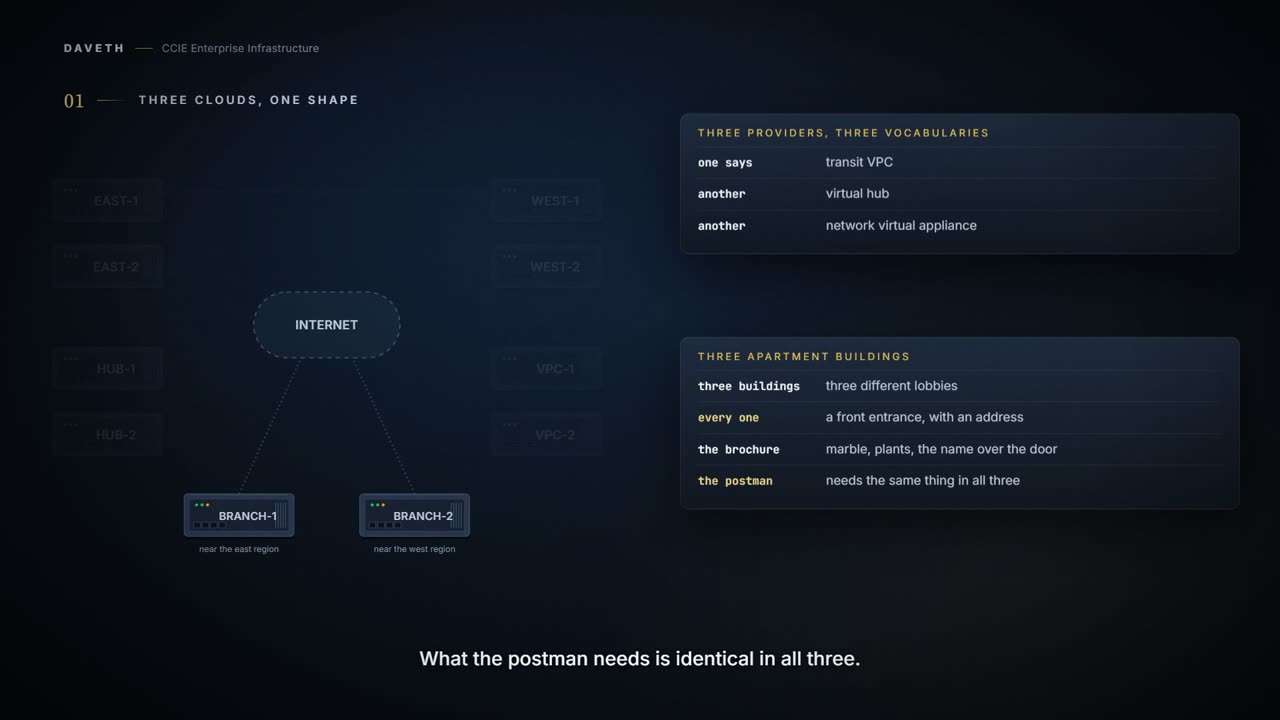
Three apartment buildings have three different lobbies. Every one of them still needs a clear front entrance with an address on it. The marble, the plants and the name over the door are what the brochure talks about. What the postman needs is identical in all three.
One. A pair of virtual WAN edge routers, in a cloud gateway, standing between the overlay and the cloud. Each one is a WAN edge, like a branch router. The platform first:
Multicloud domain: Catalyst 8000V is supported in the Amazon Web Services (AWS), Microsoft Azure, Google Cloud, Oracle Cloud Infrastructure (OCI) and Alibaba Cloud. It is also available in Equinix and Megaport middle-mile providers.
What actually gets deployed
Look at the AWS case first, because every other provider repeats it:
The cloud gateway consists of a pair of cloud services routers that are instantiated within a transit VPC.
The cloud gateway: the AWS pair in us-east-1, and the two branches that reach it across the internet.
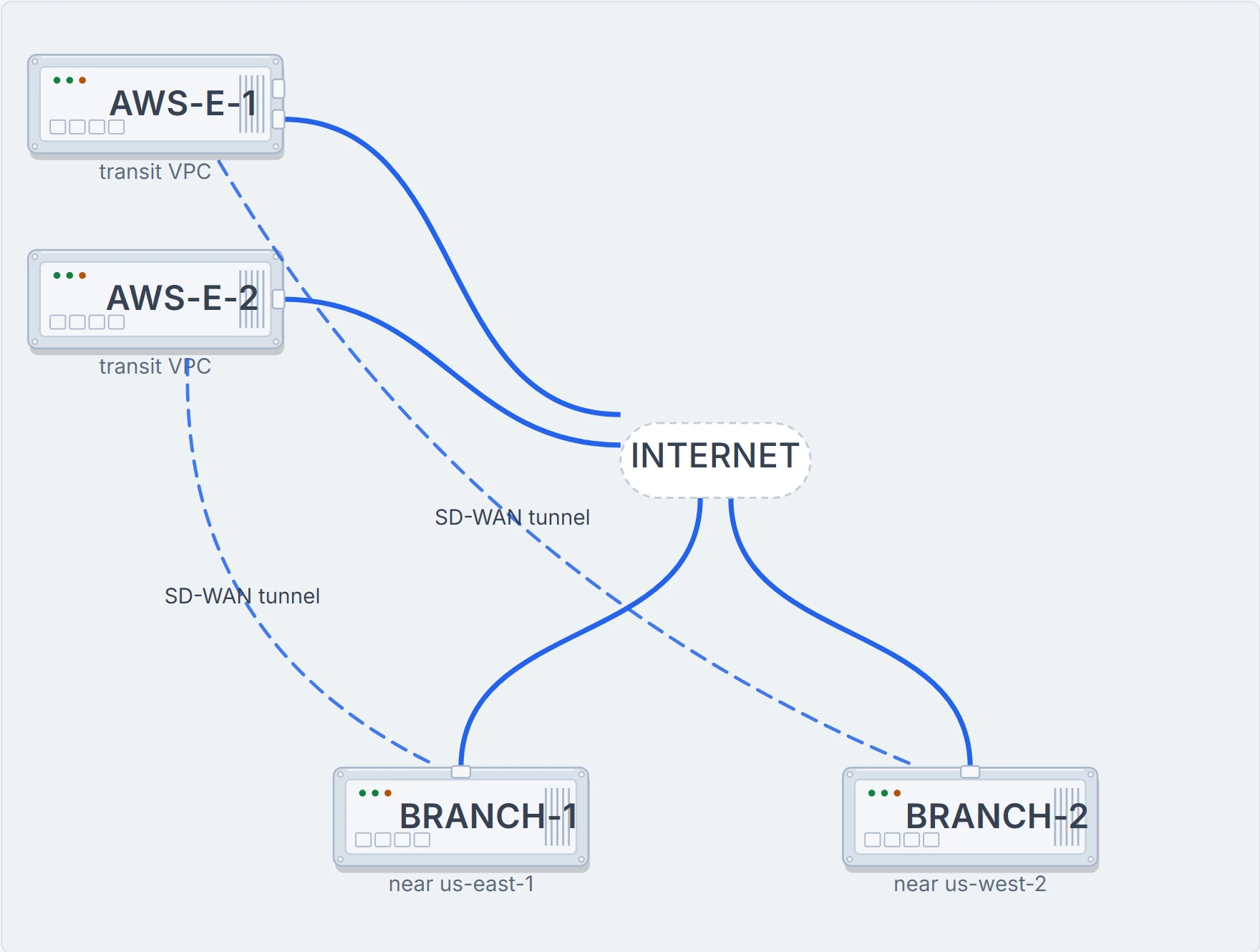
Two things to take from that. A pair, not a single router, and the Azure chapter says why:
Using redundant routers to form the transit offers path resiliency to the public cloud.
And the wizard builds it, branches included. Read what the AWS chapter lists as automated:
A configuration wizard in Cisco SD-WAN Manager automates the bring-up of the transit gateway to your public cloud account, the creation of cloud gateways that includes transit gateways and Cisco Catalyst 8000V Edge, and the connections between public-cloud applications and the users of those applications at branches in the overlay network.
What carries a branch to the pair? The Azure chapter names it while describing ExpressRoute:
Cisco SD-WAN Manager supports ExpressRoute connections from branch offices to NVAs through Cisco Catalyst SD-WAN tunnels.
The same pair, by provider
Where does the pair land? Here is the vocabulary as a table; read it across, not down:
| Provider | The pair sits in |
|---|---|
| AWS | a transit VPC |
| Azure | a virtual WAN hub, as network virtual appliances |
| Google Cloud | the WAN VPC and two transit VPCs |
The integration of the Cisco Catalyst SD-WAN solution with Azure virtual WAN enhances Cloud OnRamp for Multicloud deployments and enables configuring Cisco Catalyst 8000V Edge Software (Cisco Catalyst 8000V) as a network virtual appliance (NVA) in Azure Virtual WAN Hubs. The connection between the overlay network and a public-cloud application is provided by a pair of redundant Cisco Catalyst 8000V instances that are configured inside the Azure virtual WAN hub as part of the Cloud OnRamp for Multicloud workflow for Azure. Cloud gateways consist of a pair of Cisco Catalyst 8000V instances with their interfaces anchored in three different VPCs. The Cloud OnRamp for Multicloud workflow in Cisco SD-WAN Manager automates the bring-up of the WAN Virtual Private Cloud (VPC) and two transit VPCs in Google Cloud.
Three vendors looked at the same pair of routers and invented three names for the room they sit in.
One real difference, not a naming one. Google Cloud does not stop at two:
You can deploy a minimum of two and a maximum of eight Cisco Catalyst 8000V instances as part of a cloud gateway in a particular region.
So "a pair" is the minimum everywhere and the rule for AWS and Azure, not a law for all three.
Continue the lesson
The whole lesson, with its drawings and its questions. 4 more sections after the ones above.