
Transport configuration and TLOCs
A TLOC is three things: system IP, colour and encapsulation. Change any one and it is a different TLOC, so one router on one circuit with IPsec and GRE presents two. WAN edges try to connect to every TLOC over each transport, including TLOCs of other colours, and between transports with no path those attempts stay down. The restrict keyword on a colour stops them.
By Arif, founder of Daveth · Updated
The full 5 min walkthrough is in Daveth Pro (Network). See what the plan opens
What this page answers
What is an SD-WAN TLOC?
A transport locator, identified by three things: the system IP, the colour and the encapsulation. Changing any of the three makes a different TLOC. Read it in “A TLOC is three things”
What does restrict do on an SD-WAN tunnel color?
It prevents attempts to establish BFD sessions to TLOCs of a different colour, so an edge does not try to build tunnels between transports that cannot reach each other. Read it in “Which is what restrict is for”
Why does show sdwan omp tlocs list the same circuit twice?
Because the encapsulation is part of the TLOC: the same router over the same circuit with IPsec and with GRE presents two different TLOCs. Read it in “The part people leave out”
A TLOC is three things
System IP · colour · encapsulation.
Not one thing. Three, and all three are part of the identity. Change any one of them and you have a different TLOC.
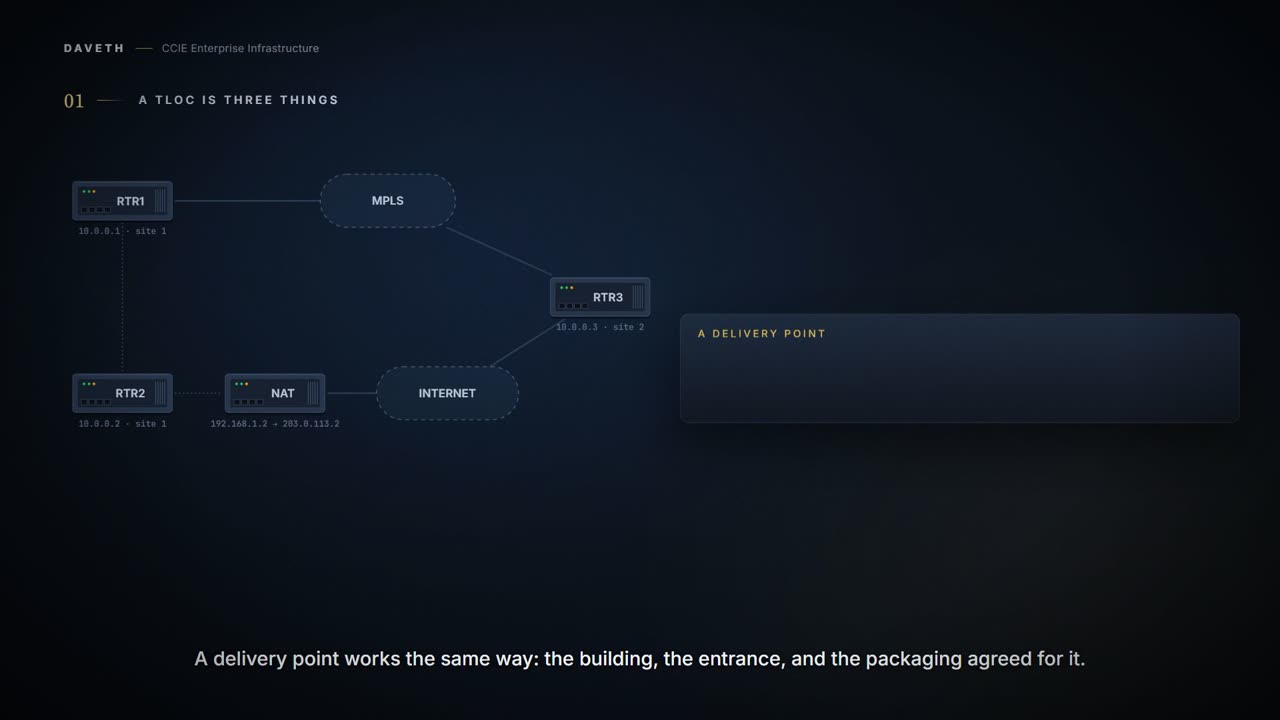
A delivery point is identified the same way: the building, the entrance you use, and the packaging that has been agreed for it. Change the building and it is somewhere else. Keep the building and use the other entrance and it is a different delivery point, with its own arrangements. Same address, different door, different agreement.
Where the delivery stops: a courier at the wrong door can knock and ask. Here nothing knocks. Two ends that do not agree on all three parts are not negotiating anything; the session simply never forms, and what you get is silence rather than an error.
That is the anchor for this entire topic. Everything else in transport configuration exists to make TLOCs work, so start by getting the definition exactly right: a three-tuple remembered as basically the IP address will mislead you through every policy topic that follows.
System IP says which device: the persistent address you configured in 2.2.b.iv. Colour says which transport: a site with MPLS and broadband has two, and colour is how they are told apart. Encapsulation says how the tunnel is built, IPsec or GRE, and it is the part people leave out of the definition.
State 1 Two sites, two transports
Which of these routers is attached to which circuit?
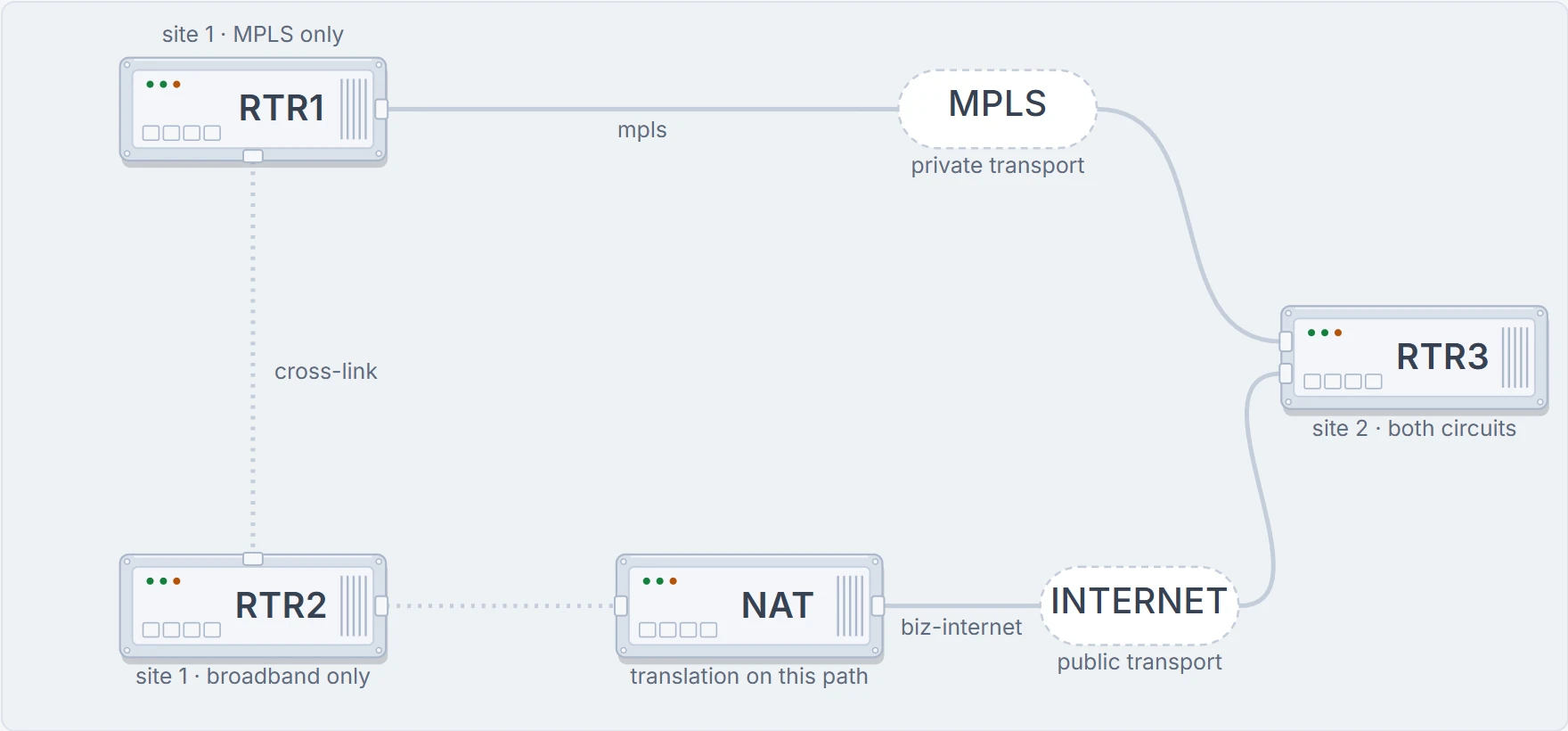
This course's output, not a capture: RTR3 in this scenario, computed from the state and drawn in this command's own columns, without the timer columns.
RTR3# show sdwan omp tlocs
ADDRESS FAMILY  TLOC IP     COLOR          ENCAP   MTU   FROM
ipv4-unicast    10.0.0.3    mpls           ipsec   1442  local
ipv4-unicast    10.0.0.3    biz-internet   ipsec   1442  local
Two circuits, one encapsulation, 2 TLOCs. Each row is a whole identity: 10.0.0.3 · mpls · ipsec.
The part people leave out
That third component has a consequence worth seeing clearly. The same router, over the same circuit, with two different encapsulations, presents two different TLOCs.
This course's output, not a capture: RTR3 in this scenario, computed from the state and drawn in this command's own columns, without the timer columns.
RTR3# show sdwan omp tlocs
ADDRESS FAMILY  TLOC IP     COLOR          ENCAP   MTU   FROM
ipv4-unicast    10.0.0.3    mpls           ipsec   1442  local
ipv4-unicast    10.0.0.3    mpls           gre     1468  local
ipv4-unicast    10.0.0.3    biz-internet   ipsec   1442  local
ipv4-unicast    10.0.0.3    biz-internet   gre     1468  local
The physical transport has not changed. The identity has, and the count went from 2 to 4.
| Encapsulation | Default MTU |
|---|---|
| ipsec | 1442 |
| gre | 1468 |
Worth knowing they differ; worth checking the current figures rather than trusting a memory of them.
Two transports at each end
Put a number on this before you read the answer.
WAN Edge routers attempt to connect to every TLOC over each WAN transport, including TLOCs that belong to other transports marked with different colors.
Computed from the state: every pair RTR3 could try, and what becomes of each. No command prints it.
mpls → mpls                   private address  up
mpls → biz-internet           public address   down: no path between these transports
biz-internet → mpls           public address   down: no path between these transports
biz-internet → biz-internet   public address   up
The session output below has a row per session it is attempting; this reading has every pair, including the ones a later section will stop it from attempting at all.
This course's output, not a capture: RTR3 in this scenario, computed from the state and drawn in this command's own columns, without the timer columns.
RTR3# show sdwan bfd sessions
SYSTEM IP   SITE  STATE SOURCE COLOR   REMOTE COLOR   DST IP          ENCAP
10.0.0.1    1     up    mpls           mpls           172.16.1.1      ipsec
10.0.0.1    1     down  biz-internet   mpls           172.16.1.1      ipsec
10.0.0.2    1     down  mpls           biz-internet   203.0.113.2     ipsec
10.0.0.2    1     up    biz-internet   biz-internet   203.0.113.2     ipsec
4 attempts, 2 up. Two of those four are usually nonsense: an MPLS TLOC has no path to a broadband TLOC in most designs, so those sessions never come up, and you are left with BFD attempting connections that will always fail.
Two doors at your end and two at theirs gives four pairings, not two. It looks like addition and it is multiplication, which is the moment this stops being arithmetic you can do in your head at a site with several transports.
And the router is not sorting them into sensible piles for you. It does not know that your MPLS circuit has no business reaching their broadband one. Colours are labels; nothing in a label tells the router which pairs are worth trying, which is precisely the gap the next section fills.
Which is what restrict is for
To prevent this behavior, there is a restrict keyword that can be specified along with the color of the tunnel. This prevents attempts to establish BFD sessions to TLOCs with different color.
Computed from the state: every pair RTR3 could try, and what becomes of each. No command prints it.
mpls → mpls                   private address  up
mpls → biz-internet           public address   not attempted: restrict
biz-internet → mpls           public address   not attempted: restrict
biz-internet → biz-internet   public address   up
This course's output, not a capture: RTR3 in this scenario, computed from the state and drawn in this command's own columns, without the timer columns.
RTR3# show sdwan bfd sessions
SYSTEM IP   SITE  STATE SOURCE COLOR   REMOTE COLOR   DST IP          ENCAP
10.0.0.1    1     up    mpls           mpls           172.16.1.1      ipsec
10.0.0.2    1     up    biz-internet   biz-internet   203.0.113.2     ipsec
2 attempts now, 2 up, and 2 never made. Applied to the MPLS TLOC it stops that TLOC trying to reach anything that is not also MPLS: "commonly used on private transports to prevent forming sessions with public transports", which is exactly the four-into-two reduction.
Note what restrict is not. It is not security and it is not policy. It is a statement that this transport can only reach its own kind. And getting it wrong in the other direction: restricting a colour that genuinely needed to reach a different one: produces a site that will not form the tunnel you were relying on.
And note where restrict lives. It is a property of a TLOC, not of a site, so a cross-colour pair is only prevented if one of its own two ends carries it. Restricting one colour at one end and a different colour at the other leaves the pair between the two unrestricted colours still trying and still failing. By this course's reading, the session output lists only attempts, so a pair restrict prevented does not appear in it at all.
Continue the lesson
The whole lesson, with its drawings and its questions. 5 more sections after the ones above.