
Greenfield, brownfield and hybrid
Almost nobody deploys SD-WAN from nothing: a WAN is carrying live traffic for a business that will not pause. Greenfield is a new build, brownfield an existing WAN to migrate, and hybrid both at once, with traffic between SD-WAN and non-SD-WAN sites. A brownfield migration starts in the data center, without replacing the existing CE routers or impacting traffic for sites not yet migrated.
By Arif, founder of Daveth · Updated
The full 7 min walkthrough is in Daveth Pro (Network). See what the plan opens
What this page answers
What is the difference between greenfield and brownfield SD-WAN?
Greenfield is a new build with no existing WAN to carry along. Brownfield migrates an existing WAN with live traffic. Hybrid is both at once: some sites on SD-WAN, some not, and traffic between them. Read it in “Three situations”
Where should an SD-WAN migration start?
In the data center, without impacting normal traffic to and from it for non-SD-WAN sites, so CE routers are not usually replaced by SD-WAN routers at the start, and WAN Edge routers are not put inline. Read it in “Where a brownfield migration starts”
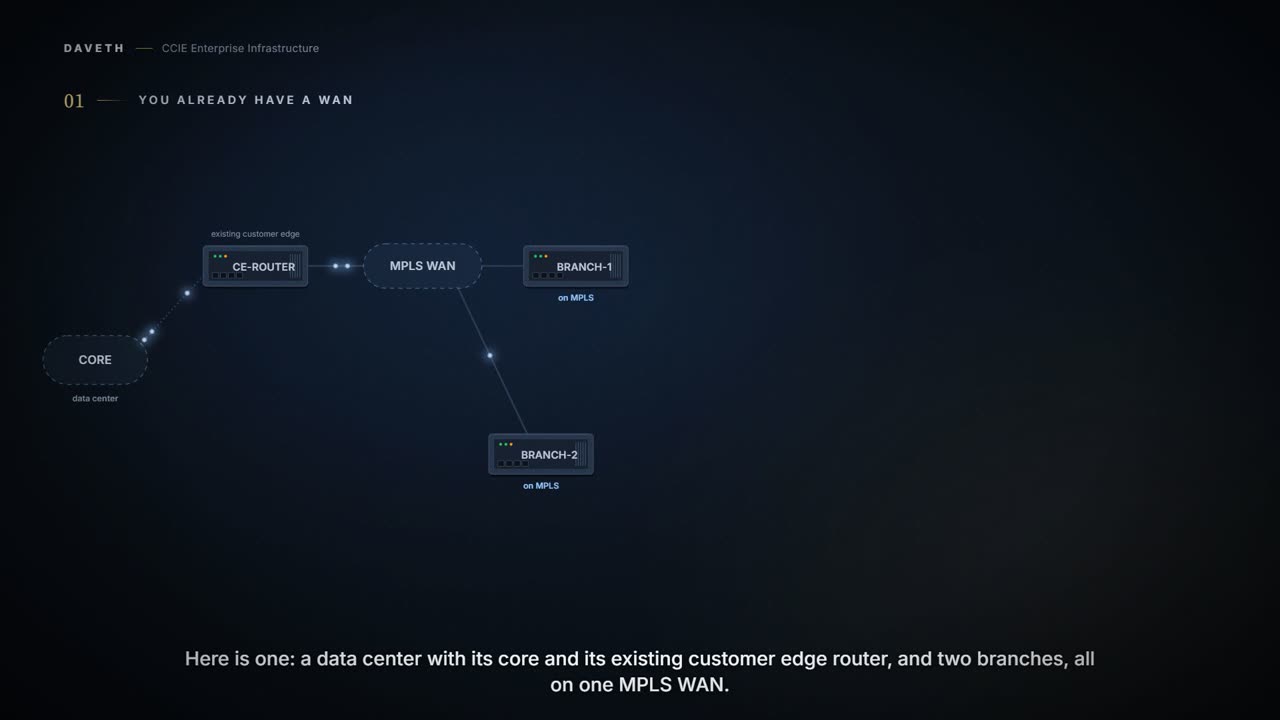
You already have a WAN
Almost nobody deploying SD-WAN starts from nothing. There is a WAN carrying live traffic for a business that will not pause while you rebuild it. What does that change about how you start?
Three situations
| Where you start | |
|---|---|
| Greenfield | A new build: new routers onboarded, no existing WAN to carry along. |
| Brownfield | An existing WAN, with live traffic, to be migrated. |
| Hybrid | Both at once: some sites on SD-WAN, some not, and traffic between them. |
This course's wording defines the three terms by their standard meanings; the published usage of the first two is quoted below.
The blueprint lists the three by name. Does Cisco mean the same by them? Its SD-Routing guide, for a related product, uses the first two the same way:
This section describes the onboarding of SD-routing enabled devices for both Greenfield and brownfield deployments. For onboarding a new router, you can connect through PnP or bootstrap workflow.
Its brownfield section, the other way round, migrates an existing DMVPN hub or spoke router rather than onboarding a new one.
A word you will meet elsewhere: the SD-WAN Design Guide also uses "hybrid", about colocation, which is a different sense from the blueprint's:
Cloud onRamp for Colocation allows for a hybrid approach to the problem by utilizing co-locations in strategic points of the network to consolidate network and security stacks and minimize latency.
On this page, hybrid means both networks running at once.
Greenfield is building the new kitchen. Brownfield is building it while somebody is still making lunch in there. The plans can be identical. The constraint is not, and the constraint is what the work will actually feel like.
Which is why hybrid is the word that matters most here. Nobody is paid to admire the finished drawing. They are paid for the year in the middle, when half the branches are on one WAN and half are on the other and both have to work.
Where a brownfield migration starts
Your first SD-WAN router, in a network that already works: which site gets it, and does it replace anything? Step 1 of the walk asks it.
SD-WAN Edge deployment should start in the data center. When deploying, it is important to not impact normal traffic flow to and from the data center for non-SD-WAN sites, so it is not common for CE routers to be immediately replaced by SD-WAN routers at the start of an SD-WAN deployment. It is recommended to not put WAN Edge routers inline at the data center site. You don’t want to interrupt traffic when deploying or make the WAN Edge routers the bottleneck for all traffic SD-WAN and non-SD-WAN traffic. Use WAN Edge for SD-WAN traffic, non-SD-WAN traffic can come into the CE and route to the core.
Start in the data center, beside the CE, not in line with it. Existing traffic keeps its path; the new router carries only SD-WAN traffic. And the existing WAN is not thrown away:
It is recommended that the VPN 0 interfaces connect into CE routers for MPLS and firewalls for Internet if possible. It is preferred to use BGP (eBGP preferred over iBGP) in the LAN if it already exists, otherwise the SD-WAN router can integrate with OSPF or EIGRP (in the case of IOS XE SD-WAN routers) if it is already present on the LAN side.
The MPLS circuit stays; the WAN Edge reaches it through the CE. What runs over it is what changes.
Continue the lesson
The whole lesson, with its drawings and its questions. 5 more sections after the ones above.