
AS path propagation
Two unrelated features share one blueprint bullet: BGP AS path propagation and SD-Access integration. When BGP routes cross the SD-WAN overlay through OMP, their AS path can be lost, and with it BGP's loop protection. propagate-aspath, under the BGP address family, carries the AS path information into OMP and back out. Configure it on some edges and not others, and the gap shows.
By Arif, founder of Daveth · Updated
The full 10 min walkthrough is in Daveth Pro (Network). See what the plan opens
What this page answers
What does propagate-aspath do in SD-WAN?
It carries BGP AS path information into OMP, so routes crossing the overlay keep their AS path and BGP can still detect loops. It is configured under the BGP address family, not on a redistribute statement. Read it in “Turning it on”
Why do routes across SD-WAN lose their BGP AS path?
BGP and OMP routes do not cross over on their own, and without propagate-aspath an edge that redistributes OMP into BGP advertises the routes without the AS path they arrived with. Read it in “The gap when it's partial”
Two features, one bullet
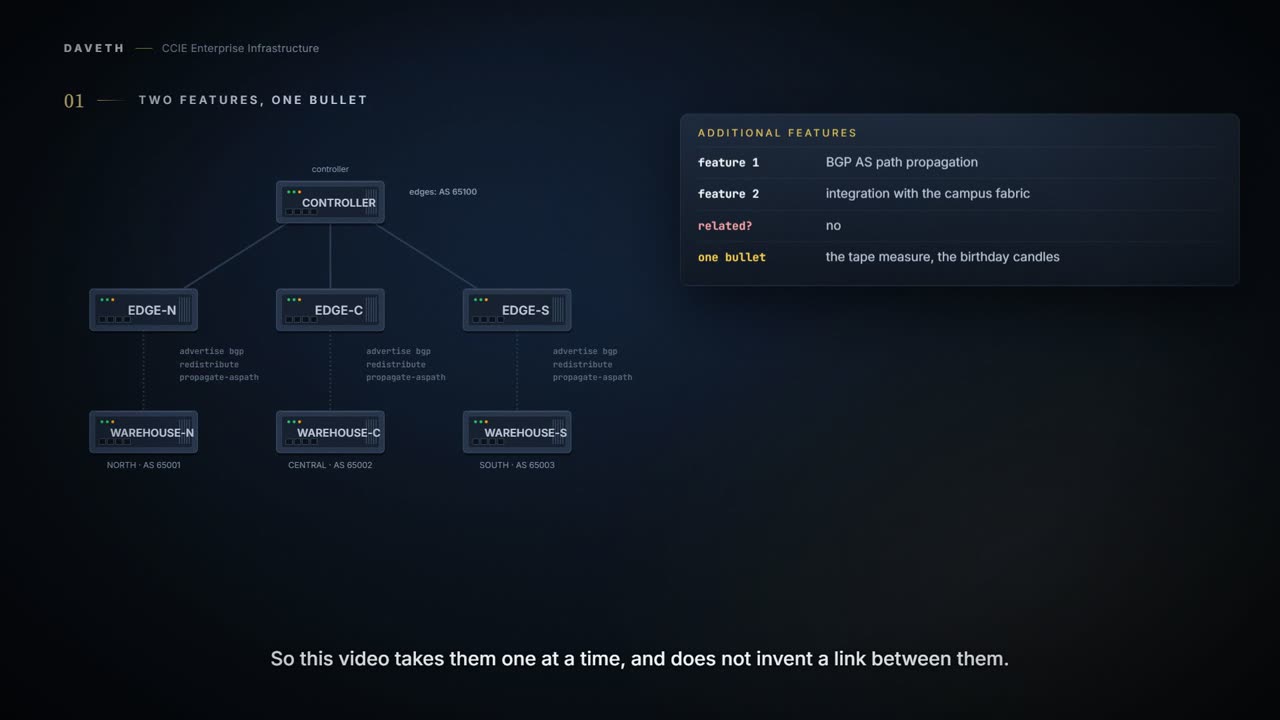
The blueprint lists two things under "additional features": BGP AS path propagation, and SD-Access integration. They aren't related. One is about stopping BGP loops through the SD-WAN overlay; the other is about where two of these architectures meet.
The blueprint files them under one bullet, the way a kitchen drawer keeps the tape measure next to the birthday candles. So this page takes them one at a time, and doesn't invent a link between them.
First, a food distributor with three warehouses: NORTH, CENTRAL and SOUTH. Each warehouse has its own router running BGP with the SD-WAN edge beside it. The team is turning AS path propagation on one site at a time. What could go wrong with a careful, phased rollout?
Why an overlay cares about AS paths
Plain words first. An AS path is the list of autonomous system numbers a BGP route has passed through. OMP is the routing protocol SD-WAN devices use between themselves. The overlay is the SD-WAN network of tunnels between sites, and the service side is the site's own network behind each edge.
One reminder from the redistribution lesson (2.2.c.iv): BGP routes and OMP routes don't cross over on their own.
By default, Cisco IOS XE Catalyst SD-WAN devices advertise to OMP both the connected routes on the device and the static routes that are configured on the device, but it does not advertise BGP external routes learned by the device. By default, OMP routes are not redistributed into BGP.
So why would OMP carry a BGP attribute at all?
Propagating BGP AS path information helps to prevent BGP routing loops by allowing routers to identify and avoid routes that contain their own AS number in the path. It also provides greater visibility into the routing path.
Read the order: loop prevention first, visibility second. A router can only spot its own AS number in a path if that number is still in the path.
Turning it on
Where does the setting live? Not on a redistribute statement. The Configure OMP page prints it as a line of its own, under the BGP address family:
From elsewhere: the propagation example. The names, numbers and addresses come from elsewhere, not from this scenario.
config-transaction
 router bgp 200
 address-family ipv4 vrf 11
  neighbor 10.20.1.0 remote-as 200
  propagate-aspath
  exit
The Configure BGP page's Propagate AS Path field says what it does in one line:
Enable this option to carry BGP AS path information into OMP.
When you configure BGP to propagate AS path information, the device sends AS path information to devices that are behind the Cisco IOS XE Catalyst SD-WAN devices (in the service-side network) that are running BGP, and it receives AS path information from these routers. If you’re redistributing BGP routes into OMP, the AS path information is included in the advertised BGP routes.
Configuration: EDGE-N, advertising BGP into OMP and propagating the AS path, one transaction per protocol, typed at the prompts these commands use.
EDGE-N# config-transaction
EDGE-N(config)# sdwan
EDGE-N(config-sdwan)# omp
EDGE-N(config-omp)# address-family ipv4
EDGE-N(config-ipv4)# address-family ipv4 vrf 10
EDGE-N(config-vrf-10)# advertise bgp
EDGE-N(config-vrf-10)# commit
EDGE-N# config-transaction
EDGE-N(config)# router bgp 65100
EDGE-N(config-router)# address-family ipv4 vrf 10
EDGE-N(config-router-af)# neighbor 10.255.1.2 remote-as 65001
EDGE-N(config-router-af)# propagate-aspath
EDGE-N(config-router-af)# redistribute omp
EDGE-N(config-router-af)# commit
Look at EDGE-N's three statements: advertise bgp puts WH-N's routes into OMP, propagate-aspath keeps their AS path, and redistribute omp hands routes from the other sites to WH-N.
SOUTH is the pilot. EDGE-S already holds NORTH's route in OMP. What it hands to WH-S depends on its own configuration.
Computed from the state: the OMP routes EDGE-S holds from the other sites. No command prints it in this form.
prefix        from      AS path in OMP
10.1.0.0/16   NORTH     65001
Configuration: EDGE-S at the pilot site, typed at the prompts these commands use.
EDGE-S# config-transaction
EDGE-S(config)# router bgp 65100
EDGE-S(config-router)# address-family ipv4 vrf 10
EDGE-S(config-router-af)# neighbor 10.255.3.2 remote-as 65003
EDGE-S(config-router-af)# propagate-aspath
EDGE-S(config-router-af)# redistribute omp
EDGE-S(config-router-af)# commit
So what does WH-S get for 10.1.0.0/16, and can it still see where the route started?
Computed from the state: what WH-S has from EDGE-S. No command prints it in this form.
prefix        AS path      origin AS in the path
10.1.0.0/16   65100 65001  yes, 65001
Notice WH-S's path: 65100 65001. 65001 is NORTH's warehouse. By this course's reading, the 65100 in front is ordinary eBGP: EDGE-S adds its own AS when it advertises to WH-S, which no SD-WAN page needs to say.
The gap when it's partial
CENTRAL can't wait for its turn in the rollout. Its warehouse needs NORTH's routes today, so EDGE-C gets redistribute omp and nothing else.
Configuration: EDGE-C before its turn, with no propagate-aspath line, typed at the prompts these commands use.
EDGE-C# config-transaction
EDGE-C(config)# router bgp 65100
EDGE-C(config-router)# address-family ipv4 vrf 10
EDGE-C(config-router-af)# neighbor 10.255.2.2 remote-as 65002
EDGE-C(config-router-af)# redistribute omp
EDGE-C(config-router-af)# commit
Computed from the state: the OMP routes EDGE-C holds from the other sites. No command prints it in this form.
prefix        from      AS path in OMP
10.1.0.0/16   NORTH     65001
EDGE-C holds 10.1.0.0/16 with 65001 in OMP. Before you read on, decide what WH-C gets.
If you configure BGP AS path propagation on some but not all devices in the overlay network, the devices on which it’s not configured receive the AS path information but they don’t forward it to the BGP routers in their local service-side network.
Computed from the state: what WH-C has from EDGE-C. No command prints it in this form.
prefix        AS path      origin AS in the path
10.1.0.0/16   65100        no, 65001 is missing
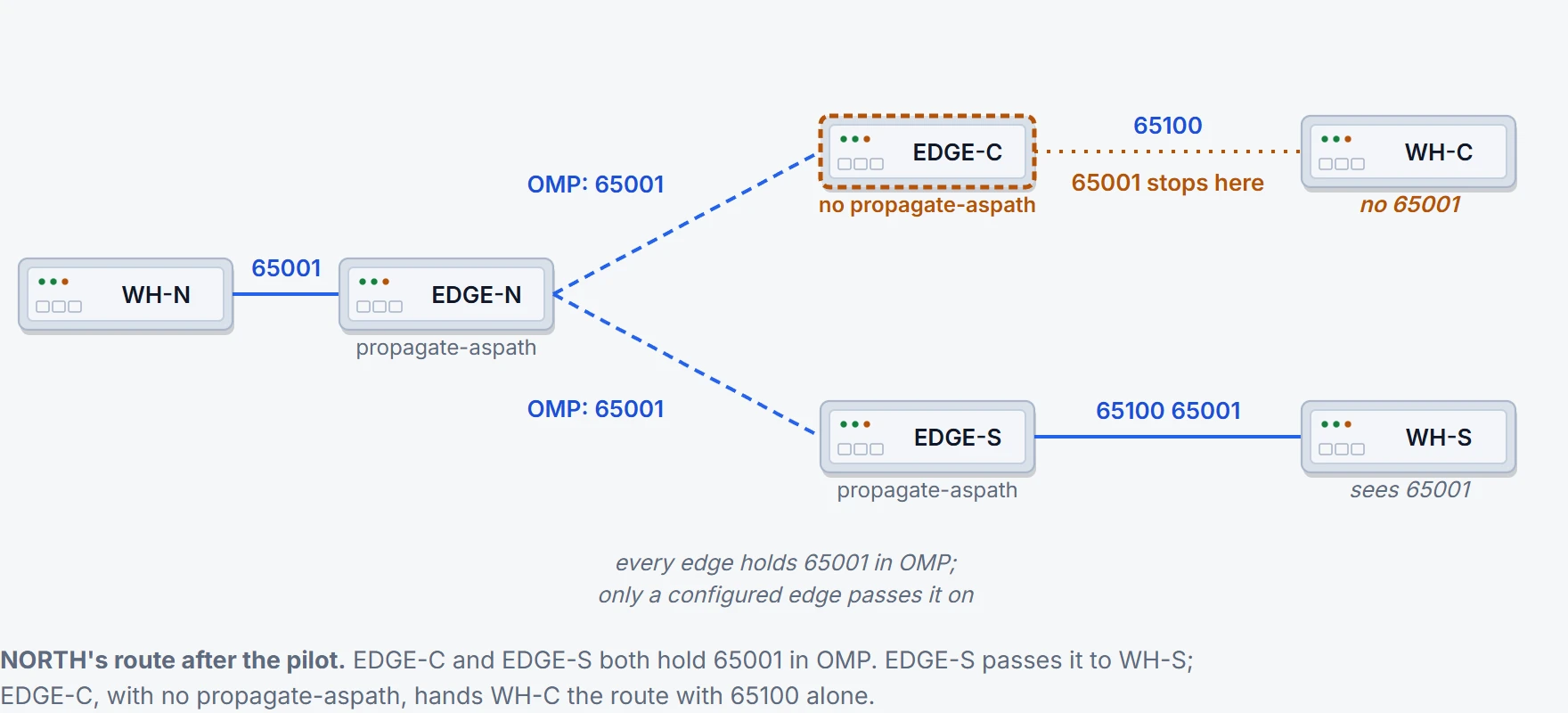
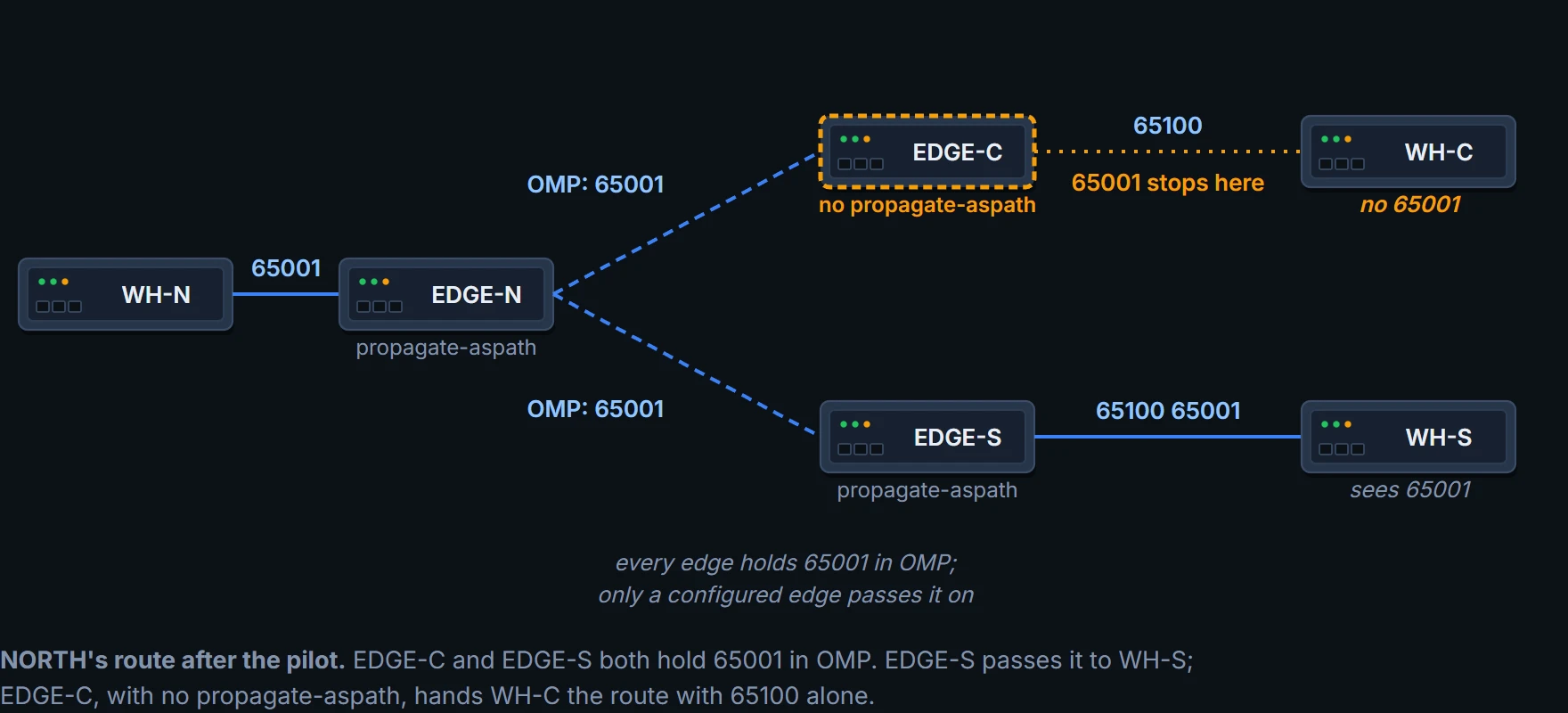
Look at where 65001 stops: on the last hop, between EDGE-C and WH-C. The overlay carried it all the way.
So the route arrived and its history did not. Everything the overlay was asked to carry, it carried; the loss happens at the final handover, on the one hop where the edge hands the prefix to a router that will make decisions with it. The route is intact. What is missing is the record of where it has been.
By this course's reading, that is loop protection lost at CENTRAL. Anything reaching WH-C through EDGE-C carries 65100 and nothing from beyond it, so WH-C can't spot its own AS, 65002, in a route that comes back through the overlay for as long as EDGE-C stays this way.
And a shortened path does not look damaged. It looks better. A route carrying fewer AS numbers reads as nearer, so the missing history can quietly win a comparison it should have lost, and there is nothing in the entry to suggest anything was left out.
So the tempting plan, configuring it on the important sites first, isn't enough. A partial deployment silently breaks the path at every unconfigured edge, and the site that breaks is whichever one the rollout hasn't reached yet.
Which is why the rule is simpler than the mechanism: Everywhere, or nowhere.
Continue the lesson
The whole lesson, with its drawings and its questions. 5 more sections after the ones above.