
Control policies
By default no centralized control policy is provisioned, so every site learns every other site directly. Centralized policy is provisioned on vSmart; control policy is the half that shapes overlay routing by changing what vSmart stores and advertises. Inbound it filters routes before they enter vSmart's table; outbound, before vSmart sends them on. One outbound policy applied to the spokes builds a hub-and-spoke overlay.
By Arif, founder of Daveth · Updated
The full 5 min walkthrough is in Daveth Pro (Network). See what the plan opens
What this page answers
What is the difference between inbound and outbound SD-WAN control policy?
Inbound filters or modifies routes advertised by an edge before they are placed in vSmart's route table. Outbound filters or modifies the routes vSmart redistributes to the edges. Read it in “What control policy acts on”
How do you build an SD-WAN hub-and-spoke topology?
With a centralized control policy on vSmart applied outbound to the spokes' site list, so the spokes learn each other's routes via the hub. Nothing is configured on the edges. Read it in “Applied outbound, to the spokes”
What is the difference between centralized and localized policy in SD-WAN?
Centralized policy is provisioned on vSmart controllers. Localized policy is provisioned on the edge device itself, through the CLI or a vManage device template. Read it in “Centralized, and localized”
The overlay nobody has shaped
2.2.a.iii said the controller changes what the edges know, and did not show it. This page shows it, in configuration and on the edges' own OMP tables.
By default, no centralized control policy is provisioned on the Cisco vSmart Controller.
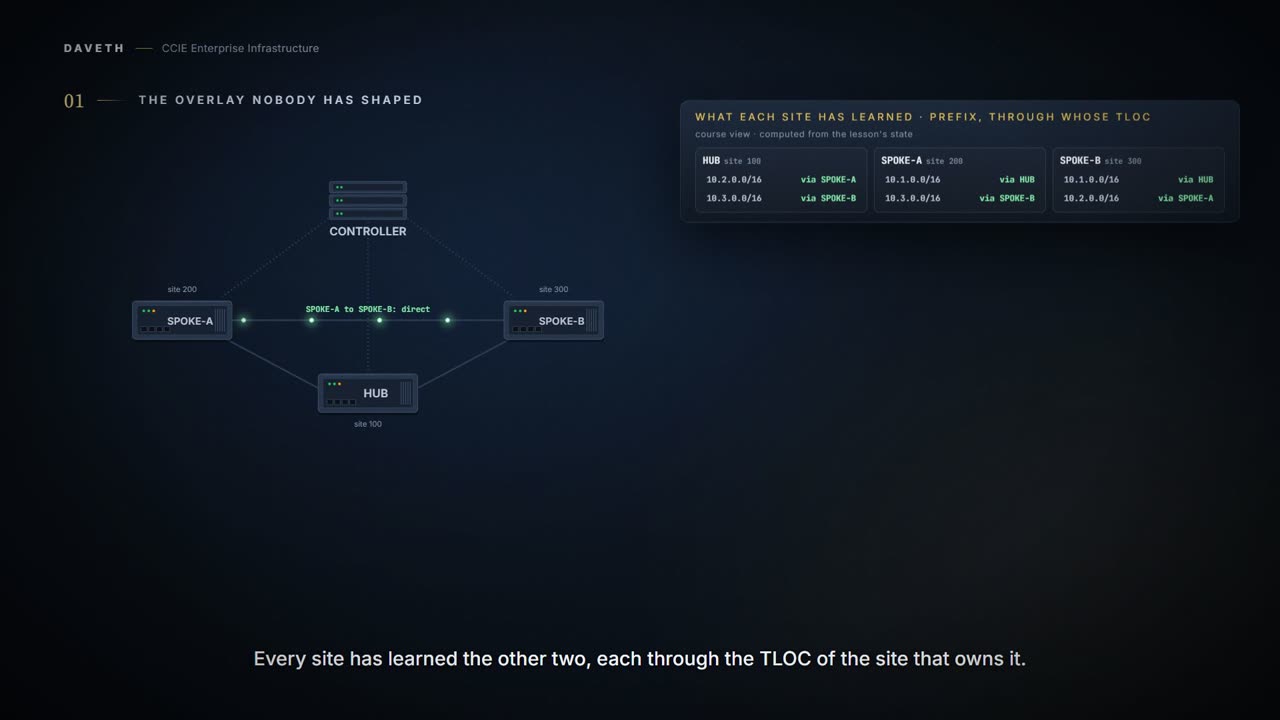
Three sites, each originating one prefix. Every site has learned both of the others, through the TLOC of the site that owns each prefix.
This course's reading: what each site was told about each other site
site      HUB         SPOKE-A     SPOKE-B
HUB       –           via SPOKE-A via SPOKE-B
SPOKE-A   via HUB     –           via SPOKE-B
SPOKE-B   via HUB     via SPOKE-A:

each row is what that site was told about the site in each column
What does SPOKE-A itself say it was told?
This course's output on SPOKE-A, computed from the walk in the layout the command reference's sample prints.
SPOKE-A# show sdwan omp routes
Code:
C -> chosen
I -> installed
Red -> redistributed
Rej -> rejected
L -> looped
R -> resolved
S -> stale
Ext -> extranet
Inv -> invalid
Stg -> staged
U -> TLOC unresolved
                                            PATH                      ATTRIBUTE
VPN    PREFIX              FROM PEER        ID     LABEL    STATUS    TYPE       TLOC IP          COLOR            ENCAP  PREFERENCE
--------------------------------------------------------------------------------------------------------------------------------------
1      10.1.0.0/16         10.0.0.10        1      1003     C,I,R     installed  10.0.0.1         mpls             ipsec  -
1      10.3.0.0/16         10.0.0.10        2      1003     C,I,R     installed  10.0.0.3         mpls             ipsec  -
! Proves what this device was told for each prefix, and the TLOC it resolves through (the TLOC IP column, to the right if the output scrolls). Does not prove why: the policy that decided it is on the controller, and is never pushed to local devices.
Read the TLOC IP column. SPOKE-B's prefix, 10.3.0.0/16, resolves through 10.0.0.3, which is SPOKE-B itself. Nothing in that table is a decision anybody made. Every change after this one is made without touching an edge device.
The layout is the second sample for show sdwan omp routes in the IOS XE Catalyst SD-WAN Qualified Command Reference. The first sample adds tenant, affinity group and region columns, which that page's command history adds from releases 17.7.1a and 17.8.1a, so a device on those releases may print more columns than are drawn here. The path IDs and labels are this page's own.
Centralized, and localized
Policy divides by where it is provisioned.
Centralized policy refers to policy provisioned on Cisco vSmart Controllers, which are the centralized controllers in the Cisco SD-WAN overlay network. Localized policy refers to a policy that is provisioned locally through the CLI on the Cisco IOS XE SD-WAN devices, or through a Cisco vManage device template.
Centralized policy has two halves: control policy, which affects overlay network-wide routing, and data policy, which affects data traffic through the VPN segments. This page is centralized control policy. Data policy is the next topic, and its direction is read from the other end, which is the one thing said about it here.
What control policy acts on
Centralized control policy applies to the network-wide routing of traffic by affecting the information that is stored in the Cisco vSmart Controller's route table and that is advertised to the Cisco IOS XE SD-WAN devices.
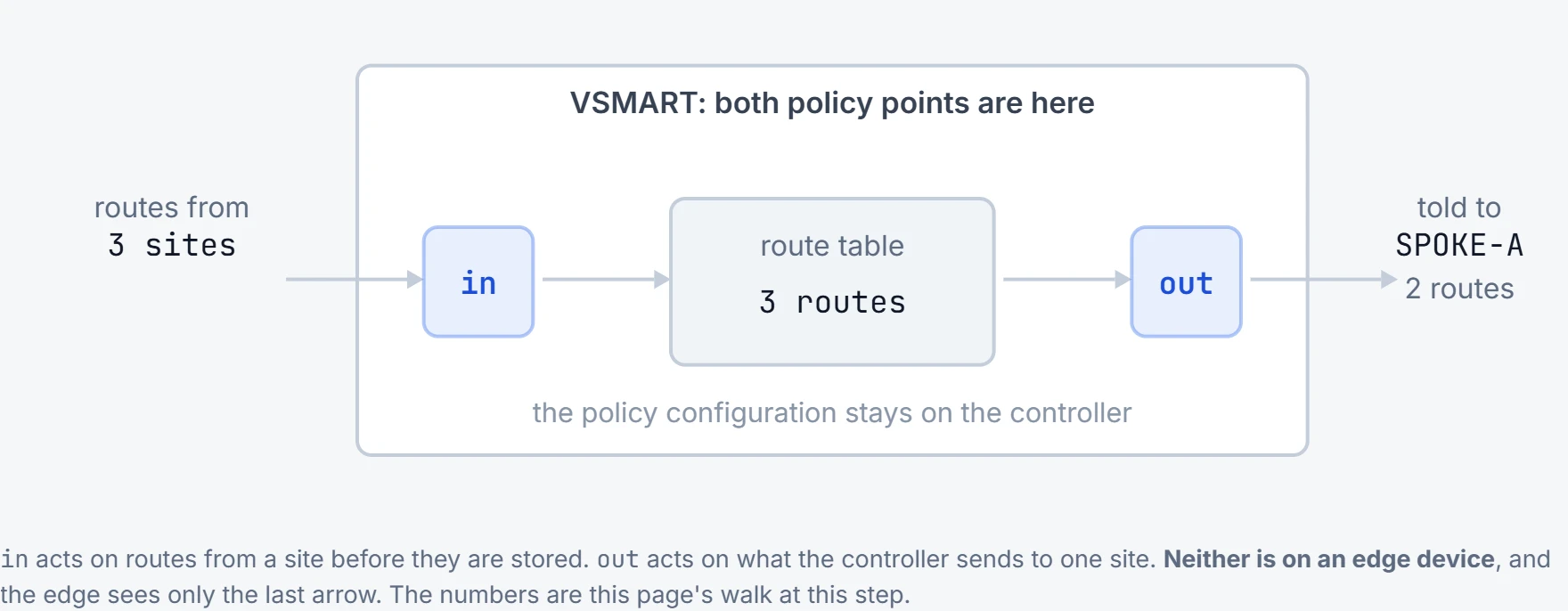
Applying a centralized control policy in the inbound direction filters or modifies the routes being advertised by the Cisco IOS XE SD-WAN device before they are placed in the route table on the Cisco vSmart Controller. Applying a control policy in outbound direction filters or modifies the routes that the Cisco vSmart Controller redistributes to the Cisco IOS XE SD-WAN devices.
Two positions, both on the controller. And both can filter or modify, which is the part people miss: an accepted route can leave with a different TLOC from the one it arrived with.
Centralized control policy, which you configure on Cisco vSmart Controllers, affects routing policy based on information in OMP routes and OMP TLOCs.
The route says which prefix; the TLOC says through whom. Changing the second without the first is how a spoke is pointed at a hub: the spoke still learns the prefix, and learns it through somebody else.
Can the controller show what it is sending, and to whom? Yes, and the two references name it differently:
To display information about OMP routes on Cisco Catalyst SD-WAN Controllers and Cisco vEdge devices only, use the show omp routes command. The difference in these three types of routes can be viewed by using the various show sdwan omp operational commands when you are logged in to the CLI on a Cisco vSmart Controller or a Cisco IOS XE SD-WAN device.
The controller's command reference gives show omp routes, with received and advertised keywords added in SD-WAN Release 20.7.1; the IOS XE Policy Overview names the show sdwan omp form for a controller too. This page uses the command reference's form and its sample layout:
This course's output on VSMART, computed from the walk in the layout the command reference's sample prints.
VSMART# show omp routes vpn 1 advertised
Code:
C   -> chosen
I   -> installed
Red -> redistributed
Rej -> rejected
L   -> looped
R   -> resolved
S   -> stale
Ext -> extranet
Inv -> invalid
Stg -> staged
IA  -> On-demand inactive
U   -> TLOC unresolved

VPN    PREFIX              TO PEER
--------------------------------------------
1      10.1.0.0/16         10.0.0.2
                           10.0.0.3
1      10.2.0.0/16         10.0.0.1
                           10.0.0.3
1      10.3.0.0/16         10.0.0.1
                           10.0.0.2
! Proves which peers each prefix is being advertised to. Does not prove the TLOC it is advertised with, which this layout does not print, or what a peer put in its table.
Each prefix goes to the two sites that did not originate it. That a site is not advertised its own prefix back is this course's reading, and the model follows it. Notice what the layout leaves out: there is no TLOC column, so this output can show a route not being sent and cannot show a route being sent with a different TLOC. That half is read on the edge.
Lists, a definition, and an application
Three building blocks. Lists group the things a policy matches or applies to: prefixes, TLOCs, VPNs and sites. The definition is numbered match-action sequences with a default-action. apply-policy binds the definition to a site list, and for a control policy, with a direction.
How does it decide, route by route?
Within each policy, the pairings are processed in sequential order, starting with the lowest number and incrementing. As soon as a match occurs, the matched entity is subject to the configured action of the sequence and is then no longer subject to continued processing. Any entity not matched in a sequence is subject to the default action for the policy. By default, this action is reject.
First match wins, and the default is reject. A route that no sequence matches is not ignored. It is rejected, unless the definition says default-action accept.
The Centralized Policy chapter's own example points one site at a hub by changing the TLOC of another site's prefix, applied outbound:
Not from this scenario: the Centralized Policy chapter, IOS XE 17.x
policy
  lists
    prefix-list east-prefixes
      ip-prefix 209.165.201.0/27
    site-list west-sites
      site-id 1
  control-policy change-tloc
    sequence 10
      match route
        prefix-list east-prefixes
        site-id 2
      action accept
        set tloc 209.165.200.225 color gold encap ipsec
apply-policy
  site west-sites control-policy change-tloc out
This page's policy does the same job for two spokes. SPOKES lists sites 200 and 300, and HUB-PREFIX holds HUB's prefix. Sequence 10 accepts the hub's prefix unchanged; sequence 20 accepts a route from a spoke site and sets its TLOC to HUB's.
This course's reading: the controller's policy configuration, before it is applied
policy
  lists
    site-list SPOKES
      site-id 200
      site-id 300
    prefix-list HUB-PREFIX
      ip-prefix 10.1.0.0/16
  control-policy HUB-AND-SPOKE
    sequence 10
      match route
        prefix-list HUB-PREFIX
      action accept
    sequence 20
      match route
        site-list SPOKES
      action accept
        set tloc 10.0.0.1 color mpls encap ipsec
    default-action reject
Nothing has changed. Every site still learns every other site directly, because a definition with no apply-policy is applied to no site. The block above is this course's rendering in the chapter example's layout, with apply-policy in the site-list form the Policy Overview and the CLI steps use; the example writes it on one line with site.
And the rest of what a sequence can match or set? The Centralized Policy chapter tables it. Two matches and one set are used here because this policy needs them, and a partial list learned as a complete one is how people write a policy that matches nothing.
Applied outbound, to the spokes
One apply-policy block, naming SPOKES and the direction out. Nothing is configured on SPOKE-A, SPOKE-B or HUB.
This course's reading: the controller's policy configuration, applied
apply-policy
  site-list SPOKES
    control-policy HUB-AND-SPOKE out
This course's reading: what each site was told about each other site
site      HUB         SPOKE-A     SPOKE-B
HUB       –           via SPOKE-A via SPOKE-B
SPOKE-A   via HUB     –           via HUB
SPOKE-B   via HUB     via HUB     –

each row is what that site was told about the site in each column
And the overlay is hub-and-spoke. SPOKE-A still holds SPOKE-B's prefix, through HUB's TLOC rather than SPOKE-B's. Nothing was blocked. The spokes were told a different thing.
What does SPOKE-A say now?
This course's output on SPOKE-A, computed from the walk in the layout the command reference's sample prints.
SPOKE-A# show sdwan omp routes
Code:
C -> chosen
I -> installed
Red -> redistributed
Rej -> rejected
L -> looped
R -> resolved
S -> stale
Ext -> extranet
Inv -> invalid
Stg -> staged
U -> TLOC unresolved
                                            PATH                      ATTRIBUTE
VPN    PREFIX              FROM PEER        ID     LABEL    STATUS    TYPE       TLOC IP          COLOR            ENCAP  PREFERENCE
--------------------------------------------------------------------------------------------------------------------------------------
1      10.1.0.0/16         10.0.0.10        1      1003     C,I,R     installed  10.0.0.1         mpls             ipsec  -
1      10.3.0.0/16         10.0.0.10        2      1003     C,I,R     installed  10.0.0.1         mpls             ipsec  -
! Proves what this device was told for each prefix, and the TLOC it resolves through (the TLOC IP column, to the right if the output scrolls). Does not prove why: the policy that decided it is on the controller, and is never pushed to local devices.
Two routes, and 10.3.0.0/16 now resolves through 10.0.0.1, HUB's TLOC. Every other column is what it was.
A control policy applied in the outbound direction influences only the route tables on the individual devices included in the site-list.
Which decisions did the policy take to get there?
This course's reading: every decision the policy took
dir  for site  route from  matched      action
out  SPOKE-A   HUB         sequence 10  accept
out  SPOKE-A   SPOKE-B     sequence 20  accept, set tloc 10.0.0.1
out  SPOKE-B   HUB         sequence 10  accept
out  SPOKE-B   SPOKE-A     sequence 20  accept, set tloc 10.0.0.1
Continue the lesson
The whole lesson, with its drawings and its questions. 7 more sections after the ones above.