
Route policies
An edge talks BGP to the site's own network and OMP to the controller, and a route policy works on the site-local side. A route policy with one accepting sequence rejects every route that matches nothing, because the default action is reject. It attaches in the router's BGP settings: to routes received from a neighbour, routes sent to it, or routes redistributed into BGP.
By Arif, founder of Daveth · Updated
The full 7 min walkthrough is in Daveth Pro (Network). See what the plan opens
What this page answers
What is the default action of an SD-WAN route policy?
Reject. A route that matches no sequence is rejected, so a policy written only to tag one network can drop every other route from that neighbour. Read it in “A tag for the tills”
Where is an SD-WAN route policy applied?
In the router's BGP settings: on prefixes received from a neighbour, prefixes sent to a neighbour, or routes redistributed into BGP. OMP routes are not redistributed into BGP by default. Read it in “Where a route policy attaches”
Three names, two features
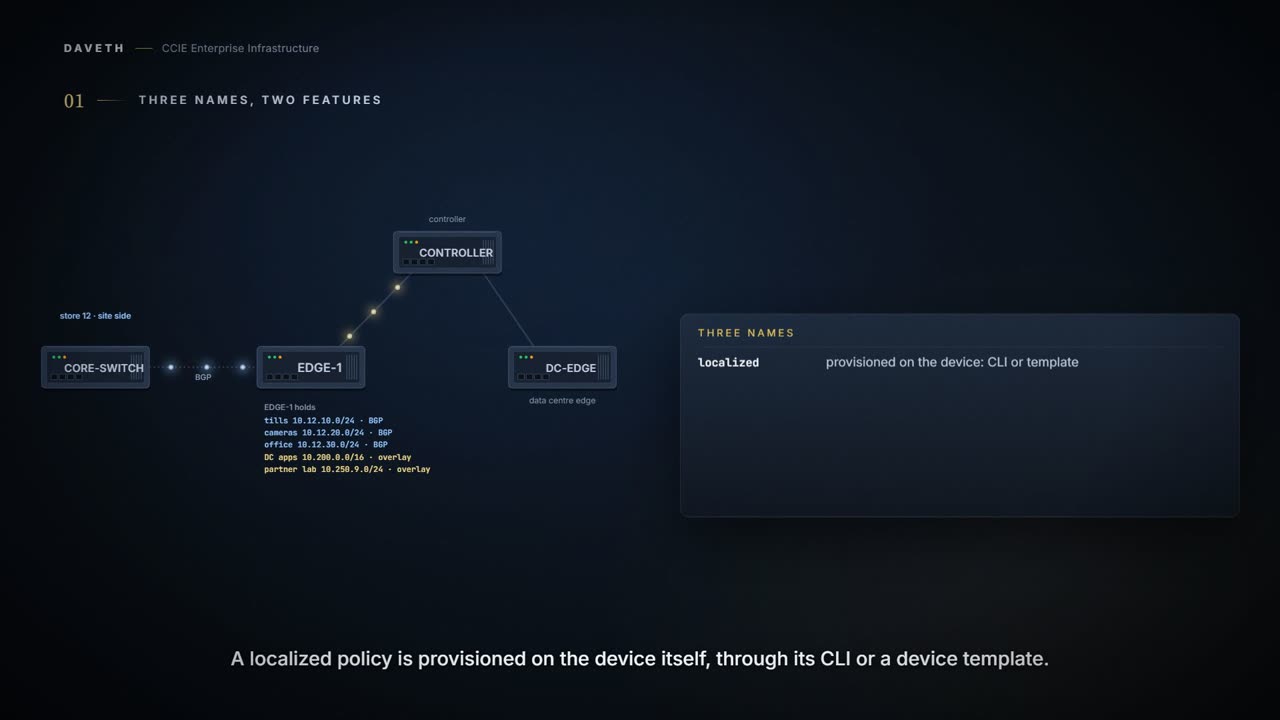
Supermarket store 12 has one SD-WAN router, EDGE-1. On one side it talks BGP to the store's core switch, CORE-SW, which knows the tills, cameras and office networks. On the other side it talks OMP to CTRL-1, the SD-WAN Controller, which tells it about the data centre's applications. The network team wants to change some routing. Which policy do they reach for?
Plain words first. The overlay is the SD-WAN network between sites, which the controller runs. The site-local network is the store's own network behind the router. OMP is the protocol the router uses to swap routes with the controller.
Localized policy refers to a policy that is provisioned locally through the CLI on the Cisco IOS XE Catalyst SD-WAN devices, or through a Cisco SD-WAN Manager device template. Localized control policy is policy that is configured on a Cisco IOS XE Catalyst SD-WAN device (hence, it is local) and affects BGP and OSPF routing decisions on the site-local network that the device is part of. This type of control policy is called route policy.
Watch the end of the first quote: the CLI on the device, or a device template. Either way, the policy lands on the router itself.
Read those three together: localized control policy and route policy are one feature, configured on the device itself, working on BGP and OSPF on the site side of EDGE-1. Centralized control policy is a different feature with nearly the same name.
Three names, two features. If that sounds like a naming scheme designed to start arguments in change-review meetings, the rest of this page is how to settle them.
In addition to participating in the overlay network, a Cisco IOS XE Catalyst SD-WAN device participates in the network at its local site, where it appears to the other network devices to be simply a regular router.
Notice the words simply a regular router: to CORE-SW, EDGE-1 is just another BGP neighbor. That is the side route policy works on.
Control policy operates on the control plane traffic in the Cisco IOS XE Catalyst SD-WAN overlay network, influencing the determination of routing paths through the overlay network.
Careful with that sentence from the same chapter. It describes control policy in general, and the chapter narrows route policy to the local branch a few sentences later.
A tag for the tills
The team wants the tills network tagged, so a later policy can pick the tills out by number. By this course's reading, that is an ordinary reason to tag a route. They build STORE-IN with one sequence and attach it to routes received from CORE-SW.
Computed from the state: route policy STORE-IN, on routes received from CORE-SW. No command prints it in this form.
STORE-IN, on routes received from CORE-SW
seq     match         action  set
1       tills         accept  omp-tag 12
default (no match)    reject
When a route matches the conditions in the match portion of a route policy, the route can be accepted or rejected Each sequence in a localized control policy can contain one action condition. Specifies the name of a Prefix-List list. If no packets match any of the route policy sequence rules, the default action is to drop the packets.
Computed from the state: what STORE-IN decides for each store route. No command prints it in this form.
route    prefix         decided by      result
tills    10.12.10.0/24  sequence 1      accept, omp-tag 12
cameras  10.12.20.0/24  default action  reject
office   10.12.30.0/24  default action  reject
Read the result column: the tills are accepted with omp-tag 12, and the cameras and office are rejected by the default action. The policy was written only about the tills, and it removed two other networks.
Which is the trap worth naming, because nobody sets out to build it: the policy was meant to add one label, and it also decided who was allowed through. Writing a sequence about one set of routes does not leave the others alone. They fall to the default, and the default on this kind of policy is not the permissive one.
Computed from the state: EDGE-1's routes after STORE-IN. No command prints it in this form.
route       IPv4           IPv6                 from  tag
tills       10.12.10.0/24  2001:db8:12:10::/64  BGP   12
DC apps     10.200.0.0/16  2001:db8:200::/48    OMP   -
partner lab 10.250.9.0/24  2001:db8:250:9::/64  OMP   -
cameras     10.12.20.0/24  2001:db8:12:20::/64  -     not in the table
office      10.12.30.0/24  2001:db8:12:30::/64  -     not in the table
Look at the bottom rows: cameras and office, not in the table. Two of the store's own networks have gone from its router's table.
Change the default action to Accept.
Computed from the state: STORE-IN with the default changed. No command prints it in this form.
STORE-IN, on routes received from CORE-SW
seq     match         action  set
1       tills         accept  omp-tag 12
default (no match)    accept
Computed from the state: what STORE-IN decides now. No command prints it in this form.
route    prefix         decided by      result
tills    10.12.10.0/24  sequence 1      accept, omp-tag 12
cameras  10.12.20.0/24  default action  accept
office   10.12.30.0/24  default action  accept
Now all three are accepted, and only the tills carry tag 12.
Proves: A route policy proves which routes the policy accepts, rejects or tags, for the routes it is attached to. Does not prove: anything about routes that never pass through its attachment point. A route learned over OMP never passes a policy on routes received from a BGP neighbor.
Where a route policy attaches
Where exactly can STORE-IN be attached, and what does it look like on the device?
Specify the name of a route policy to apply to prefixes received from the neighbor. Specify the name of a route policy to apply to prefixes sent to the neighbor. Enter the name of the route policy to apply to redistributed routes.
Notice where all three live: in the router's BGP settings. Routes in from a neighbor, routes out to a neighbor, and routes redistributed into BGP.
By default, OMP routes are not redistributed into BGP.
Read that default closely: nothing learned over OMP reaches CORE-SW unless redistribution is turned on. This walk turns it on, so CORE-SW learns the data centre's routes from EDGE-1.
So what does the configuration look like? The BGP chapter prints one example:
From elsewhere: the chapter's BGP example. The names, numbers and addresses in it are Cisco's example's, not store 12's.
router bgp 100
 bgp log-neighbor-changes
 distance bgp 20 200 20
 !
 address-family ipv4 vrf 100
  bgp router-id 10.0.0.0
  redistribute omp
  neighbor 10.0.0.1 remote-as 200
  neighbor 10.0.0.1 activate
  neighbor 10.0.0.1 send-community both
  neighbor 10.0.0.1 route-map OMP_BGP-POLICY in
  neighbor 10.0.0.1 maximum-prefix 2147483647 100
route-map OMP_BGP-POLICY permit 1
 match ip address prefix-list OMP-BGP-TEST-PREFIX-LIST
 set omp-tag 10000
route-map OMP_BGP-POLICY permit 65535
ip prefix-list OMP-BGP-TEST-PREFIX-LIST seq 5 permit 10.0.0.0/8
This is an example of a BGP configuration on a Cisco IOS XE Catalyst SD-WAN device for releases prior to Cisco IOS XE Catalyst SD-WAN Release 17.14.1a.
Watch the neighbor line: a route-map applied in. Its first entry matches a prefix list and sets omp-tag 10000, and its last entry, permit 65535, is empty. By this course's reading, that empty last entry is what lets every other route through, the job the default action does in the route policy builder.
Sets the OMP tag for OSPF to use. Specifies the peer IP address. Match origin is available only for Cisco vEdge devices not on Cisco IOS XE Catalyst SD-WAN devices.
Those are three rows from the chapter's match and set lists. The set description of the OMP tag names OSPF, while the BGP example sets a tag on BGP routes. What a tag is used for afterwards isn't on these pages, so this course doesn't claim it.
Specifies the internet protocol. The options are IPv4, IPv6, or Both.
Each sequence can take IPv4, IPv6 or both, so the readings on this page carry both families.
Route policy is not supported in Cisco vManage Release 20.9.1.
Read where that note sits: under the BGP chapter's configuration-group steps, not under its feature-template steps. On a network running vManage 20.9.1, check which of the two you use before planning a route policy.
Continue the lesson
The whole lesson, with its drawings and its questions. 5 more sections after the ones above.