
vSmart and the control plane
User traffic in SD-WAN goes edge to edge and never through a controller, yet centralised policy on vSmart decides which sites reach which. vSmart, now SD-WAN Controller, runs OMP with every edge, installing their routes and advertising them to the others. Its policy engine acts on routes inbound and outbound, so it controls traffic by controlling what the edges know.
By Arif, founder of Daveth · Updated
The full 7 min walkthrough is in Daveth Pro (Network). See what the plan opens
What this page answers
What does vSmart do?
It establishes secure connections to all other components and runs OMP to exchange routing, security and policy information. It installs the OMP routes it learns from edges and advertises them to the other edges. Read it in “What vSmart is responsible for”
How does vSmart control traffic without forwarding it?
By controlling information: edges decide where to send packets from the routes vSmart gives them, and vSmart can apply policy to routes before installing or advertising them. Read it in “Control over information, not traffic”
What can SD-WAN centralized policy on vSmart do?
Its policy engine manipulates routing information, access control, segmentation, extranets and service chaining, applying inbound policy on received routes and outbound policy before advertising them. Read it in “Why centralised policy works at all”
A controller with no traffic
One line of recap, because the question rests on it: user traffic in SD-WAN goes edge to edge, and never through a controller. Cisco draws the line between the two planes like this:
The deployment of an SD-WAN service in the context of a managed service requires deployment per customer and includes the SD-WAN management control plane (vManage, vBond and vSmart), and the corresponding data plane (vEdge and cEdge).
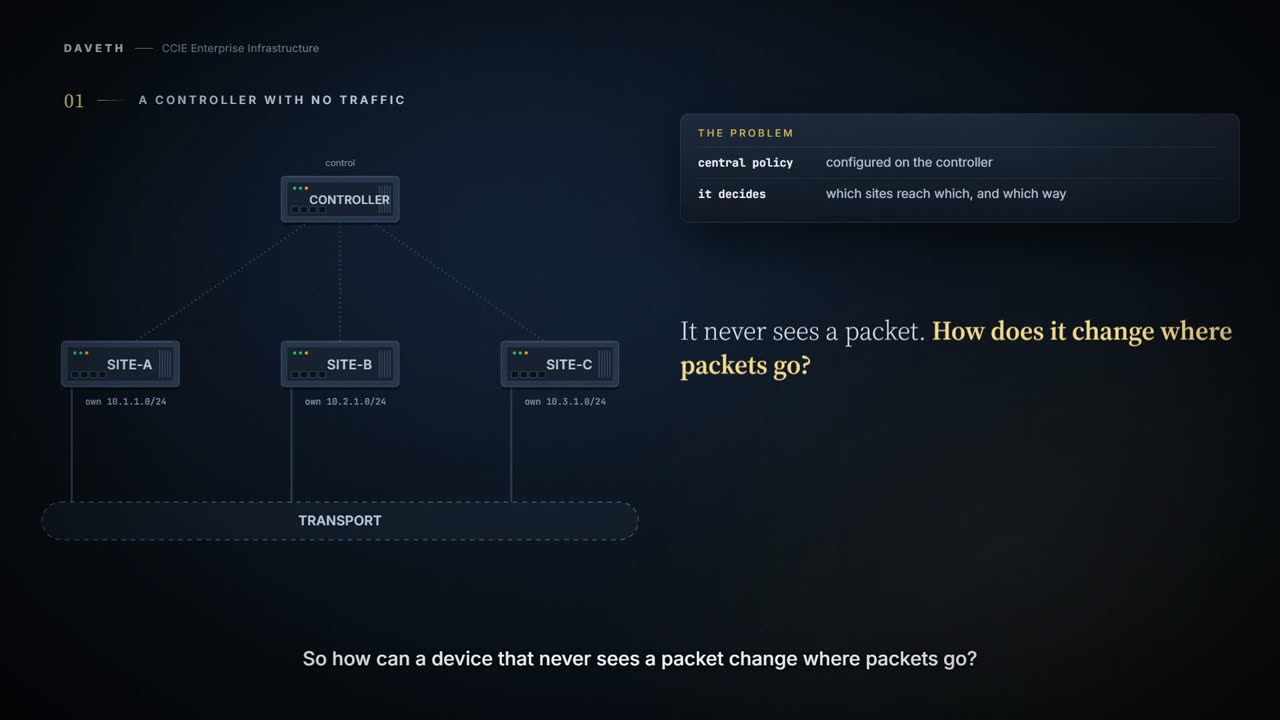
Now the problem. Centralised policy is configured on vSmart, and it decides which sites reach which and which way traffic goes. How can a device that never sees a packet change where packets go?
What vSmart is responsible for
The vSmart controllers establish the secure SSL connections to all other components in the network, and run an Overlay Management Protocol (OMP) to exchange routing, security, and policy information.
Three jobs: secure connections to every other component, running OMP, and exchanging routing, security and policy information over it. Read the third one again. That is the answer, and the rest of this page unpacks it.
Control over information, not traffic
An edge decides where to send a packet from what it knows: which prefixes exist, and behind which site. Where does it learn that? From vSmart:
Cisco SD-WAN Controller installs these OMP routes in its routing database and advertises them to the other Cisco vEdge routers in the Cisco Catalyst SD-WAN overlay network. Cisco SD-WAN Controller also updates the Cisco vEdge router with the OMP route information that it learns from other Cisco vEdge routers in the network.
So vSmart never has to touch traffic. It changes what the edges know, and the edges then forward differently on their own. The forwarding change is a consequence of an information change.
That is a different model from the one most engineers bring. A firewall sits in the path and inspects; an interface ACL drops as packets pass. vSmart is in no path at all, so every effect it has is indirect.
Why centralised policy works at all
Here is the policy engine, in the words. Notice the first thing on the list:
The centralized policy engine in vSmart provides policy constructs to manipulate routing information, access control, segmentation, extranets, and service chaining.
And here is where it acts:
Cisco SD-WAN Controller can apply inbound policy on received routes and prefixes before installing them into its routing table, and it can apply outbound policy before advertising routes from its routing table.
Before advertising. So when a control policy appears to "stop" traffic, what it has really done is edit what an edge is told. The edge is not blocked; it is uninformed. The details of those policies are their own lessons; the mechanism is this one.
The transfer question. SITE-A must stop reaching SITE-B. How does vSmart do it without touching a packet? Work it before reading on.
It does not advertise SITE-B's routes to SITE-A. SITE-A has no route to SITE-B's prefixes, so it never sends there. Notice the direction, too: SITE-B still has its routes to SITE-A unless the policy hides those as well. Step 2 of the walk shows exactly that.
The same mechanism explains a timing mistake. A policy committed on vSmart changes nothing on the wire at that moment; it changes traffic when the affected edges have received the new information:
The router uses these control connections to learn the location of Cisco Catalyst SD-WAN Controller from Cisco SD-WAN Validator, to receive its configuration from Cisco SD-WAN Manager, and to receive its policy and any policy updates from Cisco Catalyst SD-WAN Controller.
Continue the lesson
The whole lesson, with its drawings and its questions. 3 more sections after the ones above.