
Access lists
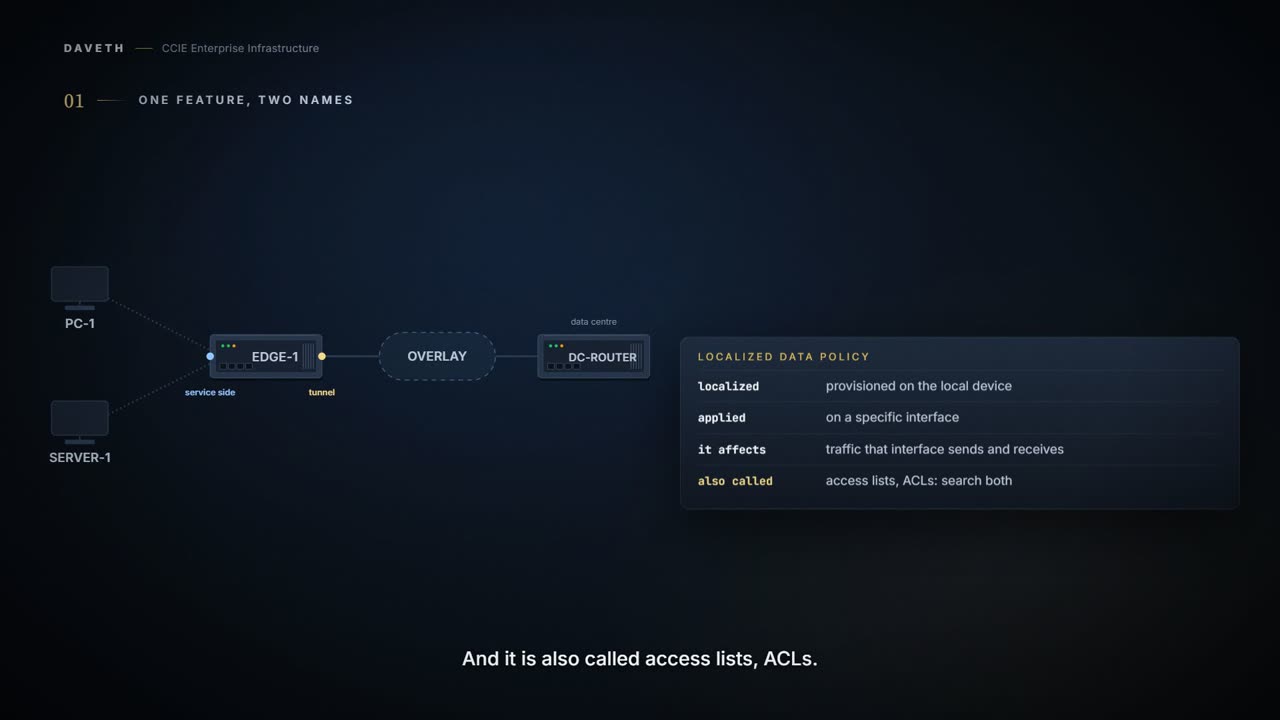
Localized data policy, also called access lists, is provisioned on the edge itself and applied to an interface. Each sequence has one match condition and one action: accept or drop, count, then classify or police accepted packets. Sequences are evaluated in order, lowest number first, and the first match ends it, so a broad low-numbered sequence hides everything after it. Then comes the default action.
By Arif, founder of Daveth · Updated
The full 8 min walkthrough is in Daveth Pro (Network). See what the plan opens
What this page answers
What is an SD-WAN localized data policy?
A policy provisioned on the local edge device and applied to a specific interface, governing the data traffic it sends and receives. It is also called an access list. Read it in “One feature, two names”
How are SD-WAN access list sequences evaluated?
In order by sequence number, lowest first, stopping at the first match. A packet that matches no sequence takes the default action. Read it in “First match, and then the default”
What does an outbound SD-WAN IPv4 ACL affect?
Data packets travelling from the local service-side network into the IPsec tunnel. An inbound IPv4 ACL affects packets leaving the tunnel and received by the local device. Read it in “Outbound, described twice”
One feature, two names
WE-1 is a branch WAN Edge on IOS XE. You want to count its voice traffic and drop anything that should not cross the overlay. What is the feature called, and where does it live?
Localized data policy, so called because it is provisioned on the local Cisco IOS XE Catalyst SD-WAN device, is applied on a specific router interface and affects how a specific interface handles the data traffic that it is transmitting and receiving. Localized data policy is also referred to as access lists (ACLs).
Search for either name. The chapter uses both, and material filed under one is missed by a search for the other.
With access lists, you can provision class of service (CoS), classifying data packets and prioritizing the transmission properties for different classes. You can configure policing. For IPv4, you can configure QoS actions.
Notice what that list leaves out. The vEdge chapter's version of the same paragraph adds mirroring:
You can configure policing and provision packet mirroring. The Cisco vEdge devices support 1:1 mirroring; that is, a copy of every packet is sent to the alternate destination.
That is a vEdge capability on these pages, and the IOS XE chapter does not mention it.
You can apply IPv4 access lists in any VPN on the router, and you can create access lists that act on unicast and multicast traffic. You can apply IPv6 access lists only to tunnel interfaces in the transport VPN (VPN 0).
What one is made of
What goes in a sequence?
Access lists can match IP prefixes and fields in the IP headers. Each sequence in an access-list must contain one match condition. Each sequence in an access list can contain one action condition. When a packet matches the conditions in the match portion of an access list, the packet can be accepted or dropped, and it can be counted. Then, you can classify or police accepted packets.
A configuration from elsewhere: an IPv4 access list. The names in it are the chapter's.
Device(config)# policy access-list ipv4_acl
Device(config-access-list-ipv4_acl)# sequence 100
Device(config-sequence-100)# match dscp 10
Device(config-match)# exit
Device(config-sequence-100)# action accept
Device(config-sequence-100)# action count dscp_10_count
Device(config-sequence-100)# policer policer_On_gige
Device(config-sequence-100)# action drop
vm5(config-action)#
Look at the last two lines. An action drop after action accept in the same sequence, and a prompt from a device called vm5. The chapter prints it that way.
A configuration from elsewhere: applying it to an interface. The names in it are the chapter's.
Device(config)# sdwan interface GigabitEthernet5
Device(config-interface-GigabitEthernet5)# access-list ipv4_acl
Device(config-interface-GigabitEthernet5)# commit
Look at the middle line. No direction keyword. The IPv6 sample, below, has one:
A configuration from elsewhere: applying an IPv6 access list. The names in it are the chapter's.
Device(config)# sdwan interface GigabitEthernet5
Device(config-interface-GigabitEthernet5)
# ipv6 access-list ipv6_access_list in
Device(config-interface-GigabitEthernet5)
# commit
Match class in ACL is not supported. You can use rewrite policy to configure DSCP values. When you define policers within localized policy lists, the device applies all defined policers to all localized policies.
Here is this course's ACL for WE-1: one sequence matching DSCP 46, accepted and counted, outbound on the tunnel interface.
Configuration on WE-1: the access list BRANCH_VOICE, in the prompt form of the chapter's IPv4 sample; the ACL, sequence and interface names are this course's own.
WE-1(config)# policy access-list BRANCH_VOICE
WE-1(config-access-list-BRANCH_VOICE)# sequence 100
WE-1(config-sequence-100)# match dscp 46
WE-1(config-match)# exit
WE-1(config-sequence-100)# action accept
WE-1(config-sequence-100)# action count voice_count
Then it goes on the tunnel interface, with the direction keyword the CLI steps name:
Configuration on WE-1: BRANCH_VOICE outbound on GigabitEthernet0/0/0, in the prompt form of the chapter's interface sample; the ACL, sequence and interface names are this course's own.
WE-1(config)# sdwan interface GigabitEthernet0/0/0
WE-1(config-interface-GigabitEthernet0/0/0)# access-list BRANCH_VOICE out
WE-1(config-interface-GigabitEthernet0/0/0)# commit
Proves: what the access list matches and does, and which interface and direction it is attached to. Does not prove: that any packet has matched, which is what the count action is for, or which flow the direction keyword selects on a service-side interface, where the chapter gives two answers.
First match, and then the default
The match–action pairs are evaluated in order, by sequence number, starting with the lowest numbered pair and ending when the route matches the conditions in one of the pairs.
So a broad sequence with a low number hides every sequence after it. Now a packet that matches none of them. What does the access list do with it?
Computed from the state: a DSCP 0 web packet through the ACL. No command prints it.
packet            10.10.1.20 to 10.200.5.10, DSCP 0, protocol 6, port 443
flow              service to tunnel
ACL applied       BRANCH_VOICE out on Gi0/0/0
seen by the ACL   yes
implicit ACL      not involved
result            drop
because           no sequence matches, so the default action applies: drop, the
                  rejection the chapter sets when none is configured
Look at the result row, then the row under it. The reason is the default, not a sequence.
If a packet does not match any of the conditions in one of the sequences, it is rejected by default. If you want nonmatching packets to be accepted, configure the default action for the access list:
Rejected. An access list written to count one class drops everything else unless it says otherwise.
So you set out to count voice and you built a room with one door marked in and no exit at all. Everything that is not voice walks in, finds no rule that fits, and stops. Nobody wrote a deny. Nobody meant a deny. There is one anyway, and it applies to the entire rest of the branch's traffic.
Where the room stops: you can walk round a room and find the exit for yourself. This default is printed nowhere in the list you just wrote. It is not a line you forgot; it is a line that was never going to be there, and the only way to see it is to know it exists.
Configuration on WE-1: the default action added to BRANCH_VOICE, in the block form of the chapter's SCP sample, the only one that prints it; the ACL, sequence and interface names are this course's own.
policy
 access-list BRANCH_VOICE
  default-action accept
 !
!
Computed from the state: the same packet with the default action set. No command prints it.
packet            10.10.1.20 to 10.200.5.10, DSCP 0, protocol 6, port 443
flow              service to tunnel
ACL applied       BRANCH_VOICE out on Gi0/0/0
seen by the ACL   yes
implicit ACL      not involved
result            accept
because           no sequence matches, so the default action applies: accept
Outbound, described twice
Which packets does an outbound ACL see? The chapter answers in its overview:
Applying an IPv4 ACL in the outbound direction affects data packets traveling from the local service-side network into the IPsec tunnel toward the remote service-side network. Applying an IPv4 ACL in the inbound direction affects data packets exiting from the IPsec tunnel and being received by the local Cisco IOS XE Catalyst SD-WAN device. For IPv6, an outbound ACL is applied to traffic being transmitted by the router, and an inbound ACL is applied to received traffic.
And again in its CLI steps:
Applying the access list in the inbound direction (in) affects packets being received on the interface. Applying it in the outbound direction (out) affects packets being transmitted on the interface.
Computed from the state: the two descriptions on GigabitEthernet0/0/0. No command prints it.
on Gi0/0/0  overview (IPv4)       CLI steps             same?
out         service to tunnel     service to tunnel     yes
in          tunnel to service     tunnel to service     yes
Look at the last column: on the tunnel interface they agree. Transmitted on the tunnel interface is service side into the tunnel.
Computed from the state: the two descriptions on GigabitEthernet0/0/1. No command prints it.
on Gi0/0/1  overview (IPv4)       CLI steps             same?
out         service to tunnel     tunnel to service     no
in          tunnel to service     service to tunnel     no
On a service-side interface they name opposite flows. Transmitted on GigabitEthernet0/0/1 is traffic toward the hosts; the overview's outbound is traffic from them into the tunnel.
Now take the default action off again and move BRANCH_VOICE to GigabitEthernet0/0/1, still outbound. PC-1 sends the same DSCP 0 web packet. Does the access list see it?
Computed from the state: BRANCH_VOICE outbound on GigabitEthernet0/0/1, by the CLI steps. No command prints it.
packet            10.10.1.20 to 10.200.5.10, DSCP 0, protocol 6, port 443
flow              service to tunnel
ACL applied       BRANCH_VOICE out on Gi0/0/1
seen by the ACL   no
implicit ACL      not involved
result            accept
because           BRANCH_VOICE out on Gi0/0/1 does not see service to tunnel
                  traffic under this reading
Continue the lesson
The whole lesson, with its drawings and its questions. The rest of this section and 4 more after it.