
OSPF Network Types and DR/BDR Election
The OSPF network type is a per-interface setting. Point-to-point and broadcast both discover neighbours; only broadcast elects a designated router and a backup. The election picks the highest interface priority, then the highest router ID. Once elected, a DR stays: a better router joining later does not take over, and if the DR fails the BDR does.
By Arif, founder of Daveth · Updated
The full 9 min walkthrough is in Daveth Pro (Network). See what the plan opens
What this page answers
How is the OSPF DR and BDR elected?
By the highest OSPF interface priority, 0 to 255 with a default of 1, then, if priorities tie, the highest router ID. ip ospf priority on the interface is the tool for influencing it. Read it in “The election rules, and why they stick”
Does OSPF DR election preempt?
No. When a better router joins the subnet it does not replace the existing DR or BDR. If the DR fails, the BDR becomes DR and a new BDR is elected. Read it in “The election rules, and why they stick”
What is the difference between OSPF broadcast and point-to-point network types?
Both discover neighbours dynamically. Broadcast, the default on Ethernet, elects a DR and BDR on each subnet; point-to-point does not. Read it in “Two network types”
Two network types
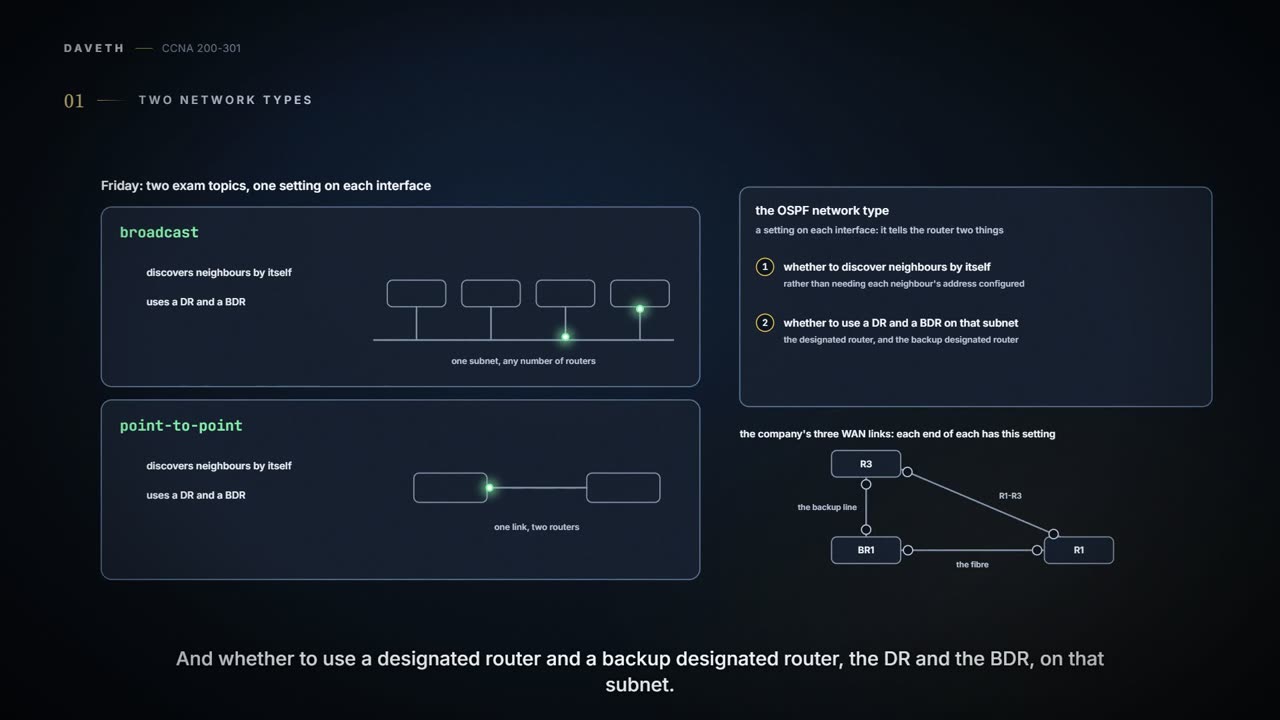
Friday, month three, week three. Two of OSPF's exam topics name a setting outright: point-to-point, and broadcast (with DR/BDR selection). Both are values of the OSPF network type, a per-interface setting that tells the router two things: whether to discover neighbours dynamically (rather than needing each neighbour's address configured), and whether to use a designated router (DR) and backup designated router (BDR) on the subnet. Both of these types discover neighbours; only one uses a DR:
| Network type keyword | Discovers neighbours by itself | Uses a DR/BDR |
|---|---|---|
broadcast | Yes | Yes |
point-to-point | Yes | No |
OSPF uses broadcast by default on every kind of Ethernet interface, so every example so far, the company's links included, has been using it. (Some older kinds of interface defaulted to other types, which is why the interface subcommand ip ospf network broadcast exists; on Ethernet you wouldn't need it.)
Two exam topics, one setting, two keywords. Exams rarely give away this much.
A chair and a deputy
Ravi has built the lab from Tuesday's sketch: five routers, A to E, each with its Gi0/0 on one VLAN. With the broadcast type, each router's interface on a subnet:
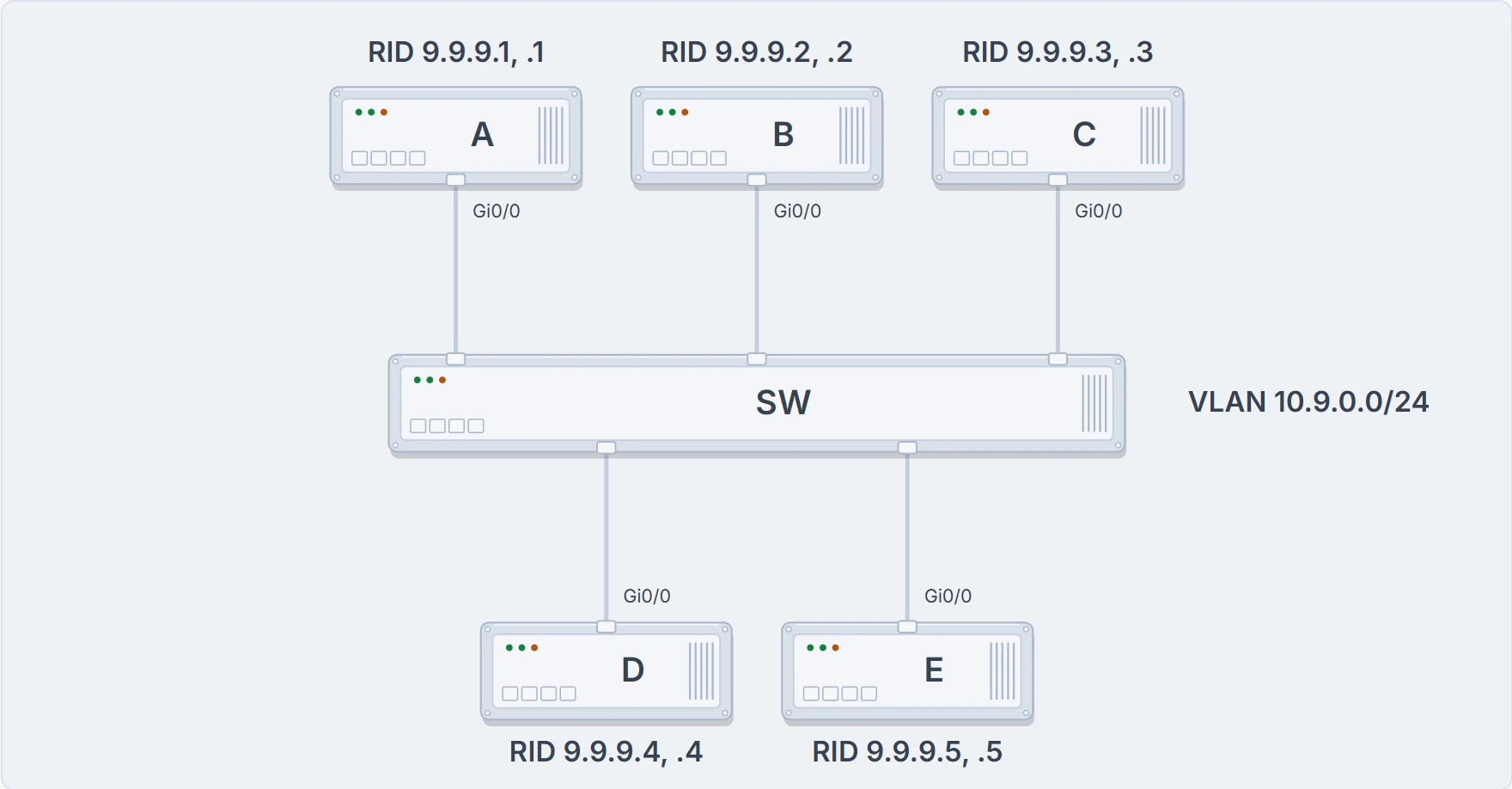
Ravi's lab: five routers on one VLAN, 10.9.0.0/24, with router IDs 9.9.9.1 to 9.9.9.5 and addresses .1 to .5.
- discovers neighbours by sending Hellos to 224.0.0.5, the all-OSPF-routers address;
- takes part in electing a DR and a BDR for that subnet;
- becomes the DR itself where it's alone on the subnet, like BR1 on its two LANs;
- on a shared subnet, ends up as the DR, the BDR, or a DROther (neither), waiting ready to become the BDR if the DR or BDR fails;
- sends messages meant for the DR and BDR to 224.0.0.6, the all-OSPF-DRs address.
The election compares two things, in order: the highest OSPF interface priority (0 to 255; the default is 1), then, if priorities tie, the highest router ID. Highest wins in both. A priority of 0 takes a router out of the running: it's never elected DR or BDR, though it still has neighbours, as a DROther. (The lab routers keep the default reference bandwidth, so their gigabit ports cost 1.)
Here's the lab after all five powered up together, from router C, a DROther:
C# show ip ospf neighbor
Neighbor ID     Pri   State           Dead Time   Address       Interface
9.9.9.1           1   2WAY/DROTHER    00:00:35    10.9.0.1      GigabitEthernet0/0
9.9.9.2           1   2WAY/DROTHER    00:00:31    10.9.0.2      GigabitEthernet0/0
9.9.9.4           1   FULL/BDR        00:00:38    10.9.0.4      GigabitEthernet0/0
9.9.9.5           1   FULL/DR         00:00:33    10.9.0.5      GigabitEthernet0/0
C# show ip ospf interface brief
Interface    PID   Area            IP Address/Mask    Cost  State Nbrs F/C
Gi0/0        1     0               10.9.0.3/24        1     DROTH 2/4
C# show ip ospf interface g0/0
GigabitEthernet0/0 is up, line protocol is up
  Internet Address 10.9.0.3/24, Area 0, Attached via Network Statement
  Process ID 1, Router ID 9.9.9.3, Network Type BROADCAST, Cost: 1
! (lines left out)
  Transmit Delay is 1 sec, State DROTHER, Priority 1
  Designated Router (ID) 9.9.9.5, Interface address 10.9.0.5
  Backup Designated router (ID) 9.9.9.4, Interface address 10.9.0.4
  Timer intervals configured, Hello 10, Dead 40, Wait 40, Retransmit 5
! (lines left out)
  Neighbor Count is 4, Adjacent neighbor count is 2
    Adjacent with neighbor 9.9.9.4  (Backup Designated Router)
    Adjacent with neighbor 9.9.9.5  (Designated Router)
! (the rest is left out)
C#
Every router on the link should become a neighbour and reach at least 2-way, and every relationship that involves the DR or the BDR should go on to full, making them fully adjacent (05.2.2). So C is full with E (DR) and D (BDR), and 2-way with A and B, which is perfectly normal. In show ip ospf neighbor, the part after the slash is the neighbour's role. In show ip ospf interface brief, the State column is the local router's role (DROTH, short for DROther), and Nbrs F/C counts the fully adjacent neighbours, then all the neighbours: 2/4 for C.
It acts kind of like a committee with a chair and a vice-chair: everyone reports to both, and the chair sends out the minutes (here, the LSAs). (Where it stops: a committee votes; OSPF's election is pure arithmetic on priority and RID, and nobody campaigns.)
The election rules, and why they stick
You might want a particular router to be the DR. Before configuring anything, know the rules once a DR and BDR exist:
- If the DR fails, the BDR becomes the DR, and a new BDR is elected.
- When a better router joins the subnet, it doesn't preempt the existing DR or BDR.
So setting one router to the highest priority only raises its chances of being DR at any moment. If it fails, others take over, and it won't be DR again until both the current DR and BDR have failed, or there's a completely new election. To influence the election, the interface subcommand ip ospf priority value is a better tool than choosing RIDs, since RIDs are usually picked to make routers easy to recognise.
A# configure terminal
Enter configuration commands, one per line.  End with CNTL/Z.
A(config)# interface GigabitEthernet0/0
A(config-if)# ip ospf priority 100
A(config-if)# end
A# show ip ospf interface g0/0 | include Priority
  Transmit Delay is 1 sec, State DROTHER, Priority 100
A#
The setting took, and A is still a DROther: E stays DR. Only a new election would change that.
A completely new election happens when everything starts over at once, after a power cut, or when the LAN switch between them fails and recovers. Here are the rules on Ravi's lab VLAN, every priority at 1:
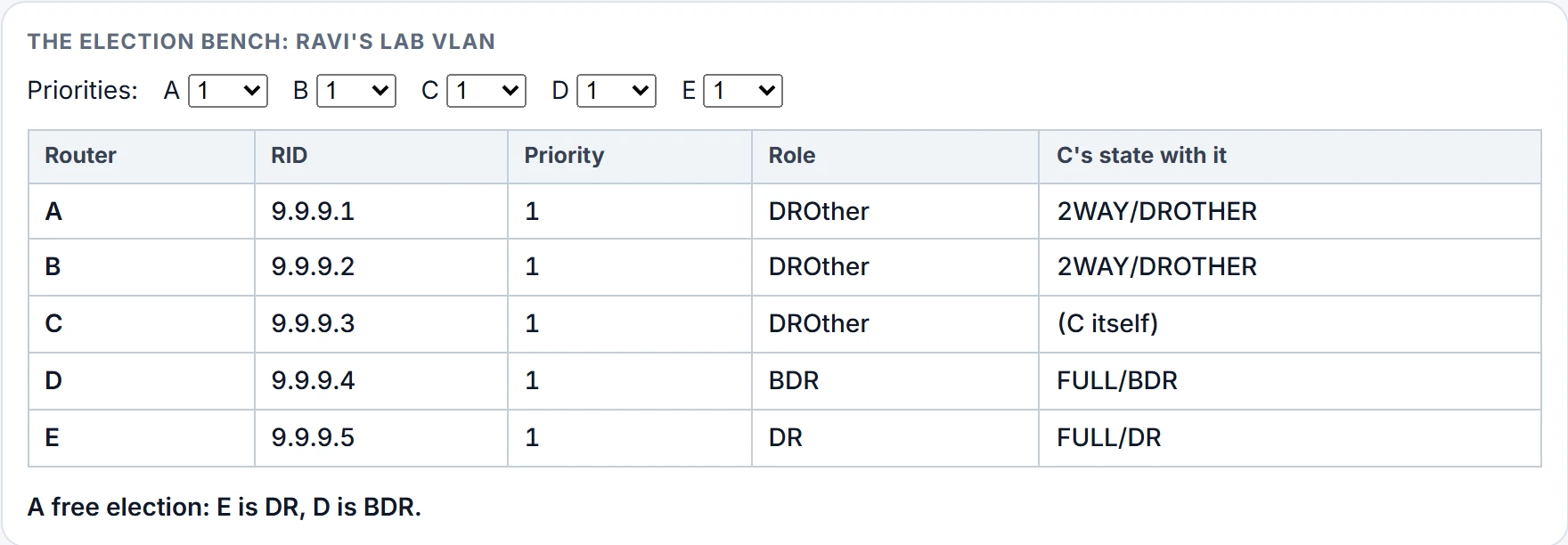
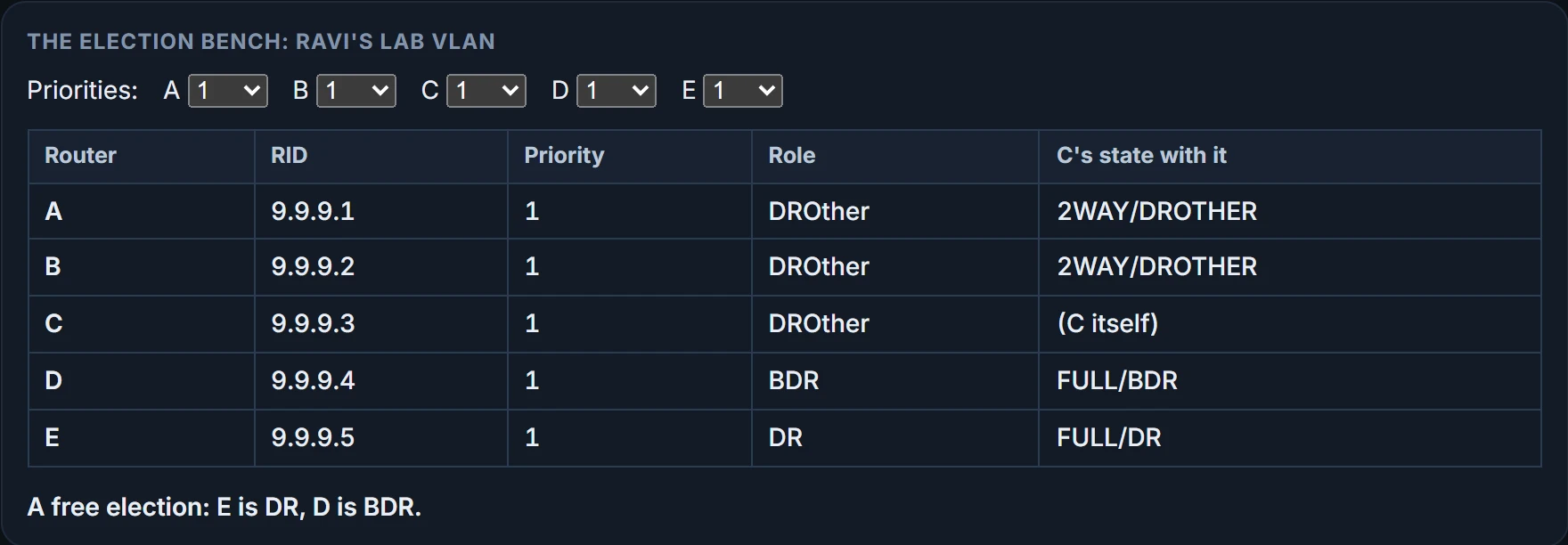
STP's root election works in a similar spirit with two key differences: STP's lowest value wins, and a better new switch does take over as root (03.3.2). OSPF's highest wins, and the DR stays put.
The chair came back from lunch. The meeting didn't throw out whoever was chairing in the meantime.
Continue the lesson
The whole lesson, with its drawings and its questions. 2 more sections after the ones above.