
Source Specific Multicast
SSM removes the rendezvous point: a receiver subscribes to an (S,G) channel, naming both source and group, so the network never has to find senders. SSM is a range of groups, set with ip pim ssm, inside which only (S,G) joins are sent and register messages are refused. Receivers need IGMPv3, and an application that knows only groups needs SSM mapping on the router.
By Arif, founder of Daveth · Updated
The full 6 min walkthrough is in Daveth Pro (Network). See what the plan opens
What this page answers
What is Source Specific Multicast?
An extension of IP multicast where traffic is forwarded to receivers only from the sources they explicitly joined. Receivers subscribe to (S,G) channels, and inside the SSM range only SSM trees are built, with no shared tree or RP. Read it in “Switch the last three lessons off”
Why does SSM need IGMPv3?
A receiver has to name the source it wants, and IGMPv3 reports carry sources. The default IGMP version is 2, so the receiver-facing interface needs ip igmp version 3. Read it in “One channel, joined”
What is SSM mapping?
For hosts that send only IGMPv1 or IGMPv2 reports, the router determines one or more sources for the group, treats the report as an IGMPv3 report and sends PIM (S,G) joins on the host's behalf. Read it in “The router answers for the host”
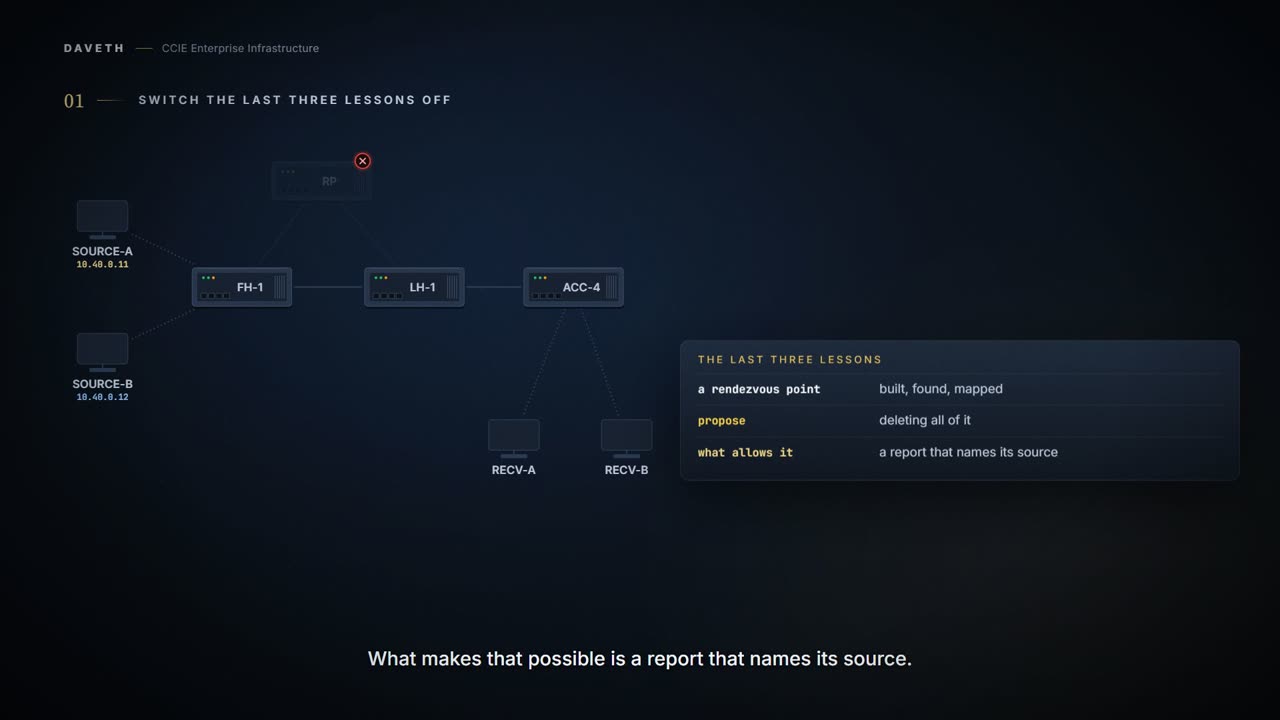
Switch the last three lessons off
1.6.c.i built a rendezvous point, 1.6.c.ii found it statically, by BSR or by Auto-RP, and 1.6.c.iii mapped groups to it. Propose deleting all of it. What would have to be true?
1.6.a.i-iii ended on the answer: an IGMPv3 report that names its source. Here is what that buys:
The source-specific multicast (SSM) feature is an extension of IP multicast in which datagram traffic is forwarded to receivers from only those multicast sources that the receivers have explicitly joined. For multicast groups configured for SSM, only SSM distribution trees (no shared trees) are created.
The show ip pim rp mapping command does not work with routers in a PIM-SSM network because PIM-SSM does not use RPs.
No shared tree and no RP. And look at what else SSM is documented to run without:
If you already have somebody's address, you do not need a meeting desk to introduce you to them. That is the entire reason the apparatus of the last three lessons can come out. The receiver is no longer asking for whoever happens to be sending to this group. It is asking for this source, by address, and a request that already names both ends has nothing left to arrange.
Where the address stops, and it matters more here than usual: knowing an address is not the same as having checked who is at it. Source-specific is selective, not authenticated. The receiver chose a sender and the network honours the choice; nothing in this range verifies that the sender is who anybody thinks it is.
SSM can also be deployed alone in a network without the full range of protocols required for interdomain PIM-SM (for example, MSDP, Auto-RP, or bootstrap router [BSR]) if only SSM service is needed.
What a receiver asks for
Membership in a host group simply requires signaling the host group through IGMP version 1, 2, or 3.
That is the model the last three lessons served: a receiver names a group, and the network finds the senders. Now the other one:
In SSM, delivery of datagrams is based on (S, G) channels. However, in SSM, receivers must subscribe or unsubscribe to (S, G) channels to receive or not receive traffic from specific sources. In other words, receivers can receive traffic only from (S, G) channels to which they are subscribed, whereas in ISM, receivers need not know the IP addresses of sources from which they receive their traffic.
A channel is a source and a group together, and the receiver names both. Which version of IGMP can carry that?
The proposed standard approach for channel subscription signaling uses IGMP and includes modes membership reports, which are supported only in IGMP version 3.
Which groups are SSM?
SSM can coexist with the ISM service by applying the SSM delivery model to a configured subset of the IP multicast group address range. Cisco IOS software allows SSM configuration for the IP multicast address range of 224.0.0.0 through 239.255.255.255.
So SSM is a range of groups, not a mode the router is in. LH-1 gets one:
If you want to use an access list to define the Source Specific Multicast (SSM) range, configure the access list before you reference the access list in the ip pim ssm command.
This course's configuration: LH-1, access list 20 already permitting 239.40.0.0 to 239.40.255.255
LH-1# configure terminal
LH-1(config)# ip pim ssm range 20
LH-1(config)# end
Which groups does that put under SSM, and what becomes of a group outside the list?
This course's reading: the model LH-1 gives each group
group         in the range  model   RP
239.40.7.1    yes           SSM     not used
239.40.7.2    yes           SSM     not used
239.20.0.7    no            ISM     as in 1.6.c.i
Notice the last row: the same router still runs PIM-SM for a group outside the list. What about the default keyword? No page read says what range it selects. The command reference does name a range, in an example for a different command:
The following example shows how to permit register packets for a source address sending to any group range, with the exception of source address 172.16.10.1 sending to the SSM group range (232.0.0.0/8).
That calls 232.0.0.0/8 the SSM group range; it does not say what default selects. This page configures its own list and draws no conclusion about the keyword.
What LH-1 sends inside the range
Inside the range, LH-1 already knows what a receiver wants from whom. Predict what is left for it to send:
In this mode, only PIM (S, G) join and prune messages are generated by the router, and no (S, G) rendezvous point tree (RPT) or (*, G) RPT messages are generated. Incoming messages related to RPT operations are ignored or rejected, and incoming PIM register messages are immediately answered with register-stop messages.
Read the register half again. Registers come from first-hop routers:
These statements should be configured on all candidate RPs because candidate RPs will receive PIM registers from first-hop routers or switches.
So a first-hop router announcing a new source, to a router running SSM for that group, is answered at once with a register-stop. In effect: don't. And MSDP, inside the range:
No MSDP source-active (SA) messages within the SSM range are accepted, generated, or forwarded.
One channel, joined
The range tells LH-1 which groups are SSM. The reports arrive on Vlan420, from the receivers behind ACC-4, so that interface has to read a report that names a source:
This course's configuration: LH-1, the interface facing the receivers
LH-1# configure terminal
LH-1(config)# interface Vlan420
LH-1(config-if)# ip pim sparse-mode
LH-1(config-if)# ip igmp version 3
LH-1(config-if)# end
Enables IGMPv3 on this interface. The default version of IGMP is set to Version 2. For groups within the SSM range, (S, G) channel subscriptions are accepted through IGMPv3 include-mode membership reports.
RECV-A sends an IGMPv3 INCLUDE report for 239.40.7.1 naming 10.40.0.11. What does LH-1 make of it?
This course's reading: what LH-1 makes of each report
receiver  report                    on LH-1
RECV-A    IGMPv3 INCLUDE 10.40.0.11 (10.40.0.11, 239.40.7.1) by IGMPv3 INCLUDE
RECV-B    none                      no report
This course's reading: LH-1's (S, G) joins
(S, G) join               source sending  join kept
(10.40.0.11, 239.40.7.1)  yes             yes
Look at the join: (10.40.0.11, 239.40.7.1), straight toward the source. No RP was asked where 10.40.0.11 is, because RECV-A said.
An application that only knows groups
To run SSM with IGMPv3, SSM must be supported in the Cisco IOS router, the host where the application is running, and the application itself. Existing applications in a network predating SSM will not work within the SSM range unless they are modified to support (S, G) channel subscriptions.
Read the last item in the first sentence: the application itself. Configuring the routers cannot meet that one.
RECV-B runs such an application and reports 239.40.7.1 with IGMPv2. What does it get?
When an SSM range is defined, existing IP multicast receiver applications do not receive any traffic when they try to use an address in the SSM range (unless the application is modified to use an explicit (S, G) channel subscription).
This course's reading: what LH-1 makes of each report, with RECV-B at IGMPv2
receiver  report                    on LH-1
RECV-A    IGMPv3 INCLUDE 10.40.0.11 (10.40.0.11, 239.40.7.1) by IGMPv3 INCLUDE
RECV-B    IGMPv2 239.40.7.1         no channel
The router answers for the host
When the router receives an IGMPv1 or IGMPv2 membership report for a group, the router uses SSM mapping to determine one or more source IP addresses for the group. SSM mapping then translates the membership report as an IGMPv3 report and continues as if it had received an IGMPv3 report. The router then sends PIM joins and continues to be joined to these groups as long as it continues to receive the IGMPv1 or IGMPv2 membership reports, and the SSM mapping for the group remains the same.
This course's configuration: LH-1, static mapping of access list 11 (permitting 239.40.7.1) to 10.40.0.12
LH-1# configure terminal
LH-1(config)# ip igmp ssm-map enable
LH-1(config)# no ip igmp ssm-map query dns
LH-1(config)# ip igmp ssm-map static 11 10.40.0.12
LH-1(config)# end
By default, this command enables DNS-based SSM mapping. Disable DNS-based SSM mapping if you only want to rely on static SSM mapping.
Hence the no line: this page relies on the static map alone. Does RECV-B's IGMPv2 report become a channel now?
This course's reading: what LH-1 makes of each report, with mapping on
receiver  report                    on LH-1
RECV-A    IGMPv3 INCLUDE 10.40.0.11 (10.40.0.11, 239.40.7.1) by IGMPv3 INCLUDE
RECV-B    IGMPv2 239.40.7.1         (10.40.0.12, 239.40.7.1) by SSM mapping
RECV-B's report became (10.40.0.12, 239.40.7.1). The source came from the configuration, not from the host, and the guide states the cost:
The SSM Mapping feature does not share the benefit of full SSM. SSM mapping takes a group G join from a host and identifies this group with an application associated with one or more sources, therefore, it can only support one such application per group G. Nevertheless, full SSM applications may still share the same group also used in SSM mapping.
One mapped application per group, and RECV-A's full SSM application still shares 239.40.7.1 with it.
Continue the lesson
The whole lesson, with its drawings and its questions. 7 more sections after the ones above.