
Reverse path forwarding check
A multicast group is not a place: 239.1.1.1 is not an interface or a host, so routing toward it is meaningless. PIM asks about the source instead. The reverse path forwarding check looks the source up in the ordinary unicast routing table and accepts the source's traffic only on the interface that route leaves by. Change the unicast routing and multicast can break with no multicast change.
By Arif, founder of Daveth · Updated
The full 5 min walkthrough is in Daveth Pro (Network). See what the plan opens
What this page answers
What is the multicast RPF check?
A router looks up the packet's source address in the unicast routing table. The interface the route to the source leaves by is the only interface it accepts that source's multicast traffic on; traffic arriving elsewhere fails the check. Read it in “So it asks about the source instead”
Why is PIM called protocol independent?
It has no routing protocol of its own. It uses whichever unicast protocol populated the routing table, EIGRP, OSPF, BGP or static routes, for its RPF check. Read it in “The sentence that makes this domain tractable”
Why did multicast stop after a unicast routing change?
The RPF interface follows the best unicast path back to the source. Changing an OSPF cost can move that path, and the stream then arrives on an interface that no longer passes the check. Read it in “Change the unicast routing, not the multicast configuration”
A packet arrives for 239.1.1.1
Every routing topic in this course has answered the same question. Where is that address, and which interface gets me closer to it? Look up the destination, find the best path, forward.
Where is 239.1.1.1?
State 1 Search the drawing for it
The source is on the left and the receiver is on the right. Where on this network is 239.1.1.1?
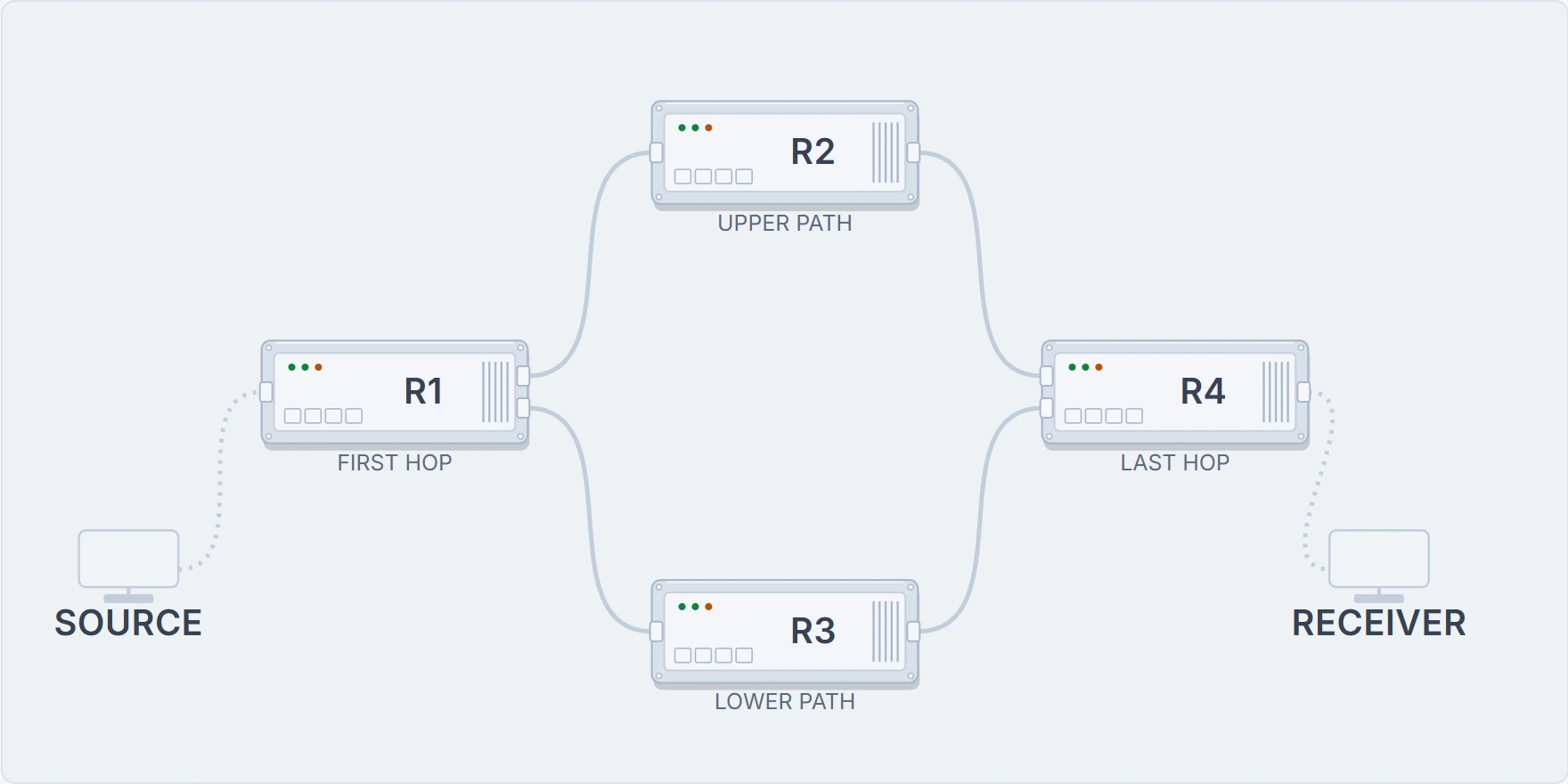
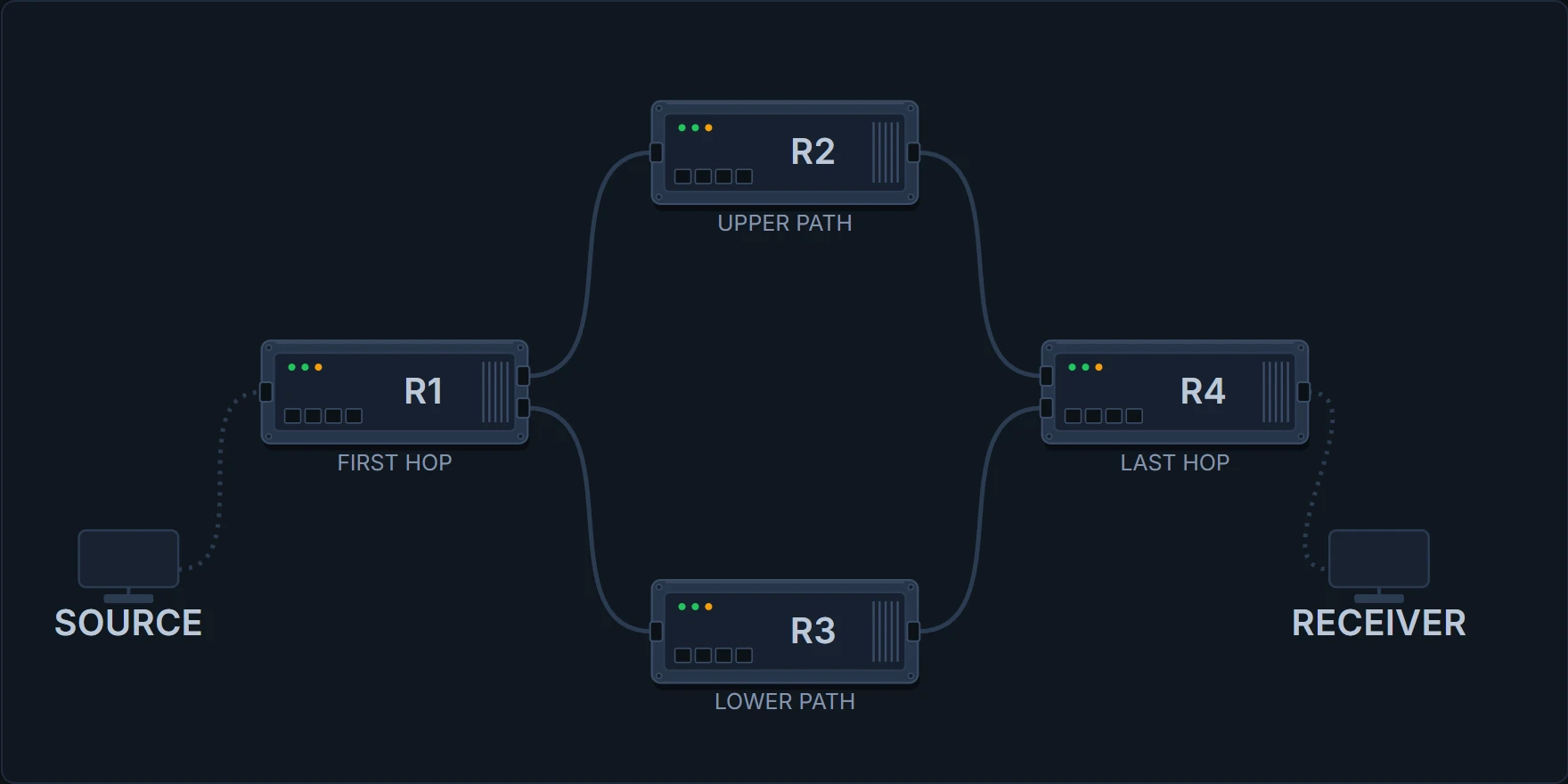
Nowhere. It is not an interface, not a host, not behind anything. A multicast group is an arbitrary number of receivers that join a group in order to receive a particular data stream: an arbitrary number, anywhere. No router has a route to it and none ever will.
This course’s output: show ip route 239.1.1.1 on R4, computed from the state. The field names are the standard ones; no command prints this exact layout.
R4# show ip route 239.1.1.1
% Network not in table
! Not a fault. There is nothing to have a route to.
So the question every previous domain asked has no answer here, and multicast forwarding is built on a different one.
Computed from the state: what each address is, from its own octets. No command prints it in this form.
239.1.1.1  administratively or limited scoped, for private multicast domains
10.1.1.10  a unicast address, and the only one either table can look up
| Range | What it is |
|---|---|
| 224.0.0.0 to 239.255.255.255 | the Class D host group range |
| 224.0.0.0 to 224.0.0.255 | reserved for network protocols on a local network segment |
| 239.0.0.0 to 239.255.255.255 | administratively or limited scoped, for private multicast domains |
Two of those are worth knowing on sight. 224.0.0.x is for protocols talking on one local segment. 239.x.x.x is for private multicast domains, the range an enterprise uses inside its own network, and the one this page uses.
One range is deliberately missing from that table. The globally scoped range. The page this course consulted names it without delimiting it, so no boundaries are given here rather than boundaries being supplied from somewhere else.
So it asks about the source instead
PIM also uses a unicast routing table to perform the reverse path forwarding (RPF) check function instead of building a completely independent multicast routing table.
Notice which field it looks up. Not the destination: the source. R4 takes 10.1.1.10, looks it up in the ordinary unicast routing table, and the interface that route leaves by is the interface it will accept that source's traffic on.
So which interface would R4 send a packet to 10.1.1.10 out of, and which interface will it accept 10.1.1.10’s traffic on? Read these two outputs against each other. The second is not a separate calculation; it is the first one, read as an arrival direction instead of a departure one.
This course’s output: show ip route 10.1.1.10 on R4, computed from the state. The field names are the standard ones; no command prints this exact layout.
R4# show ip route 10.1.1.10
Routing entry for 10.1.1.0/24
  Known via "ospf 1", distance 110, metric 21
  Routing Descriptor Blocks:
  * 10.24.0.2, via GigabitEthernet1/0/1
  ! The interface a packet TO the source would leave by.
This course’s output: show ip rpf 10.1.1.10 on R4, computed from the state. The field names are the standard ones; no command prints this exact layout.
R4# show ip rpf 10.1.1.10
RPF information for ? (10.1.1.10)
  RPF interface: GigabitEthernet1/0/1
! The same interface, now the one a packet FROM the source must arrive on.
  RPF neighbor: ? (10.24.0.2)
  RPF route/mask: 10.1.1.0/24
  RPF type: unicast (ospf 1)
  ! Unicast. It is reading a table somebody else built.
  Doing distance-preferred lookups across tables
The comparison, in the source’s words. When a multicast packet arrives on an interface, the RPF process checks to ensure that this incoming interface is the outgoing interface used by unicast routing in order to reach the source of the multicast packet. The same guide gives the reason in one line: This RPF check process prevents loops.
And what happens to traffic that fails: "Traffic that fails an Reverse Path Forwarding (RPF) check is called non-RPF traffic. Non-RPF traffic is forwarded by the Integrated Switching Engine by filtering (persistently dropping) or rate limiting the non-RPF traffic."
Read the two verbs. Filtering, which it glosses as persistently dropping, or rate limiting. The packet is treated as traffic that should not be there, because from the router's point of view it arrived from the wrong direction. The sentence says nothing about a message, and this course has not verified whether a device logs one, so treat the check as something you go and read rather than something you will be told about.
The memory hook for the whole domain: multicast asks where the packet came from, not where it is going.
The sentence that makes this domain tractable
"Protocol-Independent Multicast (PIM) is protocol independent because it can leverage whichever unicast routing protocol is used to populate the unicast routing table, including EIGRP, OSPF, BGP, static route, to support IP multicast."
Count the protocols in that list. EIGRP, OSPF, BGP, static route: that is every routing protocol in this course.
Now notice what PIM does not have: a routing protocol of its own. It does not exchange prefixes, run SPF, or maintain a topology. It borrows the table the unicast protocols built, and protocol independent means it does not care which one built it.
The source starts sending, and the tree is built back toward it: each router joining through the interface its own check would accept.
Computed from the state: each router’s unicast path back to the source, the interface the stream arrives on against the one the check requires, and whether the receiver gets it. No command prints it in this form.
ROUTER   COST   PATH BACK TO THE SOURCE
R1       1      R1 → SOURCE
R2       11     R2 → R1 → SOURCE
R3       11     R3 → R1 → SOURCE
R4       21     R4 → R2 → R1 → SOURCE
ROUTER   ARRIVES ON  RPF SAYS    VERDICT
R1       Gi1/0/1     Gi1/0/1     passes
R2       Gi1/0/1     Gi1/0/1     passes
R3       –           Gi1/0/1     not in the tree
R4       Gi1/0/1     Gi1/0/1     passes
delivered: SOURCE → R1 → R2 → R4 → RECEIVER
Everything passes, and it is worth naming why. The two things agree because one of them was built out of the other. The tree was built along the RPF interfaces, so of course every router receives on its RPF interface. So what happens to the tree when the table changes?
Change the unicast routing, not the multicast configuration
Multicast has been working for a year. Nobody touches any multicast configuration. An engineer raises the OSPF cost on one interface of R4, to move some unicast traffic onto a better-provisioned link.
Configuration: the OSPF cost on R4’s upper link, in this course’s own form.
R4# configure terminal
R4(config)# interface GigabitEthernet1/0/1
R4(config-if)# ip ospf cost 20
R4(config-if)# end
Decide what happens to the multicast stream before you read on.
The best unicast path back to the source moved. With it, the interface R4 will accept that source's traffic on.
Computed from the state: each router’s unicast path back to the source after the change. No command prints it in this form.
ROUTER   COST   PATH BACK TO THE SOURCE
R1       1      R1 → SOURCE
R2       11     R2 → R1 → SOURCE
R3       11     R3 → R1 → SOURCE
R4       22     R4 → R3 → R1 → SOURCE
So which interface does R4 expect 10.1.1.10’s traffic on now?
This course’s output: show ip rpf 10.1.1.10 on R4, computed from the state. The field names are the standard ones; no command prints this exact layout.
R4# show ip rpf 10.1.1.10
RPF information for ? (10.1.1.10)
  RPF interface: GigabitEthernet1/0/2
  ! Was Gi1/0/1. One cost changed and this moved with it.
  RPF neighbor: ? (10.34.0.3)
  RPF route/mask: 10.1.1.0/24
  RPF type: unicast (ospf 1)
  Doing distance-preferred lookups across tables
State 2 Where the stream comes in now
Which way did the stream reach R4 before the change, and which way does it come in now?
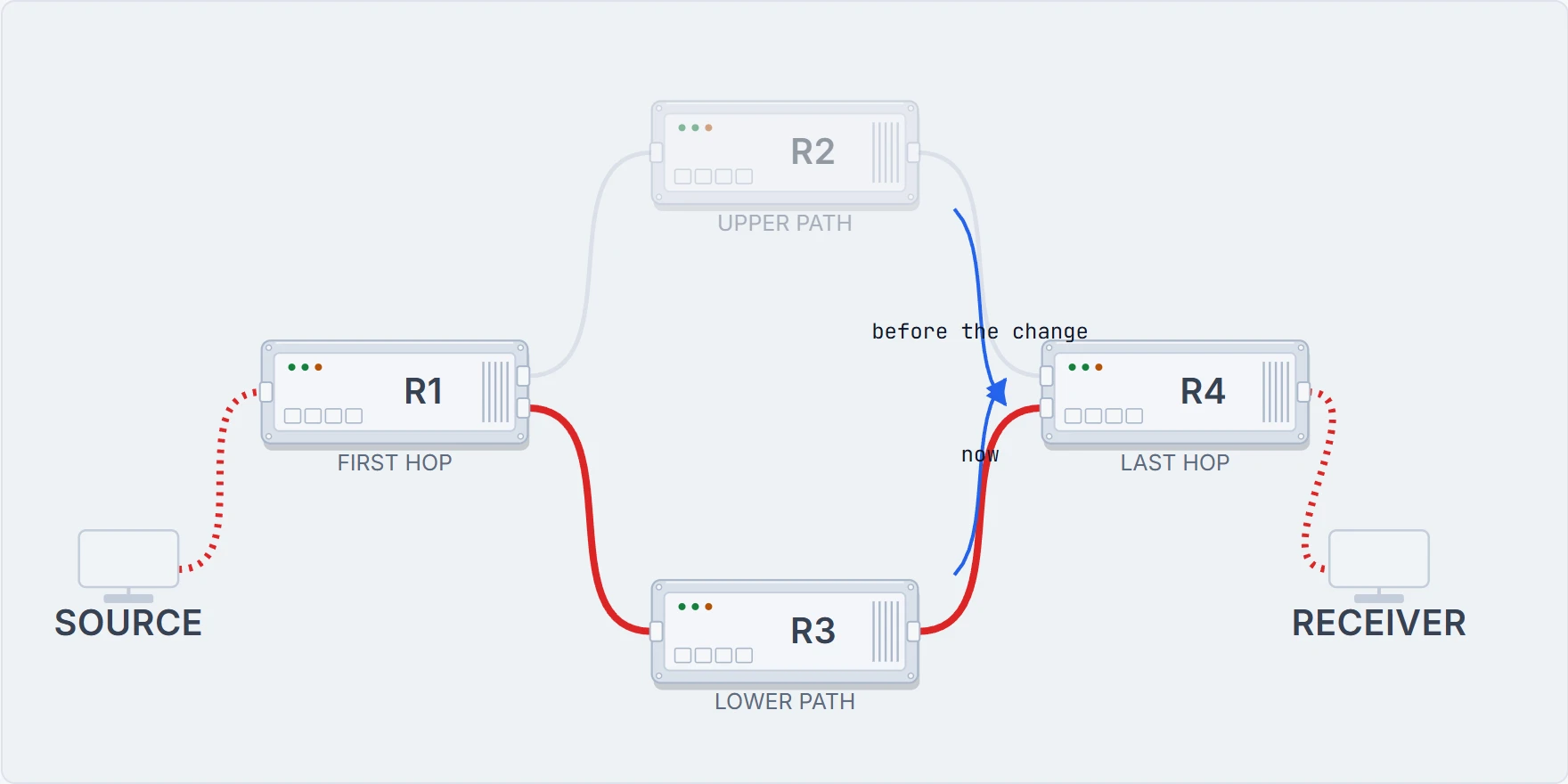
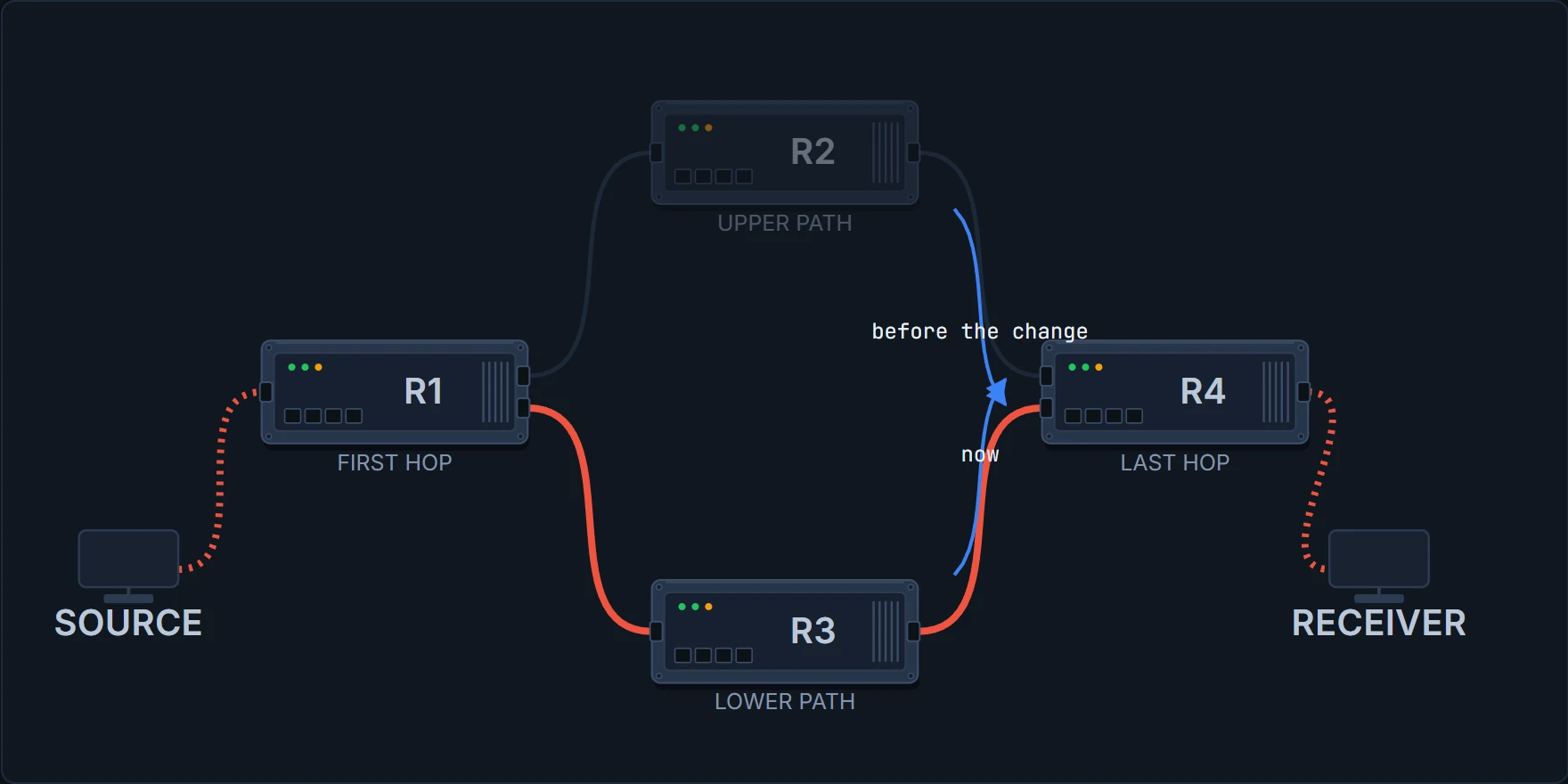
The stream moved with the RPF interface. R4 sent a join toward R3 and a prune toward R2. That is RFC 7761’s rule when a router’s upstream neighbour changes: "Send Join(S,G) to the new upstream neighbor, which is the new value of RPF'(S,G). Send Prune(S,G) to the old upstream neighbor". And a Cisco router does not wait to notice: "Multicast subsecond convergence provides the ability to trigger a check of RPF changes for mroute states. This check is triggered by unicast routing changes."
Computed from the state: the interface the stream arrives on against the one the check requires, and whether the receiver gets it. No command prints it in this form.
ROUTER   ARRIVES ON  RPF SAYS    VERDICT
R1       Gi1/0/1     Gi1/0/1     passes
R2       –           Gi1/0/1     not in the tree
R3       Gi1/0/1     Gi1/0/1     passes
R4       Gi1/0/2     Gi1/0/2     passes
delivered: SOURCE → R1 → R3 → R4 → RECEIVER
Was there an outage at all? A short one. Until the new branch delivers, whatever still arrives on Gi1/0/1 fails the check. How long that gap lasts is not claimed here: no page this course cites gives a figure for this network, and it is PIM’s own timing, which belongs to 1.6.c.i.
This comparison is not the output of any command on this page. show ip rpf 10.1.1.10 gives you the side the check requires, and the stream’s arrival is the other side; putting them together is yours to do, and it is why the first command on a multicast forwarding problem is the RPF one.
Continue the lesson
The whole lesson, with its drawings and its questions. 4 more sections after the ones above.