
PIMv6 anycast RP
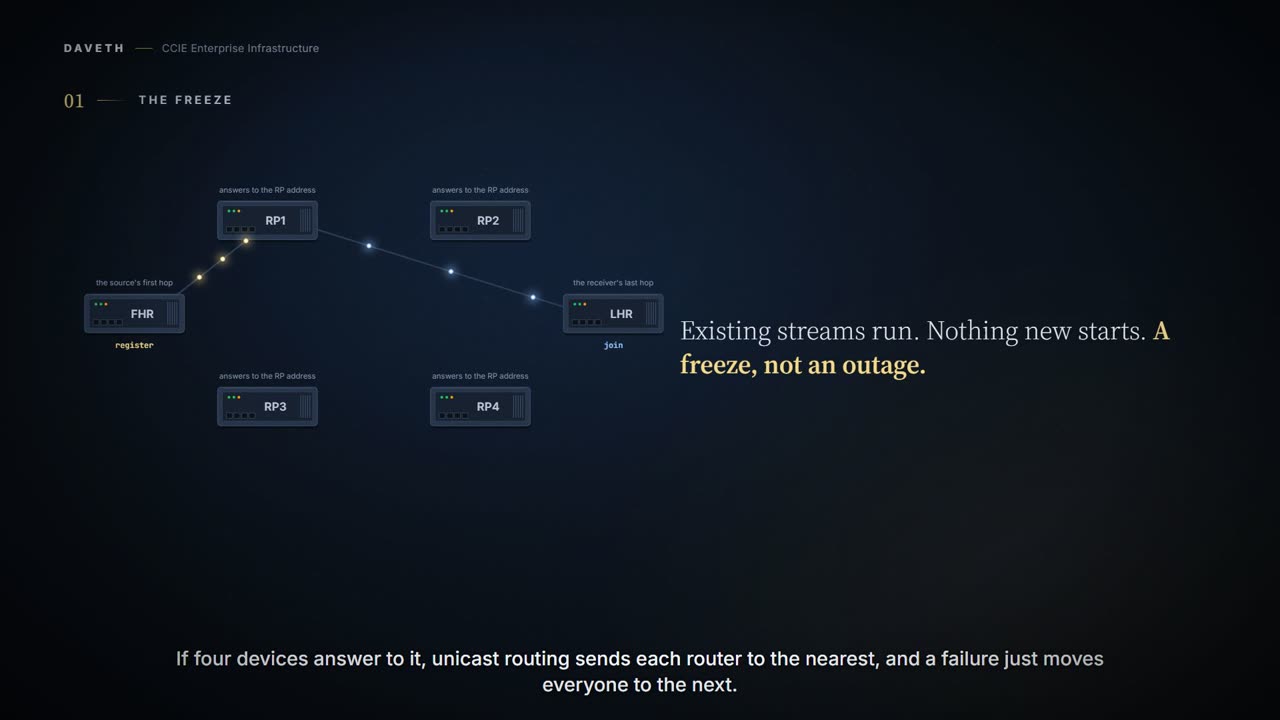
When the RP fails, running streams continue and nothing new can start. Anycast RP puts one RP address on several routers, so unicast routing sends each router to the nearest. On its own that breaks: a source can register with one member and a receiver join another. Each member also needs its own address, and in IPv6 the members share sources inside PIM, with no MSDP.
By Arif, founder of Daveth · Updated
The full 6 min walkthrough is in Daveth Pro (Network). See what the plan opens
What this page answers
How do you configure PIMv6 anycast RP?
On every member, ipv6 pim anycast-RP rp-address peer-address for each device in the set, including the local one. The configuration must be consistent on all RPs in the set. Read it in “Configuring it”
Does IPv6 anycast RP use MSDP?
No. MSDP runs only on IPv4. In IPv6 the anycast RP members share source information inside PIM, so the domain runs PIM only. Read it in “How the members share”
Why does anycast RP need the members to share sources?
A source's first-hop router and a receiver's last-hop router each reach the nearest member, which may not be the same one. Without sharing, one member has a source nobody asked for and another has a receiver that never hears of it. Read it in “What the naive version does”
Four RPs, one address
1.6.c.i left you with a bad dependency. The RP fails, existing streams keep running, and nothing new can start: a freeze rather than an outage, which is worse, because nobody notices.
Anycast RP is a mechanism that ISP-based backbones use to get fast convergence when a PIM RP device fails.
So here is the obvious fix: put the same RP address on several routers. Every router already has that address, configured or learned. If four devices answer to it, unicast routing sends each router to whichever is nearest, and a failure just moves everyone to the next.
Before you read on, work it out. That proposal breaks something, and the breakage is the reason this feature exists.
What the naive version does
A source's first-hop router registers it, and a receiver's last-hop router joins. Both aim at the same address. Do they reach the same router?
This course's reading: which member each end reaches
end     reaches   because                 what it does there
FHR     RP1       it is the nearest copy  registers the source
LHR     RP2       it is the nearest copy  joins toward the group

they reached different members: RP1 and RP2
Not necessarily, and nothing makes them. RP1 has a source nobody asked for; RP2 has a receiver and has never heard of any source for the group. The guide's own normal-operation example has sources choosing RPs the same way:
S11 and S31 are sources that use RP1 and RP3, respectively, based on their unicast routing metric.
This course's reading: which members know about the source
member  knows   how it found out
RP1     yes     registered with it directly
RP2     no      nobody told it
RP3     no      nobody told it
RP4     no      nobody told it

one of four members know, and no member forwarded it again
So the redundancy design's first achievement is to stop multicast working on a network where it worked with one RP. Anycast on its own is an addressing trick, not a protocol.
To allow receivers and sources to rendezvous to the closest RP, the packets from a source need to get to all RPs to find joined receivers.
Two addresses, not one
A unicast IP address is chosen as the RP address. This address is either statically configured or distributed using a dynamic protocol to all PIM devices throughout the domain. Each device in the anycast RP set is configured with a loopback interface using the RP address. The RP address, or a prefix that covers the RP address, is injected into the unicast routing system inside of the domain.
That is the shared address, and 1.6.c.ii already gave both ways of getting it everywhere. And each member needs a second one:
Each device in the anycast RP set also needs a separate physical IP address to be used for communication between the RPs.
Why can the members not use the anycast address to talk to each other?
This course's reasoning, marked: the requirement is on the page and the reason is not. The anycast address cannot be used to reach a particular peer, because from any member's own point of view the nearest copy of that address is itself. Member-to-member communication needs addresses that identify one member each.
This course's addresses: what each member holds
RP1   anycast 2001:db8:0:abcd::1   physical 2001:db8::1:1
RP2   anycast 2001:db8:0:abcd::1   physical 2001:db8::2:2
RP3   anycast 2001:db8:0:abcd::1   physical 2001:db8::3:3
RP4   anycast 2001:db8:0:abcd::1   physical 2001:db8::4:4
How the members share
Anycast RP can be used in IPv4 as well as IPv6, but it does not depend on the Multicast Source Discovery Protocol (MSDP), which runs only on IPv4. The anycast RP solution in IPv6 PIM allows an IPv6 network to support anycast services for the PIM-SM RP. It allows anycast RP to be used inside a domain that runs PIM only.
Anycast RP is the idea; MSDP is one mechanism for the sharing it needs, and only on IPv4. For IPv6 the sharing is inside PIM. Each member lists every member:
Each device in the Anycast set must contain the list of all the devices in the Anycast set.
And what a member does with a register, in the guide's four-RP example:
RP1 also sends the register (which may encapsulate the data packets) to RP2, RP3, and RP4. RP2, RP3, and RP4 do not further forward the register to each other. The previous five steps repeat for null registers sent by DR1.
Two rules. A member that receives a register from a first-hop router forwards it to every other member. A member that receives one from another member does not pass it on. With every set complete, which members know about the source?
This course's reading: which members know about the source
member  knows   how it found out
RP1     yes     registered with it directly
RP2     yes     forwarded by RP1
RP3     yes     forwarded by RP1
RP4     yes     forwarded by RP1

four of four members know, and no member forwarded it again
And the flow works. RP2 knows about a source it never heard register, because RP1 told it.
Now move the receiver's nearest copy to RP3. It still works: that member got its copy from the same first member.
Predict what would happen without rule two. The first member tells the other three, each of those tells the other three, and every register circulates among the set forever. The rule stops that by where the register came from, which works because rule one already sent it to everybody.
And how long does a forwarded register last? Not stated in the guides cited. What is stated is who forwards to whom, who does not forward again, and that the same steps repeat for null registers.
Configuring it
The syntax, as the guide gives it
ipv6 pim anycast-RP rp-address peer-address
Use this command to configure the address of the PIM RP for an anycast group range. Each device in the anycast RP set is configured with the addresses of all other devices in the anycast RP set, and this configuration must be consistent in all RPs in the set. The IP address of the local device must be included in the set so that all devices in anycast set have the same IP addresses.
Note what the local-address rule buys. If every member's own address is in the set, the anycast RP set is identical on every member and can be copied rather than hand-edited. Hand-editing a peer list on each of four routers is how one member ends up missing another.
This course's reading: every member's set, side by side
member  peers  its set, sorted
RP1     4      RP1 RP2 RP3 RP4
RP2     4      RP1 RP2 RP3 RP4
RP3     4      RP1 RP2 RP3 RP4
RP4     4      RP1 RP2 RP3 RP4

every member's set is the same text, so a difference would be visible
The guide's own example, reproduced as printed. Read it for the shape: its addresses do not line up with each other (RP1's static RP address is 2001:DB8::1:1 while its anycast-rp line names 2001:DB8:0:ABCD::1), and each device shows a single anycast-rp line.
Reproduced from the IOS XE 17.x PIMv6 Anycast RP chapter
RP1
Device1(config)# ipv6 pim rp-address 2001:DB8::1:1 acl_sparse1
Device1(config)# interface Loopback4
Device1(config-if)# ipv6 address 2001:DB8::4:4/64
Device1(config-if)# no shut

Device1(config)# interface Loopback5
Device1(config-if)# ipv6 address 2001:DB8:0:ABCD::1/64
Device1(config-if)# no shut
Device1(config-if)# exit
Device1(config)# ipv6 pim anycast-rp 2001:DB8:0:ABCD::1 2001:DB8::3:3

RP2 (Anycast RP Peer)
Device2(config)# ipv6 pim rp-address 2001:DB8::1:1 acl_sparse1
Device2(config)# interface Loopback4
Device2(config-if)# ipv6 address 2001:DB8::3:3/64
Device2(config-if)# no shut

Device2(config)# interface Loopback5
Device2(config-if)# ipv6 address 2001:DB8:0:ABCD::1/64
Device2(config-if)# no shut
Device2(config)# ipv6 pim anycast-rp 2001:DB8::1:1 2001:DB8::4:4

Device2 show ipv6 pim anycast-rp 2001:DB8::1:1

Anycast RP Peers For 2001:DB8::1:1   Last Register/Register-Stop received
  2001:DB8::3:3 00:00:00/00:00:00
  2001:DB8::4:4 00:00:00/00:00:00
Look at the sample output at the end. Device2 lists its own address, 2001:DB8::3:3, alongside its peer. What does one of this page's members list?
RP4# show ipv6 pim anycast-rp 2001:DB8:0:ABCD::1
Anycast RP Peers For 2001:DB8:0:ABCD::1   Last Register/Register-Stop received
  2001:DB8::1:1 00:00:00/00:00:00
  2001:DB8::2:2 00:00:00/00:00:00
  2001:DB8::3:3 00:00:00/00:00:00
  2001:DB8::4:4 00:00:00/00:00:00
! Proves which addresses this member has in its set, its own included. Does not prove that any other member lists this one: that is another router's configuration. The timer column prints the guide's sample values; what it reads with registers flowing is not claimed.
Continue the lesson
The whole lesson, with its drawings and its questions. 7 more sections after the ones above.