
MLD and MLD snooping
MLD is derived from IGMP: MLDv1 is equivalent to IGMPv2 and MLDv2 to IGMPv3. But MLD is a subprotocol of ICMPv6, so an ACL that drops ICMPv6 drops it too. MLD snooping takes effect only when enabled globally with ipv6 mld snooping, whatever the VLAN setting. And until the switch discovers a router port, all IPv6 multicast floods the VLAN.
By Arif, founder of Daveth · Updated
The full 6 min walkthrough is in Daveth Pro (Network). See what the plan opens
What this page answers
What is the difference between MLD and IGMP?
MLD does IGMP's job for IPv6: MLDv1 is equivalent to IGMPv2 and MLDv2 to IGMPv3. MLD messages are ICMPv6 messages, identified by Next Header value 58. Read it in “The mapping is real”
Why is MLD snooping not working on a VLAN?
MLD snooping must be enabled globally, with ipv6 mld snooping, for VLAN MLD snooping to take place. A VLAN showing it enabled is not enough. Read it in “The default”
Why does IPv6 multicast flood with MLD snooping enabled?
Until the first IPv6 multicast router port is discovered, all IPv6 multicast data is flooded to the VLAN. After that, unknown IPv6 multicast goes only to the router ports. Read it in “Where it breaks: the window before a router is known”
Assume it all transfers
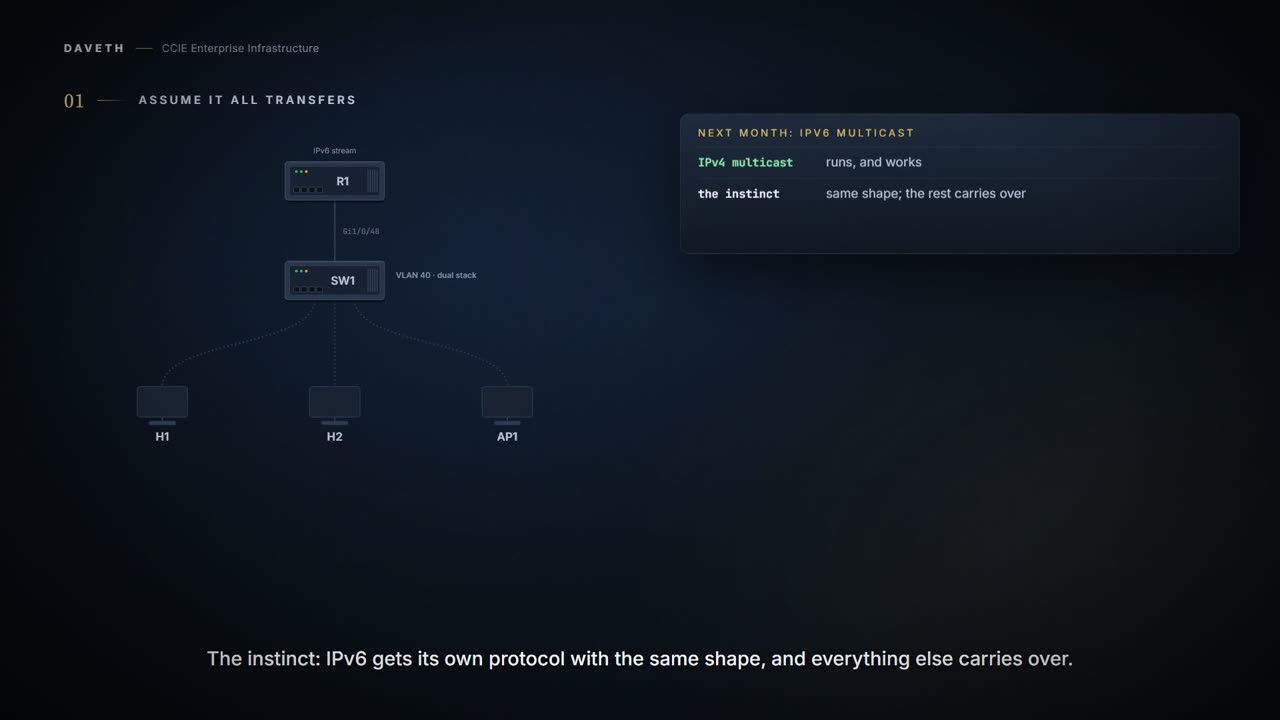
IPv6 multicast goes live on the campus next month. You already run IPv4 multicast, and it works. What do you think you have to do about it? Be honest about the instinct: IPv6 gets its own protocol with the same shape, and the rest carries over. The instinct is half right, and it is worth finding out which half before the first stream goes live.
The mapping is real
MLD is derived from IGMP; MLD Version 1 (MLDv1) is equivalent to IGMPv2, and MLD Version 2 (MLDv2) is equivalent to IGMPv3.
Read that as permission. Everything 1.6.a.i-iii taught about IGMPv2 and v3 is the same conversation with longer addresses. Where it sits in the stack is different, though, and that matters:
MLD is a subprotocol of Internet Control Message Protocol Version 6 (ICMPv6), and MLD messages are a subset of ICMPv6 messages, identified in IPv6 packets by a preceding Next Header value of 58.
MLD is ICMPv6. An access list or control-plane policy that filters ICMPv6 broadly is filtering MLD, whether or not anybody meant it to. How many of your IPv6 access lists name ICMPv6 without naming MLD?
Listener Queries are the equivalent of IGMPv2 queries and are either General Queries or Multicast-Address-Specific Queries (MASQs). Multicast Listener Reports are the equivalent of IGMPv2 reports Multicast Listener Done messages are the equivalent of IGMPv2 leave messages. With MLD snooping, IPv6 multicast data is selectively forwarded to a list of ports that want to receive the data, instead of being flooded to all ports in a VLAN. This list is constructed by snooping IPv6 multicast control packets.
Query, report, done: ask, answer, withdraw. So far the transfer holds completely, which is exactly the setup.
The default
Nothing on this switch has been configured for multicast, so VLAN 40's own MLD snooping setting is at its default, Enabled. Is an IPv6 stream on VLAN 40 kept to the ports that want it? Step 1 of the walk asks it.
MLD snooping must be globally enabled for VLAN MLD snooping to take place. You can configure MLD snooping characteristics at any time, but you must globally enable MLD snooping by using the ipv6 mld snooping global configuration command for the configuration to take effect.
| Default row, as printed | MLD snooping chapter | IGMP chapter |
|---|---|---|
| Snooping | MLD snooping (Global): Disabled. MLD snooping (per VLAN): Enabled. | IGMP snooping: Enabled globally and per VLAN |
| Immediate Leave | MLD snooping Immediate Leave: Disabled. | IGMP snooping Immediate Leave: Disabled |
| Suppression | MLD listener suppression: Disabled. | IGMP report suppression: Enabled |
Read the first row as arithmetic. Per VLAN Enabled, globally Disabled, and the global setting decides. The sum is off. And the IGMP chapter's own row: Enabled globally and per VLAN. So on a switch nobody has configured for multicast, IPv4 multicast is kept to its listeners and IPv6 multicast floods, and the difference is entirely in the defaults.
Enabled on the VLAN, disabled on the switch, four rows apart in the same table: the most useful fact in this lesson is laid out to look like good news.
Notice the last row too. The tables differ on suppression as well. The pages do not say the two rows are the same feature, and this lesson does not claim they are.
The fix, as the guide's procedure for a VLAN types it. The first command is not optional.
SW1# configure terminal
SW1(config)# ipv6 mld snooping
SW1(config)# ipv6 mld snooping vlan 40
SW1(config)# end
The VLAN value overrides the global setting. When the VLAN value is 0, the VLAN uses the global count.
That note sits under the robustness and last-listener rows, which print a per-VLAN value of 0. Do not stretch it to the Enabled row: it is about counts, and for snooping itself the global setting decides, as the first sentence in this section says.
One thing the guide does not settle. Its procedure for the global command alone ends with reload; its procedure for a VLAN, which types the same global command, stops at end. The walk follows the sentence above, that the global command is what makes the configuration take effect. Whether a 17.9 switch also needs the reload is not verified here. If you do reload, plan it as the outage it is: every port on the switch is down until it is back, so it belongs in a maintenance window, not in an experiment to settle this sentence.
Where it does not break: sources
MLDv2 lets a host name the sources it wants. What can the switch do with that?
The switch does not support MLDv2 enhanced snooping, which sets up IPv6 source and destination multicast address-based forwarding. The device supports IGMPv3 snooping based only on the destination multicast IP address.
The same limit on both address families. The switch forwards on the destination group; it does not build Layer 2 state per source. That one is not a divergence, and it is worth having checked rather than assumed.
Where it breaks: the window before a router is known
After the discovery of the first IPv6 multicast router port, unknown IPv6 multicast data is forwarded only to the discovered router ports (before that time, all IPv6 multicast data is flooded to the ingress VLAN).
Two behaviours in one sentence, and the parenthesis is the interesting half. Until a router port is discovered, all IPv6 multicast data floods the VLAN. Step 2 of the walk: snooping enabled globally and correctly, and still flooding, because the switch has not heard from a router yet. Nothing is broken; it simply has no information.
Dynamic port learning results from MLDv1 snooping queries and IPv6 PIMv2 packets. Dynamic multicast router port aging is based on a default timer of 5 minutes; the multicast router is deleted from the router port list if no control packet is received on the port for 5 minutes. Ports configured by a user never age out.
Continue the lesson
The whole lesson, with its drawings and its questions. The rest of this section and 5 more after it.