
Group-to-RP mapping
A router can hold several RP mappings for one group, and choosing among them takes three questions. Is the RP eligible? A static RP with no access list maps to all groups. When a typed and a learned mapping both apply, the learned one wins unless the static line says override. Within BSR, every router hashes the group address the same way and picks the same RP.
By Arif, founder of Daveth · Updated
The full 6 min walkthrough is in Daveth Pro (Network). See what the plan opens
What this page answers
Does a static RP or an Auto-RP mapping win?
Dynamic group-to-RP mappings take precedence over static ones, so RPs discovered through Auto-RP beat statically configured RPs, unless the static line uses the override keyword. Read it in “Question two: when a typed mapping and a learned one both apply, which wins?”
Which groups does a static RP serve with no access list?
All of them. If no access list is specified, the static RP maps to all multicast groups; the access list names the groups the RP serves. Read it in “Question one: is this RP even eligible for this group?”
How do routers choose an RP from the BSR RP-set?
Every router uses the same RP hashing algorithm: the group address is ANDed with the hash mask length set on the candidate BSR, then hashed, so all routers pick the same RP for a group. Read it in “Question three: within BSR, which candidate?”
Three answers, one group
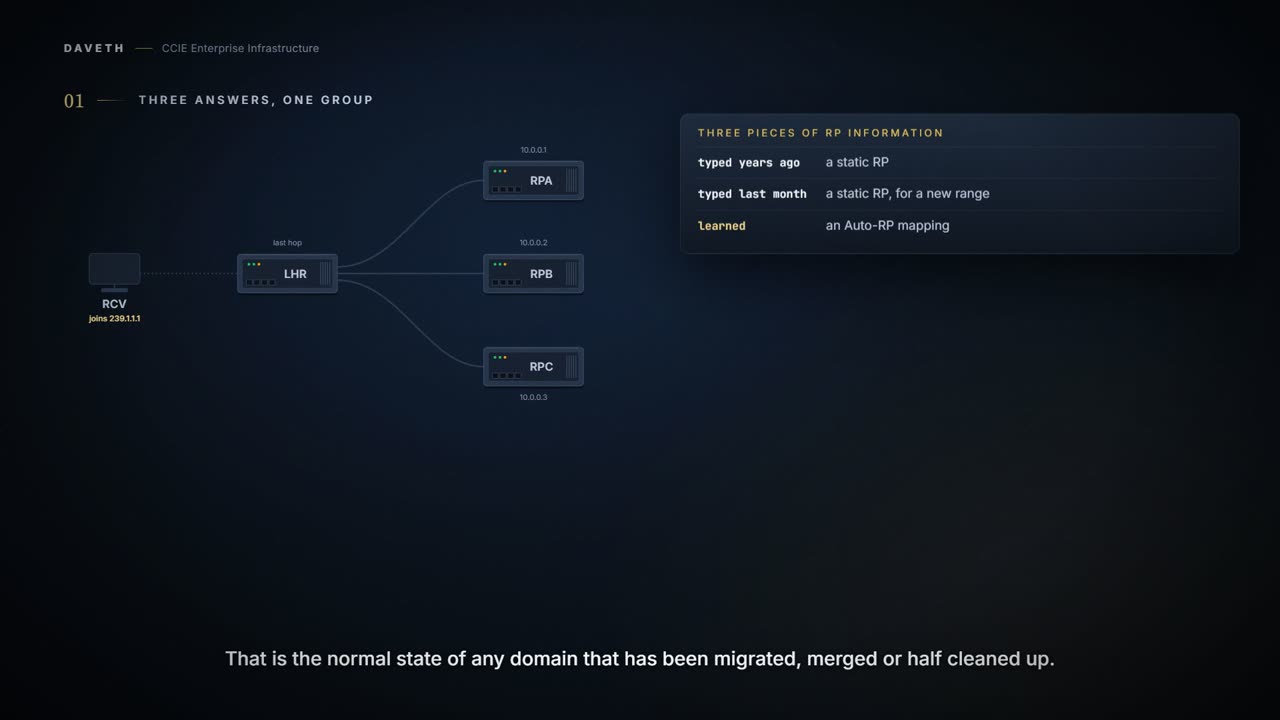
A router in your domain holds three pieces of RP information. One static line was typed years ago. A second was typed last month for a new range. And one mapping arrived from an Auto-RP mapping agent.
A receiver joins 239.1.1.1. Three mappings, one group, one answer. Which RP does this router send the join toward?
1.6.c.ii got the information onto the router. It said nothing about what the router does when more than one piece applies, and that is not a corner case: it is the normal state of any domain that has been migrated, merged or half cleaned up. Three questions settle it, asked in order. The walk asks them on one router, LHR.
Question one: is this RP even eligible for this group?
Before any contest, work out who is in the running. An RP only serves the groups it was scoped to:
The access list conditions specify the groups for which the device is an RP.
The syntax.
ip pim [ vrf vrf-name] rp-address rp-address [ access-list] [ override ] [ bidir]
Predict the default before you read it. Leave out the access list, and how many groups does that RP serve?
If no access list is specified, the static RP will map to all multicast groups.
All of them. An RP configured the quick way claims the whole multicast range, which works fine until a second RP arrives for a different purpose and claims it too. Both dynamic methods scope the same way:
So leaving the access list off is a decision, not a default you skipped past. That one omission gives the RP the entire range, and it will keep working until the day somebody adds an RP for one application and cannot understand why it is being ignored.
If no access list is configured, the RP is used for all groups. If no group-list is specified, the device is a candidate RP for all groups.
The first is the command reference on ip pim send-rp-announce; the second is the guide on ip pim rp-candidate. Several RPs serving different ranges is the normal design, not an advanced one, and it only works if each is scoped.
So what happens when two static RPs both match a group? Here are two that do, as LHR gets them in steps 2 and 3 of the walk: the quick line first, then a scoped one for a new range.
This course's lines, in the guide's procedure for assigning an RP: addresses and access list are this course's.
LHR# configure terminal
LHR(config)# ip pim rp-address 10.0.0.1
LHR(config)# ip pim rp-address 10.0.0.2 10
LHR(config)# access-list 10 permit 239.0.0.0 0.255.255.255
LHR(config)# end
Both match 239.1.1.1: the first because it has no access list, the second because access list 10 permits 239.0.0.0/8. The command reference settles it, for static lines:
You can configure multiple RPs, but only one RP per group range. Highest RP IP address selected regardless of reachability then the RP for the group is determined by the RP with the highest RP address configured.
Notice the heading's last three words. The higher address wins even if it is down. A scoping mistake that leaves two static lines overlapping can therefore point joins at an RP that cannot answer, and the configuration still looks tidy. Steps 1 to 3 of the walk.
Question two: when a typed mapping and a learned one both apply, which wins?
Now the contest. LHR holds its two static lines, and an Auto-RP mapping arrives for the same range. Predict before you read the rule: step 4 asks it.
Dynamic group-to-RP mappings take precedence over static group-to-RP mappings--unless the override keyword is used. RPs dynamically discovered through Auto-RP take precedence over statically configured RPs.
Read that before you react to it. The typed mapping loses.
Hold that against everything else this course has taught. A static route beats OSPF, EIGRP and BGP, because administrative distance assumes that what an operator typed was meant. Here the convention runs the other way: a mapping a person entered is set aside for one a protocol learned.
Why would it be built like that? The guide gives the reason in its advice on a sink RP, a static RP kept as a last resort:
A sink RP is a statically configured RP that may or may not actually exist in the network. Configuring a sink RP does not interfere with Auto-RP operation because, by default, Auto-RP messages supersede static RP configurations.
So the default treats a static RP as a fallback: present in case nothing better is learned, never getting in the way of what is. That is a sensible default for a sink RP and a trap for anyone who meant the static line to be in charge.
There is one escape. Predict its shape first: it has to be something you add to the static line, because the dynamic side is not yours to change.
The override keyword indicates that if there is a conflict between the RP configured with this command and one learned by Auto-RP or BSR, the RP configured with this command prevails.
Step 5, on LHR: only the line that changes; the access list stays as it was.
LHR# configure terminal
LHR(config)# ip pim rp-address 10.0.0.2 10 override
LHR(config)# end
One keyword, and the rule turns back to what you expected. So override is not a tuning option: it is the difference between a static RP that is in force and one that is decoration. Step 5.
It is a short word carrying the whole decision. Leave it out and the configuration still reads as though somebody chose an RP for that group, because every line you typed is present and correct. What is missing is the one that decides whether any of it is consulted.
Look at what getting it wrong looks like. The static line is in the running configuration. It has no error. show run shows exactly what you intended. And the router is using somebody else's RP.
Question three: within BSR, which candidate?
Auto-RP settles conflicts at the mapping agent, as 1.6.c.ii showed. BSR works differently: it hands the whole candidate list to every router and lets each one work out the same answer.
PIMv2 uses the BSR to discover and announce RP-set information for each group prefix to all the routers and multilayer switches in a PIM domain. The routers and switches select the same RP for a given group because they all use a common RP hashing algorithm.
One argument on the candidate BSR controls that calculation.
The syntax.
ip pim [ vrf vrf-name] bsr-candidate interface-id [ hash-mask-length] [ priority]
The guide on the hash mask length:
specify the mask length (32 bits maximum) that is to be ANDed with the group address before the hash function is called. All groups with the same seed hash correspond to the same RP. For example, if this value is 24, only the first 24 bits of the group addresses matter.
Work it through. The group address is masked first, then hashed. So the mask decides how many group addresses collapse into the same seed, and one seed means one RP. A long mask keeps more of the address, so adjacent groups can land on different RPs; a short one keeps less, so whole blocks share an RP.
Continue the lesson
The whole lesson, with its drawings and its questions. The rest of this section and 5 more after it.