
EIGRP stub with leak map
A remote router with two hubs declares itself an EIGRP stub, and only the remote is configured. Neighbours that learn of the stub status stop querying it. The keywords connected, static, summary, redistributed and receive-only decide which of its routes still leave, and a leak map lets through a route the keywords would suppress without giving up the stub declaration.
By Arif, founder of Daveth · Updated
The full 6 min walkthrough is in Daveth Pro (Network). See what the plan opens
What this page answers
What does eigrp stub do?
It tells neighbours this router is a stub, so they do not query it for any routes. Only the remote device is configured, and only the route types its keywords name are advertised. Read it in “A claim the hubs act on”
What does an EIGRP stub leak map do?
eigrp stub leak-map name references a leak map that identifies routes the stub keywords would otherwise suppress, so one route, such as a static, can still reach the hubs. Read it in “A route the keywords leave out”
What are the eigrp stub keywords?
receive-only, leak-map, connected, static, summary and redistributed. Only the specified routes are propagated; eigrp stub connected static, for example, advertises connected and static routes. Read it in “What the keywords change”
A remote router with two hubs
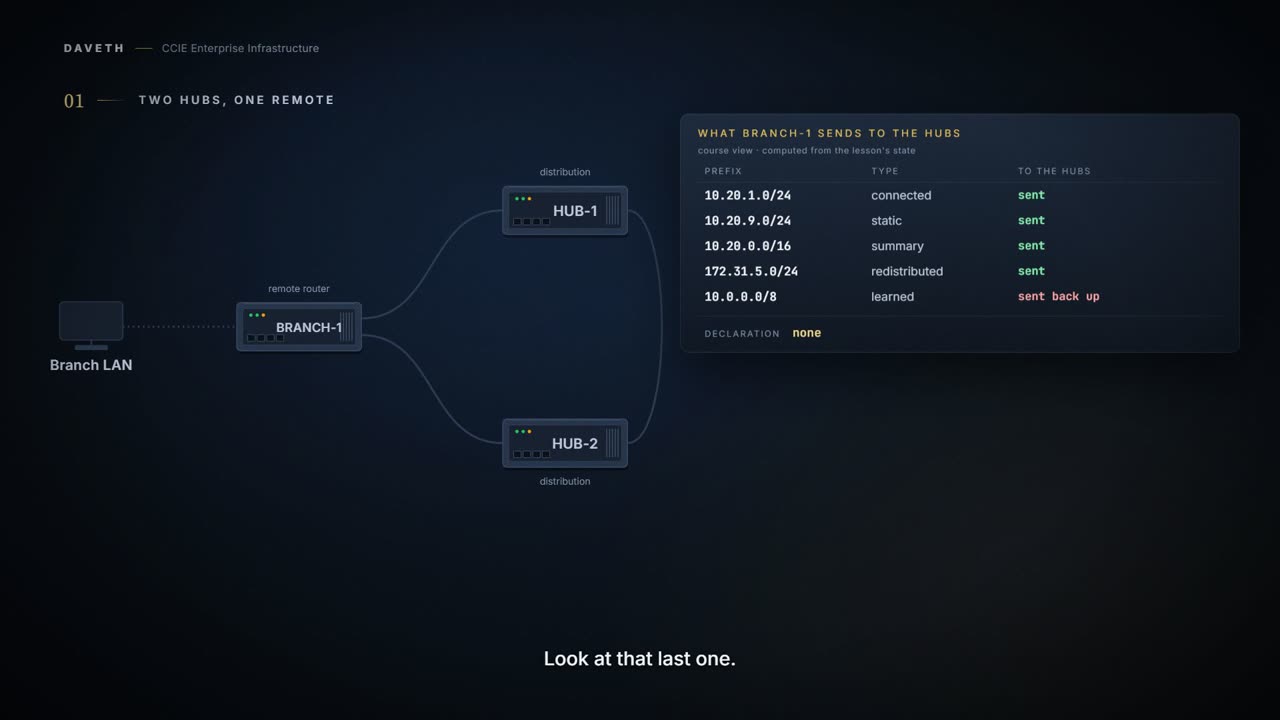
BRANCH-1 has one LAN, two uplinks, and HUB-1 and HUB-2 above it. What does it need to tell the hubs, and what should they stop asking it?
The EIGRP stub routing feature improves network stability, reduces resource utilization, and simplifies the stub device configuration. Stub routing is commonly used in hub-and-spoke network topologies. When using the EIGRP stub routing feature, you need to configure the distribution and remote devices to use EIGRP and configure only the remote device as a stub.
Computed from the state: what BRANCH-1 advertises before any declaration. No command prints it.
prefix          type           to the hubs
10.20.1.0/24    connected      sent
10.20.9.0/24    static         sent
10.20.0.0/16    summary        sent
172.31.5.0/24   redistributed  sent
10.0.0.0/8      learned        sent
declaration     none
Look at 10.0.0.0/8. It is a core route learned from one hub, and it goes back out toward the other.
The EIGRP stub routing feature can prevent this problem by preventing the remote device from advertising core routes back to the distribution devices.
A claim the hubs act on
Configuration: the declaration, no keywords, in the form this command takes; the names and numbers are this course's own.
BRANCH-1# configure terminal
BRANCH-1(config)# router eigrp 100
BRANCH-1(config-router)# eigrp stub
BRANCH-1(config-router)# end
BRANCH-1 has made the claim. What changes at HUB-1 and HUB-2?
Any neighbor that receives a packet informing it of the stub status will not query the stub device for any routes, and a device that has a stub peer will not query that peer. The stub device responds to all queries for summaries, connected routes, redistributed static routes, external routes, and internal routes with the message “inaccessible.”
Computed from the state: the queries now. No command prints it.
HUB-1, HUB-2 query BRANCH-1   no
BRANCH-1 answers a query      inaccessible
Notice where the behavior lives. BRANCH-1 makes the claim; HUB-1 and HUB-2 are the ones that stop querying.
Instead, distribution devices to which the stub device is connected answer queries on behalf of the stub device.
So what does a plain eigrp stub still advertise?
A device that is configured as a stub with the eigrp stub command shares connected and summary routing information with all neighbor devices by default.
Computed from the state: what BRANCH-1 sends with no keywords. No command prints it.
prefix          type           to the hubs
10.20.1.0/24    connected      sent
10.20.9.0/24    static         not sent
10.20.0.0/16    summary        sent
172.31.5.0/24   redistributed  not sent
10.0.0.0/8      learned        not sent
declaration     eigrp stub
What the keywords change
eigrp stub [receive-only ] [leak-map name ] [connected ] [static ] [summary ] [redistributed ] Only specified routes are propagated from the remote (stub) device.
Now BRANCH-1 names two keywords. Which of its route types still leave?
From elsewhere: a stub naming connected and static. The names in it come from elsewhere, not from this scenario.
Device(config)# router eigrp 1
Device(config-router)# network 10.0.0.0
Device(config-router)# eigrp stub connected static
to configure the device as a stub that advertises connected and static routes (sending summary routes will not be permitted)
Computed from the state: with connected static. No command prints it.
prefix          type           to the hubs
10.20.1.0/24    connected      sent
10.20.9.0/24    static         sent
10.20.0.0/16    summary        not sent
172.31.5.0/24   redistributed  not sent
10.0.0.0/8      learned        not sent
declaration     eigrp stub connected static
Look at the summary row. Naming keywords replaced the default set; the summary is not among them.
So naming what you want is also unnaming everything you did not mention. Connected and summary were defaults, not a permanent floor that your keywords get added to. Type connected static because you wanted statics, and you have just switched the summaries off without ever deciding to.
And adding static to the list is not the same as a static route being eligible. The keyword says which category may travel. Whether any particular route qualifies is a separate question, and one permitted prefix has never been permission for a whole topology.
And receive-only, which names no route type: what does BRANCH-1 still send?
to configure the device as a receive-only neighbor (connected, summary, and static routes will not be sent)
Computed from the state: with receive-only. No command prints it.
prefix          type           to the hubs
10.20.1.0/24    connected      not sent
10.20.9.0/24    static         not sent
10.20.0.0/16    summary        not sent
172.31.5.0/24   redistributed  not sent
10.0.0.0/8      learned        not sent
declaration     eigrp stub receive-only
to configure the device to advertise other protocols and autonomous systems
By this course's reading of the examples, each named keyword sends only its own type; the redistributed example does not say whether connected routes still go, and this page does not claim it.
A route the keywords leave out
BRANCH-1 names connected only, and its static route 10.20.9.0/24 has to reach the hubs. What lets that one route through without giving up the declaration?
From elsewhere: a stub referencing a leak map. The names in it come from elsewhere, not from this scenario.
Device(config)# router eigrp 1
Device(config-router)# network 10.0.0.0
Device(config-router)# eigrp stub leak-map map1
to configure the device to reference a leak map that identifies routes that would have been suppressed
Configuration: connected and a leak map, LEAK-STATIC, in the form this command takes; the names and numbers are this course's own.
BRANCH-1# configure terminal
BRANCH-1(config)# router eigrp 100
BRANCH-1(config-router)# eigrp stub connected leak-map LEAK-STATIC
BRANCH-1(config-router)# end
Computed from the state: with the leak map. No command prints it.
prefix          type           to the hubs
10.20.1.0/24    connected      sent
10.20.9.0/24    static         sent
10.20.0.0/16    summary        not sent
172.31.5.0/24   redistributed  not sent
10.0.0.0/8      learned        not sent
declaration     eigrp stub connected leak-map LEAK-STATIC
By this course's reading, LEAK-STATIC identifies 10.20.9.0/24, so it is sent beside the connected route. The page names a leak map and shows no route map or access list behind it; building one is not taught here.
Did the exception undo the claim? Do HUB-1 and HUB-2 query BRANCH-1 again?
Computed from the state: the queries, with the leak map. No command prints it.
HUB-1, HUB-2 query BRANCH-1   no
BRANCH-1 answers a query      inaccessible
Notice the first row is unchanged. The exception adds a route; it does not end the declaration.
Continue the lesson
The whole lesson, with its drawings and its questions. 5 more sections after the ones above.