
Query propagation boundaries
"Summarisation blocks queries" points at the right technique and describes it wrongly. Stub routing limits how many queries are generated; summarising the distribution block toward the core bounds those that are generated to one hop. A core router queried about a component subnet of a summary replies at once that it has no path, so the query goes no further.
By Arif, founder of Daveth · Updated
The full 5 min walkthrough is in Daveth Pro (Network). See what the plan opens
What this page answers
Does EIGRP summarization stop queries?
Not exactly. A query still reaches the core, but the core has only the summary, so it replies immediately that it has no valid path to the component subnet and does not query further: the query is bounded to one hop. Read it in “And the query DIST1 sends to the core”
How do EIGRP stub routers limit queries?
Stub routers are not queried, so stub routing limits the number of queries generated, while summarization bounds those that are generated to a single hop. Read it in “One sentence, two verbs”
"Summarisation blocks queries."
You have read that sentence, or said it. It points at the right technique, and as a description of what happens it is wrong: wrong in a way that puts the boundary in the wrong place on your diagram.
1.3.c.iv left a problem: a query goes to every neighbour on every interface, travels outward, switch to switch, and the switch that started it waits for all of it. One slow participant stalls everything, and after three minutes an adjacency dies. Two mechanisms fix that, and neither of them blocks anything.
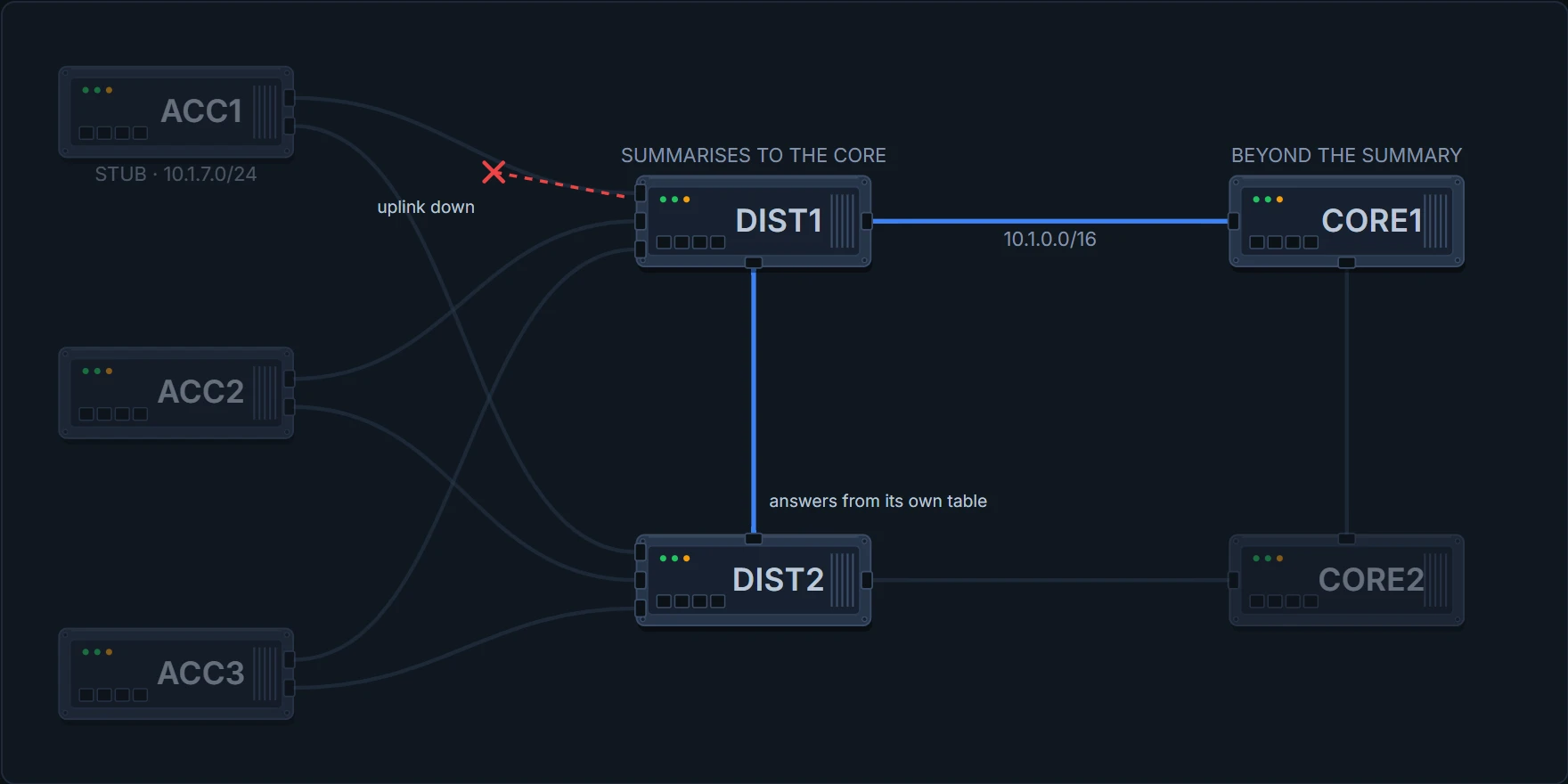
State 1 A routed-access campus, both mechanisms already in place
Where, in this picture, does a query stop?
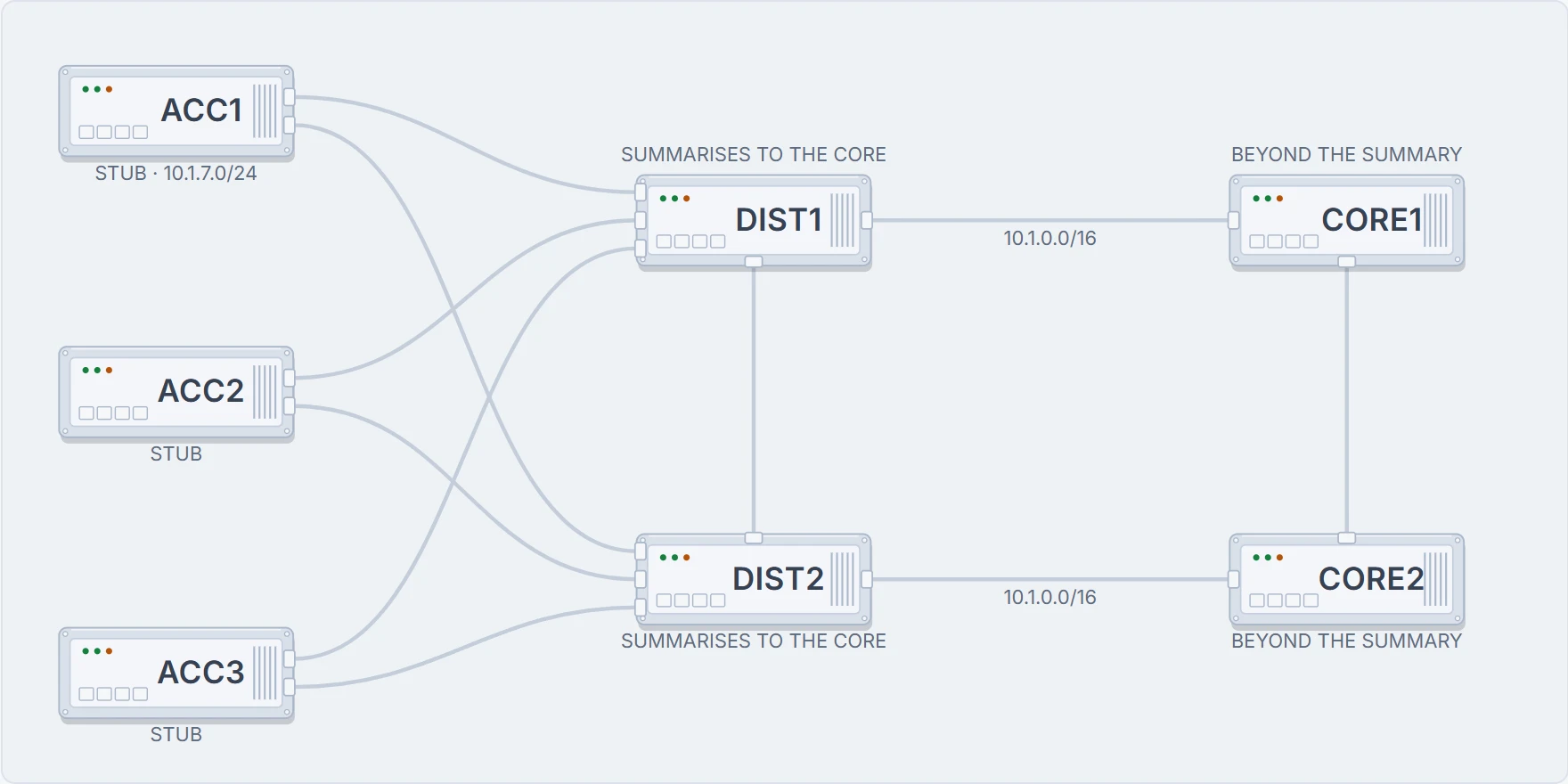
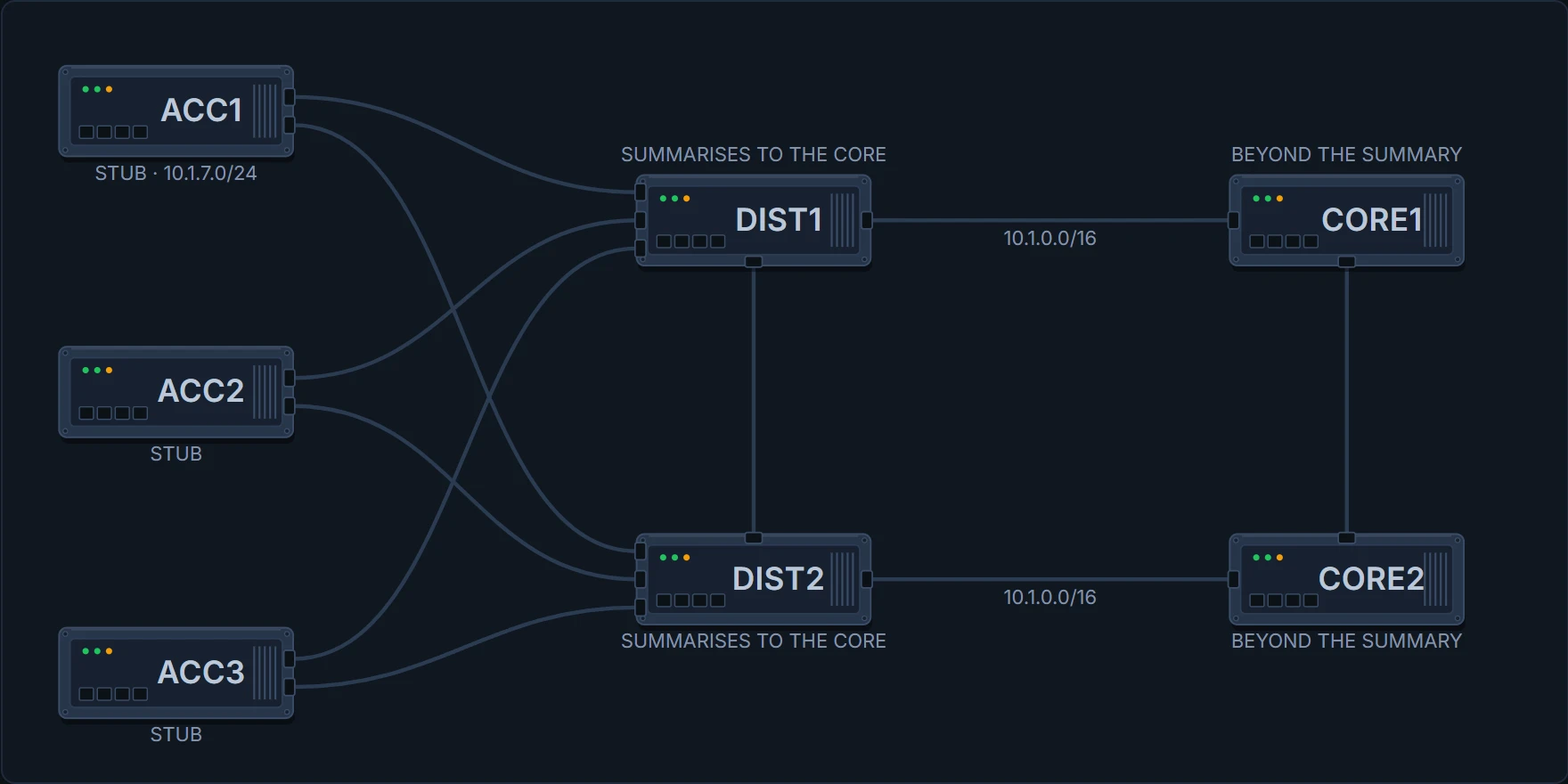
The access tier runs as a stub. The distribution pair advertises 10.1.0.0/16 towards the core instead of the component subnets behind it. Those two facts do completely different things, in different places, and the shorthand erases the difference between them.
One sentence, two verbs
Using a combination of stub routing and summarizing the distribution block routes upstream to the core both limits the number of queries generated and bounds those that are generated to a single hop in all directions.
Limits the number generated: that is stub. Bounds those that are generated to a single hop: that is the summary. Two different verbs for two different mechanisms, in one sentence, and the shorthand collapses them into a third verb that appears nowhere in the source.
So everything below reports two numbers and never one: how many queries were generated anywhere in the network, and how far the furthest one travelled. Watch which of them each mechanism moves.
An access uplink fails
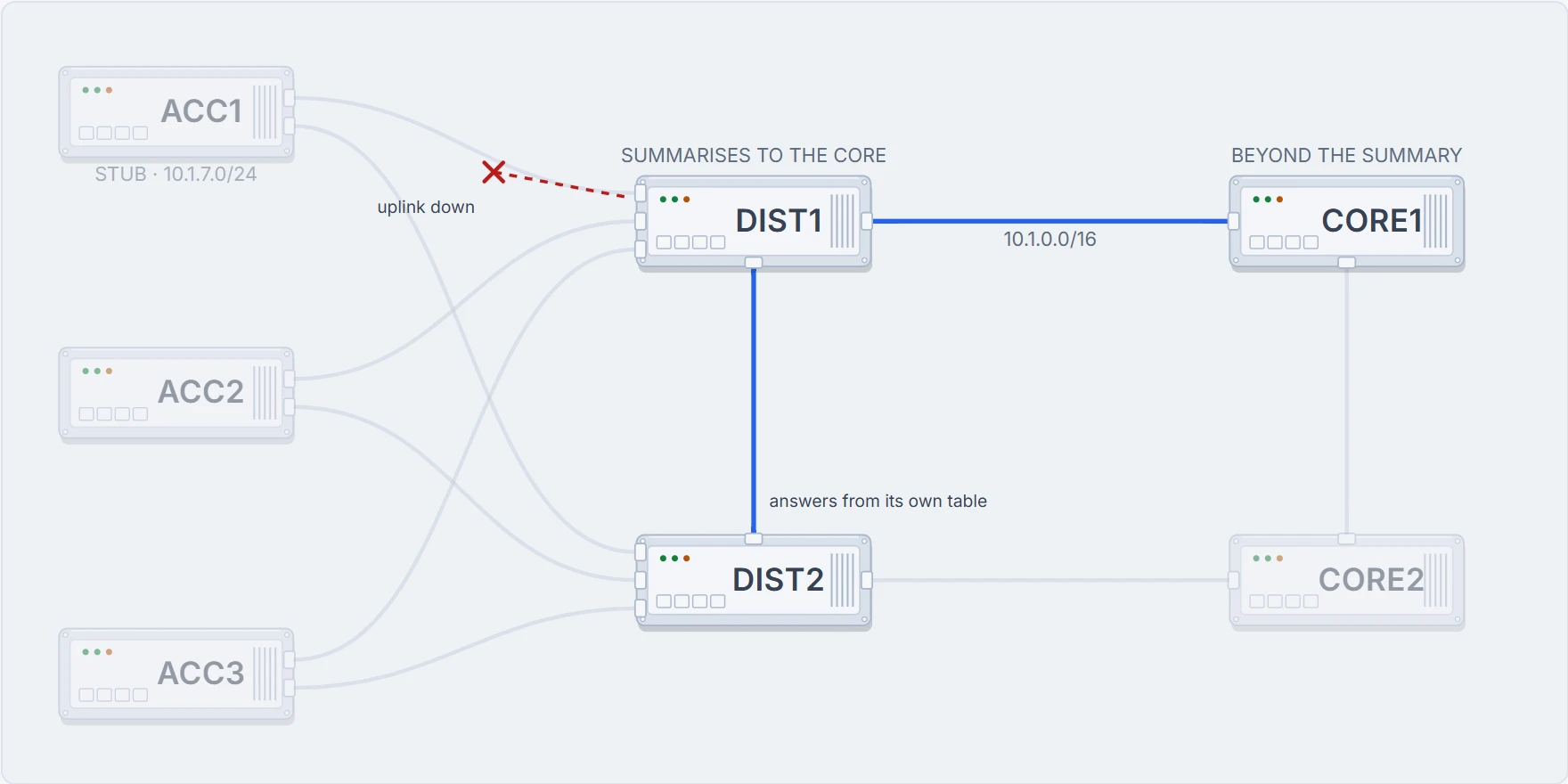
ACC1's uplink to DIST1 goes down. DIST1 loses its successor for 10.1.7.0/24, has no feasible successor for it, and goes active.
State 2 Two queries
DIST1 asks. Which of its neighbours does it ask, and which does it not?
DIST1# show ip eigrp neighbors detail
EIGRP-IPv4 Neighbors for AS(100)
H   Address           Interface       Hold  Uptime    Q Cnt
0   10.1.103.1        Te1/0/2         12    1d04h     0
    Stub Peer Advertising (CONNECTED) Routes
  ! told not to ask, so no query is generated for this neighbour at all
1   10.1.105.1        Te1/0/3         12    1d04h     0
    Stub Peer Advertising (CONNECTED) Routes
2   10.1.200.2        Te1/0/4         12    1d04h     0
3   10.1.201.2        Te1/0/5         12    1d04h     0
Four neighbours listed, and ACC1 is not one of them. It stopped being a neighbour when the uplink went down, so the reason it is not queried has nothing to do with stub routing. Two of the four listed are stubs, and the output says so.
"Any neighbor that receives a packet informing it of the stub status will not query the stub device for any routes, and a device that has a stub peer will not query that peer." So ACC2 and ACC3 are not asked. Not filtered, not dropped: the query is never generated for them.
Which makes sense the moment you ask what a stub is. A non-transit switch at the edge cannot have an alternative path to somewhere else; it is a dead end by design. Asking it "do you know another way to 10.1.7.0/24?" is asking a question whose answer is structurally always no. The stub flag is a way of saying do not bother.
| queries generated | 2 |
| furthest hop | 1 |
| switches involved | 3 of 7 |
| never queried | ACC1, ACC2, ACC3, CORE2 |
Most of the campus is never asked anything, and one of the switches never asked is the one the failure is attached to.
And the query DIST1 sends to the core
Predict this one before reading on. DIST1 has summarised 10.1.0.0/16 towards the core. A component subnet of it, 10.1.7.0/24, has gone active, and DIST1 queries CORE1 about it.
"whenever the distribution switch generates a query for a component subnet of the summarized route, the core switches reply that they do not have a valid path (cost = infinity) to the subnet query."
Read the design goal in the sentence that configures it, too: "To ensure that the core switches generate an immediate response to the query, it is necessary to summarize the block of distribution routes into a single summary route advertised towards the core." Not prevent the query. Generate an immediate response. The intent is a fast answer, not a blocked question.
So what does CORE1 actually hold for this block? Its entire topology table:
CORE1# show ip eigrp topology
EIGRP-IPv4 Topology Table for AS(100)/ID(10.0.3.1)
Codes: P - Passive, A - Active, r - reply Status

P 10.1.0.0/16, 1 successors
! one entry, and 10.1.7.0/24 is not in it anywhere
        via 10.1.201.1, Te1/0/1
And what does the switch that asked hold?
DIST1# show ip eigrp topology
EIGRP-IPv4 Topology Table for AS(100)/ID(10.0.2.1)
Codes: P - Passive, A - Active, r - reply Status

A 10.1.7.0/24, 0 successors
! active, and waiting on the two neighbours it asked
        r via 10.1.200.2, Te1/0/4
        r via 10.1.201.2, Te1/0/5
P 10.1.8.0/24, 1 successors
        via 10.1.103.1, Te1/0/2
P 10.1.9.0/24, 1 successors
        via 10.1.105.1, Te1/0/3
Three entries against one. CORE1 has never heard of 10.1.7.0/24. Asked about a subnet it has no entry for, it does not need to consult anybody: it answers from its own table, instantly, and the query ends there.
Sit with the inversion, because it is genuinely counter-intuitive. The switch answers fast precisely because it knows less. Summarisation works by creating ignorance, deliberately, in exactly the right place. Every switch beyond the summary is unable to help and therefore unable to delay you.
So the query was generated. It was sent. It travelled exactly one hop and terminated in a reply rather than in more queries. That is better than the shorthand, because it tells you where the boundary really is: not at the summarising switch, at the switch beyond it. DIST1 still queries. CORE1 is where the query stops.
Proves: show ip eigrp topology on a switch proves what that switch holds, which is the only thing that determines whether it can end a query. show ip eigrp neighbors detail proves that a given neighbour has advertised stub status, which is how you confirm the configuration took rather than assuming it.
Does not prove: that your summary bounds anything. A summary configured on this switch proves what this switch advertises. Whether it forms a boundary depends entirely on what its neighbour holds, and neither command on this page, run on the summarising switch, shows what its neighbour holds.
Which number does each mechanism move?
Same failure, same topology, and the knobs turned one at a time.
Before you read the table, notice which knobs are not in it. There is no timer here. Nothing in this design makes a switch answer sooner than it otherwise would; what changes is how many switches are asked anything at all, and how far the asking travels. Fewer questions is a result of the design, not a setting you turn up.
| Design | Queries generated | Furthest hop | Switches involved |
|---|---|---|---|
| stub and summary | 2 | 1 | 3 |
| summary only | 4 | 1 | 5 |
| stub only | 3 | 2 | 4 |
| neither | 5 | 2 | 6 |
Take the stub away and the count doubles while the distance does not move. The extra queries go to switches that are dead ends by construction, and each of them answers from its own table exactly as it would have if nobody had asked.
Take the summary away and the distance doubles while the count barely moves. With the component routes in the core, the switch that is asked has something to evaluate and no feasible successor for it, so it goes active and asks onward. What does CORE1 hold now?
CORE1# show ip eigrp topology
EIGRP-IPv4 Topology Table for AS(100)/ID(10.0.3.1)
Codes: P - Passive, A - Active, r - reply Status

A 10.1.7.0/24, 0 successors
! now it has something to evaluate, and no feasible successor for it
        r via 10.1.203.2, Te1/0/2
P 10.1.8.0/24, 1 successors
        via 10.1.201.1, Te1/0/1
P 10.1.9.0/24, 1 successors
        via 10.1.201.1, Te1/0/1
Continue the lesson
The whole lesson, with its drawings and its questions. The rest of this section and 4 more after it.