
Leak-map with summary routes
A router summarizes 10.1.0.0/22 and one component, 10.1.2.0/24, must stay visible. ip summary-address eigrp takes a leak-map naming a route map that matches the components to let through. Each way of getting it wrong is one missing object, and they fail in opposite directions: a missing route map suppresses every component, a missing ACL advertises them all.
By Arif, founder of Daveth · Updated
The full 4 min walkthrough is in Daveth Pro (Network). See what the plan opens
What this page answers
How do you advertise a component route along with an EIGRP summary?
Add leak-map name to the summary line, ip summary-address eigrp as-number address mask leak-map name, with a route map that matches the components to leak, such as through an ACL. Read it in “One component through the summary”
What happens if an EIGRP leak map references a route map that does not exist?
The keyword has no effect: the summary is advertised and all component routes are suppressed, so the route you meant to leak quietly disappears. Read it in “Two missing objects”
One component through the summary
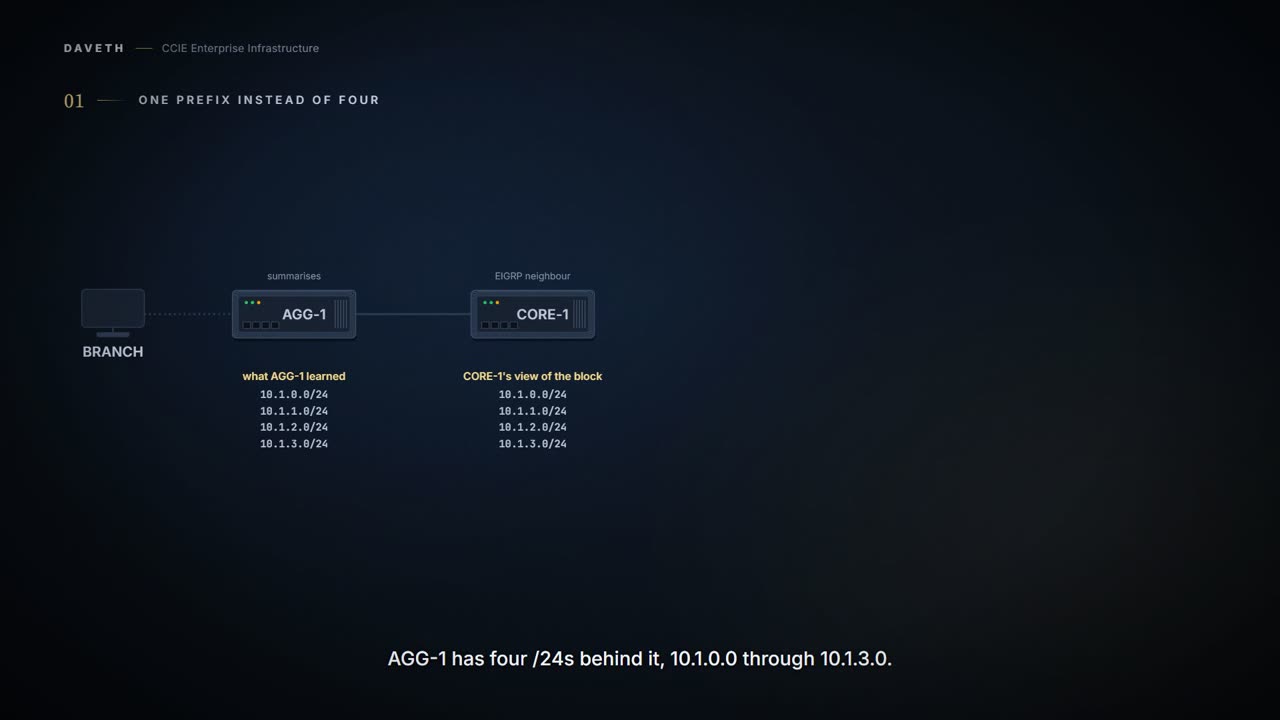
AGG-1 summarizes 10.1.0.0/22 toward CORE-1, and 10.1.2.0/24 has to stay visible. How do you advertise one prefix and still let one of its components through?
Computed from the state: what CORE-1 holds before any summary. No command prints it.
prefix          at CORE-1     what it is
10.1.0.0/22     absent        the summary
10.1.0.0/24     held          a component
10.1.1.0/24     held          a component
10.1.2.0/24     held          a component
10.1.3.0/24     held          a component
outcome         components only
The ip summary-address eigrp command is used to configure interface-level address summarization. ip summary-address eigrp as-number ip-address mask [admin-distance] [leak-map name] Route-map reference to configure route leaking through the summary.
What does a plain summary on Gi0/1 leave for the core to see?
Configuration: the summary, no leak-map, in the form this command takes; the names, addresses and numbers are this course's own.
AGG-1# configure terminal
AGG-1(config)# interface GigabitEthernet0/1
AGG-1(config-if)# ip summary-address eigrp 10 10.1.0.0 255.255.252.0
AGG-1(config-if)# end
Computed from the state: what CORE-1 holds now. No command prints it.
prefix          at CORE-1     what it is
10.1.0.0/22     held          the summary
10.1.0.0/24     absent        a component
10.1.1.0/24     absent        a component
10.1.2.0/24     absent        a component
10.1.3.0/24     absent        a component
outcome         summary only
Configuring the leak-map keyword allows to advertise a component route that would otherwise be suppressed by the manual summary. Any component subset of the summary can be leaked. A route map and access list must be defined to source the leaked route.
From elsewhere: the command reference's example, four lines it prints one per block, in its order. The names in it come from elsewhere, not from this scenario.
Router(config)# access-list 1 permit 10.1.1.0 0.0.0.255
Router(config)# route-map LEAK-10-1-1 permit 10
Router(config-route-map)# match ip address 1
Router(config-if)# ip summary-address eigrp 1 10.0.0.0 255.0.0.0 leak-map LEAK-10-1-1
Look at the two lines in the middle. The route map is what the summary names; the access list is what the route map matches. The leak-map depends on both.
So on AGG-1, which three lines let 10.1.2.0/24 through?
Configuration: ACL 20, route map LEAK-ONE, and the summary naming it, in the form this command takes; the names, addresses and numbers are this course's own.
AGG-1# configure terminal
AGG-1(config)# access-list 20 permit 10.1.2.0 0.0.0.255
AGG-1(config)# route-map LEAK-ONE permit 10
AGG-1(config-route-map)# match ip address 20
AGG-1(config-route-map)# interface GigabitEthernet0/1
AGG-1(config-if)# ip summary-address eigrp 10 10.1.0.0 255.255.252.0 leak-map LEAK-ONE
AGG-1(config-if)# end
Computed from the state: what CORE-1 holds with the leak-map. No command prints it.
prefix          at CORE-1     what it is
10.1.0.0/22     held          the summary
10.1.0.0/24     absent        a component
10.1.1.0/24     absent        a component
10.1.2.0/24     held          a component
10.1.3.0/24     absent        a component
outcome         summary and the leaked component
By this course's reading of "any component subset", the component that crosses is the one ACL 20 permits. The page does not say how the match is evaluated beyond that sentence.
Read that table again and count the rows, because the word leak makes people expect one. The summary did not go anywhere. It is still advertised, and the leaked component is advertised beside it, so the core now holds two overlapping entries that came from the same interface on the same router. Nothing about the exception cancels the aggregate.
That is the whole design, and it is why the feature is worth having. Traffic for the leaked prefix takes the specific route because it is the longer match; everything else inside the block still follows the summary. So you get the table you wanted to reduce and the one visible detail you could not afford to lose, and you pay for it with exactly one extra entry rather than all of them.
Two missing objects
Now someone removes route map LEAK-ONE, and the summary line still names it. What does CORE-1 hold?
Computed from the state: the objects. No command prints it.
summary line         ip summary-address eigrp 10 10.1.0.0 255.255.252.0 leak-map LEAK-ONE
route map LEAK-ONE   does not exist
matches the ACL      no
ACL 20               exists
If the leak-map keyword is configured to reference a nonexistent route map, the configuration of this keyword has no effect. The summary address is advertised but all component routes are suppressed.
Computed from the state: what CORE-1 holds. No command prints it.
prefix          at CORE-1     what it is
10.1.0.0/22     held          the summary
10.1.0.0/24     absent        a component
10.1.1.0/24     absent        a component
10.1.2.0/24     absent        a component
10.1.3.0/24     absent        a component
outcome         summary only
Put the route map back, and remove ACL 20 instead. Same summary line, same leak-map name. Does it fail the same way?
Computed from the state: the objects. No command prints it.
summary line         ip summary-address eigrp 10 10.1.0.0 255.255.252.0 leak-map LEAK-ONE
route map LEAK-ONE   exists
matches the ACL      yes
ACL 20               does not exist
Look at the highlighted row, then predict the table before you read it.
Computed from the state: what CORE-1 holds. No command prints it.
prefix          at CORE-1     what it is
10.1.0.0/22     held          the summary
10.1.0.0/24     held          a component
10.1.1.0/24     held          a component
10.1.2.0/24     held          a component
10.1.3.0/24     held          a component
outcome         summary and every component
The command reference's sentence for this case:
If the leak-map keyword is configured but the access-list does not exist or the route map does not reference the access list, the summary address and all component routes are sent.
Notice the second half of that sentence: "or the route map does not reference the access list". The ACL can exist and the result is the same if LEAK-ONE has no match line naming it.
Computed from the state: with the ACL back and no match line. No command prints it.
prefix          at CORE-1     what it is
10.1.0.0/22     held          the summary
10.1.0.0/24     held          a component
10.1.1.0/24     held          a component
10.1.2.0/24     held          a component
10.1.3.0/24     held          a component
outcome         summary and every component
Read the summary line in all three. leak-map LEAK-ONE is on it every time; the objects behind it are what changed, and CORE-1's table is where the difference shows.
Which way is worse
Which failure would you rather find in production?
By this course's reading, the missing access list is the costlier one: the summary was configured to hide the components, and every one of them is now advertised beside it. The missing route map loses one intended route and keeps the rest hidden.
Which gives you the one thing worth memorising about this feature: both ways of getting it wrong are one missing object, and they fail in opposite directions. Forget the route map and you advertise too little, quietly, and somebody loses a route they were promised. Forget the access list and you advertise everything, loudly, and the summary you configured to keep the table small has just filled it back up. Same typo-sized mistake. Opposite ditch.
Hiding components changes what CORE-1 is told; it does not by itself decide where queries travel. The Catalyst 9300 chapter, explaining why stub routing exists, says a query can still reach the remote device behind a summary:
If a route is lost somewhere in the corporate network, EIGRP could send a query to the distribution device, which in turn would send a query to the remote device, even if routes are being summarized.
Query scope is 1.3.e.i. This page claims only what the two sentences say about what is advertised.
Continue the lesson
The whole lesson, with its drawings and its questions. 6 more sections after the ones above.