
EIGRP packet types
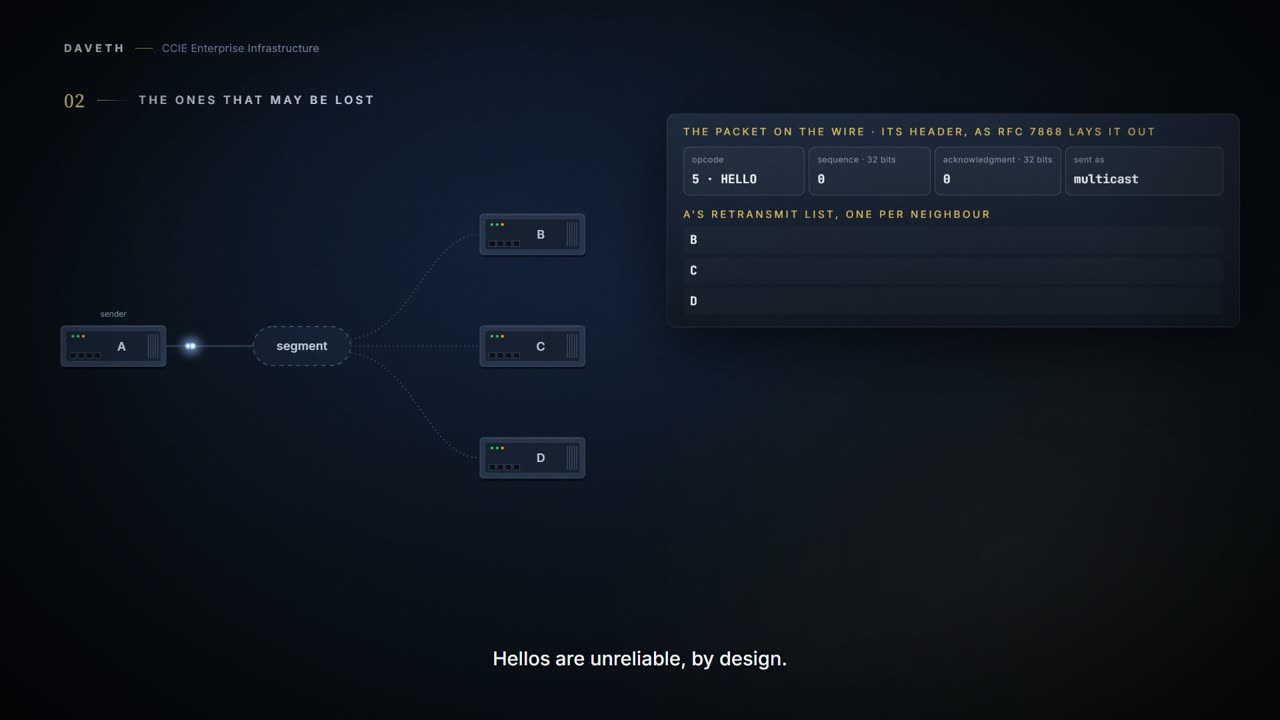
Sort EIGRP's packets by one question: which may be lost? DUAL assumes lossless communication, so the reliable transport guarantees ordered delivery of updates, queries and replies. Hellos are unreliable by design, sent with sequence number 0, and losing one costs nothing because the hold time is three hellos long. An ACK is a hello with a non-zero acknowledgement field.
By Arif, founder of Daveth · Updated
The full 4 min walkthrough is in Daveth Pro (Network). See what the plan opens
What this page answers
What are the EIGRP packet types?
RFC 7868 lists five: HELLO, which includes ACK; QUERY, including SIA-Query; REPLY, including SIA-Reply; REQUEST; and UPDATE. Read it in “The RFC's five”
Which EIGRP packets are sent reliably?
UPDATE, QUERY and REPLY are always transmitted reliably, because DUAL depends on them. HELLO packets are not, and carry sequence number 0. Read it in “The class that may not be lost”
How does EIGRP reliable transport work?
Without windowing: the receiver acknowledges each packet individually and drops packets received out of order. The first transmission is multicast, and retransmissions are unicast. Read it in “How the guarantee works”
Which of them may be lost?
Before you meet EIGRP's packet types, answer one question: which of them is EIGRP allowed to lose? Sorting them by that answer teaches more than listing them, because the answer predicts how each one is sent, acknowledged and retried.
Why anything has to be guaranteed
DUAL assumes there is lossless communication between devices and thus must depend on the transport protocol to guarantee that messages are transmitted reliably. The reliable transport is responsible for guaranteed, ordered delivery of EIGRP packets to all neighbors.
DUAL, from 1.3.c.i, reasons about distances its neighbors reported, and that reasoning falls apart if a report goes missing. So something underneath has to make its assumption true. Anything DUAL depends on must be guaranteed; anything else must not be allowed to cost that guarantee.
The class that may be lost
HELLO packets are not transmitted reliably, so the sequence number should be set to 0. The default Hold Time will be three times the HELLO interval.
Hellos are unreliable by design, marked with sequence number 0 to say so. Losing one costs nothing: the hold time is three hellos long, and from 1.3.a you know that any packet from the neighbor resets it.
There is a small irony in a protocol known for reliable delivery sending its most frequent packet with no delivery guarantee at all.
Think about the alternative. If every hello had to be acknowledged, every acknowledgment would be a packet, and a five-second heartbeat to fifty neighbors would become a retransmission problem instead of a liveness check. And the acknowledgment itself?
A HELLO packet with a non-zero ACK field should be decoded as an ACK packet rather than a HELLO packet. The sending of the acknowledgment is accomplished either by sending an ACK packet or by piggybacking the acknowledgment onto another packet already being transmitted.
An ACK is a HELLO with a non-zero ACK field, so it is unreliable too, and it can even ride on another packet that was going out anyway. If an ACK goes missing, the sender simply retransmits and gets another one.
Which stops the obvious runaway before it starts: nothing acknowledges an acknowledgement. If every receipt needed a receipt there would be no end to it, so the reliable half of this protocol is carried by a packet type that is explicitly allowed to go missing.
The RFC's five
EIGRP uses five different packet types to handle session management and pass DUAL Message types:
The RFC then lists HELLO (which includes ACK), QUERY (which includes SIA-Query), REPLY (which includes SIA-Reply), REQUEST and UPDATE. The RFC names REQUEST and does not describe its use in the text consulted, so this page does not either.
| Packet | Carries | Reliable? |
|---|---|---|
| HELLO (and ACK) | liveness; an ACK is a HELLO with a non-zero ACK field | No: SEQ=0 |
| UPDATE | destinations and their reachability | Yes |
| QUERY (and SIA-QUERY) | this route is active: what do you have? | Yes for QUERY; the RFC's text consulted does not say for SIA-QUERY |
| REPLY (and SIA-REPLY) | the answer to a query | Yes for REPLY; the RFC's text consulted does not say for the SIA pair |
| REQUEST | listed by the RFC, not described in the text consulted | not claimed |
The class that may not be lost
UPDATE packets carry the DUAL UPDATE message type and are used to convey information about destinations and the reachability of those destinations. UPDATE packets are always transmitted reliably. A QUERY packet carries the DUAL QUERY message type and is sent by a router to advertise that a route is in ACTIVE state and the originator is requesting alternate path information from its neighbors. Since EIGRP uses a reliable transport mechanism, route QUERY packets are also guaranteed be reliably delivered. A REPLY packet carries the DUAL REPLY message type and will be sent in response to a QUERY or SIA-QUERY packet.
Read those as a conversation. An update says here is what I know. A query says this route is active, so I am asking for alternatives; from 1.3.c.i, active means the router cannot prove a path, not that it has none. A reply answers it. Query and reply are what runs when the feasibility condition fails, the case 1.3.b.i took you to and stopped at: the router asks.
How the guarantee works
The protocol has no explicit windowing support. A receiver will acknowledge each packet individually and will drop packets that are received out of order. A sender of a packet includes its global sequence number in the sequence number field of the fixed header. Any packets that do not require acknowledgment must be sent with a sequence number of 0. The initial packet is always multicast and subsequent retransmissions are unicast addressed.
No windowing, and a packet out of order is dropped rather than kept: DUAL processing a change out of sequence would reason from a state that never existed. Sequence number 0 is the visible marker for do not acknowledge this. And look at what multicast-then-unicast buys, in the RFC's own figure:
The RFC's Figure 7, its first two messages, lines as printed, with the figure's two columns set one under the other. "A send" is the figure's own wording.
A send UPDATE (multicast)
SEQ=100, ACK=0
B sends ACK (unicast)
SEQ=0, ACK=100
Steps 2 and 3 of the walk: one multicast UPDATE, SEQ=100. C and D each acknowledge, SEQ=0, ACK=100. B's copy is lost, so SEQ 100 stays on B's list and goes again, by unicast, to B alone. C and D are not sent it twice.
That retransmission went to B alone, and that is the design. One neighbour missed it, so one neighbour gets it again. The two that answered are not made to sit through the same update a second time, and on a segment with fifty neighbours that difference is the whole reason this scales.
And note what an acknowledgement is evidence of. It proves the packet arrived. It says nothing about what the receiver then did with it, whether DUAL liked the change or whether the route went anywhere, so an ACK is a receipt rather than an agreement.
Continue the lesson
The whole lesson, with its drawings and its questions. 5 more sections after the ones above.