
EIGRP graceful shutdown
Neighbours normally notice a router has gone when its hold time runs out, so during a planned reload they keep forwarding to it until then. The goodbye message, sent when an EIGRP process shuts down, tells peers at once. Older releases that do not support it misread it as a K-value mismatch, because the signal is a hello carrying K-values set to 255.
By Arif, founder of Daveth · Updated
The full 4 min walkthrough is in Daveth Pro (Network). See what the plan opens
What this page answers
What is the EIGRP goodbye message?
A message sent when an EIGRP routing process is shut down, telling neighbours about the coming topology change so they recalculate at once instead of waiting for the hold timer to expire. Read it in “Saying goodbye”
Why does an EIGRP neighbour log a K-value mismatch during a shutdown?
A peer running a release without goodbye support can misread the goodbye as a K-value mismatch. Older routers signal it with the parameters TLV, the one carrying K-values, with all K-values set to 255 except K6. Read it in “Why it reads as a K-value mismatch”
Detection by silence
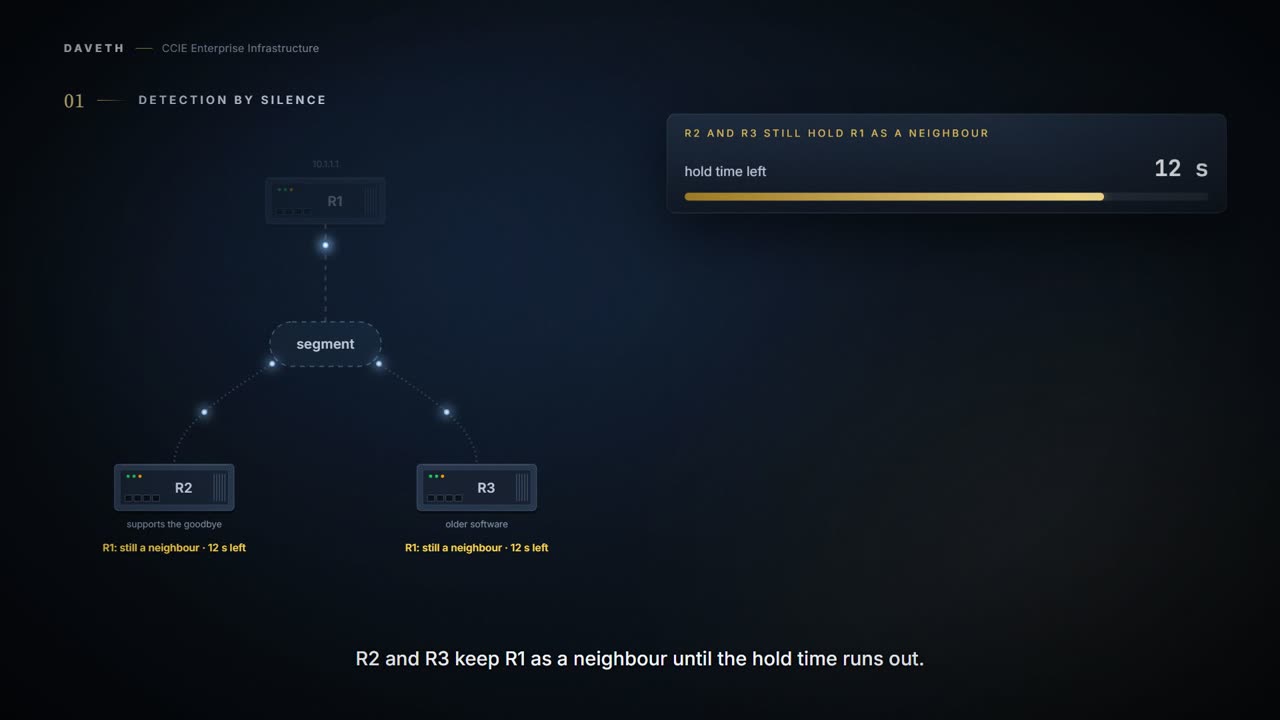
Somebody is about to reload a router. Not a failure: planned work, change window, everybody knows. The question is what its neighbors experience, because the ordinary way EIGRP notices a neighbor has gone is to notice it has stopped talking:
The hold time is advertised in hello packets and indicates to neighbors the length of time they should consider the sender valid.
Read the mechanism in that sentence. You are valid until a countdown runs out. So during a planned, known-about shutdown, every neighbor spends the hold time still forwarding toward a router that has already gone. Not because anything is wrong; because nobody said anything. Why not just tell them? Steps 1 and 2 of the walk.
Saying goodbye
The goodbye message is a feature designed to improve EIGRP network convergence. The goodbye message is broadcast when an EIGRP routing process is shut down to inform adjacent peers about an impending topology change. This feature allows supporting EIGRP peers to synchronize and recalculate neighbor relationships more efficiently than would occur if the peers discovered the topology change after the hold timer expired.
Notice what that buys: you swap a timeout for a notification. The peers still do the same work, recalculating and running DUAL. They just start now instead of after a countdown that was telling them nothing. It spares them none of that work, and it preserves nothing across the reload. It changes when the neighbors find out, and nothing else.
And the countdown was never information. It was a period of not knowing, dressed up as a measurement. Everything the neighbours learn at the end of it, they could have been told at the start, and traffic was being sent toward a router that had already gone for the whole of the difference.
The blueprint calls this item graceful shutdown. The guide calls the mechanism the goodbye message, and the RFC names the signal a peer termination. Same thing, three names.
The part that will catch you
Two neighbors hear the same goodbye. One runs a release that supports it; one does not. Predict what the older one logs before reading on; step 3 of the walk asks it.
The guide's two example lines, as printed. They are two examples, one for each kind of peer, not one moment seen twice.
*Apr 26 13:48:42.523: %DUAL-5-NBRCHANGE: IP-EIGRP(0) 1: Neighbor 10.1.1.1 (Ethernet0/0) is down: Interface Goodbye received
A Cisco device that runs a software release that does not support the goodbye message can misinterpret the message as a K-value mismatch and display the following error message:
*Apr 26 13:48:41.811: %DUAL-5-NBRCHANGE: IP-EIGRP(0) 1: Neighbor 10.1.1.1 (Ethernet0/0) is down: K-value mismatch
Misinterpret. The older router hears a polite farewell and files a configuration complaint. And that complaint is a real one elsewhere: from 1.3.a, a K-value mismatch is a genuine reason two routers will not become neighbors. So the same log line now has two causes: the K-values really differ, or a neighbor said goodbye and this device did not know what that was.
Why it reads as a K-value mismatch
RFC 7868 describes the signal, in section 6.7.7, the Peer Termination TLV:
This TLV is used in HELLO packets to notify the list of neighbors that the router has reset the adjacency. This is used anytime a router needs to reset an adjacency, or signal an adjacency it is going down.
And its implementation note says how older Cisco routers do it: with the Parameters TLV, the one that carries K-values in hellos,
with all K-values set to 255 (except K6).
Put that beside two more sentences from the same RFC:
The HELLO packet will include the configured EIGRP metric K-values. Two routers become neighbors only if the K-values are the same. Setting K-values up to 254 scales the impact of the scalar metric on the final composite metric.
This course's reading, joining the two sources: a configured K-value runs up to 254, so 255 is a signal, not a setting. A router that knows the signal reads goodbye. A router that does not compares 255 with its own K-values, finds they differ, and says so. The guide says it misinterprets; the RFC says what it receives; the join is ours.
Continue the lesson
The whole lesson, with its drawings and its questions. 6 more sections after the ones above.