
Introduction to TCP/IP Networking
Networks work because devices follow agreed rules: protocols, which define what a message looks like and what each part means, and standards, which any company can build products to. A networking model collects those rules and sorts them into layers. TCP/IP is the model networks use today; vendors' own models and OSI fell away.
By Arif, founder of Daveth · Updated
The full 9 min walkthrough is in Daveth Pro (Network). See what the plan opens
What this page answers
What is a networking protocol?
A set of logical rules that devices must follow to communicate: what a message looks like, and what each part of it means. A standard is a published agreement any company can build its products to. Read it in “Rules: protocols and standards”
What is a networking model?
A large set of documents, each describing one small function a network needs, which together define everything that should happen for a network to work. A model sorts its protocols and standards into categories called layers. Read it in “Networking models”
Rules: protocols and standards
Networks work because the devices on them, and the software on those devices, follow rules. The rules come as protocols and standards: agreements about how one particular part of a network should work. A standard is a published agreement that any company can build its products to.
Power plugs are the everyday version. Because the shape of the wall socket is agreed and published, any company can make a kettle that fits it, and nobody has to ask who made the socket.
A protocol is a set of logical rules that devices must follow to communicate: what a message looks like, and what each part of it means. Other rules are physical, such as the voltage and current levels used on a cable.
A restaurant kitchen shows why. The waiter writes "T12 / 2 tea / 1 no sugar" on a ticket, and the cook reads it. If the cook reads T12 as "twelve teas" instead of "table 12", the ticket arrived perfectly and lunch still went wrong. (The comparison stops there: devices follow exact rules, bit by bit, not handwriting.)
The kitchen follows the ticket that arrived, not the order everybody hoped was on it.
Data travels as bits: each bit is a single 1 or 0. Why do devices need agreed rules if the cable already carries the bits? Two devices, one working cable, sixteen bits:
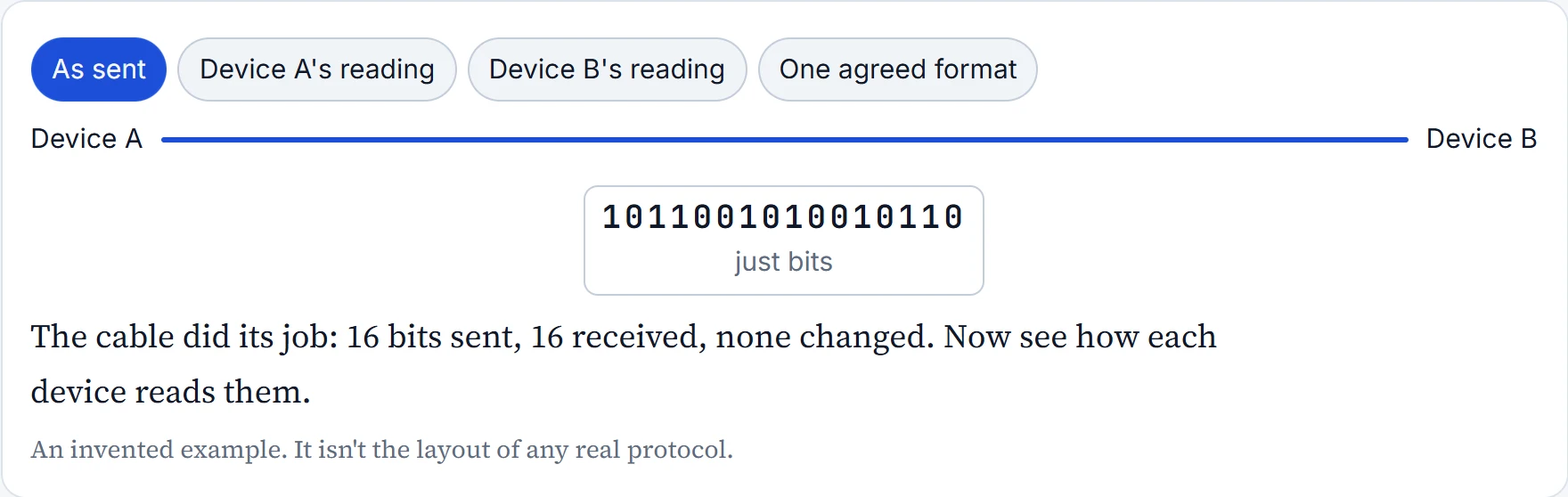
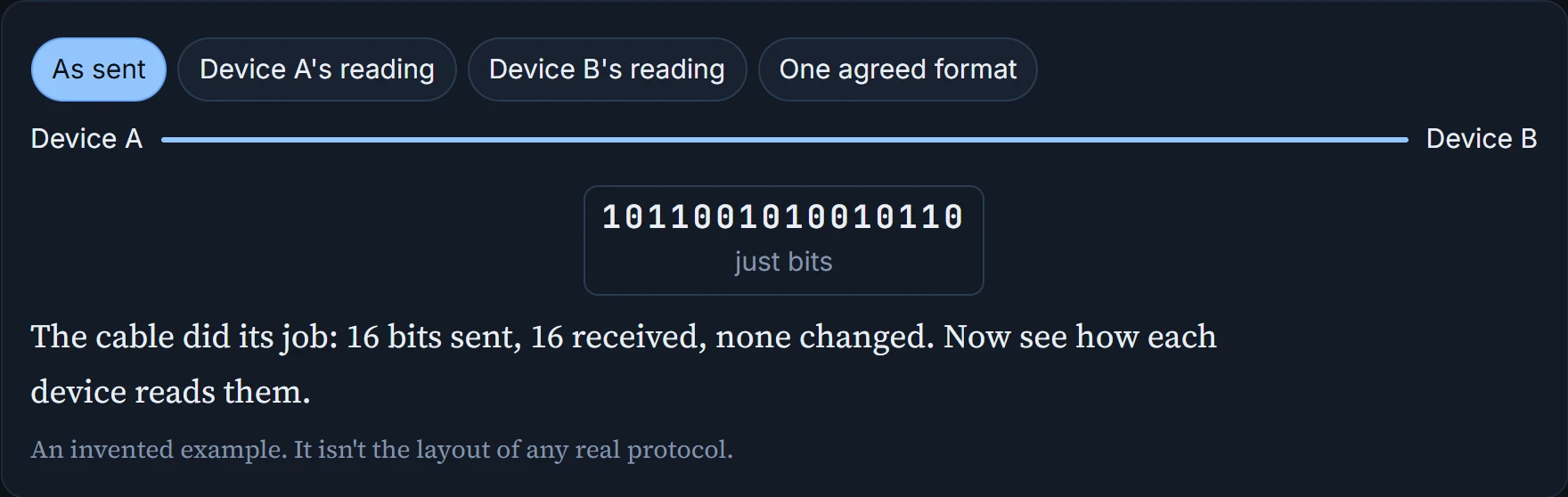
The cable delivered every bit perfectly. The two devices disagreed about what the bits meant. Very efficient confusion.
Delivering bits isn't the same as communicating. The devices also need the same rules, decided in advance and written down, so that both read the same message from the same bits. That agreement is a protocol.
Maya's office from 01.1 depends on this. Her desk PC, SW1 and the staff portal's server were made by different companies, and they work together.


The path from 01.1: Maya's desk PC, SW1, the enterprise network, and the staff portal's server.
Networking models
A working network needs a great many protocols and standards: so many that keeping them all in mind can be hard, even for a network engineer. So, over time, networking has used several networking models. A networking model is also called a networking architecture or a networking blueprint.
A networking model is a large set of documents. Each one describes one small function a network needs, and together they define everything that should happen for a network to work. Some documents define protocols; others define physical requirements.
A model also sorts its protocols and standards into a few categories, called layers. When a new protocol comes along, it has a place to go. The last section of this page shows TCP/IP's layers.
In plain words: a networking model is the big rulebook for networks, and the layers are its sections, one for each kind of work.
The name "blueprint" fits. You could build a house without one. But the blueprint helps make sure the house has the right foundation and the hidden spaces for plumbing, electrics and gas. And the framers, electricians, bricklayers and painters who follow it know their part shouldn't cause problems for anyone else's. The people who make networking products, and the people who build networks from them, follow a model in the same way: it defines how each part of a network should work, and how the parts work together.
You could build a network from scratch, writing your own software and making your own network cards, the parts of a computer that connect it to a cable or to Wi-Fi. It's much easier to buy products built to a well-known model. Because vendors, the companies that make them, build their products with a model in mind, those products should work well together.
How TCP/IP came to be
Networking didn't start with one shared model. The first protocols were made by vendors, and each vendor's protocols supported only that vendor's computers. A model owned by one company like that is called proprietary. The computer company that had the largest market share in many markets during the 1970s and 1980s published its own model in 1974, and other vendors made their own.
Inside one vendor's world, that often worked well. The trouble came when a company bought computers from several vendors. With three vendors, engineers often had to build three different networks, and then connect them somehow. That made the whole network much more complex.
It was a bit like each phone maker using its own charger: fine while you owned one brand, and a drawer full of cables once you owned three. (The real problem was bigger than cables: whole separate networks.)
Vendor A talked fluently to Vendor A. Vendor B could join after somebody found a translator and, very likely, a purchase order.
An open, vendor-neutral model, one that no single company owns, would help competition and cut that complexity. Two efforts set out to make one:
- OSI, the Open Systems Interconnection model, from the ISO, the International Organization for Standardization. Work began in the late 1970s, with people from most technologically developed nations taking part, and a big goal: protocols that let every computer on the planet communicate.
- TCP/IP, from a less formal effort. It grew from a US Department of Defense contract, and researchers at several universities volunteered to develop it further.
In the 1990s, companies began adding OSI, TCP/IP or both to their networks. By the end of the decade TCP/IP was the common choice and OSI had fallen away. Today TCP/IP dominates. Proprietary models still exist, but most have been dropped in its favour. OSI never succeeded in the marketplace. Its development suffered, in part, from a slower formal standards process than TCP/IP's. And TCP/IP, built almost entirely by volunteers, became the most widely used networking model there has ever been.
You'll probably never work on a network that runs OSI's own protocols. You'll still often meet OSI's terms, and 01.3 covers them.
OSI had the committees. TCP/IP had the volunteers, and the volunteers got there first.
Here are the three decades side by side. As in 01.1, each shape is a whole network whose inside isn't drawn:
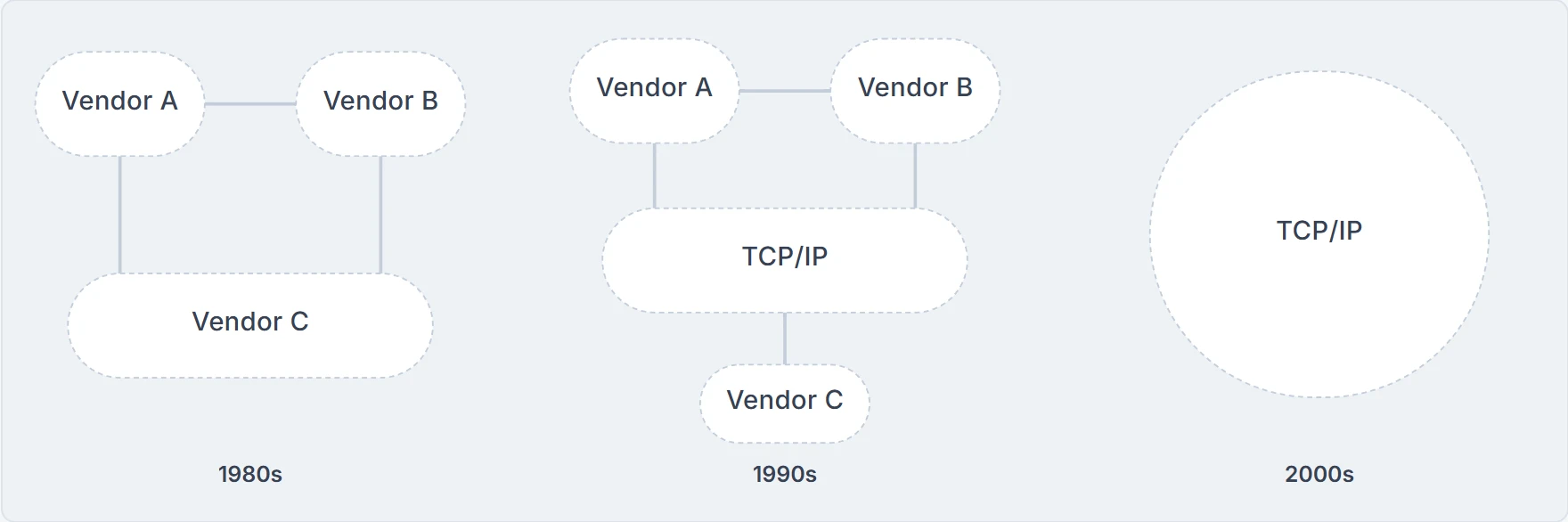
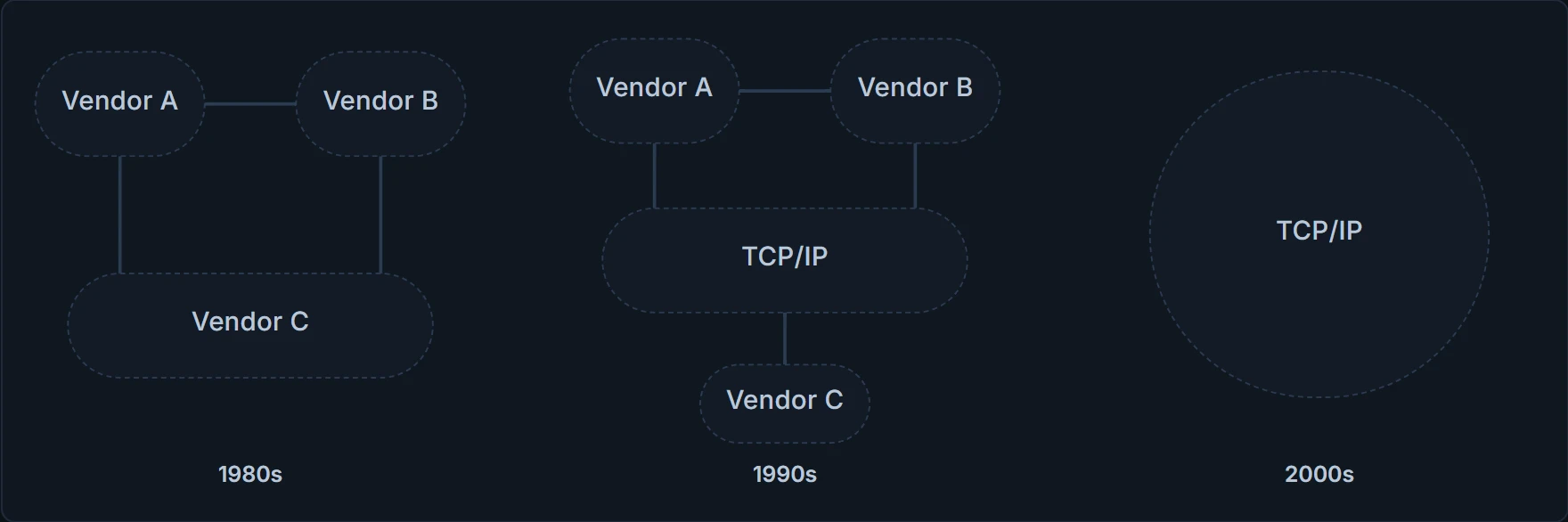
Left to right: in the 1980s, three vendor networks, each joined to the other two. In the 1990s, the same vendor networks with TCP/IP among them. Since then, one TCP/IP network.
Continue the lesson
The whole lesson, with its drawings and its questions. 3 more sections after the ones above.