
Route reflectors
A router that learns a route over iBGP does not pass it to its other iBGP peers, so without a full mesh routes stop in the middle. A route reflector is an ordinary iBGP router allowed to pass them on to clients you name on the reflector alone. Routes from clients go to everyone; routes from non-clients go only to clients, so two non-clients still need their own session.
By Arif, founder of Daveth · Updated
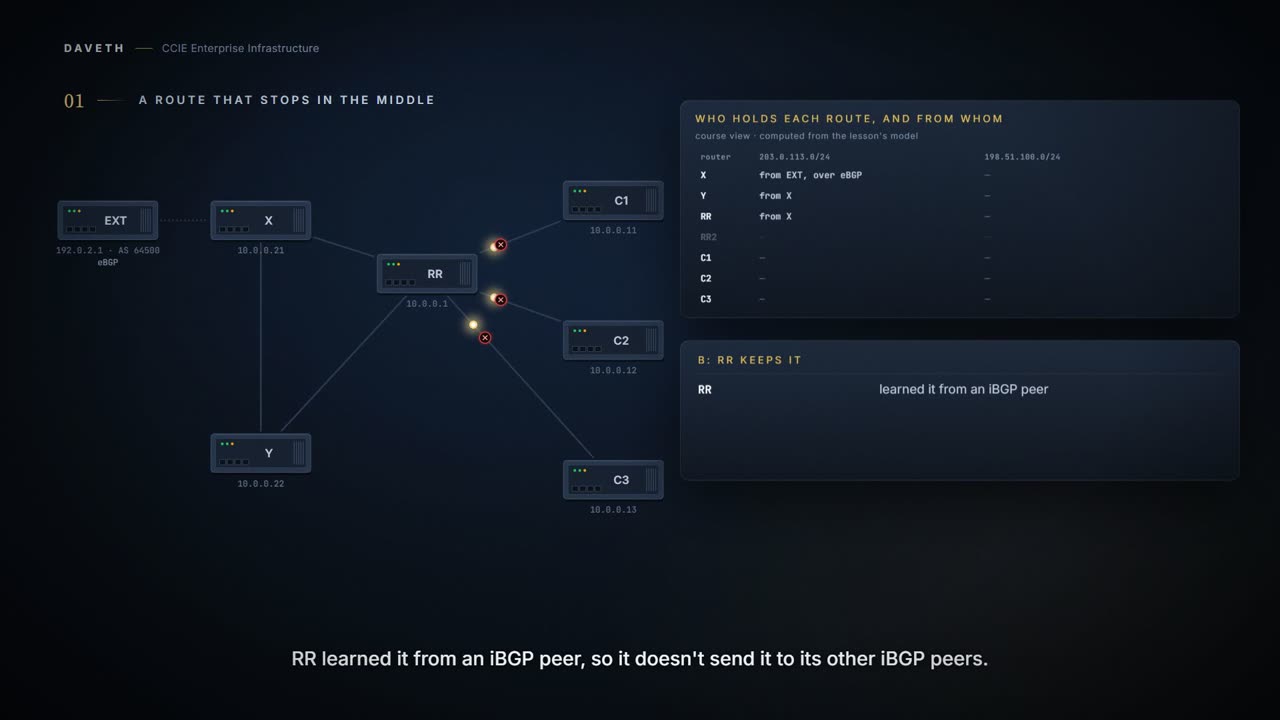
The full 6 min walkthrough is in Daveth Pro (Network). See what the plan opens
What this page answers
What are the BGP route reflector rules?
A route from a non-client is advertised to all clients, not to other non-clients. A route from a client is advertised to all clients and non-clients. A route from an eBGP speaker is advertised to all clients and non-clients. Read it in “X sends a route to RR. Where does RR send it?”
How do you configure a BGP route reflector?
On the reflector only: neighbor address route-reflector-client for each client. Nothing about reflection is typed on the clients. Read it in “A router allowed to pass iBGP routes on”
Do non-clients need a full mesh with a route reflector?
Yes, between themselves. The reflector will not reflect a non-client's route to another non-client, so removing the session between two non-clients loses routes even though every other session is up. Read it in “Removing the X–Y session”
A route that stops in the middle
EXT sends 203.0.113.0/24 to X over eBGP. X tells RR over iBGP. RR has not been configured as anything special yet.
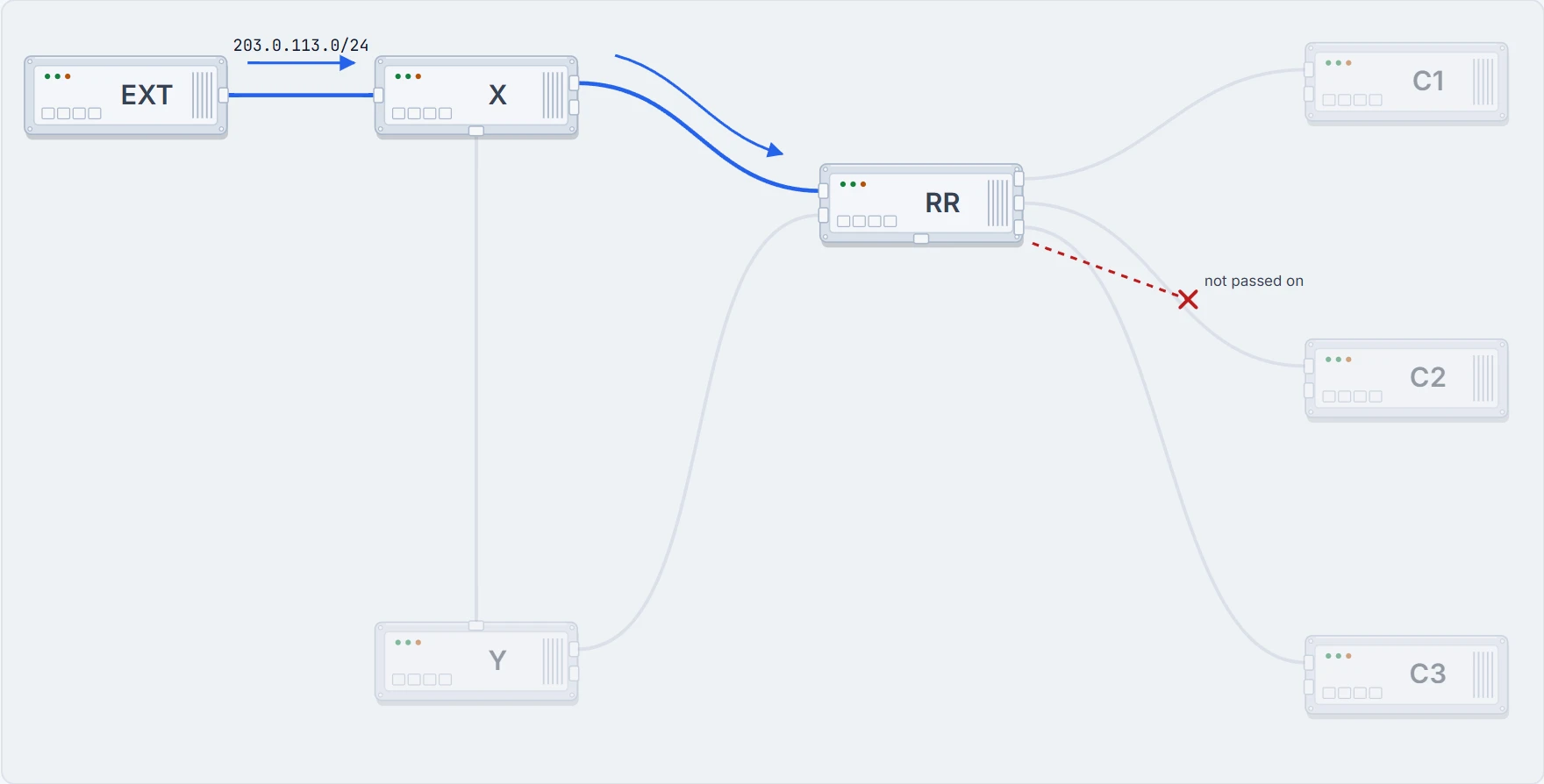
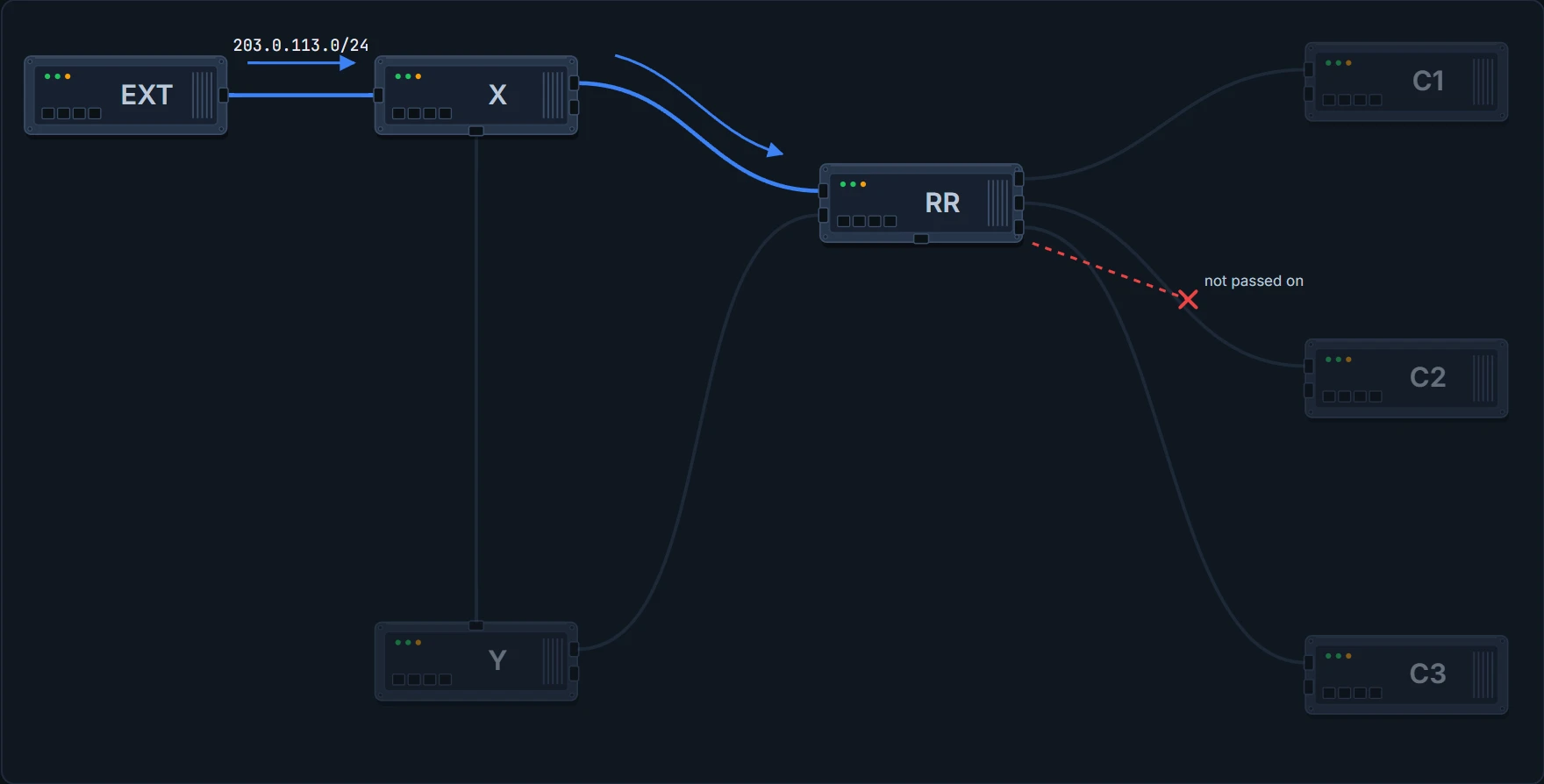
RR learned the route from an iBGP peer, so RR does not pass it to its other iBGP peers. C1, C2 and C3 never hear it. That is normal iBGP, and it is there to stop a route going round in circles inside one AS.
So what does C1 hold for it?
This course's output on C1, computed from the scenario, in a layout of its own; the field names are the documented ones.
C1# show ip bgp 203.0.113.0/24
% Network not in table   ! C1 never heard it.
One fix is a direct session from X to C1. Then X–C2, X–C3, and the same from Y, and between the clients, every router talking directly to every other. With 6 routers that is 15 sessions. With 40 it is 780.
Everyone phoning everyone works beautifully, right up until somebody hires another router. Add one more and every router already there needs its details typed in. And these are peer statements, not cables: nobody is asking you to pull hundreds of fibres.
A router allowed to pass iBGP routes on
With route reflectors, all iBGP speakers need not be fully meshed because there is a method to pass learned routes to neighbors.
A route reflector is an ordinary iBGP router given permission to pass iBGP-learned routes on, to peers you name. You name them on the reflector:
RR# configure terminal
RR(config)# router bgp 65001
RR(config-router)# neighbor 10.0.0.11 route-reflector-client
RR(config-router)# neighbor 10.0.0.12 route-reflector-client
RR(config-router)# neighbor 10.0.0.13 route-reflector-client
RR(config-router)# end
C1, C2 and C3 are now clients. X and Y are non-clients. Nothing about reflection was typed on C1, C2 or C3, the relationship is RR's view of its neighbors, and it shows only on RR. Which of RR's neighbors are clients?
This course's output on RR, computed from the scenario, in a layout of its own; the field names are the documented ones.
RR# show ip bgp neighbors
BGP neighbor is 10.0.0.21,  remote AS 65001, internal link
  BGP state = Established
BGP neighbor is 10.0.0.22,  remote AS 65001, internal link
  BGP state = Established
BGP neighbor is 10.0.0.11,  remote AS 65001, internal link
  Route-Reflector Client
  ! The client relationship lives on the reflector.
  BGP state = Established
BGP neighbor is 10.0.0.12,  remote AS 65001, internal link
  Route-Reflector Client
  BGP state = Established
BGP neighbor is 10.0.0.13,  remote AS 65001, internal link
  Route-Reflector Client
  BGP state = Established
Who still needs a direct iBGP session?
Clients can depend on RR to pass routes between them, so C1, C2 and C3 do not need sessions with one another.
X and Y are different. If X sends a route to RR, RR will not reflect it to Y. So X and Y still need their own direct iBGP session.
Every session here is Established. The relationship is still complicated. Watch which two: a route X learns cannot reach Y through RR, and a route Y learns cannot reach X. Non-client to non-client is the pair reflection never covered, and it is the session people delete first.
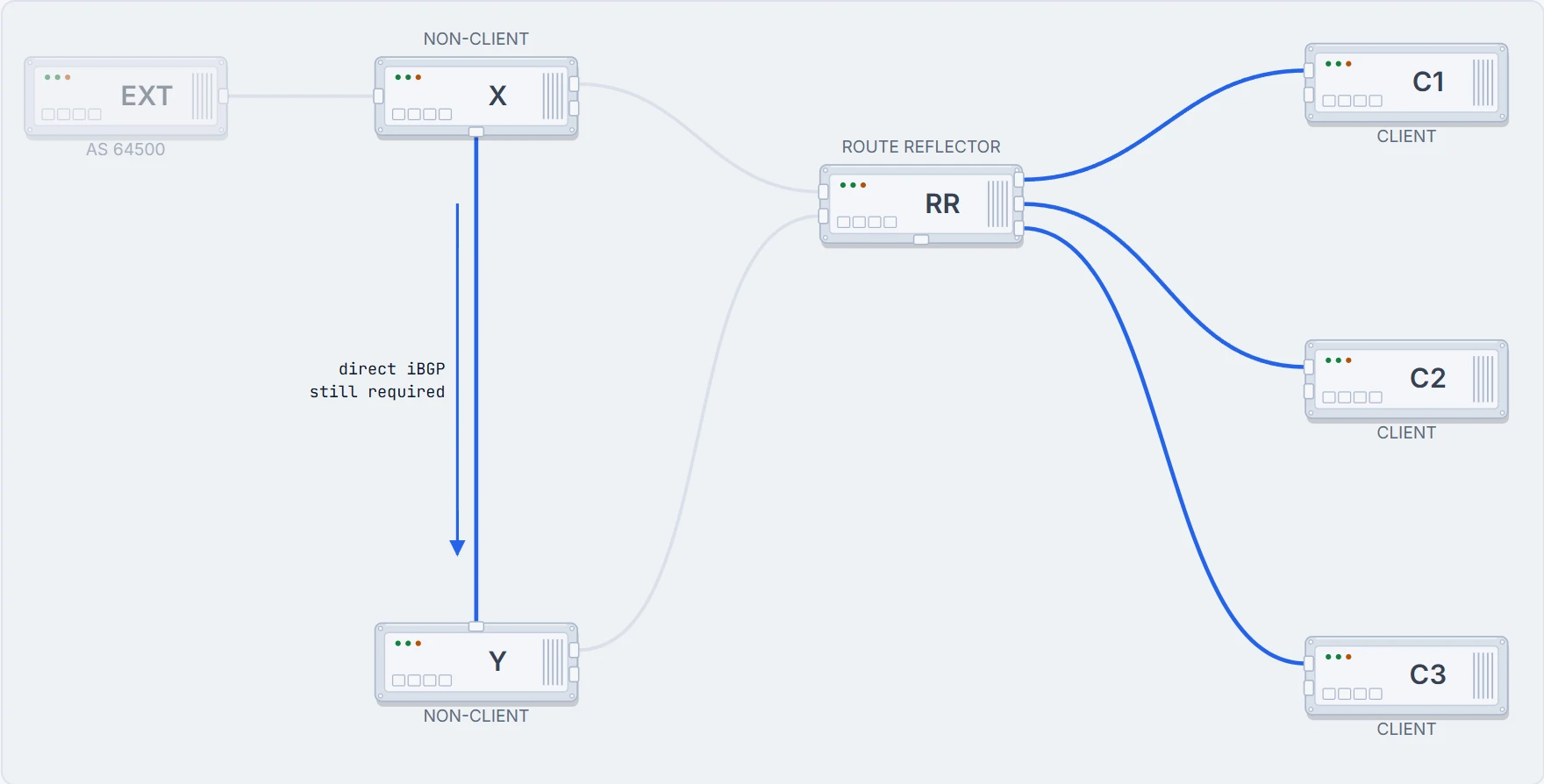
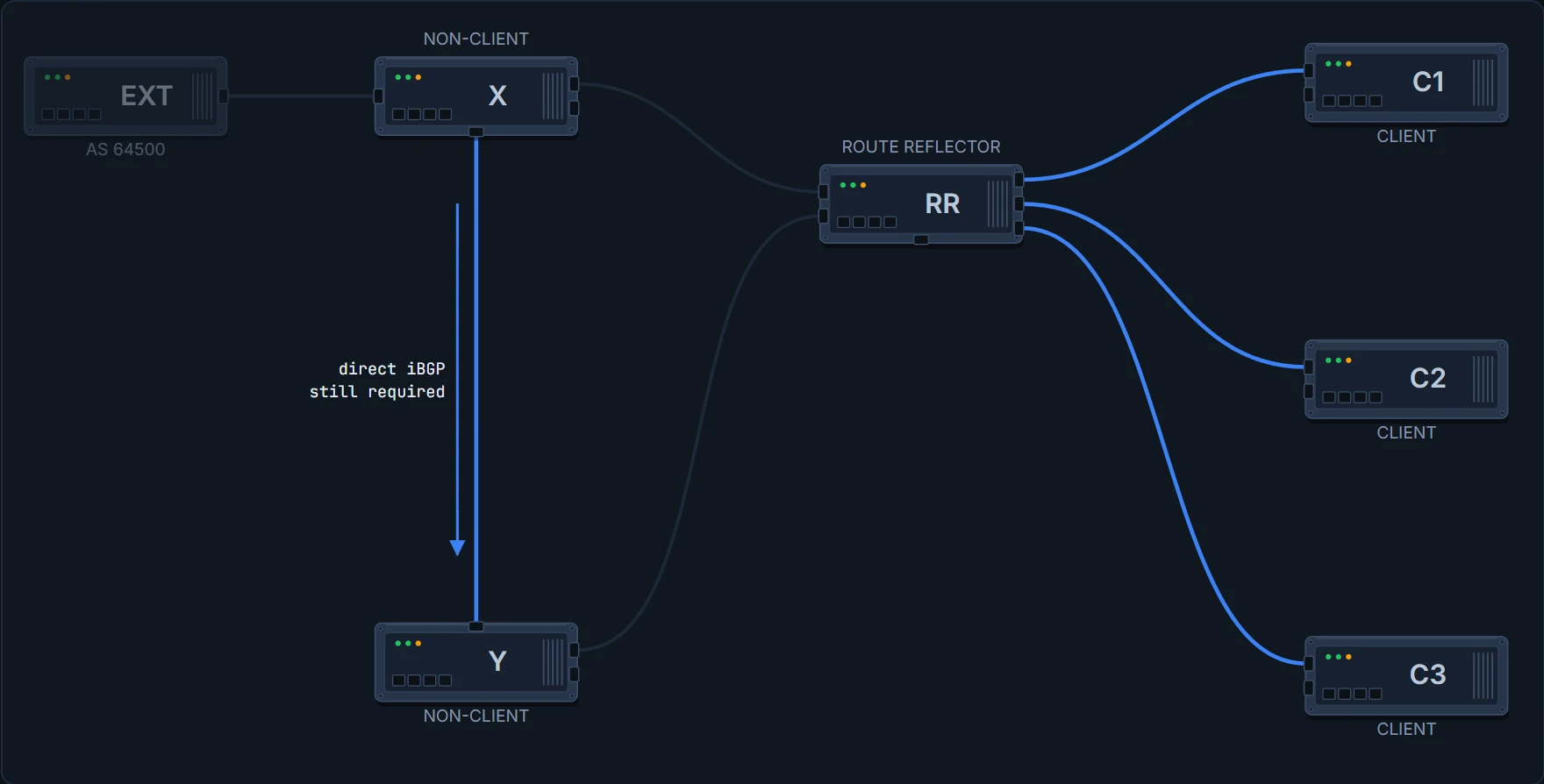
That direct X–Y line is the part route reflection did not remove. Now the names:
The internal peers of the route reflector are divided into two groups: client peers and all the other routers in the autonomous system (non-client peers). The route reflector and its client peers form a cluster. The non-client peers must be fully meshed with each other, but the client peers need not be fully meshed.
X sends a route to RR. Where does RR send it?
X learned 203.0.113.0/24 from EXT, and tells its iBGP neighbors: RR and Y. Now watch RR. RR learned this route from X, and X is a non-client.
A route from a non-client peer is advertised to all clients.
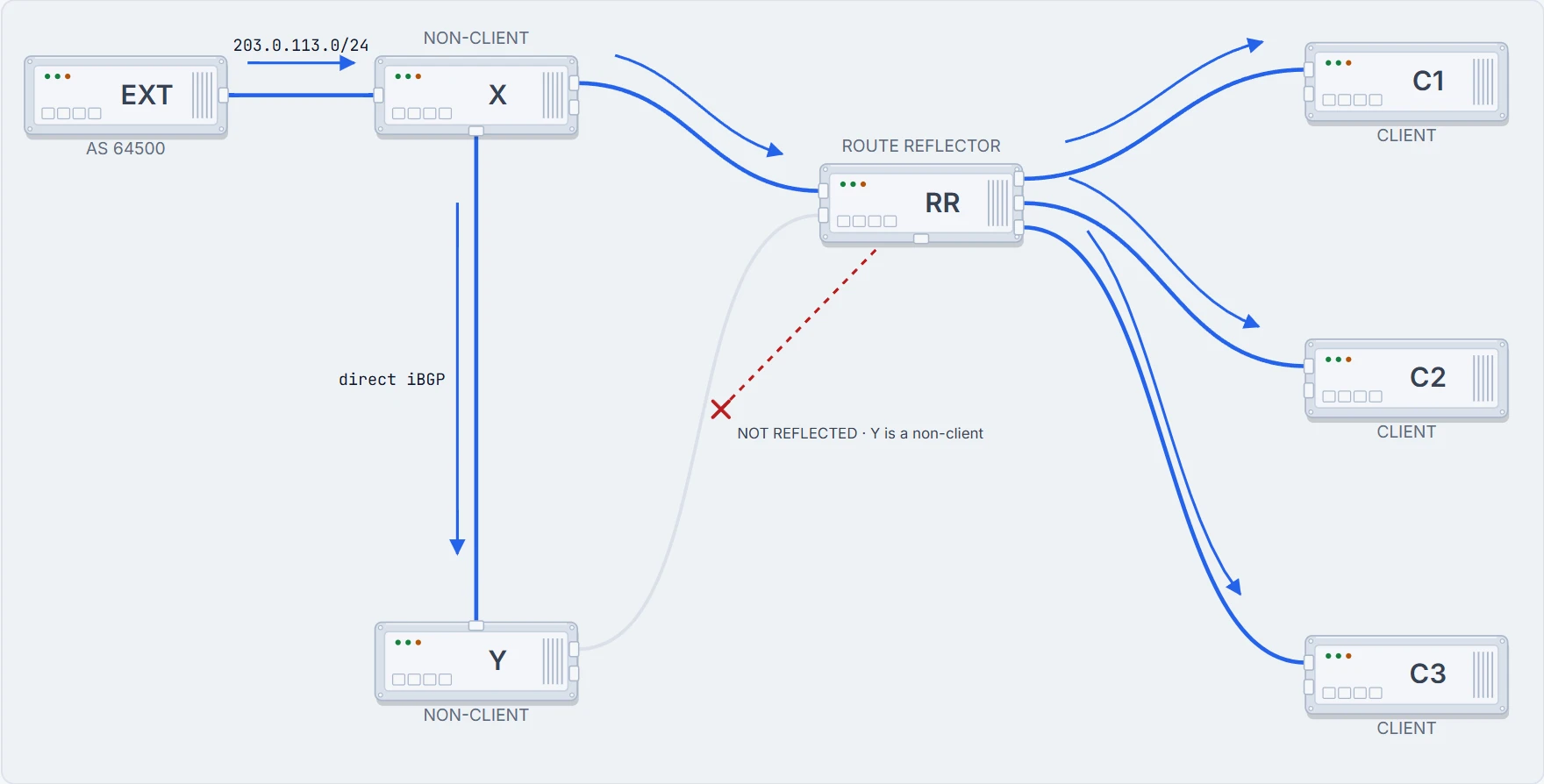
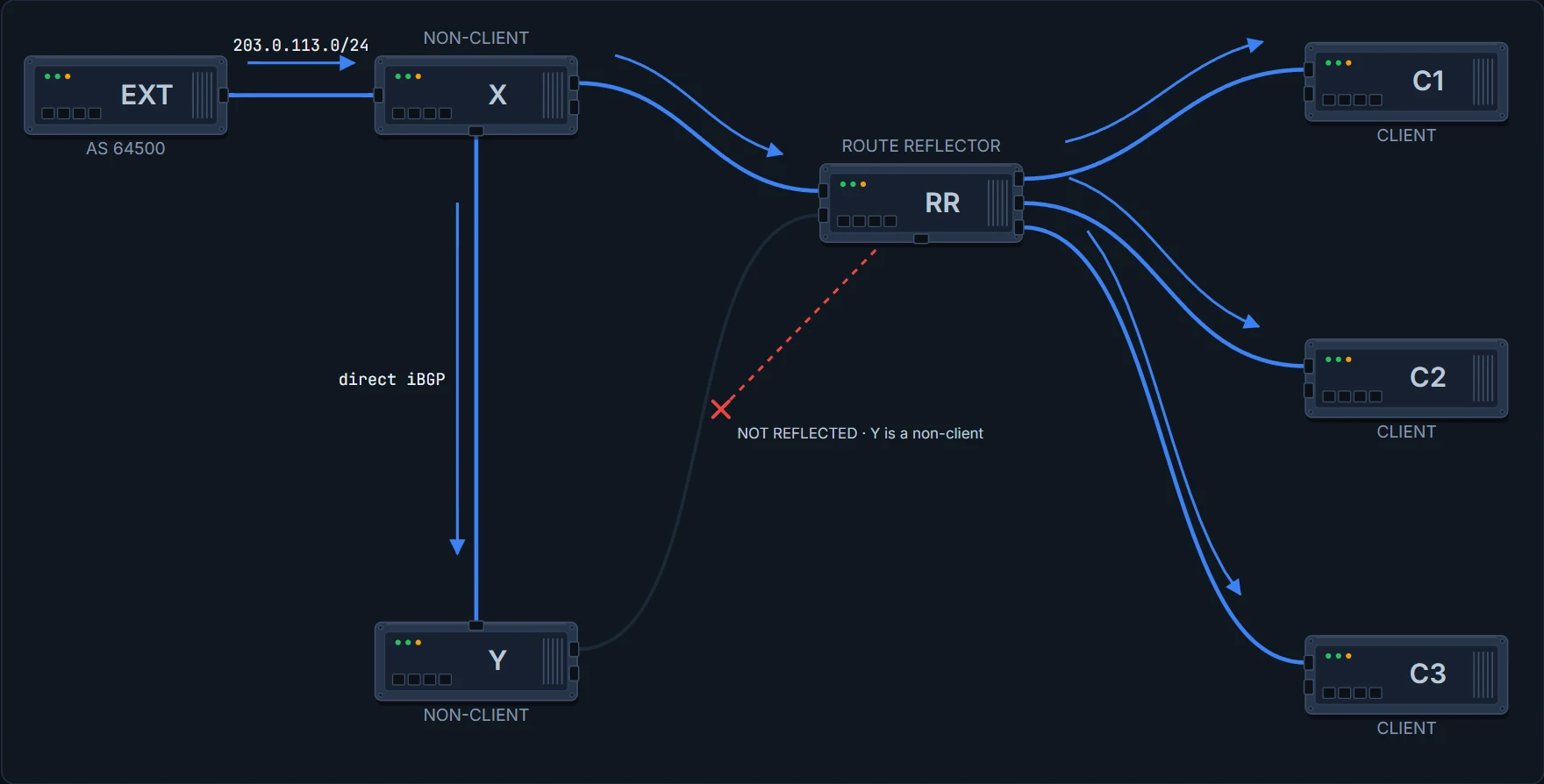
Question one: who does RR send it to? C1, C2 and C3. Not Y, Y is a non-client. And not back to X, where RR learned it.
Non-client to non-client, the reflector's answer is that the two of you need your own arrangement. It is not being unhelpful. Reflecting between two routers that never made it a reflector is not a job it was given, and this is the single most common reason a route quietly does not arrive after somebody tidies a mesh.
Question two: who ends up with it? RR, X, Y, C1, C2, C3, every internal router. So where did Y get its copy?
This course's output on Y, computed from the scenario, in a layout of its own; the field names are the documented ones.
Y# show ip bgp 203.0.113.0/24
BGP routing table entry for 203.0.113.0/24
Paths: (1 available, best #1)
  64500
    192.0.2.1 from 10.0.0.21 (10.0.0.21)
    ! From X directly. Not from RR.
      Origin IGP, localpref 100, valid, internal, best
Everyone has the route. RR did not send it to everyone. Y gets it straight from X because X and Y kept their session. RR is not checking whether Y already has it; RR is following the rule for where it learned the route and what Y is configured as.
A route from a client goes to everyone
C1 originates 198.51.100.0/24. RR learned it from a client:
A route from a client is advertised to all clients and non-client peers.
So RR sends it to C2, C3, X and Y. RR, X, Y, C1, C2, C3 all have it.
And the third case, for completeness, a route RR learns directly from an eBGP neighbor of its own:
A route from an external BGP speaker is advertised to all clients and non-client peers.
That is not what happened with X's route. RR learned 203.0.113.0/24 from X over iBGP, so from RR's point of view it is a route from a non-client, not an external route.
| RR learned the route from | RR sends it to |
|---|---|
| a client | other clients and non-clients |
| a non-client | clients only |
| its own eBGP neighbor | clients and non-clients |
Removing the X–Y session
Somebody sees the X–Y session, decides RR makes it unnecessary, and removes it.
This course's output on Y, computed from the scenario, in a layout of its own; the field names are the documented ones.
Y# show ip bgp 203.0.113.0/24
% Network not in table   ! Gone from Y.
Nothing is wrong with RR. Its client sessions are still Established, it still has 203.0.113.0/24, and it is correctly refusing to reflect a non-client's route to another non-client. The missing route on Y is the consequence of deleting the session Y depended on.
And the change is not invisible. Start where the symptom is: which neighbors does Y still have?
This course's output on Y, computed from the scenario, in a layout of its own; the field names are the documented ones.
Y# show ip bgp summary
BGP router identifier 10.0.0.22, local AS number 65001

Neighbor        AS      State/PfxRcd
10.0.0.1        65001   1
! Only RR left: the 10.0.0.21 neighbor is gone.
Proves: on Y, which neighbors Y has and how many prefixes each sent. X is no longer one of them.
Does not prove: that RR should have covered for it. RR's rule for X's routes never included Y. A healthy reflector, with every session Established, is exactly what this failure looks like from RR.
Two repairs. Put the X–Y session back, the honest fix, since the mesh is what was broken. Or make Y a client of RR, which in this one-reflector design also removes the need for X–Y. That second option is a design choice for this network, not a rule that every iBGP peer should be a client: larger designs deliberately keep non-client relationships, especially between reflectors.
Continue the lesson
The whole lesson, with its drawings and its questions. 6 more sections after the ones above.