
EIGRP, seen from OSPF: DUAL, feasible successors, metrics and unequal-cost load balancing
EIGRP is an enhanced distance vector protocol, published as RFC 7868, whose DUAL algorithm keeps loop-free backups ready. The successor is the next hop of the lowest-metric path; a feasible successor is a backup whose reported distance is less than the feasible distance. Its metric counts bandwidth and delay, and variance installs unequal-cost paths.
By Arif, founder of Daveth · Updated
The full 10 min walkthrough is in Daveth Pro (Network). See what the plan opens
What this page answers
What is EIGRP?
An enhanced distance vector routing protocol, Cisco's and published as RFC 7868, that adds unequal-cost load balancing and rapid convergence. Its DUAL algorithm keeps pre-computed loop-free backup paths, and its metric counts link speed and delay, not just hops. Read it in “4.1 A distance vector protocol with a memory”
What is an EIGRP feasible successor?
A backup path whose reported distance, the neighbour's own metric to the destination, is less than the router's feasible distance. In the guide's example R4 reports 2816 against an FD of 3328, so it qualifies. Read it in “4.1 A distance vector protocol with a memory”
How does EIGRP variance work?
The feasible distance times the variance multiplier is the variance value; any feasible successor whose metric is below it is installed too. Divide the feasible successor's metric by the successor's and round up: 5376 / 3328 is about 1.6, so variance 2. Read it in “4.1 A distance vector protocol with a memory”
4.1 A distance vector protocol with a memory
EIGRP is an enhanced distance vector routing protocol. It started out Cisco-proprietary and was published through the IETF as RFC 7868 in May 2016. Against plain distance vector protocols like RIP, it adds unequal-cost load balancing, support for networks 255 hops away and rapid convergence. Its algorithm, DUAL (the diffusing update algorithm), finds paths and keeps pre-computed loop-free backups ready, and its metric counts link speed and delay, not just hops. 02-1 placed it among the four algorithm families; this lesson opens it up.
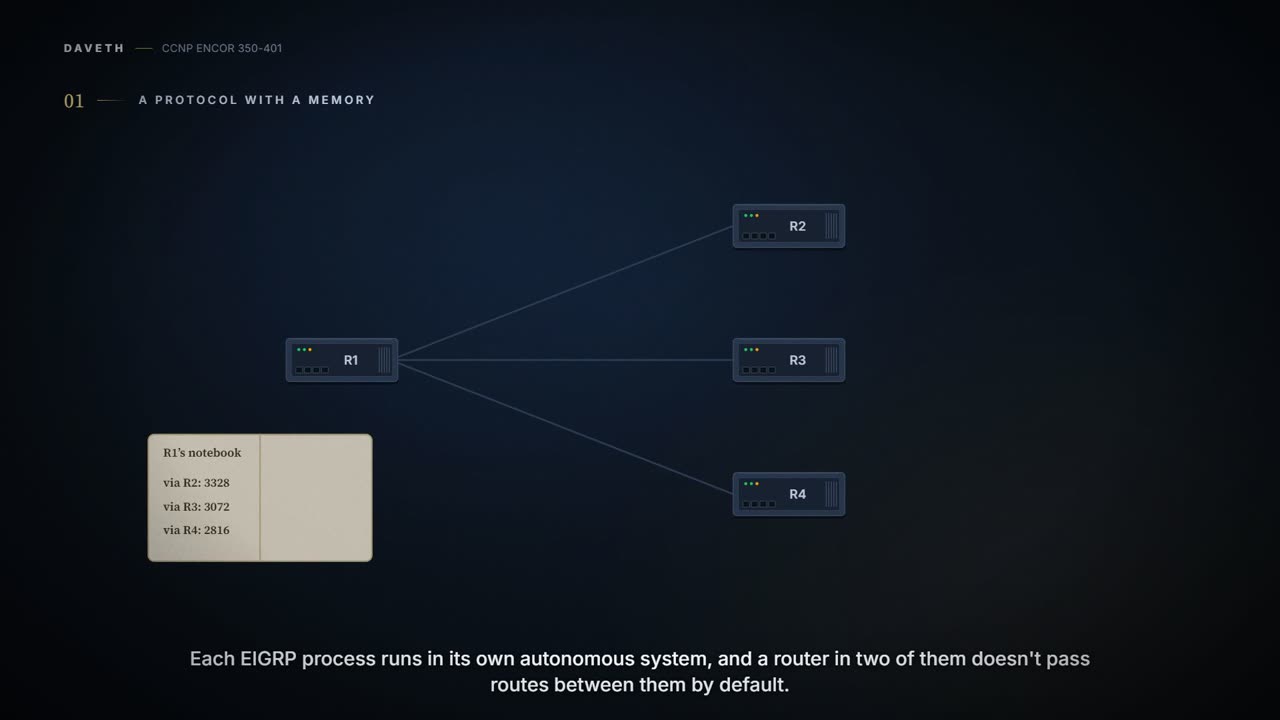
It's basically like asking three shopkeepers the way to the station and writing all three answers down, not just the best one. EIGRP still learns only what its neighbours tell it, like any distance vector protocol, but it keeps every neighbour's answer, and that notebook is what makes an instant backup possible.
EIGRP went public as RFC 7868. The guide's own reference list calls it RFC 7838, so even the book needed a backup for that number.
A router can run several EIGRP processes, each in its own autonomous system: a routing domain whose routers use the same metric formula and exchange routes only with each other. An EIGRP AS isn't a BGP autonomous system (02-9). In Figure 7-1, AS 100 holds R1 to R4 and AS 200 holds R3, R5 and R6. Each process keeps its own topology table, so R1 knows nothing of AS 200, and R3, which sits in both, doesn't pass routes between them by default. Consider it your family group chat and your work group chat: you're in both, and nothing said in one turns up in the other unless you deliberately forward it.
Figure 7-2 is the reference: R1 working out its best path, and its loop-free backups, to 10.4.4.0/24 on R4. Six terms do all the work:
| Term | Meaning | In Figure 7-2 |
|---|---|---|
| Successor route | the lowest-metric path to a destination | R1→R3→R4 |
| Successor | the first next hop of that path | R3 |
| Feasible distance (FD) | the metric of the lowest-metric path, calculated locally | 3328 (256 + 256 + 2816) |
| Reported distance (RD) | the distance a neighbour reports: its own FD | R3 reports 3072; R4 reports 2816 |
| Feasibility condition | a backup's RD must be less than the local FD | - |
| Feasible successor | a route that meets the condition, kept as a backup | R1→R4: RD 2816 < FD 3328 |
The feasibility condition is the rule the whole protocol rests on: a neighbour qualifies as a backup only if its reported distance is less than your feasible distance, and that guarantees a loop-free path. Think about the last time you asked a stranger the way to a station. If they're standing closer to it than you are, whatever route they're about to take can't come back through the spot where you're standing. That's the whole idea. RFC 7868 words it the same way: the neighbour must be "closer to the destination than the router itself has ever been" since the route last settled. That "ever been" is why the FD is a remembered value, not just today's best metric.
Now read R1's topology table (Figure 7-3, show ip eigrp topology):
P 10.4.4.0/24, 1 successors, FD is 3328
        via 10.13.1.3 (3328/3072), GigabitEthernet0/1
        via 10.14.1.4 (5376/2816), GigabitEthernet0/2
Each via line is a neighbour, and the pair in brackets is (path metric/reported distance). R3's line, 3328/3072, is the successor. R4's line, 5376/2816, is the feasible successor: 2816 is less than the FD of 3328. (The guide's paragraph compares 2816 with R3's 3072; it's the FD that counts, as its own figure labels it: "2816<3328".)
In EIGRP a dead heat is a disqualification. R2 reports 10.4.4.0/24 at 3328, exactly R1's FD, and doesn't make the backup list.
That's no typo. R2's own best path is through R3, so it reports 3328, and "less than" is strict. R2's path is loop-free in fact, but the rule can't prove it, so EIGRP won't trust it as a backup, like a bank that won't cash a cheque it can't verify, however honest the person who wrote it. R2's advertisement is still stored; it just never becomes a feasible successor. Notice that Figure 7-3's output lists only R3 and R4 for this prefix: the command as shown lists successors and feasible successors. (Seeing every neighbour's entry needs another option of the command: check its syntax on IOS XE 17.9.) The memory hook for the whole section: closer than I've ever been, or it's not a backup.
This table is also what makes EIGRP more than a plain distance vector protocol. It holds every prefix in the AS, the neighbours that advertised it, their metrics (reported distance, hop count) and the inputs to the metric (load, reliability, total delay, minimum bandwidth). The P means passive: the route is stable. During a topology change a route goes active while the router computes a new path.
Neighbours swap their whole routing tables once, when the adjacency forms, and after that only incremental updates as things change; a neighbour adjacency table tracks each neighbour's status and the updates sent to it. It acts kind of like a shared shopping list: one full copy at the start, then people only call out what's been added or crossed off. EIGRP has its own IP protocol number, 88, and five packet types:
| Type | Packet | Used for |
|---|---|---|
| 1 | Hello | finding neighbours, and noticing when one's gone |
| 2 | Request | asking one or more neighbours for specific information |
| 3 | Update | sending routing and reachability information |
| 4 | Query | searching for another path during convergence |
| 5 | Reply | answering a query |
It uses multicast where it can, to 224.0.0.10, and unicast when it has to; the quiz adds the MAC address, 01:00:5E:00:00:0A. That's roughly equivalent to calling "coffee's ready" across the office, and walking over to one desk when only one person needs to hear.
EIGRP has its own IP protocol number, 88, so it doesn't even ride in TCP or UDP. It brought its own car to the party.
EIGRP's classic metric uses bandwidth and delay by default, and can add load and reliability. K values decide which factors count and how much. They don't map one to one onto the four inputs: K1 and K2 both involve bandwidth. In the formula, BW is the slowest link in the path (the minimum, not the maximum or the average), taken from the configured interface bandwidth and scaled against 10 Gbps (10^7 over the bandwidth in kbps); delay is the total along the path, in tens of microseconds. It's IGRP's formula multiplied by 256, to turn a 24-bit metric into a 32-bit one. In full (Figures 7-4, 7-5):
metric = 256 × [ ( K1 × BW  +  (K2 × BW) / (256 − load)  +  K3 × delay ) × K5 / (K4 + reliability) ]
         with BW = 10^7 / minimum bandwidth in kbps, delay = total delay in µs / 10
With the defaults, K1 = K3 = 1 and K2, K4, K5 = 0, it shrinks to (Figure 7-6):
metric = 256 × ( 10^7 / minimum bandwidth in kbps + total delay in µs / 10 )
The K5 factor needs one rule the figure doesn't print: when K5 is 0 it counts as 1, not as zero. And MTU, which Chapter 6 lists among EIGRP's inputs, travels with the route but isn't in the metric.
It works just like when you drive on a motorway that narrows to one lane for a mile: the whole trip moves at the pace of the narrowest bit, while every mile still adds its minutes. So bandwidth is a minimum and delay is a sum. That's also why the quiz says changing an interface's delay steers EIGRP without touching OSPF: OSPF's cost comes from bandwidth (02-3), and delay isn't in it.
Each update carries the path attributes that make this work per hop: hop count, total delay, minimum bandwidth and RD, each updated at every router. Figure 7-7 follows 10.1.1.0/24 from R1 (100 Mbps LAN, 100 µs) across a 10 Mbps, 1000 µs link to R2, then a 100 Mbps, 100 µs link to R3:
| At | Hop count | Min bandwidth | Total delay | Metric |
|---|---|---|---|---|
| R1 advertises | 0 | 100 Mbps | 100 µs | 256 × (100 + 10) = 28,160 |
| R2 advertises | 1 | 10 Mbps | 1100 µs | 256 × (1000 + 110) = 284,160 |
| R3 computes | 2 | 10 Mbps | 1200 µs | 256 × (1000 + 120) = 286,720 |
Back in Figure 7-2, R1's metric to 10.4.4.0/24 is all gigabit, 30 µs in total: 256 × (10^7 / 1,000,000 + 30 / 10) = 256 × 13 = 3328.
Table 7-4 gives the metric of a single link of each type:
| Interface | kbps | Delay | Metric |
|---|---|---|---|
| Serial | 64 | 20,000 µs | 40,512,000 |
| T1 | 1544 | 20,000 µs | 2,170,031 in the guide; 2,169,856 with the bandwidth term truncated |
| Ethernet | 10,000 | 1000 µs | 281,600 |
| FastEthernet | 100,000 | 100 µs | 28,160 |
| GigabitEthernet | 1,000,000 | 10 µs | 2816 |
| 10 GigabitEthernet | 10,000,000 | 10 µs | 512 |
The truncation is where classic metrics run out. GigabitEthernet and 10 GigabitEthernet have the same delay, and above 10 Gbps the bandwidth term truncates to zero, so an 11 Gbps link and a 20 Gbps link score the same (Example 7-1). It's a bit like a kitchen scale that ignores everything after the decimal point: a 0.5 kg bag and a 0.9 kg bag both read 0.
Under classic metrics an 11 Gbps link and a 20 Gbps link both score 256. Somewhere a sales engineer is quietly crying.
Wide metrics fix it. The formula (Figure 7-9) adds a K6 term for an extended attribute, jitter, energy, or whatever comes next:
wide metric = [ ( K1 × BW + (K2 × BW) / (256 − load) + K3 × latency + K6 × extended ) × K5 / (K4 + reliability) ]
It scales by 65,535 instead of 256, which handles links up to 655 Tbps, and measures latency in picoseconds instead of microseconds. RFC 7868's delay table shows the difference: classic gives GigabitEthernet and 10 Gig the same 10 µs, wide gives 10 µs and 1 µs. The two styles are backward compatible: with K1 = K3 = 1 and the rest 0, routers form adjacencies as long as K1 to K5 match and K6 isn't set, and a wide-metric router unscales the metrics it hears from a classic one (Figure 7-11).
If several successor routes tie on metric, EIGRP installs them all: equal-cost multipathing (ECMP). It also does unequal-cost load balancing with the variance multiplier. The FD times the multiplier is the variance value, and any feasible successor whose metric is below the variance value goes into the RIB too, up to the maximum number of paths. Look at Figure 7-3 again for an ECMP case: 10.23.1.0/24 shows "2 successors", via R2 and via R3, both 3072.
To find the multiplier you need, divide the feasible successor's metric by the successor's and round up. For R1's direct path to R4: 5376 / 3328 ≈ 1.6, so a multiplier of 2 (Figure 7-12). You can think of it as a shop's price-match promise: it'll match any rival up to twice its own price, but only rivals on its approved list. And Example 7-2 proves both paths went in:
R1# show ip route 10.4.4.0
  * 10.14.1.4, from 10.14.1.4, 00:00:35 ago, via GigabitEthernet0/2
      Route metric is 5376, traffic share count is 149
    10.13.1.3, from 10.13.1.3, 00:00:35 ago, via GigabitEthernet0/1
      Route metric is 3328, traffic share count is 240
The traffic share count sets the ratio of traffic on each path: 240 to 149. The better path gets more, in inverse proportion to the metrics (240 × 3328 / 5376 ≈ 149). It's a bit like giving the quicker of two couriers more of the parcels: both work, but not equally.
Before you touch D1, predict. With a multiplier of 3, the variance value is 3 × 3328 = 9984. The path through R2 costs 5888 by Figure 7-2's labels. Does R1 install it? Work it out before reading on.
D1
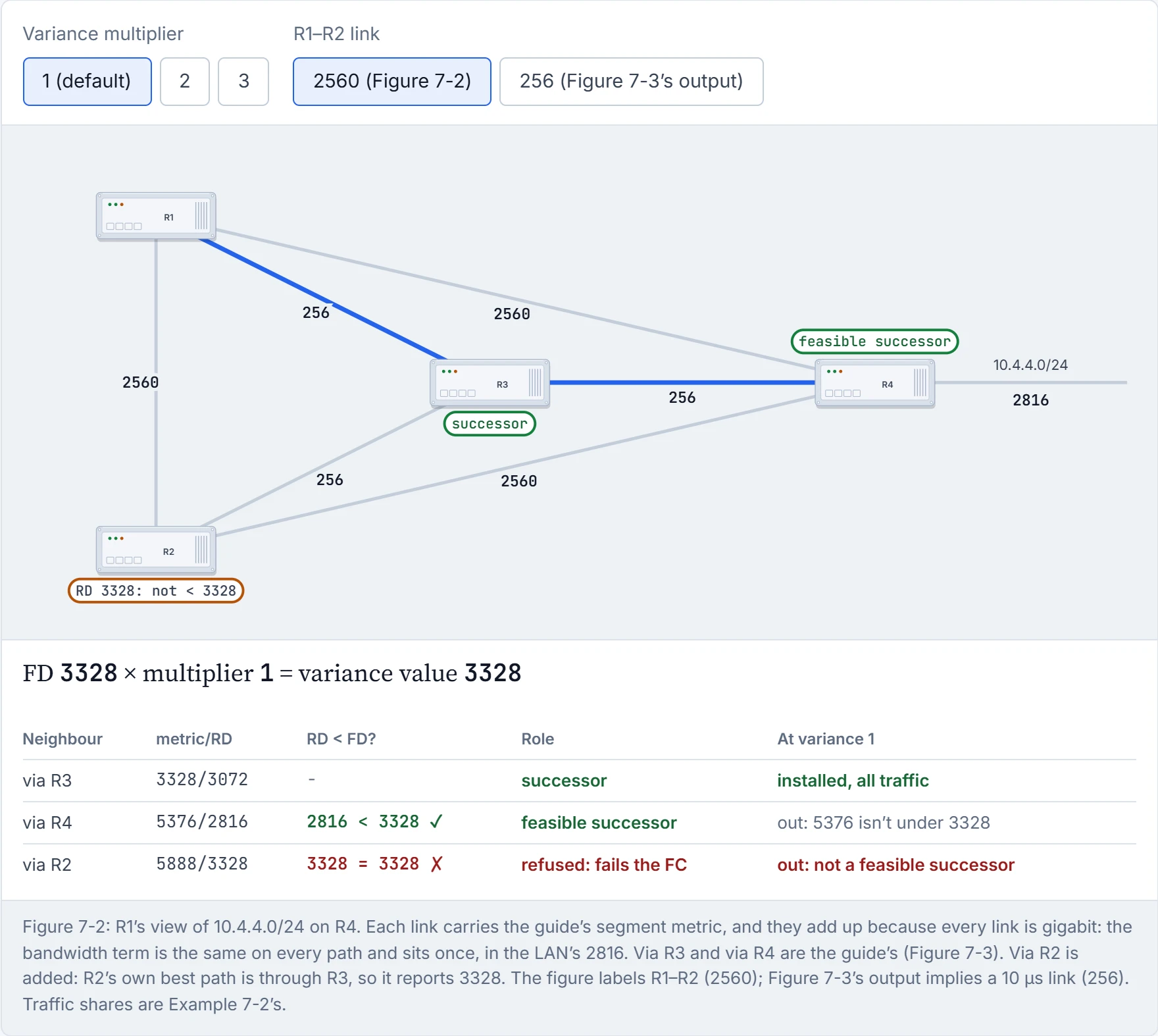
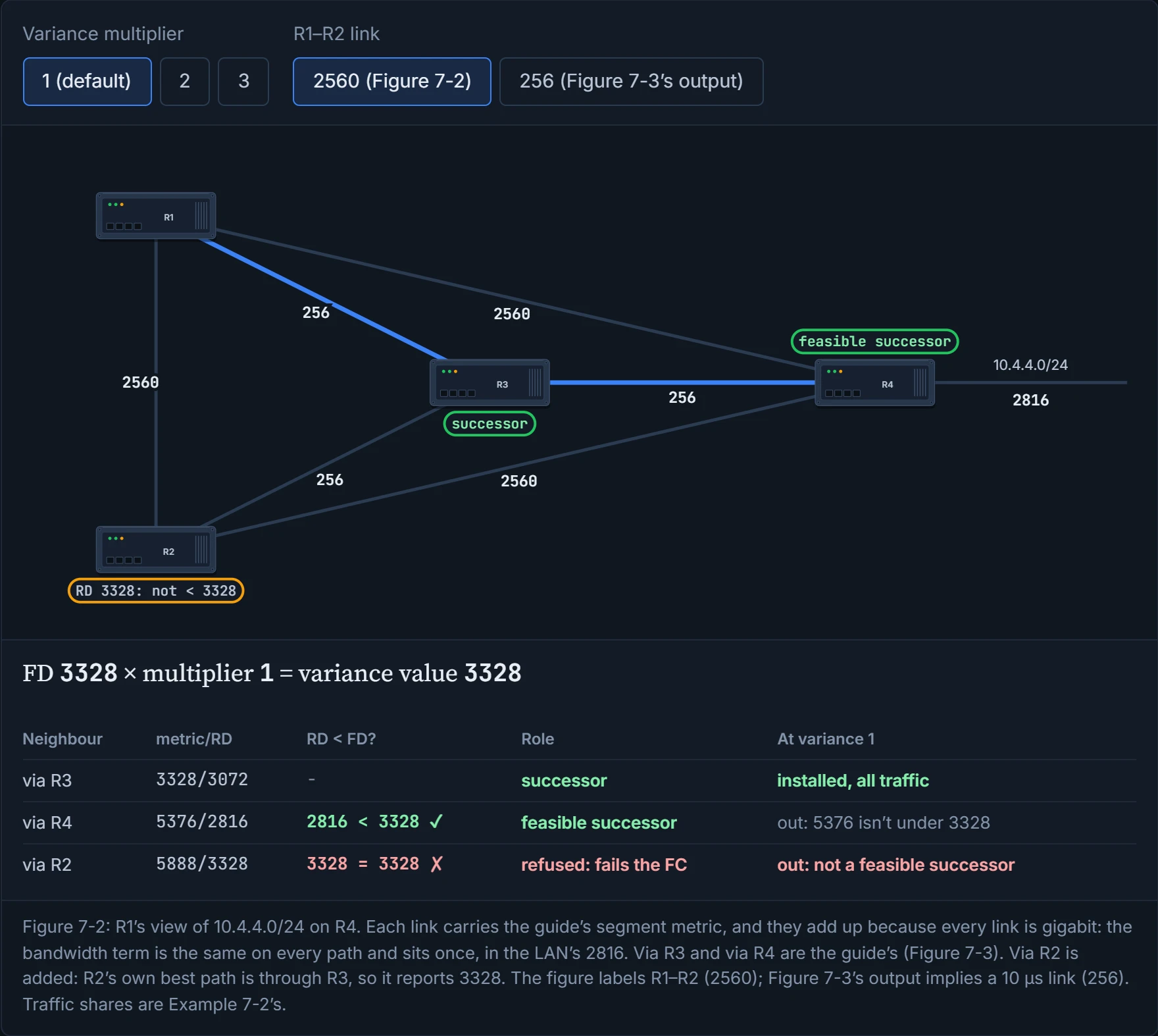
No. Variance only widens the door for feasible successors, and R2 isn't one (section 4.2): its RD, 3328, isn't less than the FD. However high you turn the knob, R2's path stays out. That's the trap behind "I set variance and nothing changed". D1's second knob shows the other trap: with the R1–R2 link as Figure 7-3's output has it, R2's path is the second-best one, and it still isn't the backup.
Variance is the only time a network engineer happily takes a worse path on purpose, and even then the path has to show its paperwork first.
Hellos have a second job: proving the neighbour is still there. They go every 5 seconds by default, or every 60 on slow interfaces (T1 or slower). The hold time is three times the hello, 15 s or 180 s; it counts down, every hello resets it, and at zero the neighbour is declared unreachable and DUAL is told. If you've ever had a friend on a night out text "still here" every few minutes, you know how it works: one missed text is fine, but after three in a row you go looking. (A link that goes down is quicker: the neighbour drops with the interface.)
When a successor goes, there are two very different stories, and D2 plays both.
With a feasible successor (Figure 7-13, R1–R3 fails): R3 already has R2 as a feasible successor (RD 9 < FD 10), so it switches instantly and sends an update with its new RD, 19. Downstream routers rerun DUAL on the new numbers: R5 now sees 29 via R3 and 25 via R4, and moves to R4. Have you ever noticed how a car with a spare in the boot just swaps the wheel and carries on? That's R3. One subtlety at R5: R4's RD (20) isn't less than R5's FD (20), so R4 isn't a feasible successor, while R3 (RD 19) still is. RFC 7868 can be read either way here: its definition of the passive state points to R5 going active briefly, its event list to R5 staying passive because a feasible successor remains. Which IOS does is unconfirmed; the guide simply has R5 choose R4.
Without one, the route goes active. The router sends queries for the prefix with the delay set to infinity, so its neighbours know it's lost the path, and it flags each neighbour as owing a reply. While a route is active it can't be used, which is why a feasible successor is worth designing for. A router that gets a query does one of three things:
- replies that it has no route;
- if the query didn't come from its successor, replies with its own route;
- if it did come from its successor (and it has no feasible successor), goes active itself and queries its own neighbours.
The first two end the search there: that's the query boundary. A router with queries out waits for every reply, then finishes DUAL, goes passive, and replies to whoever queried it. Imagine if you lost your house keys with no spare: you ring everyone who might have one, and you can't stop until every single person has answered, even the ones who only say no.
Continue the lesson
The whole lesson, with its drawings and its questions. The rest of this section and 9 more after it.