
OSPF network types
Two routers on one link refuse to become neighbours because each end runs a different OSPF network type, and the type sets the timers. Five types, ip ospf network broadcast, non-broadcast, point-to-multipoint, point-to-multipoint non-broadcast and point-to-point, each answer three questions: is a DR elected, must neighbours be named by hand, and what are the default timers?
By Arif, founder of Daveth · Updated
The full 4 min walkthrough is in Daveth Pro (Network). See what the plan opens
What this page answers
What are the default OSPF hello timers per network type?
Broadcast and point-to-point use a 10-second hello; non-broadcast and point-to-multipoint use 30 and 120. The dead interval is four times the hello by default. Read it in “Question three: the one that ambushes people”
Which OSPF network types elect a DR?
Broadcast and non-broadcast elect a designated router and a backup. Point-to-multipoint, described as a collection of point-to-point links, requires no election. Read it in “Question one: is there a designated router?”
When do you need the OSPF neighbor command?
On network types that cannot multicast hellos: with the non-broadcast keyword, including point-to-multipoint non-broadcast, the neighbor command is required. Read it in “Question two: do I have to name the neighbours?”
Two routers, one link, no adjacency
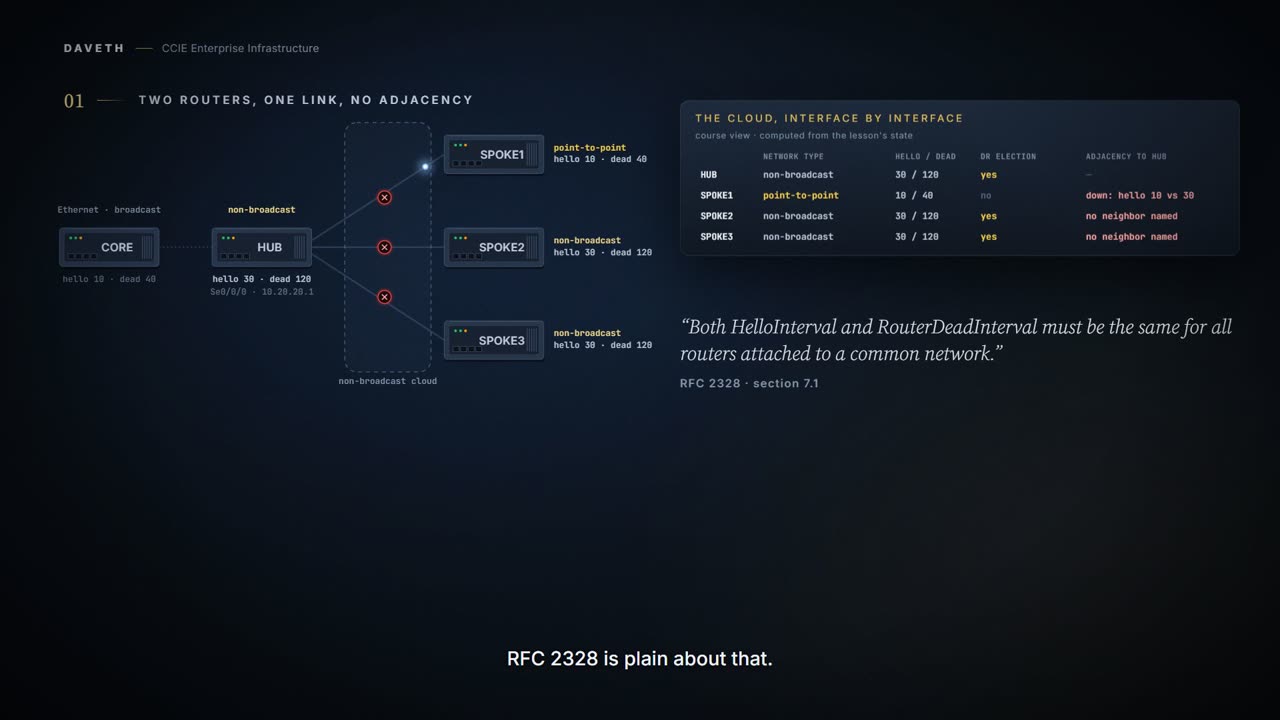
HUB and SPOKE1 are on the same link and will not become neighbours. What does each end think it is running? Ask both:
Computed by this course, not captured from HUB: the scenario's state, in the shape of Cisco's show ip ospf interface sample.
HUB# show ip ospf interface
GigabitEthernet0/0 is up, line protocol is up
  Internet Address 10.10.10.1/24, Area 0
  Process ID 1, Router ID 10.0.0.1, Network Type BROADCAST, Cost: 1
  Timer intervals configured, Hello 10, Dead 40
  State DR

Serial0/0/0 is up, line protocol is up
  Internet Address 10.20.20.1/24, Area 0
  Process ID 1, Router ID 10.0.0.1, Network Type NON-BROADCAST, Cost: 64
  Timer intervals configured, Hello 30, Dead 120   ! thirty seconds here
  State DR
Computed by this course, not captured from SPOKE1: the scenario's state, in the shape of Cisco's show ip ospf interface sample.
SPOKE1# show ip ospf interface
Serial0/0/0 is up, line protocol is up
  Internet Address 10.20.20.2/24, Area 0
  Process ID 1, Router ID 10.0.0.2, Network Type POINT-TO-POINT, Cost: 64
  Timer intervals configured, Hello 10, Dead 40
  ! and ten seconds there
  State Point-to-Point
A timer mismatch, and from 1.4.a you know that stops an adjacency dead.
But nobody has ever configured a timer on either device. No ip ospf hello-interval, no ip ospf dead-interval, nothing. Both are running defaults. So how do two routers running defaults end up with different values?
Because a different command set them, and this page is about that command.
One setting, three consequences
1.4.a left an instruction: read every OSPF state against the network type. Here is the type itself.
| ip ospf network broadcast |
| ip ospf network non-broadcast |
| ip ospf network point-to-multipoint |
| ip ospf network point-to-multipoint non-broadcast |
| ip ospf network point-to-point |
Five types, and the useful thing is that you do not have to memorise a grid. Every one of them is answered by three questions:
1. Is a designated router elected?
2. Do I have to configure neighbours by hand?
3. What are the default timers?
Notice already that the third one is in there. That is the answer to the puzzle above, and it is the one people do not expect the network type to control.
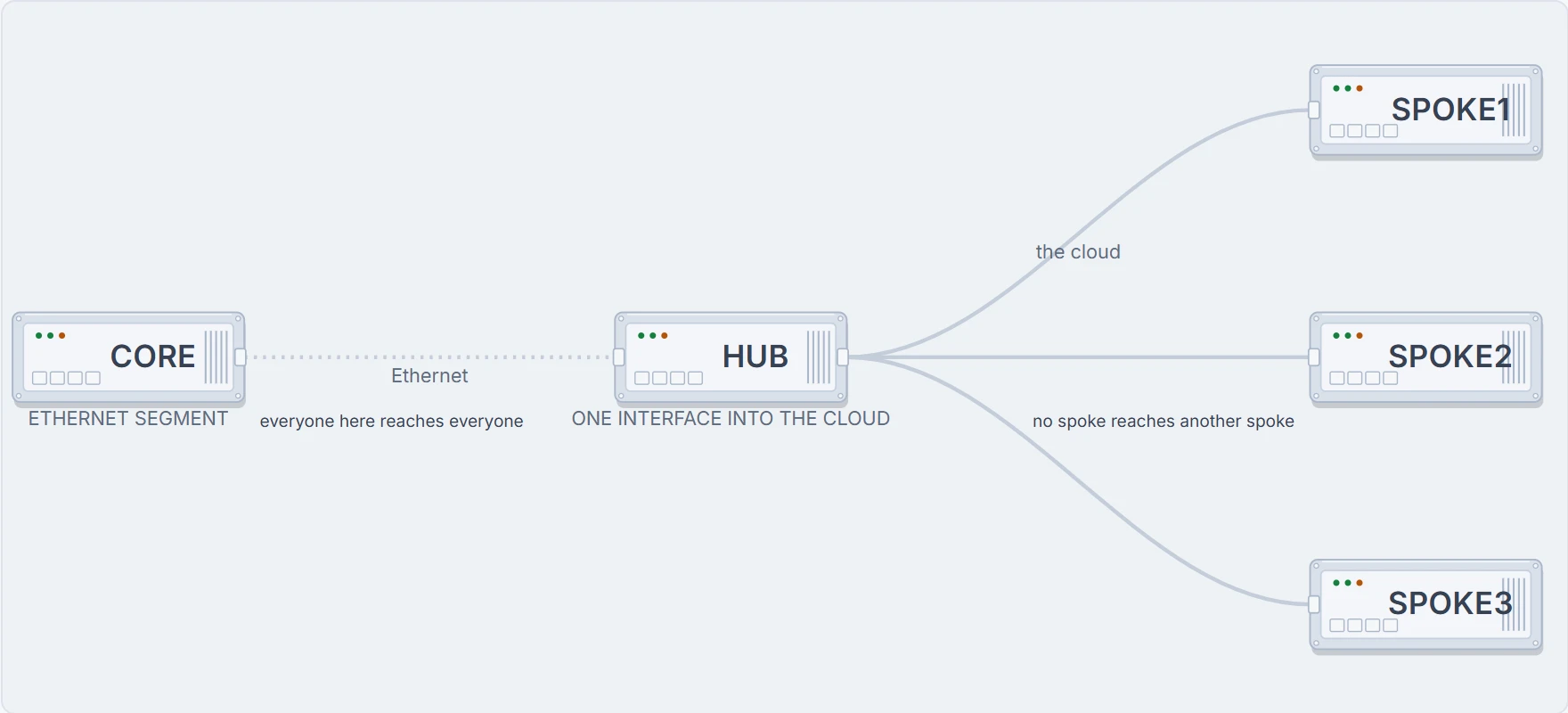
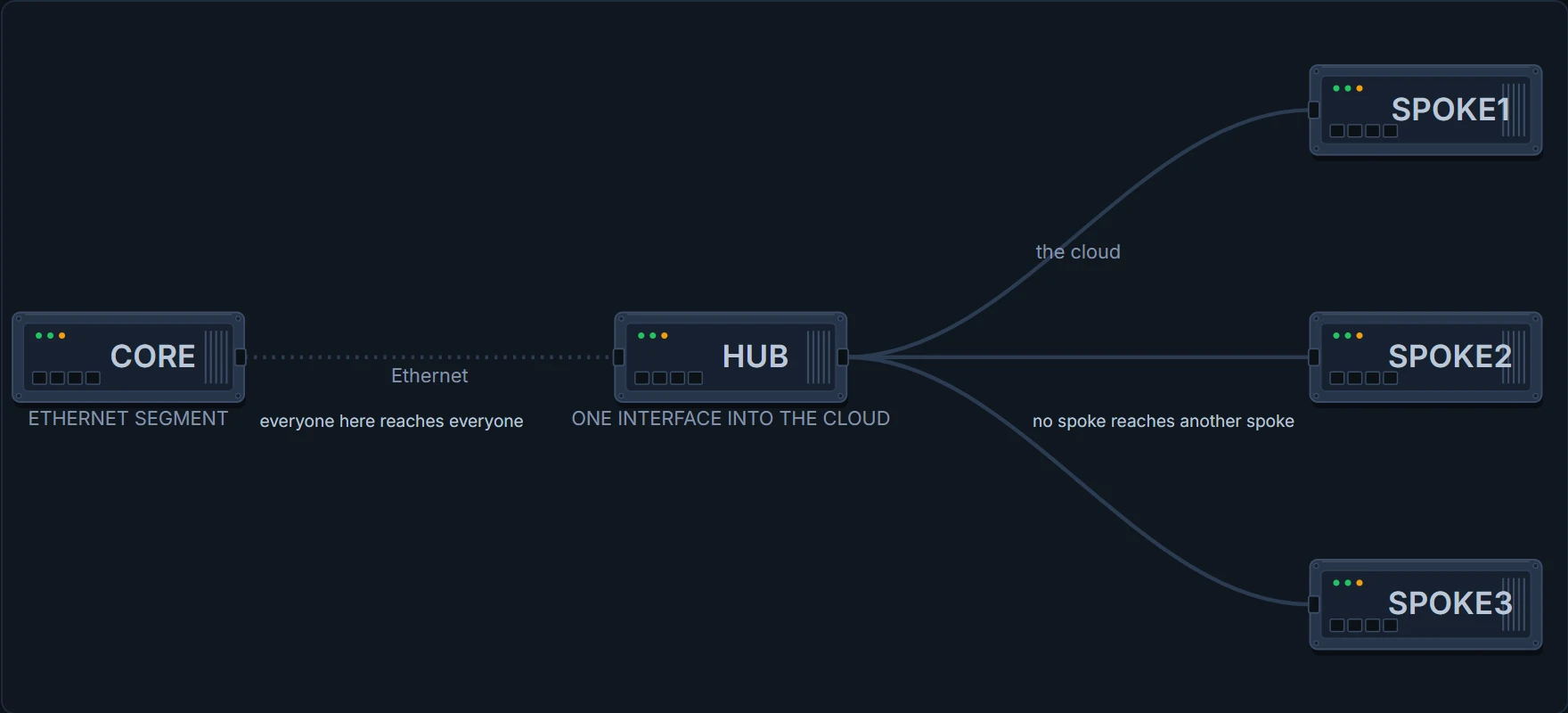
State 1 Two segments, and the difference is not in either medium's name
On which of these can every router reach every other one?
Question one: is there a designated router?
Start with what OSPF assumes if you tell it nothing: By default, OSPF classifies different media into the following three types of networks: Broadcast networks (Ethernet, Token Ring, and FDDI), Nonbroadcast multiaccess (NBMA) networks … Point-to-point networks (High-Level Data Link Control [HDLC] and PPP).
Broadcast elects one: Under this network type, a designated router (DR) and backup designated router (BDR) are elected. And so does non-broadcast: that is the entire point of the type: simulates a broadcast model by election of a designated router (DR) and a backup designated router (BDR).
Read the word simulates. The medium has no broadcast capability, so this type makes it behave like a broadcast segment for OSPF's purposes: one designated router, everyone synchronises with it, and the other routers stop at 2-Way with each other. Which is why it needs help with question two.
Point-to-multipoint is easier to configure because it requires no configuration of neighbor commands, it consumes only one IP subnet, and it requires no designated router election.
The reason is in the phrase a collection of point-to-point links. A designated router exists to stop a shared segment from becoming a full mesh of adjacencies, where every relationship is already just two routers, there is nothing to optimise and nothing to elect.
This next bit is reasoning, not quotation: point-to-point elects no designated router. No page consulted says so in a sentence. Two sourced facts point at it and neither is the statement itself. First, Point-to-Point is published as an interface State value in its own right, alongside "DR: The router is the DR", "BDR: The router is the BDR" and "DROTHER: The router is neither the DR nor the BDR": an interface in the Point-to-Point state is not holding any of the DR roles. Second, point-to-multipoint is described as a collection of point-to-point links and explicitly requires no election. The conclusion is safe; it is labelled because it was derived rather than read.
And the other half of point-to-multipoint, worth catching because it shows up in the routing table rather than in OSPF. "An OSPF point-to-multipoint interface is defined as a numbered point-to-point interface having one or more neighbors. It creates multiple host routes." Host routes: /32s. On this cloud that is 3 of them on the hub, one per neighbour it can reach. If you pick this type and later wonder why your routing table has grown a crop of /32 entries pointing at your spokes, that sentence is why. It is not a fault.
Question two: do I have to name the neighbours?
This one has a clean logic to it. Ask what a router uses to find neighbours, and the answer from 1.4.a is hello packets sent to a multicast address. So a medium that cannot multicast cannot self-discover, and you have to supply the list by hand.
On point-to-multipoint, nonbroadcast networks, use the neighbor router configuration command to identify neighbors. Assigning a cost to a neighbor is optional. And on the command itself, this is not advice: If you use the non-broadcast keyword, the neighbor command is required.
HUB# configure terminal
HUB(config)# router ospf 1
HUB(config-router)# neighbor 10.20.20.2
HUB(config-router)# neighbor 10.20.20.3
HUB(config-router)# neighbor 10.20.20.4
HUB(config-router)# end
Required. Configure the type and forget the neighbours and you have an interface that will never find anybody. Here it is 3 statements on the hub, maintained forever, and one more every time the business opens a branch.
Whereas plain point-to-multipoint does not need it, because it requires no configuration of neighbor commands.
Question three: the one that ambushes people
On broadcast and point-to-point links, the default is 10 seconds, and By default, the dead timer interval is four times the hello timer interval. Non-broadcast and point-to-multipoint report 30 and 120.
The network type sets the default timers. You did not configure 30 seconds; you configured a type, and 30 came with it.
Which answers the opening. HUB and SPOKE1 are on different network types. Neither engineer touched a timer. The timers differ anyway, because they are a consequence of a setting nobody was thinking about as a timer setting.
| Network type | Designated router? | neighbor needed? | Hello / Dead | Host routes? |
|---|---|---|---|---|
| broadcast | Yes | No | 10 / 40 | No |
| non-broadcast | Yes | Yes | 30 / 120 | No |
| point-to-multipoint | No | No | 30 / 120 | Yes |
| point-to-multipoint non-broadcast | No | Required | 30 / 120 | Yes |
| point-to-point | No | No | 10 / 40 | No |
Read the designated-router column and the timer column together and notice they do not line up. Broadcast and point-to-point share timers and disagree about the election; non-broadcast and point-to-multipoint share timers and also disagree about it. There is no single principle joining the three columns, which is exactly why you have to know the table rather than derive it, and why a mismatch produces symptoms that look unrelated to each other.
Continue the lesson
The whole lesson, with its drawings and its questions. 4 more sections after the ones above.