
Catalyst SD-WAN: orchestration, management, control and data planes
SD-WAN builds one overlay across any IP transport, Internet, MPLS, LTE or satellite, with central control. Cisco's design splits it into four planes with one component each: orchestration, the Validator (vBond); management, the Manager (vManage); control, the Controller (vSmart); and data, the WAN Edge routers. The Validator introduces, the Manager configures, the Controller decides, the WAN Edge carries.
By Arif, founder of Daveth · Updated
The full 9 min walkthrough is in Daveth Pro (Network). See what the plan opens
What this page answers
What are the components of Cisco SD-WAN?
The SD-WAN Validator (vBond) onboards routers into the overlay; the Manager (vManage) gives central configuration and monitoring; the Controller (vSmart) builds the topology and decides where traffic flows; the WAN Edge routers forward the packets. Read it in “4.1 Why SD-WAN”
Why do companies use SD-WAN?
For lower cost and risk through WAN automation, extending the enterprise into the public cloud, a good SaaS experience, a transport-independent underlay, application visibility with path control, and end-to-end segmentation and encryption. Read it in “4.1 Why SD-WAN”
4.1 Why SD-WAN
Enterprise WANs got harder: multicloud, applications moving to the cloud, mobile and IoT devices multiplying, and the Internet edge moving out to the branches. The guide lists what customers want from SD-WAN: lower cost and risk through WAN automation and orchestration; the enterprise extended into the public cloud; a good experience for SaaS applications; a transport-independent WAN, whose underlay can be any IP network (Internet, MPLS, 3G/4G LTE, satellite, dedicated circuits); application visibility with path control to meet SLAs; and end-to-end segmentation and encryption. If you've ever sent a parcel by whichever courier was cheapest that day, you know the appeal: the parcel doesn't care which van it rides in. What these buy against a traditional WAN, and what they cost, is 06-7.
Cisco offered two SD-WAN solutions when the guide was written: Cisco SD-WAN, based on Viptela, for granular segmentation, advanced routing, security and complex topologies; and Meraki SD-WAN, for organisations wanting unified threat management in one appliance or already running Meraki. The chapter covers only the Viptela-based one, which Cisco has since renamed Catalyst SD-WAN. It works like a car model that gets a new badge halfway through its life: same engine, new name on the boot.
Catalyst SD-WAN is the same product that was called Viptela, then Cisco SD-WAN; by the exam it will have been renamed at least once more than your study notes.
The guide calls Cisco SD-WAN a cloud-delivered overlay WAN, connecting remote offices, branches, campuses, data centres and the cloud over any IP transport, with its management components deployable in a data centre or a private or public cloud. The overlay sits on the transports like a private tram line laid over whatever roads a town already has. Cisco's design guide splits it into four planes, one component each:
| Plane | Does | Component now | The guide's name |
|---|---|---|---|
| Orchestration | onboards routers into the overlay | SD-WAN Validator | vBond orchestrator |
| Management | central configuration and monitoring | SD-WAN Manager | vManage NMS |
| Control | builds the topology and decides where traffic flows | SD-WAN Controller | vSmart controller |
| Data | forwards packets on the control plane's decisions | WAN Edge router | SD-WAN router (vEdge or cEdge) |
The guide counts "four main components and an optional analytics service": vAnalytics is an optional extra, not one of the four. Picture yourself joining a big firm: reception checks who you are and points you onwards, HR hands you the rule book, your manager tells you what to work on, and you do the work. Or in short: the Validator introduces, the Manager configures, the Controller decides, the WAN Edge carries.
Every component has two names, the guide's and Cisco's current one, and the exam question will use whichever your notes don't.
The Validator authenticates the Controllers and the WAN Edges and orchestrates the connections between them. It's the only component that must have a public IP address, so that every device can reach it. It keeps a permanent DTLS connection with each Controller, and uses DTLS to authenticate WAN Edges when they come online, by certificates and RSA cryptography; it facilitates the initial orchestration between routers and Controllers when one or both are behind NAT, using standard peer-to-peer techniques (NAT traversal); and with several Controllers it load-balances routers across them. A vBond orchestrator is itself an SD-WAN router that performs only vBond functions. Cisco's design guide adds that it hands the Manager's and Controllers' addresses to the new router. Consider it your company's reception desk: every visitor goes there first, and nobody gets past without being checked and pointed to the right floor.
Cisco's design guide gives the bring-up in four steps, like the first morning at a new job:
- The WAN Edge, with a minimal bootstrap or through ZTP or PnP, authenticates to the Validator over DTLS; the Validator sends it the Manager's and Controllers' addresses and tells them about the new router.
- It opens DTLS or TLS sessions to the Manager and Controllers, and tears down the Validator session; the Manager pushes its configuration.
- It opens DTLS or TLS to the Controllers over each transport, establishes OMP, and learns prefixes, TLOCs, service routes, encryption keys and policies.
- It builds BFD sessions over IPsec to the remote TLOCs on each transport.
The Validator is the one address every router must be able to reach, which makes it the one address nobody can afford to mistype in a bootstrap.
The Manager is the single pane of glass: one GUI to configure and manage the whole solution, provisioning centrally; Cisco's design guide adds monitoring and maintenance of every device and link, for Day 0, Day 1 and Day 2 operations. It configures IOS XE SD-WAN routers exactly as it does vEdges. Every WAN Edge keeps a permanent DTLS or TLS control connection to it, over just one transport. It works like the HR portal at a large firm: one place where every rule is written, and every employee's copy comes from there.
vAnalytics is optional: visibility into applications and infrastructure across the WAN, forecasting and what-if analysis, and recommendations. The guide's example: if a branch's MPLS link shows loss or latency, vAnalytics compares it with other organisations it monitors in the area and, if they're seeing the same, can report the problem to the provider with confidence; it can also show how much bandwidth a site really needs. That's like a traffic reporter who checks the next street before blaming the council for your jam. Of the components, the WAN Edges and the Validator come as appliances or VMs, the Manager and Controllers only as VMs, and the VMs run on premises (ESXi, KVM) or in AWS and Azure.
vAnalytics can show your provider that the whole neighbourhood's MPLS is lossy, which is a much harder ticket to close as "no fault found".
The Controller is the brains. It authenticates every WAN Edge that comes online, with pre-installed credentials, then keeps a permanent DTLS connection to each and runs Overlay Management Protocol (OMP) over it: a BGP-like protocol that advertises routes, next hops, keys and policy. Cisco's design guide says the connection is DTLS or TLS, and in its design of two Controllers the WAN Edge connects to both Controllers over each transport. The Controller works out the topology from the OMP routes and advertises reachability to all the routers; it also enforces the control policies created on the Manager (service chaining, traffic engineering, segmentation per VPN). The guide's example: a policy that YouTube may see no more than 1% loss and 150 ms latency is written on the Manager, pushed to the Controller, and applied to every router without a CLI. OMP also runs between the Controllers themselves. In Cisco's words, the Controller acts like a BGP route reflector: it receives routes from WAN Edges, applies policy and advertises them to the others, and it also reflects each router's crypto keys, so the WAN Edges don't need IKE between them. It's basically like directory enquiries: it hands every caller the number they need, and never carries the call itself.
The identifiers you'll meet:
- System IP: a persistent IPv4 address identifying the device, like a router ID; it doesn't need to be advertised in the underlay.
- Site ID: identifies the site; by default, routers with the same site ID don't build tunnels to each other.
- TLOC (transport location): where a WAN Edge attaches to a transport, identified by system IP, colour and encapsulation (IPsec or GRE). Colours label the transports: C1's example is a public biz-internet and a private mpls; a router can't use the same colour twice.
- VPNs: segmentation like VRFs. VPN 0 is the transport VPN (the WAN interfaces; control connections start there); VPN 512 is out-of-band management, ignored by OMP; service VPNs (1-511 recommended) carry user traffic.
Predict before D1: two Controllers, two transports. How many control connections does one WAN Edge keep?
D1
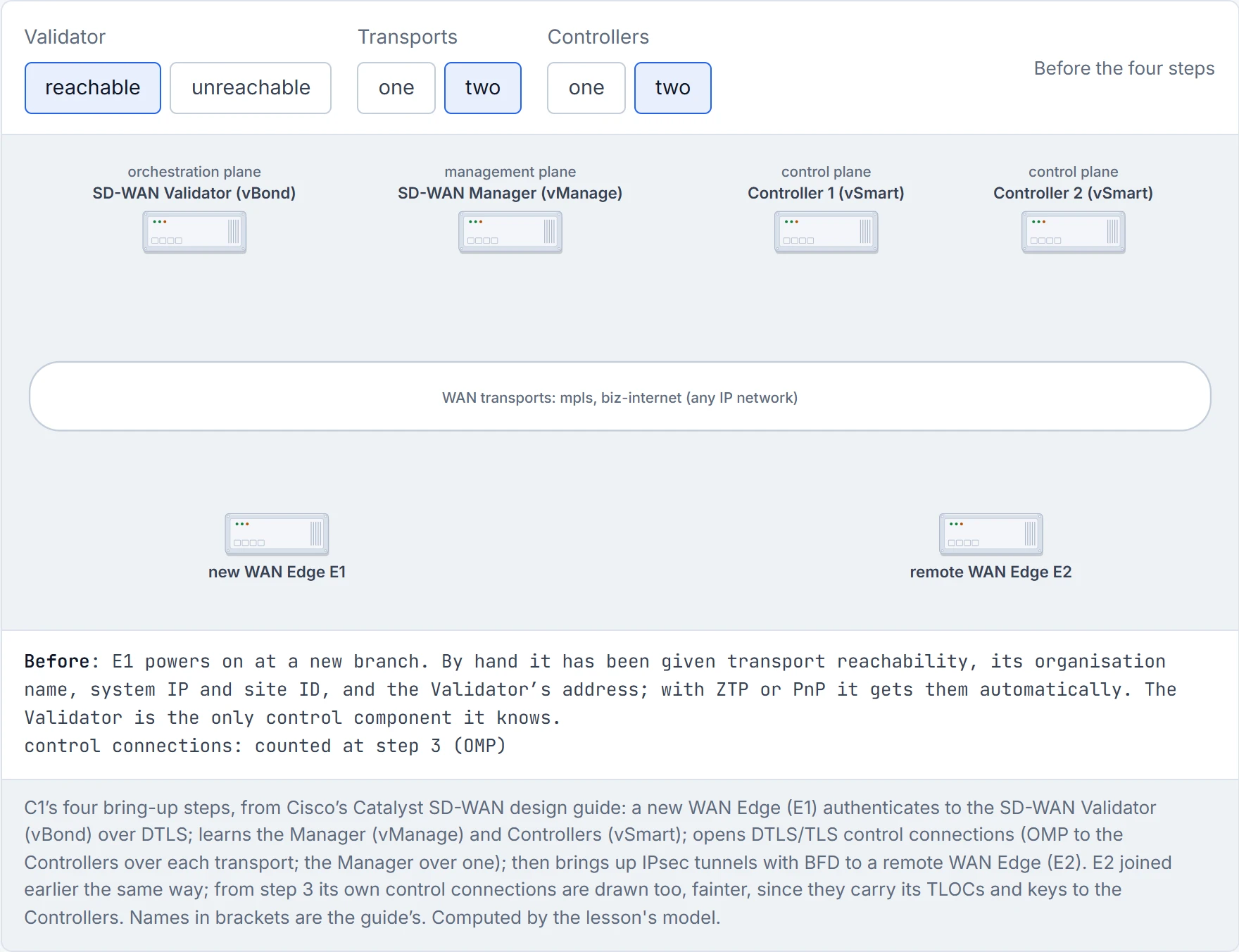
Step 1 of 5 E1 is a new branch router. Besides getting onto a transport and knowing who it is, the only control component it needs to know is the Validator; everything else it learns.
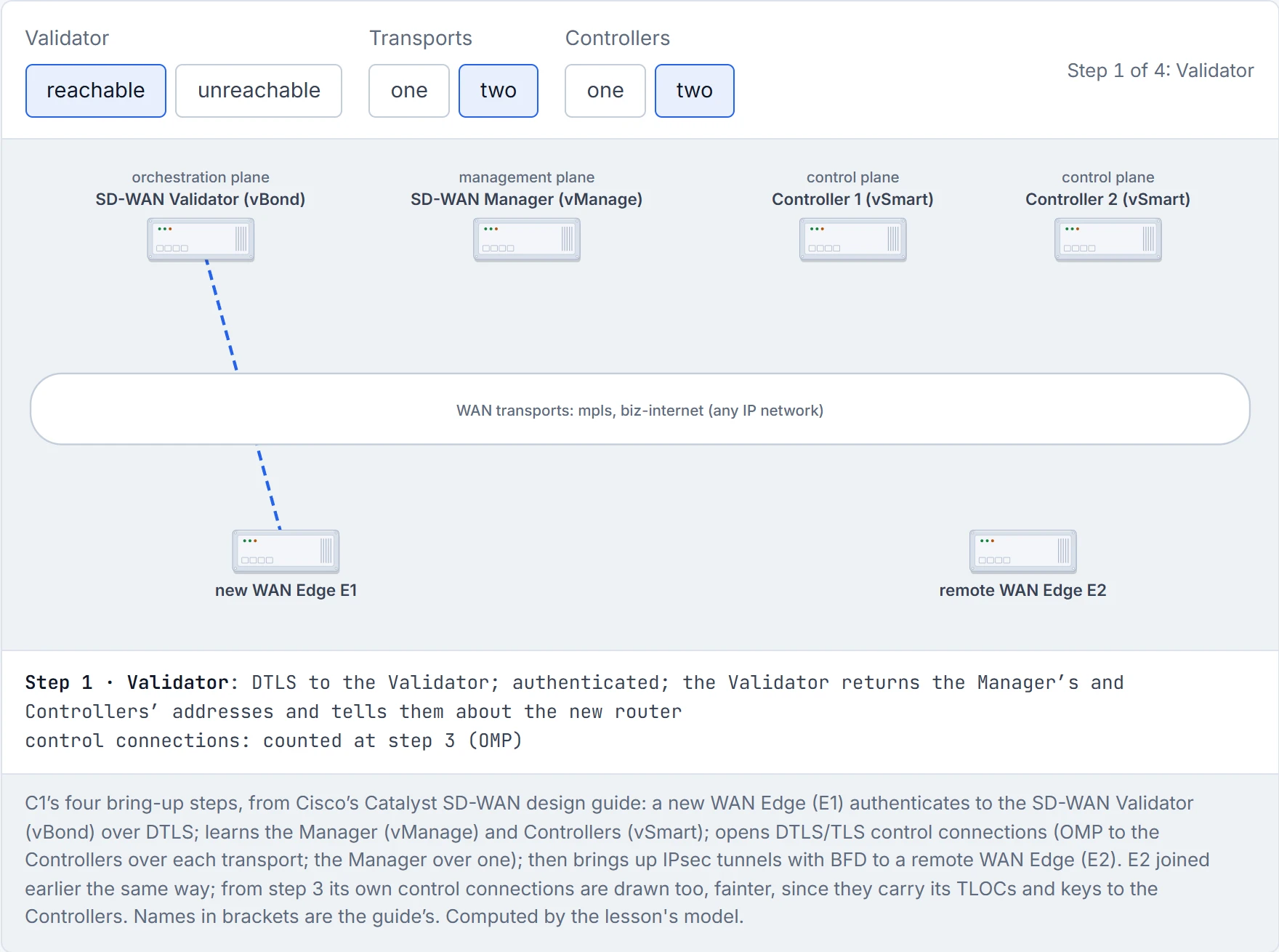
Step 2 of 5 Step 1: E1 authenticates to the Validator over DTLS. The Validator tells it where the Manager and Controllers are, and tells them about E1.
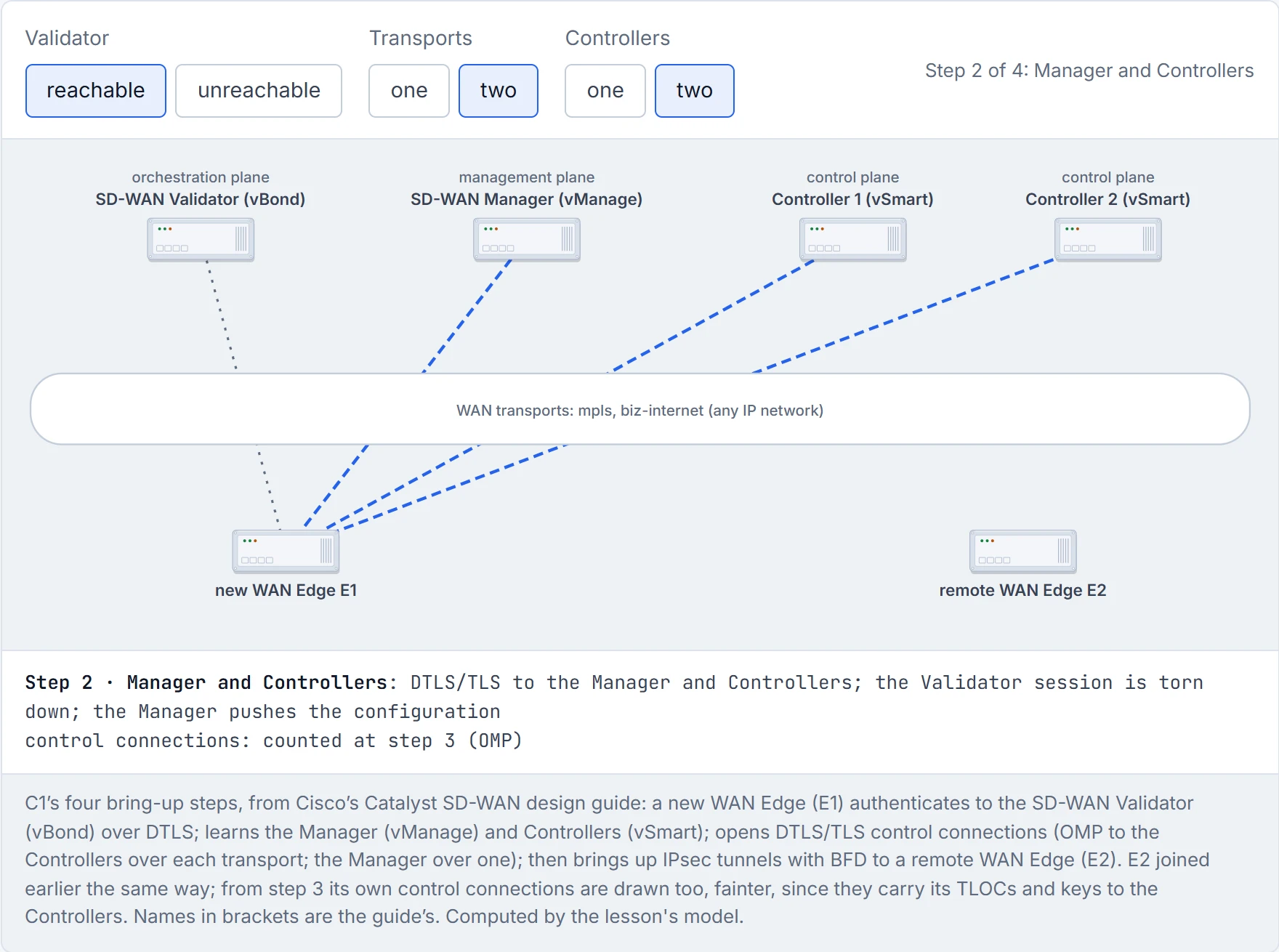
Step 3 of 5 Step 2: E1 opens DTLS or TLS connections to the Manager and Controllers and drops the Validator. The Manager pushes E1’s configuration.
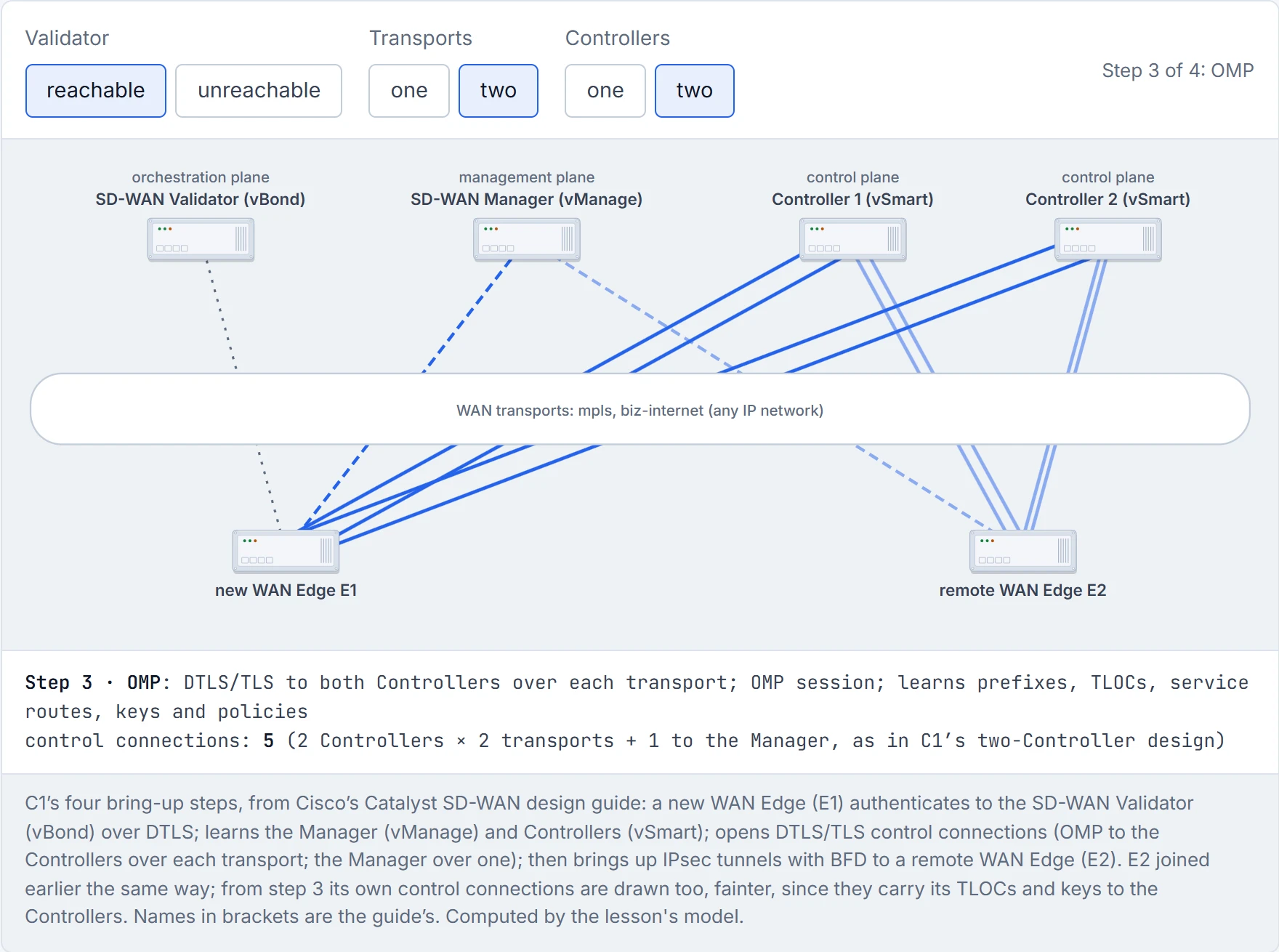
Step 4 of 5 Step 3: E1 runs OMP with the Controllers over each transport, and learns prefixes, TLOCs, service routes, keys and policies. The Controller is a route reflector: E1 never talks OMP to E2. The fainter lines are E2’s own connections, made when it joined: that’s how E2’s TLOCs and keys reached the Controllers.
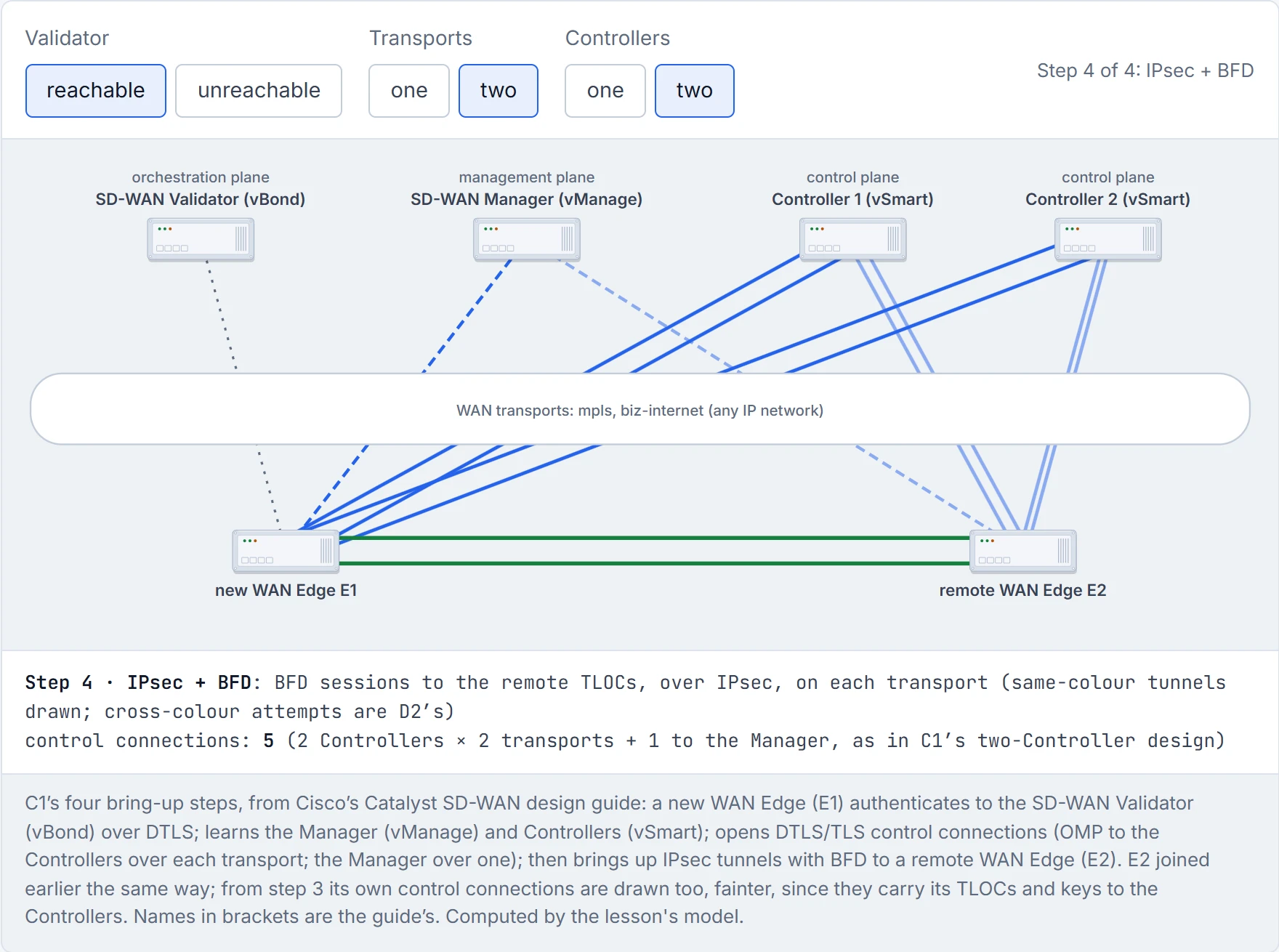
Step 5 of 5 Step 4: with E2’s TLOCs and keys learnt from the Controller, E1 builds IPsec tunnels to E2 on each transport, and BFD runs in every tunnel. No IKE: the keys came through OMP.
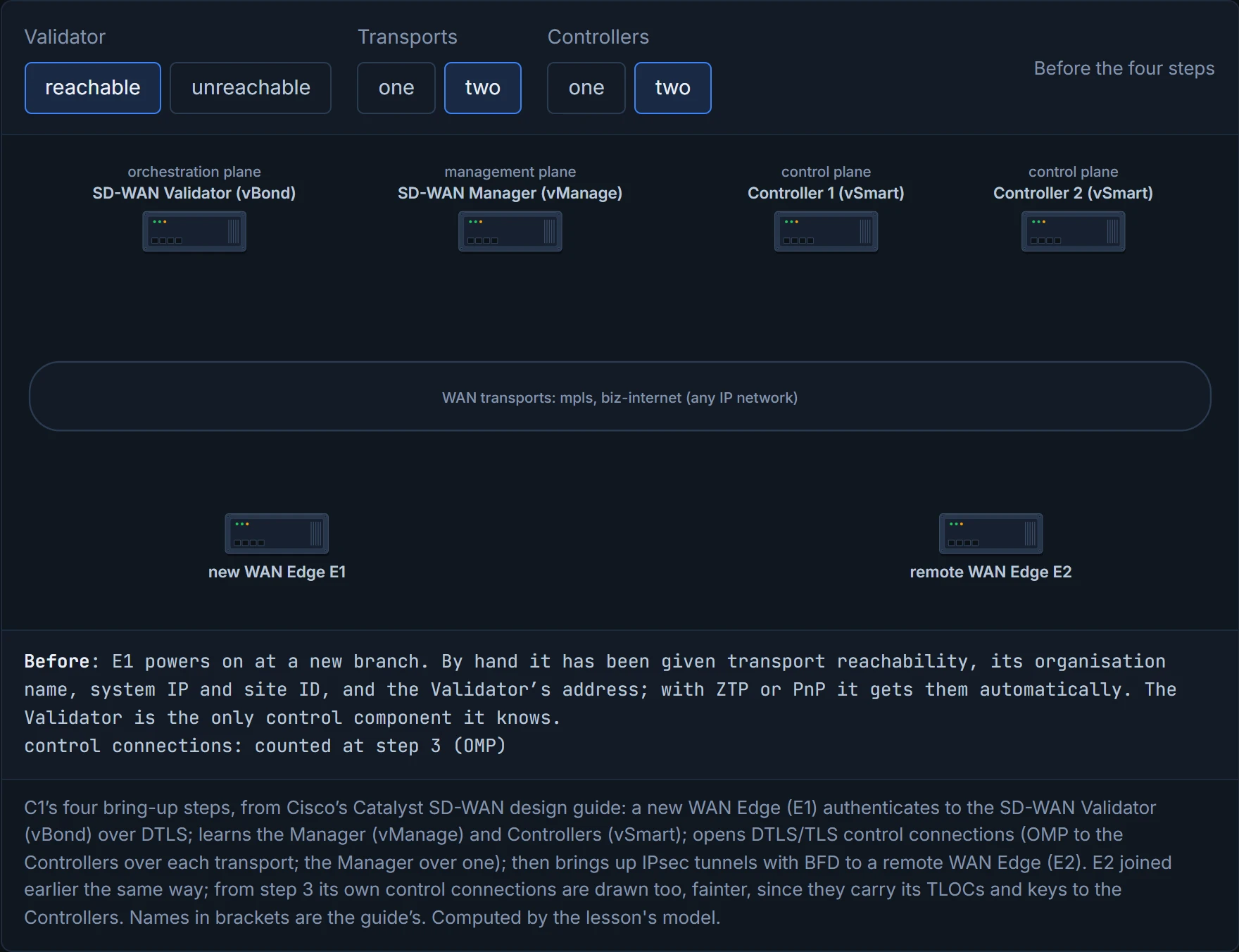
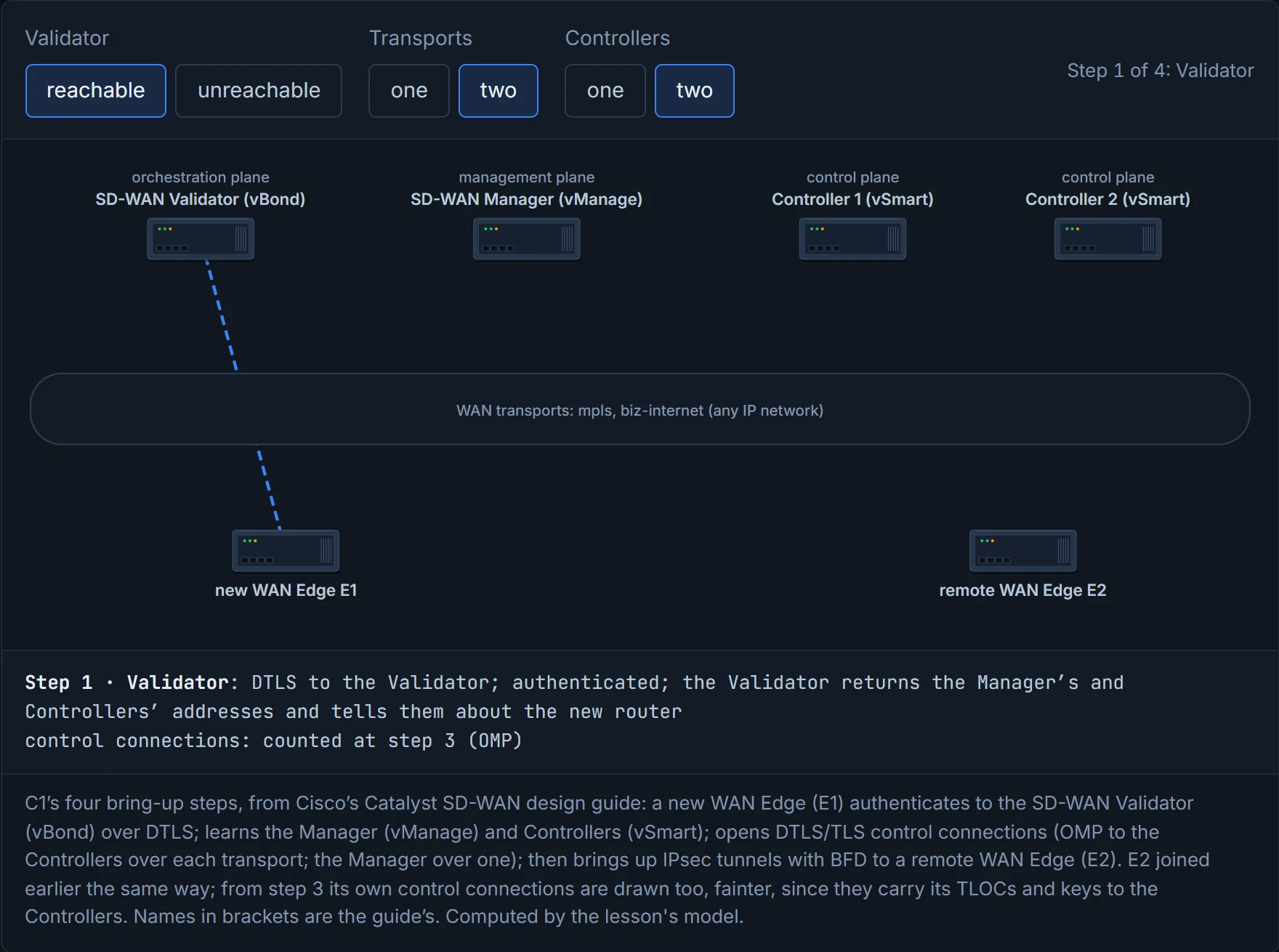
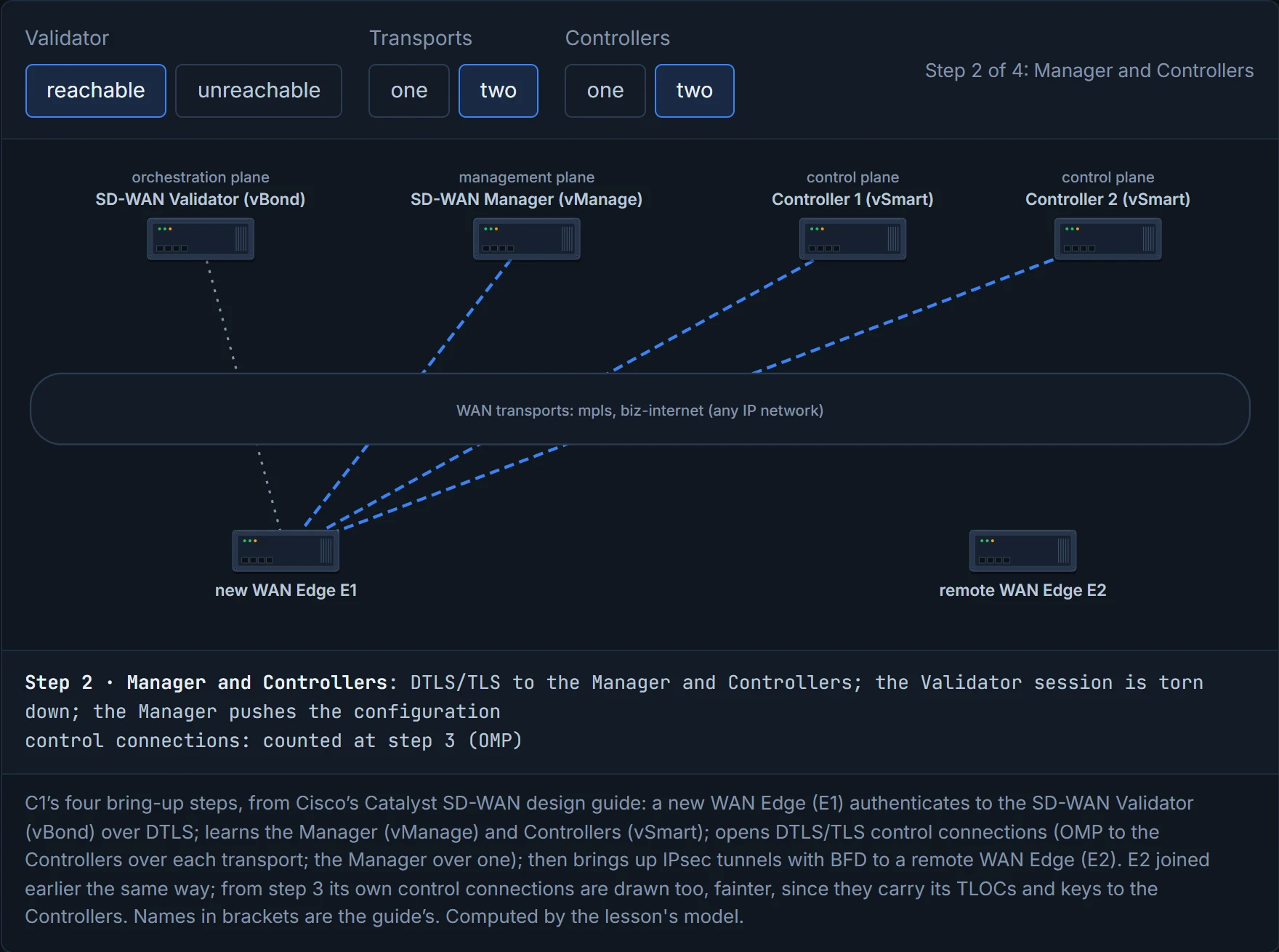
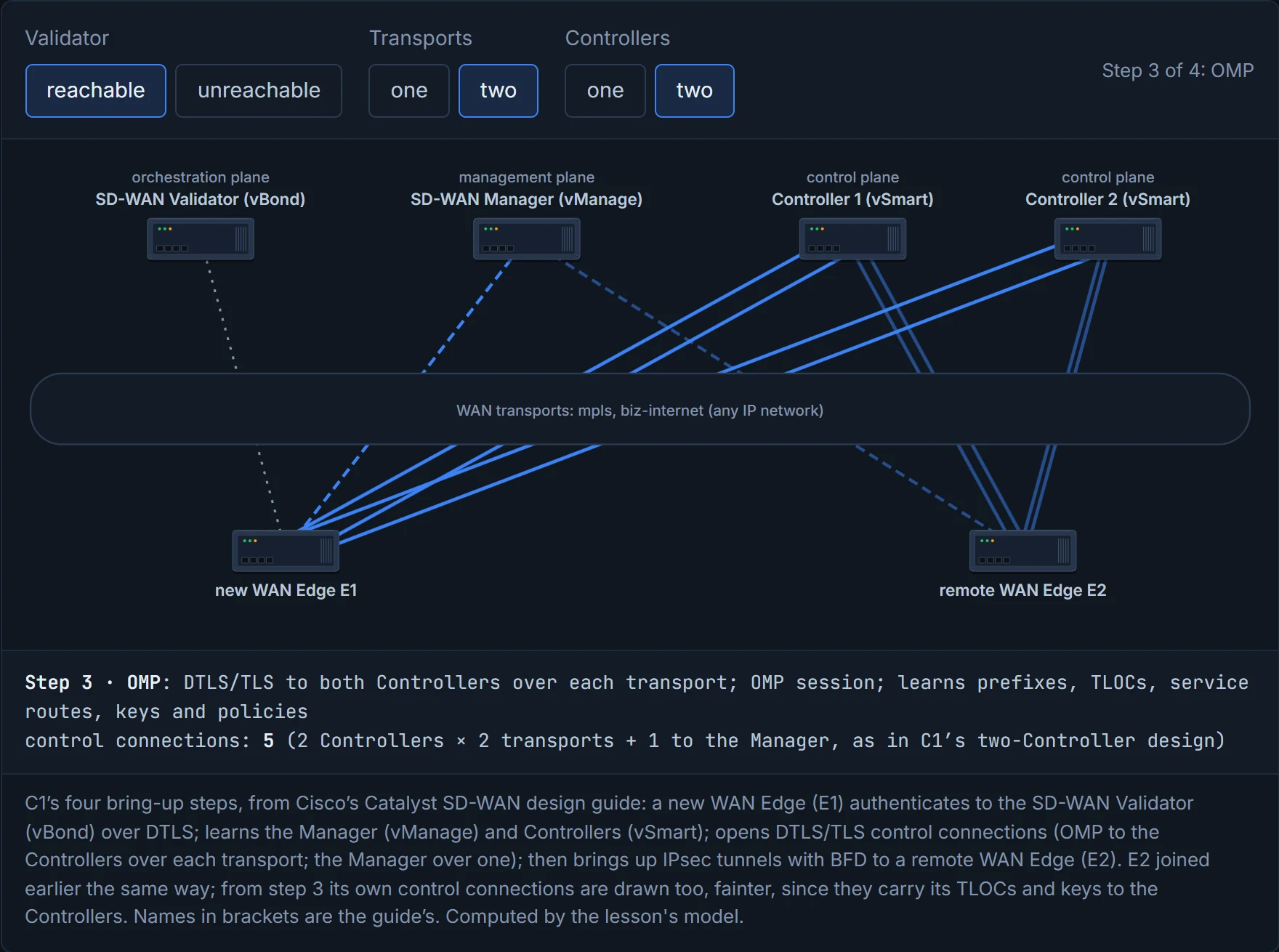
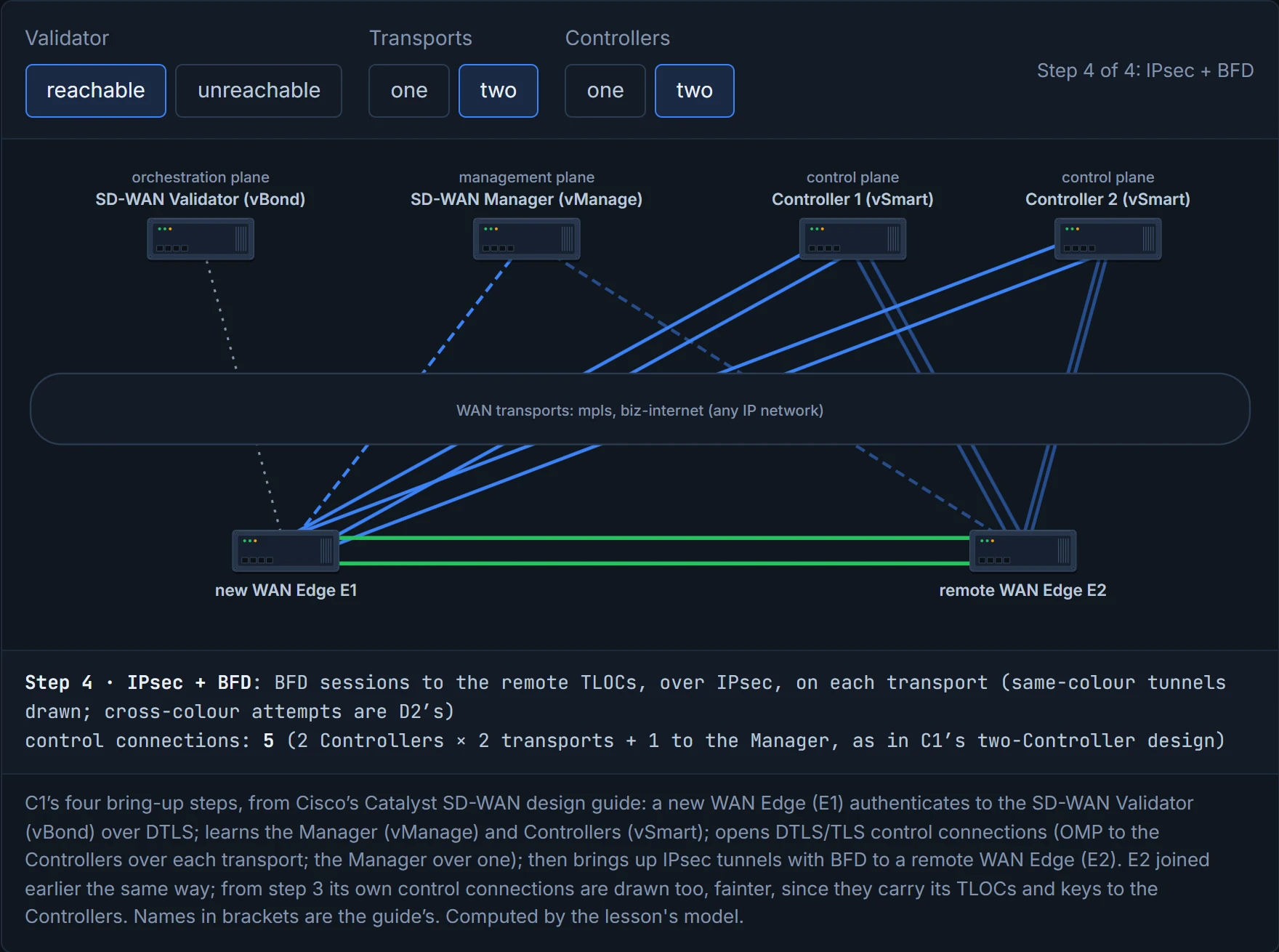
Five: two Controllers on each of two transports, plus one to the Manager on a single transport. And notice what never happens: E1 never runs OMP to E2. Everything it knows about E2 came through the Controller.
The Controller runs the whole WAN's routing and never forwards a single user packet, which makes it the most influential device in the building that nobody's traffic ever touches.
The WAN Edge routers (the guide's SD-WAN routers) sit at the edge of each site (branch, campus, data centre, cloud), as hardware, software, cloud or virtual routers. They run ordinary routing (OSPF, BGP), ACLs, QoS and policies as well as the overlay; each keeps its DTLS connection and OMP session with the Controller, builds standard IPsec sessions with the other routers, and makes local decisions (routing, HA, interfaces, ARP, ACLs) itself, like a branch manager who follows head office's rule book but runs the day-to-day alone. Two families:
- vEdge: the original Viptela platforms and software.
- cEdge: Viptela software integrated into IOS XE (CSR, ISR, ASR 1000, ENCS, and the cloud CSRv and ISRv), in an SD-WAN image that carries only the IOS XE features that make sense for SD-WAN. The guide's Table 23-2 gives cEdge the advanced security vEdge lacks: AMP and Threat Grid, URL filtering, the Snort IPS and embedded platform security; both have the enterprise firewall and Umbrella DNS security. At the time of writing, URL filtering and IPS weren't supported on ASR 1000 cEdges, and vEdge's firewall DPI is done by Qosmos (what these features do: 08-5 and 08-6; platform differences as a design cost: 06-7).
Continue the lesson
The whole lesson, with its drawings and its questions. The rest of this section and 9 more after it.