
Traditional campus next to SD-Access
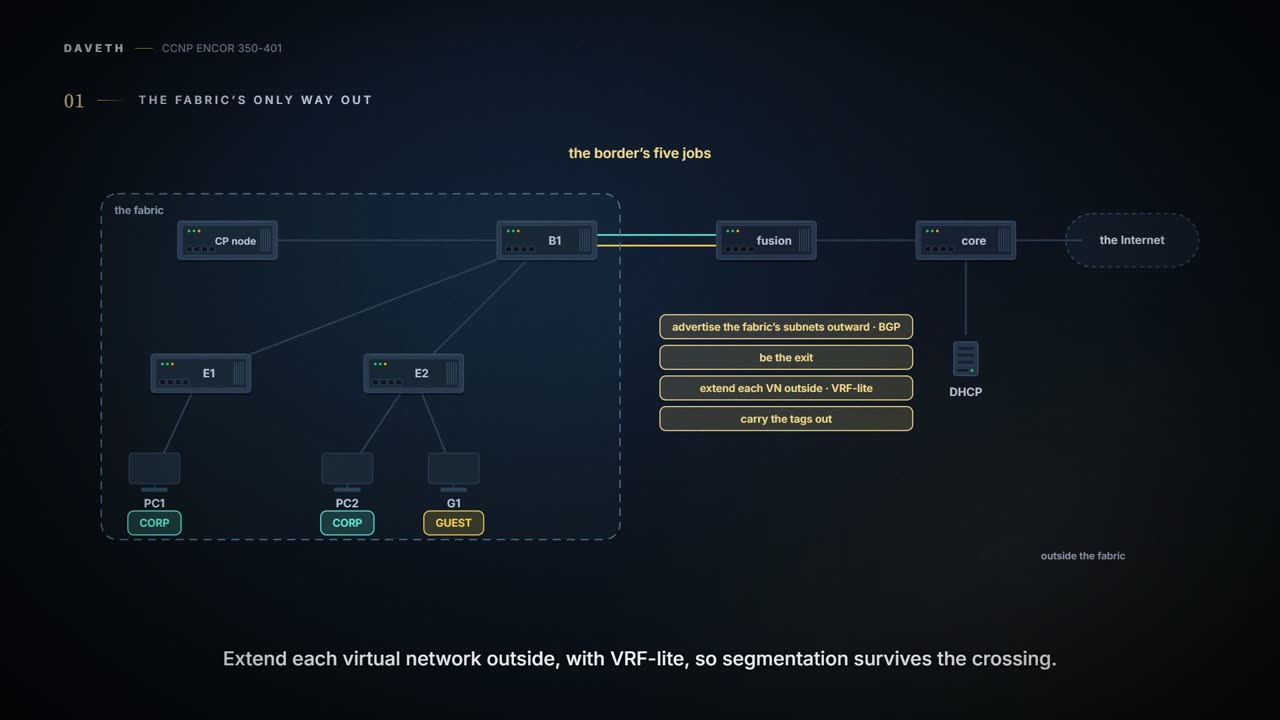
A border node is the fabric's only way in and out: a LISP proxy tunnel router that connects external Layer 3 networks and translates reachability and policy, VRFs and SGTs, between the two. It advertises the fabric's subnets outward with BGP, acts as the edges' gateway of last resort, extends virtual networks with VRF-lite, and adds or removes VXLAN.
By Arif, founder of Daveth · Updated
The full 8 min walkthrough is in Daveth Pro (Network). See what the plan opens
What this page answers
What does an SD-Access border node do?
It connects the fabric to external Layer 3 networks: it advertises the fabric's subnets outward with BGP, is the edge nodes' gateway of last resort, extends virtual networks with VRF-lite, carries SGTs out, and adds or removes VXLAN. Read it in “4.1 The border: the fabric's only way out”
4.1 The border: the fabric's only way out
The guide calls borders LISP proxy tunnel routers that connect external Layer 3 networks to the fabric and translate reachability and policy information, such as VRF and SGT information, from one domain to another. It works like the only bridge off an island: whatever arrives or leaves, it crosses there. Cisco's design guide spells out the jobs:
- Advertise the fabric's subnets outward with BGP, as a coarse aggregate, so traffic from outside is attracted back to the border.
- Be the exit: the external border is the fabric edges' gateway of last resort (LISP PxTR); an internal border registers known networks outside the fabric (a data centre's, say) with the control plane node.
- Extend the VNs outside with VRF-lite and VRF-aware routing protocols, so segmentation survives the crossing.
- Map policy: carry SGTs out when the packet is de-encapsulated.
- Encapsulate and de-encapsulate: VXLAN in for traffic arriving, VXLAN off for traffic leaving.
Everything a traditional campus needs from the fabric, and everything the fabric needs from it, goes through that list. You can think of it as a border crossing between two countries: the lorries are the same on both sides, but the paperwork is checked and re-stamped at the barrier.
The control plane node knows where every endpoint in the fabric is; the border is where that map runs out and somebody else's begins.
Most traffic leaves through a Layer 3 border. Cisco's design guide names three roles for it: the external border is the gateway of last resort; the internal border registers known internal networks (such as a data centre's prefixes: inside the organisation, outside the fabric) with the control plane node; and internal + external does both. (06-4 maps these to the guide's internal, default and internal + default (anywhere); the current Catalyst Center UI no longer shows these names, but they still describe the design.) Registering internal prefixes matters: without it, fabric edges would send data-centre traffic to the external border, which would hairpin it to the internal border. It works like a building with a staff entrance and a public one: if the staff entrance isn't signposted, everyone queues at the front and gets walked round the back.
The handoff itself keeps the VNs apart: each VN leaves in its own VRF over VRF-lite, and a routing protocol that knows about VRFs carries its routes. Catalyst Center (07-8) automates the border's end: a subinterface or SVI per VN, eBGP to advertise the fabric's prefixes and attract traffic back; the next-hop device is outside the fabric and isn't automated. Cisco's fusion-router note shows the usual shape: one trunk from the border to the next device, a VLAN and a BGP session per VRF. That's roughly equivalent to a customs hall with a separate queue for each airline: one building, one door, and no passenger ever crosses into another airline's queue.
Catalyst Center configures the border's end of every VRF-lite link for you, which leaves you only the other end of every one of them.
The users are in VNs; the things every user needs (DHCP, DNS, NTP, the Internet, ISE, the controller, WLCs) usually aren't. Cisco's design guide puts shared services outside the fabric, typically upstream of the border. So something has to join each VN's VRF to wherever those services live. The design guide calls it a VRF-aware peer directly attached outside the fabric, which leaks shared-service routes across the VNs; firewalls (08-5) there add inspection between VNs, and LISP extranet is an alternative that avoids BGP route leaking. The design guide says such a peer can "fuse these routes together", and Cisco's tech note calls the device the fusion router: it "enables Virtual Routing and Forwarding (VRF) leaking across SD-Access Fabric domains, and enables host connectivity to shared services", leaking the fabric VRFs' subnets into the global routing table (or a shared-services VRF) and the other way. And one catch: the fabric side is configured by Catalyst Center, but the fusion device is outside the fabric, so it's configured by hand. The leaking itself is one of two kinds: route leaking, when the shared services are in the global table (IP prefix lists match their routes, route maps reference the lists, and the VRFs import only those), or VRF leaking, when they sit in their own VRF (route targets between the fabric VNs' VRFs and the services VRF). It acts kind of like a connecting door between two locked offices: each office is sealed, and the door opens only onto the rooms you've listed.
The fusion device isn't the only option, and it's worth knowing the others. A non-VRF-aware peer (a WAN router, an ISP) merges all the VNs into its one global table, which is merging, not leaking, and risks east-west traffic across the link unless something (ideally a firewall) stops it. A firewall peer joins VNs with inspection, for Internet, data-centre or inter-VN traffic. LISP extranet does the leaking inside LISP, but only from subscriber VNs to a provider VN, such as shared services, never between two subscriber VNs.
Predict before D1: PC1 asks for a DHCP address, and the fusion device has no route leaking. Where does the request die?
D1
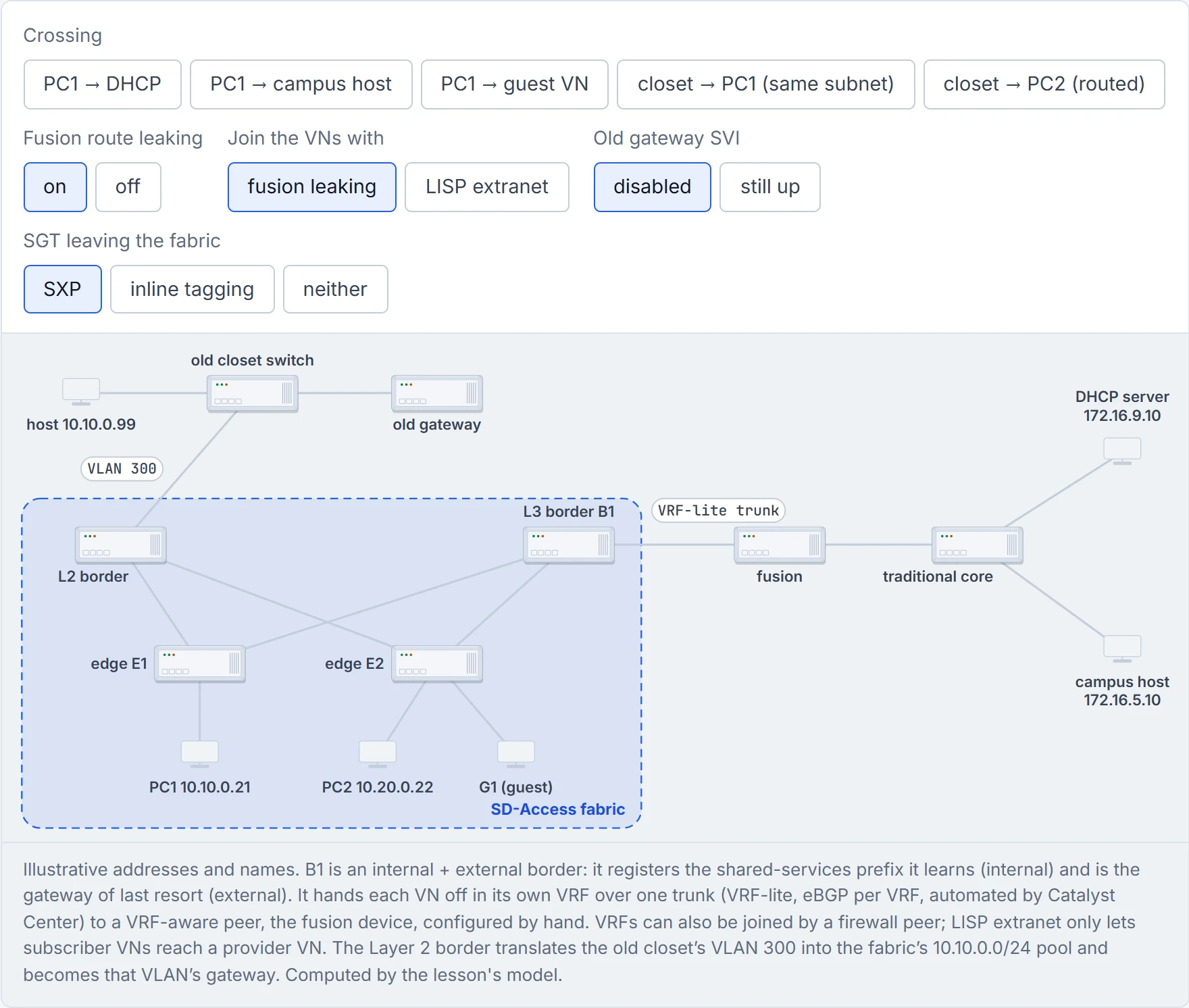
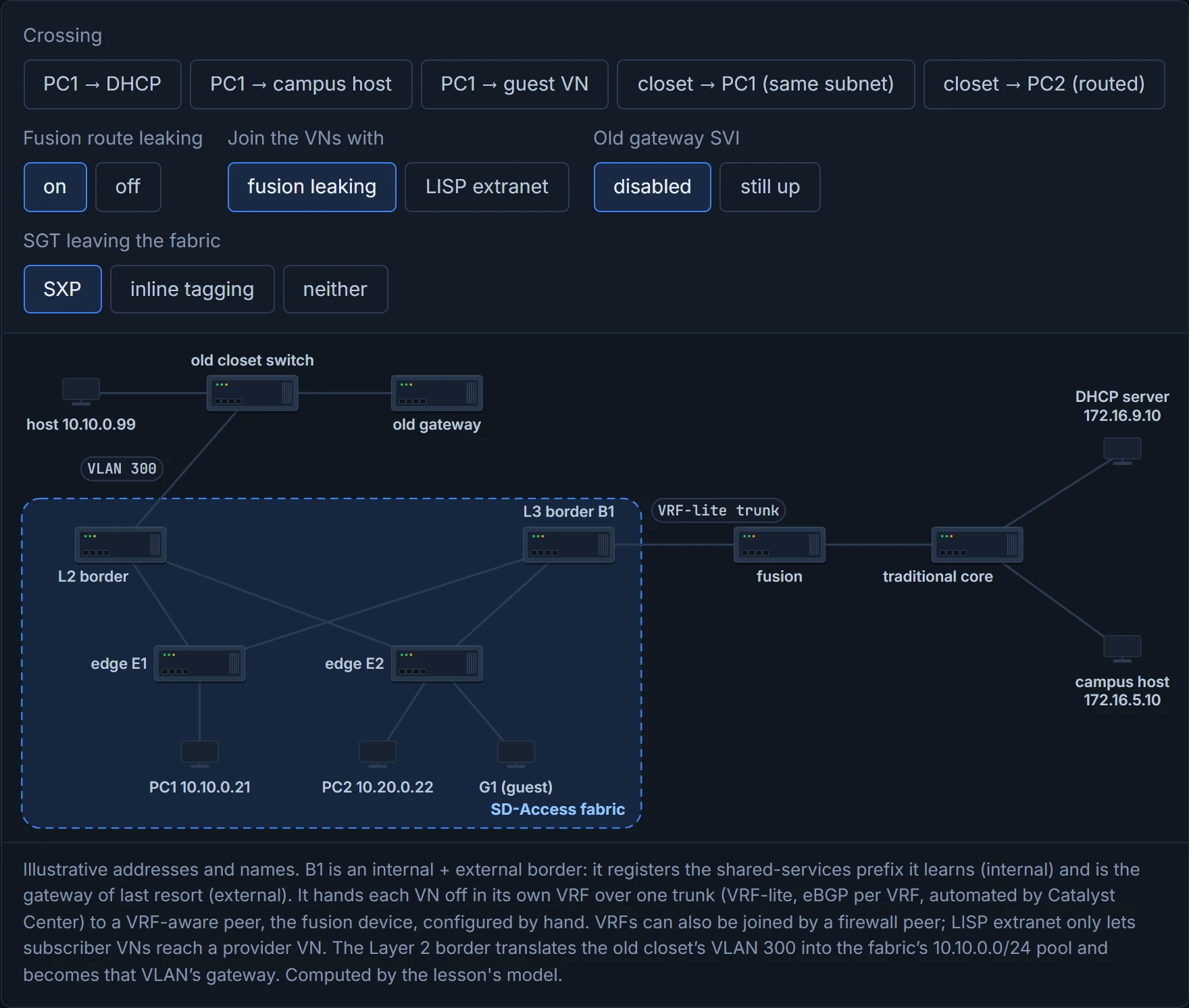
At the fusion device. The edge and the border did their jobs, like a relay team handing the baton to a runner who's there but was never told the next leg: VRF CORP arrived at the fusion device intact, but nothing there joins VRF CORP to the global table where DHCP lives. Notice the first hop, too: with no leak there's nothing for B1 to register, so E1 fell back to the default route; with the leak on, B1's internal side registers the DHCP prefix and E1 goes to it by LISP. With leaking back on, take the guest VN: two VNs meet here, outside the fabric; a LISP extranet join would refuse, because both are subscriber VNs.
The first fabric user who can't get an address has found the fusion device before the network team did.
A VN survives the border as a VRF. A group needs its own passport, like a traveller whose visa is a separate document from the ticket. When the border de-encapsulates a packet, the group can travel onwards two ways: inline tagging, carried in each frame, or SGT Exchange Protocol (SXP), which sends the IP-to-SGT bindings to devices that can't take tags in frames (how both work is 08-7's). The guide lists the same idea as one of TrustSec's benefits: extending policy to external networks by sending the tags to TrustSec-aware devices with SXP.
Without either (or some other way of learning the bindings), the traditional side sees a packet from 10.10.0.21 and no group. It's a bit like a conference badge that works in the main hall: step out into the hotel lobby without the lanyard and nobody knows which sessions you paid for.
An SGT that isn't exported stops being a security policy at the border and becomes a very specific kind of amnesia.
Sometimes hosts can't be re-addressed yet, or must share a Layer 2 domain with the fabric. The Layer 2 border handoff connects the fabric to a non-fabric network at Layer 2, so the fabric's segment and the traditional VLAN use the same subnet and switching domain; the border translates (or extends) the VLAN, and Catalyst Center automates the LISP configuration, the VLAN translation and the trunk. For a routed segment, the anycast gateway's SVI is provisioned on the handoff, and the border becomes the traditional VLAN's default gateway; any SVI with the same IP address in the traditional network must be disabled. If you've ever put a temporary footbridge across a river while the real bridge was built, you've seen the idea: same road on both banks, one crossing point, and it comes down afterwards.
It has rules, because it drags Layer 2 into the fabric's boundary:
- One Layer 2 border per traditional network: the traditional switches shouldn't connect to several. Dual homing is by link aggregation: if the traditional switches run as one logical switch (a stack or StackWise Virtual), a MEC to the single border; the border's own redundancy is stacking or StackWise Virtual (06-2).
- Not on an edge node, and not on Fabric in a Box.
- A dedicated device is recommended: it's exposed to the traditional network's spanning tree, and a storm there could hit it; dedicating it keeps the rest of the fabric independent.
- VTP transparent, so it can't change the traditional network's VLANs.
- VLANs 2-4093, minus 1002-1005 and 2046 (Cisco writes it as 2-4094 excluding 1, 1002-1005, 2046 and 4094).
Cisco also recommends keeping Layer 2 and Layer 3 border roles on different devices. And for OT, IoT and building systems that talk by broadcast, the Layer 2 handoff can be combined with Layer 2 flooding, so broadcasts and wake-on-LAN work across it while those systems migrate. In D1, "closet → PC1" is the same subnet, so it never touches a gateway and the old SVI can't hurt it. the host needs its gateway now, and two devices claim 10.10.0.1, like a street where two houses have the same number.
Continue the lesson
The whole lesson, with its drawings and its questions. The rest of this section and 9 more after it.