
L3 MTU and fragmentation
A packet arrives that is bigger than the outgoing link will carry, and IPv4 and IPv6 answer differently. IPv4 routers fragment it, with reassembly at the destination. IPv6 routers never do: only the source fragments, after learning the path MTU from an ICMPv6 Packet Too Big message. So large IPv6 packets depend on ICMPv6 getting back, and filtering it breaks them.
By Arif, founder of Daveth · Updated
The full 4 min walkthrough is in Daveth Pro (Network). See what the plan opens
What this page answers
Do IPv6 routers fragment packets?
No. In IPv6, fragmentation is performed only by the source node. A router that cannot forward a packet because it is too big sends an ICMPv6 Packet Too Big message back, and the source stores the MTU in its cache. Read it in “The message, and the cache”
Where are IPv4 packets fragmented and reassembled?
Fragmented at gateways, routers along the path, and reassembled at the destination host. The sender never has to know. Read it in “IPv4: the router breaks it up”
Why do large IPv6 packets fail when ICMPv6 is blocked?
Only the source can fix an oversized IPv6 packet, and it learns of one from an ICMPv6 Packet Too Big message travelling back along the path. A firewall or ACL that blocks it leaves the source sending packets that never arrive. Read it in “The dependency on the way back”
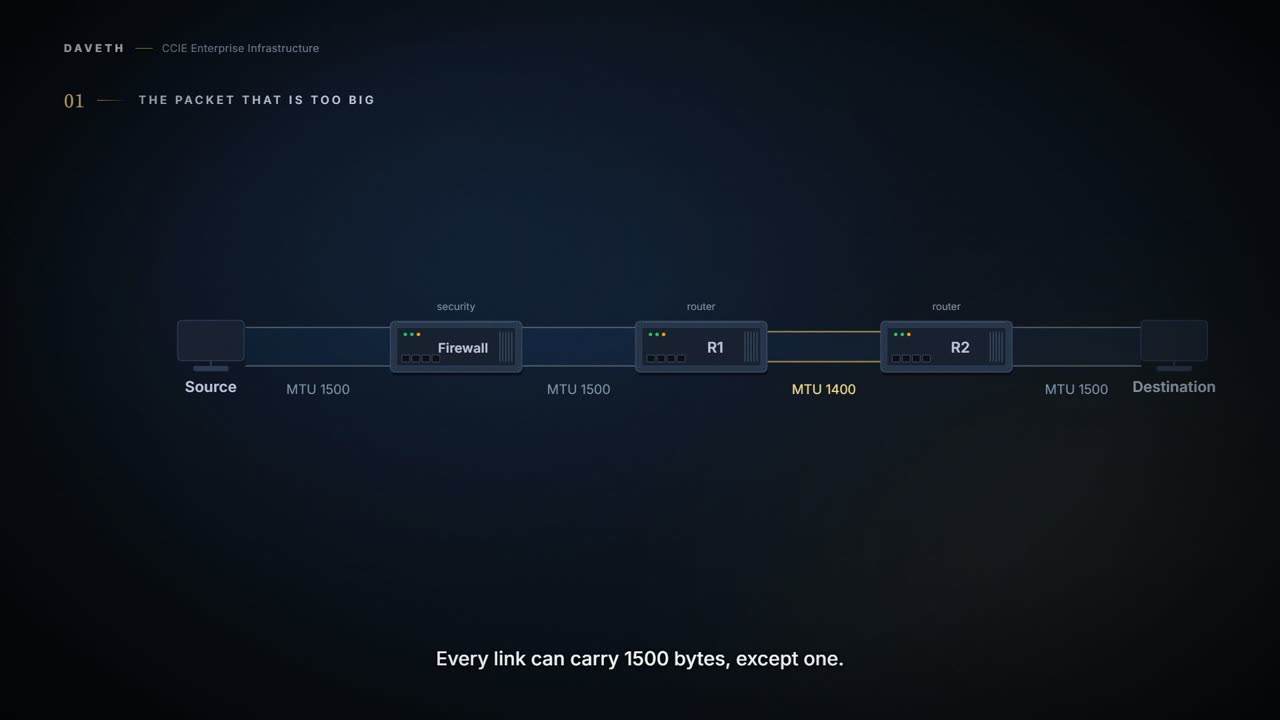
The packet that is too big
You already have half of this topic. 1.1.a gave you the layering, system mtu for the device and ip mtu and ipv6 mtu overriding it per routed interface, and the two mismatch signatures. None of that is repeated here; if it has faded, go back.
This lesson answers the question that page did not: a packet arrives that is bigger than the outgoing link will carry. What happens to it? Predict before reading on, and give a separate answer for IPv4 and for IPv6, because they are not the same. Step 2 of the walk asks the IPv6 half.
IPv4: the router breaks it up
Fragmentation of an internet datagram is necessary when it originates in a local net that allows a large packet size and must traverse a local net that limits packets to a smaller size to reach its destination. The basic internet service is datagram oriented and provides for the fragmentation of datagrams at gateways, with reassembly taking place at the destination internet protocol module in the destination host.
Fragmentation at gateways, reassembly at the destination. The router in the middle does the work, and the sender never has to know: it sent one large packet, the network did what was needed, and the data arrived. That favours "make it work" over "make it efficient". Step 1 of the walk.
IPv6: whose job is it?
As in IPv4, path MTU discovery in IPv6 allows a host to dynamically discover and adjust to differences in the MTU size of every link along a given data path. In IPv6, however, fragmentation is handled by the source of a packet when the path MTU of one link along a given data path is not large enough to accommodate the size of the packets. Having IPv6 hosts handle packet fragmentation saves IPv6 device processing resources and helps IPv6 networks run more efficiently.
Read the middle sentence again. Fragmentation is handled by the source. Not preferably, not usually: the router in the middle does not do this job. And the reason is stated: it saves processing on the IPv6 devices in the path, and the network runs more efficiently. The endpoints fragment only their own traffic; the routers in the middle never take on that work for anyone.
So what does an IPv6 router do with a packet it cannot forward?
Whatever it does, it is not going to repack anything. IPv6 routers do not offer a packet-cutting service.
The message, and the cache
With IPv6 path MTU discovery, a device originating IPv6 traffic has an MTU cache that contains MTU values received in ICMPv6
The page finishes that sentence with the message's name: toobig. So who sends one? The guide does not say. The IPv6 specifications do, and they call it Packet Too Big. RFC 8200, then RFC 8201:
unlike IPv4, fragmentation in IPv6 is performed only by source nodes, not by routers along a packet's delivery path If any of the packets sent on that path are too large to be forwarded by some node along the path, that node will discard them and return ICMPv6 Packet Too Big messages. Upon receipt of such a message, the source node reduces its assumed PMTU for the path based on the MTU of the constricting hop as reported in the Packet Too Big message.
RFC 4443 defines the message. Its rule, then two of its fields, the Destination Address and the MTU:
A Packet Too Big MUST be sent by a router in response to a packet that it cannot forward because the packet is larger than the MTU of the outgoing link. Copied from the Source Address field of the invoking packet. The Maximum Transmission Unit of the next-hop link.
Read the two fields together. The router that cannot forward the packet discards it and sends a toobig back to whoever sent it, carrying the MTU of the link it could not use. The source records that value and sends smaller. Steps 2 and 3 of the walk.
Notice what kind of thing the cache is. Not configuration: learned state, built from messages that actually arrived, which can be empty, stale or wrong. Every other MTU in this course is something you typed. This one the network told your device. Two numbers to carry:
In IPv6, the minimum link MTU is 1280 octets. We recommend using an MTU value of 1500 octets for IPv6 links.
1280 is the floor. No IPv6 link may carry less, so a source can always fall back to 1280.
One thing to keep straight: the guide describes this cache on a Cisco device, for traffic that device originates. SRC in the walk stands for any source; the commands later on this page act on the cache of the IOS XE device you type them on.
The dependency on the way back
The packet is allowed. It is simply too large to leave. Nothing here is a filter or a policy decision, which is exactly why it is so often diagnosed as one.
Put the two halves together. The router will not fix an oversized packet; only the source can; and the source only finds out from an ICMPv6 message travelling back along the path. So IPv6 connectivity for large packets depends on ICMPv6 getting back to the sender.
Suppose a firewall or ACL blocks ICMPv6, as a rule carried over from IPv4 hardening might. The source sends a large packet, a router drops it and sends toobig, and the message is filtered on the way back. The guide says nothing about that case. RFC 8201 does, in its security considerations:
If ICMPv6 filtering prevents reception of ICMPv6 Packet Too Big messages, the source will not learn the actual path MTU.
Continue the lesson
The whole lesson, with its drawings and its questions. The rest of this section and 5 more after it.