
Rendezvous points, SSM, bidir and MSDP
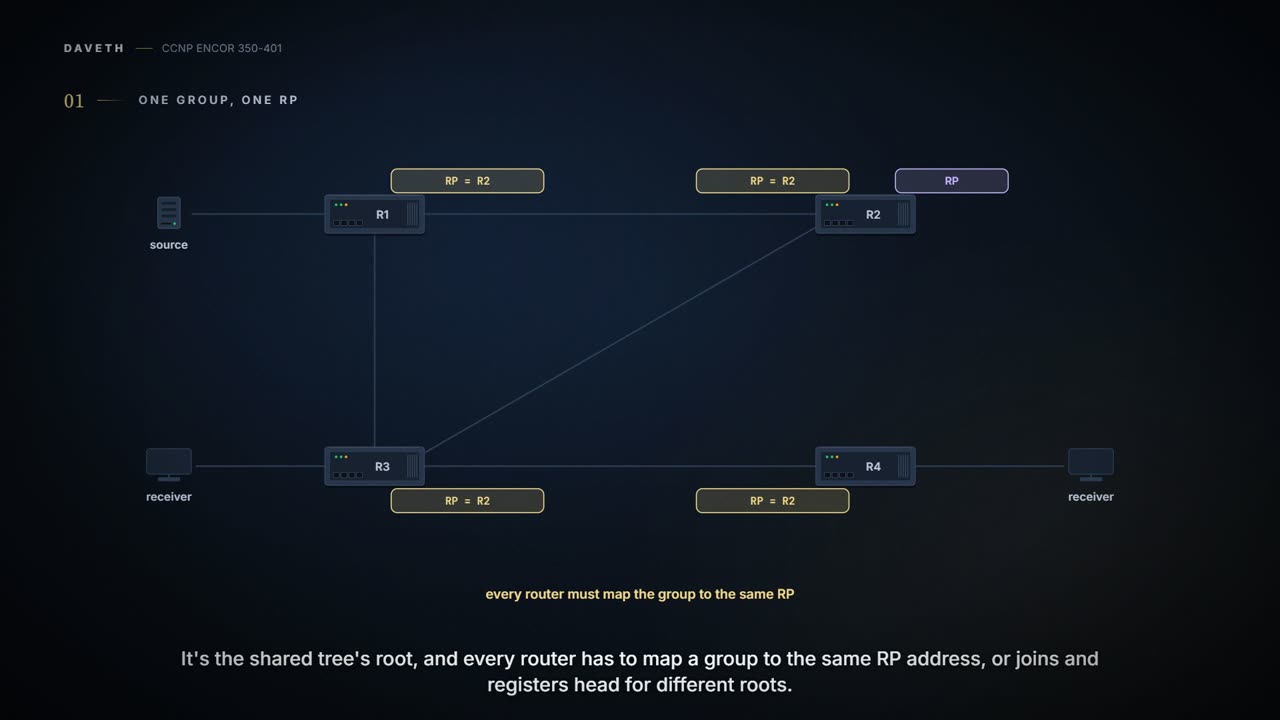
In PIM sparse mode an RP is mandatory, and every router must map a group to the same RP. Configure it statically with ip pim rp-address, or distribute it with Auto-RP, Cisco's, or BSR, but never both together. SSM names the source and skips the RP; bidir makes the RP the permanent centre of one tree; MSDP lets RPs in different domains share sources.
By Arif, founder of Daveth · Updated
The full 9 min walkthrough is in Daveth Pro (Network). See what the plan opens
What this page answers
How do routers learn the PIM rendezvous point?
Statically, with ip pim rp-address on every router, or dynamically with Auto-RP, a Cisco mechanism with announcements and a mapping agent, or with BSR, which floods the candidate list so each router chooses. Do not run Auto-RP and BSR together. Read it in “4.1 One group, one RP, and the static way to say so”
What is bidirectional PIM?
A PIM mode with one shared tree that carries traffic in both directions, making the RP its permanent centre, so sources send up the same tree receivers join. Read it in the lesson
4.1 One group, one RP, and the static way to say so
In sparse mode an RP isn't optional: "it is mandatory to choose one or more routers to operate as rendezvous points". Quiz Q13 turns it round: dense mode uses no RP, sparse mode must have one. An RP is the shared tree's common root (03-6), and every router has to map a group to the same RP address, or joins and registers head for different roots. It's like the meeting point on a school trip: it only works if every child was told the same one.
Sparse mode without an RP is a blind date where nobody booked the restaurant: everyone's keen, and nobody knows where to go.
The simplest way is to configure it: ip pim rp-address on every router, "one or two lines of configuration" each, fine when there are few RPs that rarely change or the network is small. The costs: every router needs the same address, changing the RP means touching every router, several RPs for different groups need access lists everywhere, and there's "no failover procedure" and no load splitting. Consider it your dinner-party invitation with the address written in by hand: perfect for eight guests, miserable for eight hundred. On IOS XE a static mapping loses to a dynamic one for the same group unless you add override.
Auto-RP is "a Cisco proprietary mechanism that automates the distribution of group-to-RP mappings" (quiz Q12's answer). It has two roles:
| Role | Does | Group |
|---|---|---|
| candidate RP (C-RP) | announces itself for a group range (224.0.0.0/4 by default) every 60 seconds, hold time three times that | 224.0.1.39, Cisco-RP-Announce |
| mapping agent (MA) | listens to the announcements, picks the C-RP with the highest IP address per range, and advertises the mappings every 60 seconds or on change | 224.0.1.40, Cisco-RP-Discovery |
Every PIM router joins 224.0.1.40 and caches what it hears. Several MAs can run for redundancy; they don't elect one another, they just all send the same mappings. You can think of it as a noticeboard committee: candidates pin their names to one board, the committee picks and posts the results on another, and everyone reads the second board. It gives you backup RPs, load splitting by range, simpler RP placement near the group's members and consistent mappings without touching every router. The commands are ip pim send-rp-announce on a C-RP and ip pim send-rp-discovery on an MA, each with a TTL scope.
Now the trap. The announcements and the mappings are themselves multicast, to groups that need an RP in sparse mode, and the RP is what they're trying to deliver. Cisco's classic answer was ip pim sparse-dense-mode, where a group with no known RP runs in dense mode, so the Auto-RP groups flood; but so does any other group that loses its RP, all over the network. For sparse-mode interfaces Cisco offers ip pim autorp listener, with which "Auto-RP can still be used"; it floods just the two Auto-RP groups in dense mode while everything else stays sparse. Cisco also recommends a static "sink RP" as the RP of last resort. The trap is like a building whose door code is emailed only to people already inside. Don't run Auto-RP and BSR together: the guide advises against it and Cisco says it's "not supported".
Auto-RP is the only protocol that needs multicast working before it can make multicast work.
The bootstrap router (BSR) mechanism, RFC 5059, is the standard one: part of PIMv2, doing Auto-RP's job without anything proprietary. Candidate BSRs elect one BSR: the highest priority, then the highest IP address. On a Catalyst 9300 the C-BSR priority runs 0 to 255, default 0, and larger wins. The BSR's messages go to 224.0.0.13 with a TTL of 1 and are flooded hop by hop: each router sends them on to its PIM neighbours, so no multicast routing has to work first, which is exactly Auto-RP's problem solved. (RFC 5059 and the guide send them back out of the arrival interface too; Cisco's text says "except the one on which it was received"; the RFC allows skipping it on point-to-point links.) It acts kind of like a phone tree: each person calls the next, so nobody needs the whole list to start.
Candidate RPs learn the BSR's address from those messages and unicast their advertisements to it; the BSR collects them and sends the whole list, the RP set, "every 60 seconds by default". The RP set carries the group range, the RP's priority and address, the hash mask length and whether the group is sparse or bidir. And here's the difference from Auto-RP: the BSR doesn't choose. Every router runs the same algorithm on the same list, so they all reach the same answer. It's a bit like an exam board that publishes the marking scheme and lets every school mark its own papers.
The algorithm, from RFC 7761 and Cisco's own list:
- the C-RPs whose group range is the longest match for the group;
- of those, the lowest priority value (for C-RPs, "the lower the value ... the better");
- of those, the highest hash value, from a hash of the group (ANDed with the hash mask) and the RP's address;
- and only if hash values tie, the highest IP address.
The guide skips step 3: "If the priorities are the same, the C-RP with the highest IP address is elected". Both the RFC and Cisco put the hash first, and the highest address is only the tie-break. The hash mask decides how groups spread. Cisco's default mask length is 0, so the group contributes nothing and the hash depends only on each RP's address: one RP wins every group. A mask of 30 keeps blocks of four groups together and spreads the blocks across equal-priority RPs, and it's the value RFC 5059 recommends for IPv4. Picture yourself deciding who pays the bill by a formula that only looks at each person's name and ignores what they ordered: nothing random about it, and the same person pays every time.
On the exam, watch the wording: a question built from the guide's page may expect "the highest IP address" for equal priorities; the protocol's answer is the hash, with the highest address only breaking a hash tie.
Before running D2, predict: two C-RPs with equal priority, 10.0.0.3 and 10.0.0.4, and Cisco's default mask. Which one serves 239.1.1.1, and which serves 239.1.1.9?
D2
The memory hook: static writes it down, Auto-RP announces it, BSR lets everyone work it out.
A BSR hash with a mask of 0 is the most elaborate way ever invented to pick the same RP every time.
Source-specific multicast changes the question. A receiver doesn't ask for a group; it asks for a channel, a source and a group together, (S,G), in the SSM range, 232.0.0.0/8 for IPv4 by default. It asks with an IGMPv3 INCLUDE report naming the source (03-5); on IOS XE "(S, G) channel subscriptions are accepted through IGMPv3 include-mode membership reports". For IPv6 the SSM range is FF3x::/32, and MLDv2 does the asking. If you've ever subscribed to one writer's newsletter rather than the whole newspaper, you know the model: you name who you want to hear from.
Because the receiver names the source, the LHR can send an (S,G) join straight towards it: "only SSM distribution trees (no shared trees) are created". No RP, no (*,G), no register (a register in the SSM range is answered straight away with a register-stop), no switchover and no MSDP. It also ends what RFC 4607 calls cross-delivery: a receiver no longer gets traffic from some other source that happens to use the same group. It isn't a firewall, though: a sender that forges the source address can still get in. SSM is RFC 4607's "one-to-many delivery only"; it's roughly like a radio you tune by the station's name and frequency together.
Two practical points. ip pim ssm default (232/8; the keyword's range is unconfirmed on 17.9) or ip pim ssm range acl turns it on, and only the last-hop routers need to understand SSM; the routers in between run PIM-SM, and Cisco notes they may need access control to stop registers, MSDP and shared-tree activity in the SSM range. And the (S,G) state lives as long as receivers keep asking, even if the source goes quiet, while in PIM-SM it's deleted after three minutes of silence. For hosts that can only do IGMPv2, SSM mapping (ip igmp ssm-map enable) turns a group-only report into channels using a static table or DNS. The guide notes SSM is often deployed in 239/8 inside private networks; that's what ip pim ssm range is for, since 239/8 isn't SSM until you say so.
SSM is PIM with the RP, the register, the shared tree and the switchover all removed, which is a remarkably short list of what's left.
Bidirectional PIM is for many-to-many groups, where every member might also send. It keeps only the shared tree, and traffic travels on it both ways: up from a source towards the RP, and down every branch that has receivers. A packet turns down at the first router where a branch leaves; each router forwards it out of every (*,G) interface except the one it came in on, so it only passes the RP if the RP is on the way. Routers forward on (*,G) state alone, so thousands of sources cost no extra state. There are no registers, no (S,G) joins, no asserts and no switchover; the RP never joins towards a source. It's like a party line strung along a tree of phone wires: whatever you say runs along every wire, and the exchange at the top is only where the wires meet.
Going up a tree needs a new safeguard, because the RPF check only accepts traffic coming down. On every link one router is elected the designated forwarder (DF): the one with the best route to the RP. The DF is the only router that forwards traffic down onto the link and the only one that picks traffic up off the link towards the RP; the election uses the assert's tie-breaks, with DF-election messages (PIM type 10) to 224.0.0.13. That's why a bidir (*,G) entry also lists its RPF interface as outgoing. Don't mix it up with the DR: the DR registers and joins for a LAN in sparse mode, while a DF forwards a bidir group's traffic on one link, elected per RP address. Think of it as one delegate per table at a conference who carries every question to the front and every answer back.
Two configuration surprises. The RP address doesn't have to belong to a router: "any unassigned IP address on a network that is reachable throughout the PIM domain" will do, and Cisco calls this "the preferred configuration method for establishing a redundant RP configuration for bidir-PIM". The field calls it a phantom RP, the name that turns up as a distractor in quiz Q12. And ip pim bidir-enable is on by default in 17.9; a group becomes bidir through the bidir keyword on ip pim rp-address, send-rp-announce or rp-candidate.
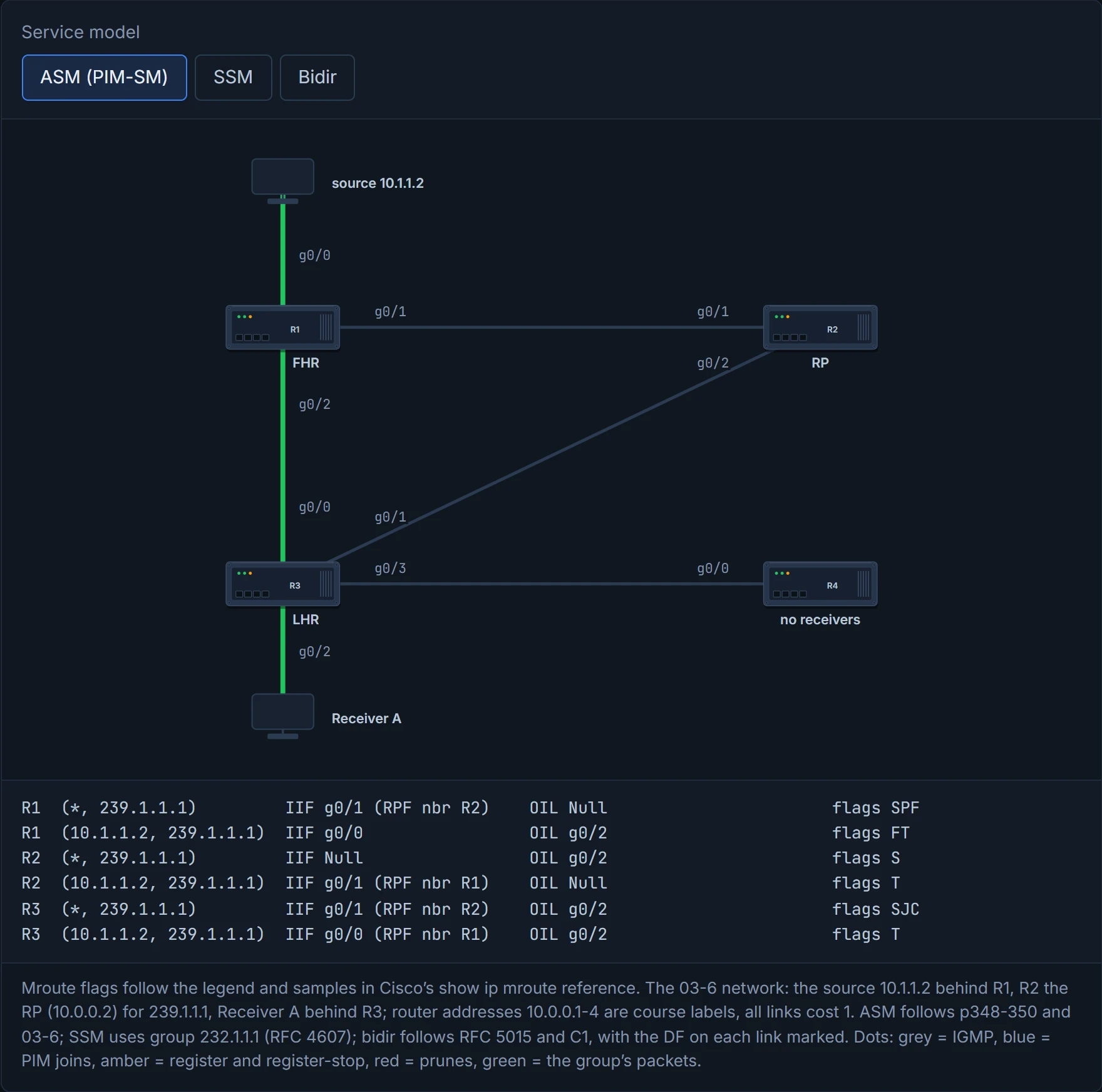
Before running D1, predict: on 03-6's network, which model's packets never pass through R2? And bidir's packets do pass it here: is that because bidir always goes through the RP, or because of where this network's branches are?
D1
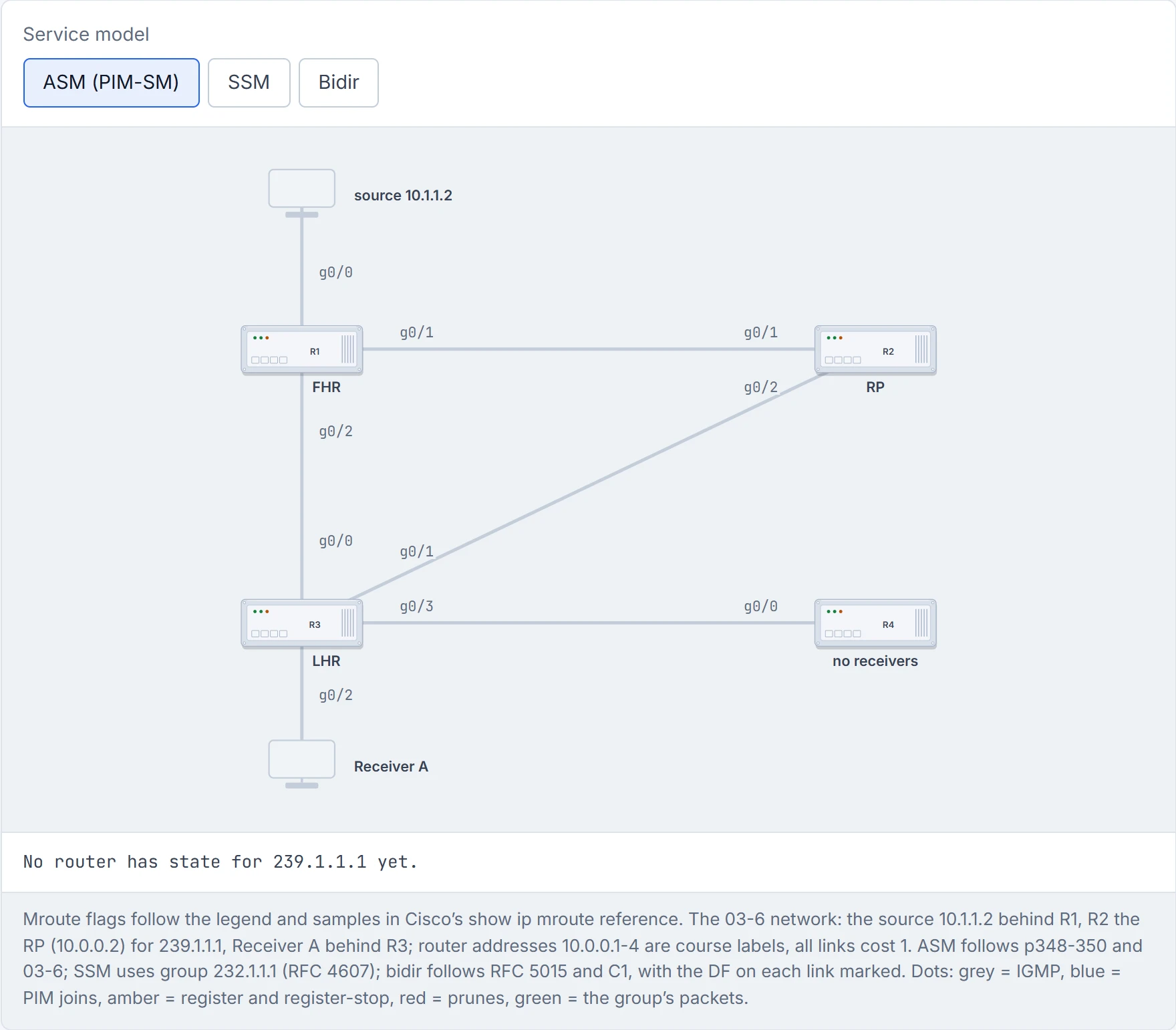
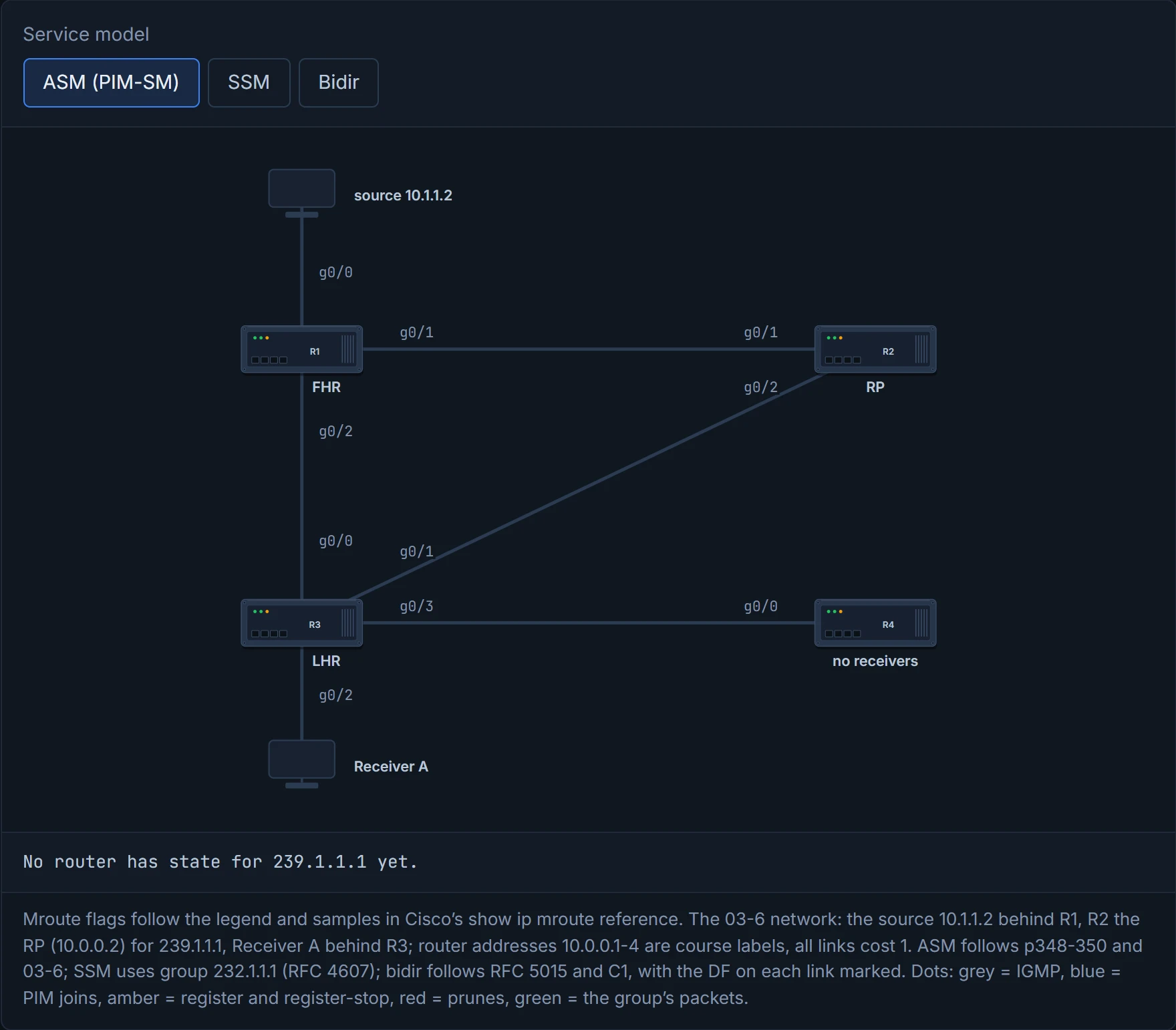
Step 1 of 6 ASM, as in 03-6. R2 is the RP for 239.1.1.1; a receiver will join the shared tree, the source will register, and R3 will switch to the source’s tree.
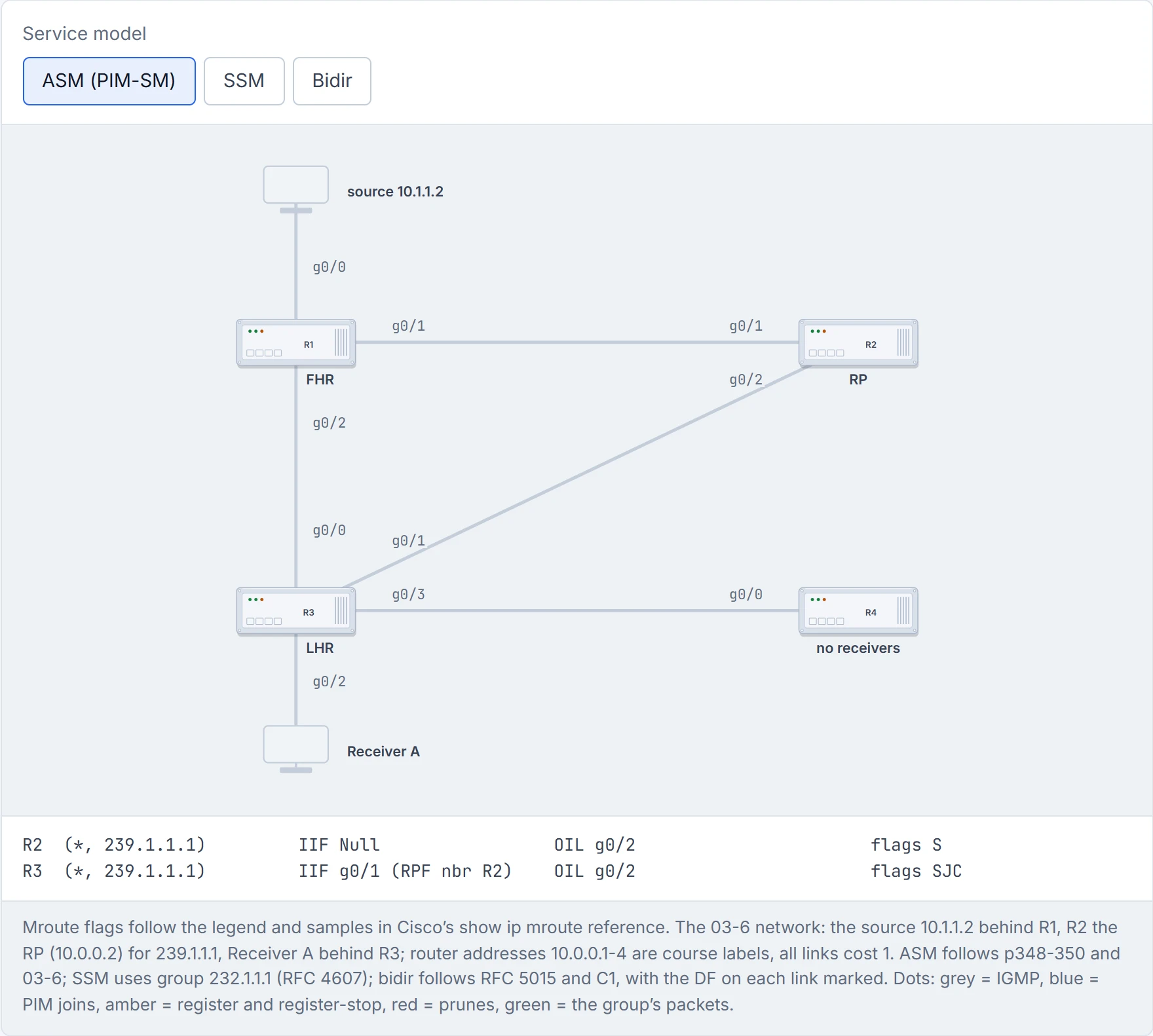
Step 2 of 6 A’s IGMP report reaches R3, which sends a (*,G) join to the RP. The shared tree now runs R2 → R3.
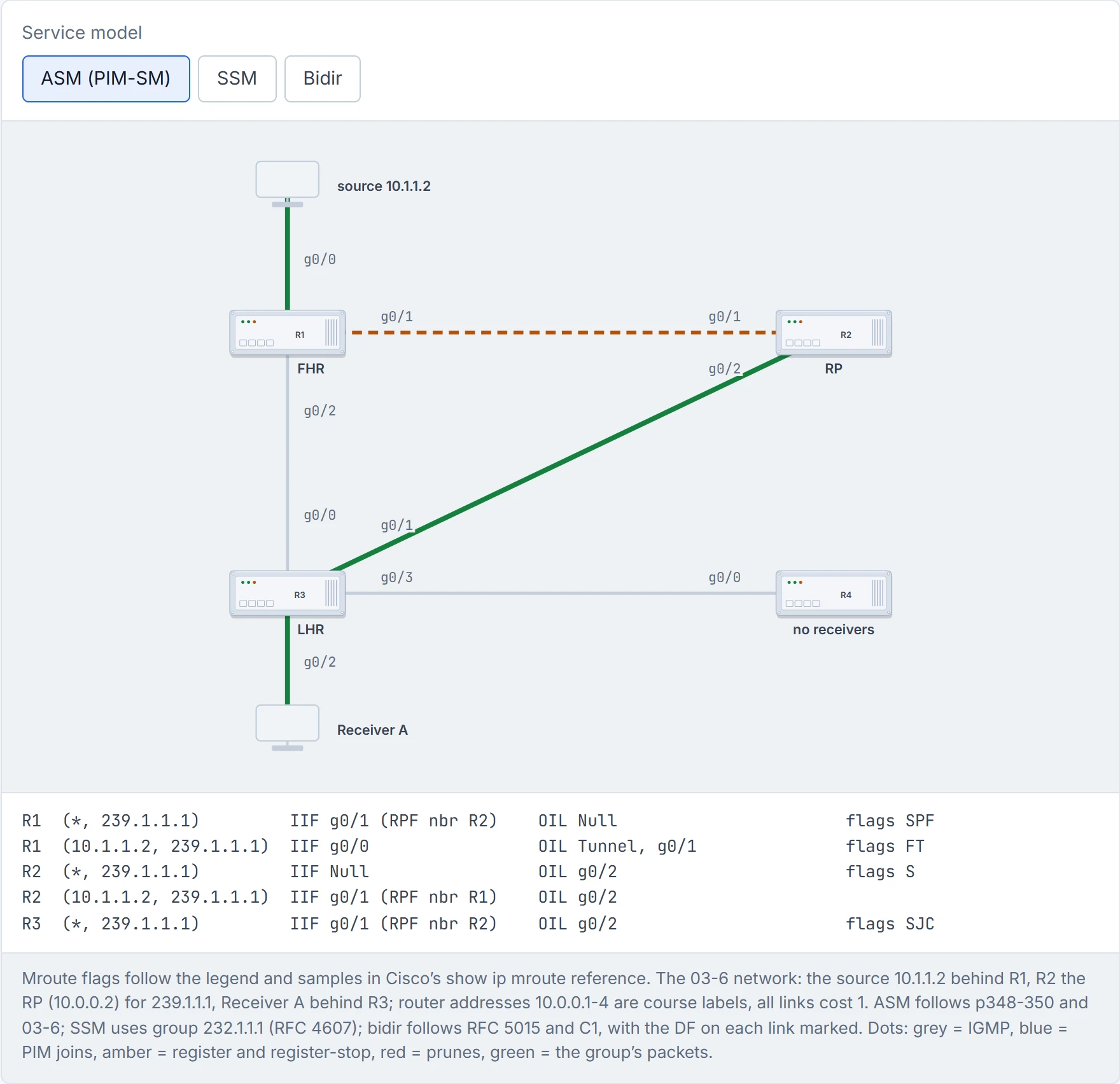
Step 3 of 6 The source sends; R1 registers it with R2 (unicast), R2 forwards down the shared tree and joins (S,G) towards R1.
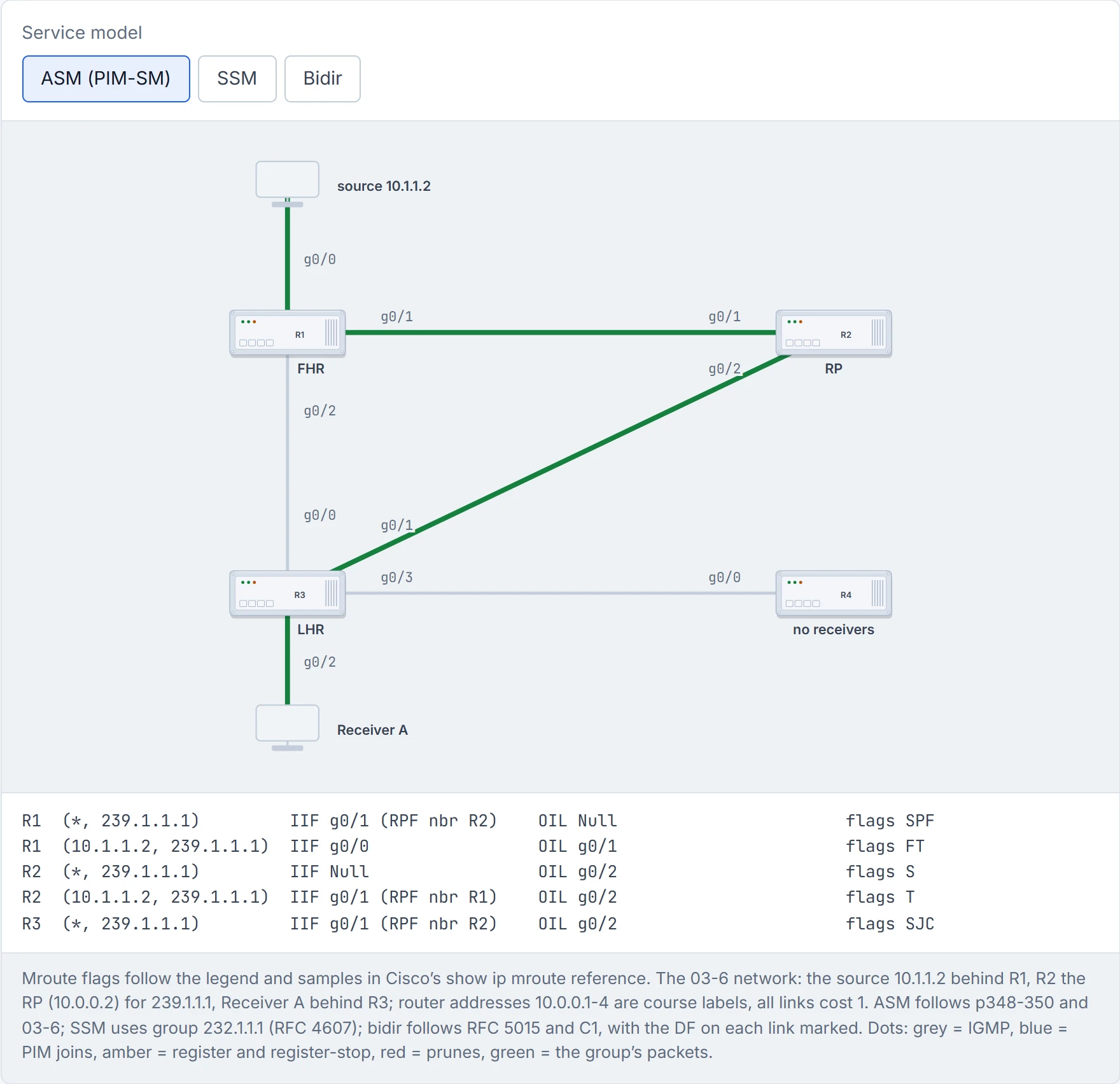
Step 4 of 6 Native packets reach R2, which sends R1 a register-stop. The stream runs source → R1 → R2 → R3 → A.
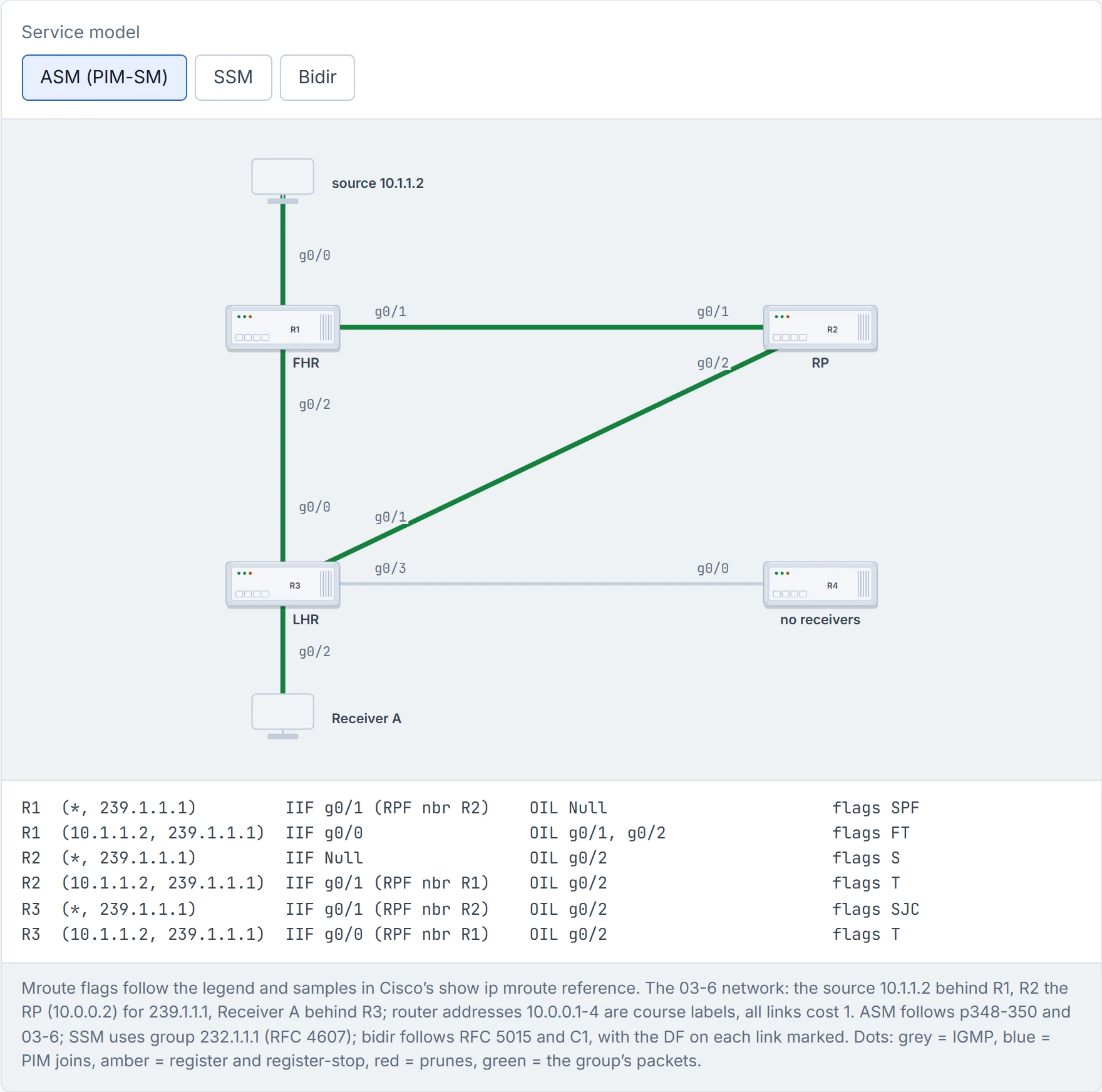
Step 5 of 6 The first packet named the source; R3 sends an (S,G) join to R1 (Cisco’s default switchover).
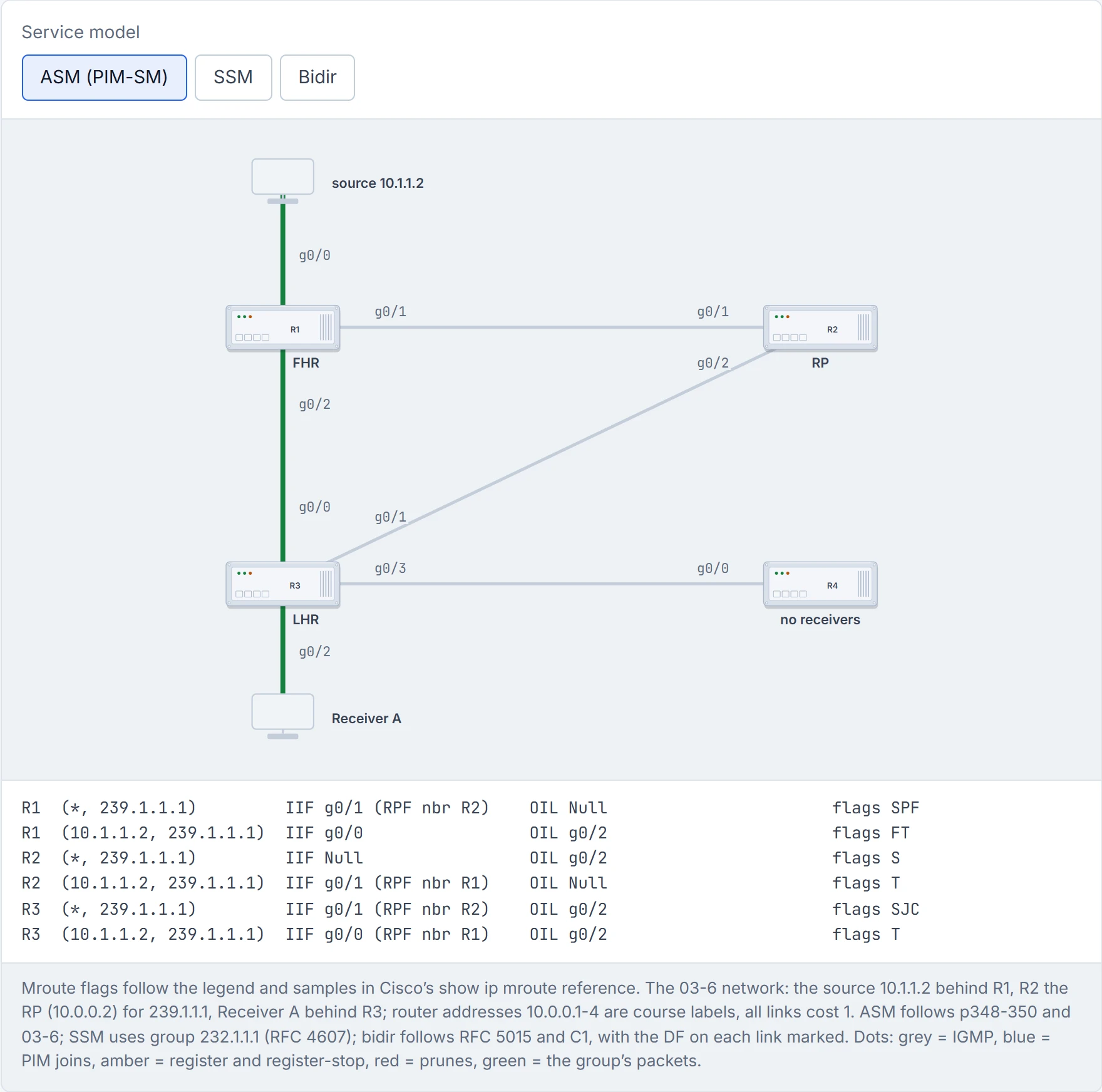
Step 6 of 6 R3 prunes the source off the shared tree, the RP prunes towards R1, and the stream runs source → R1 → R3 → A. That’s four kinds of message and a detour through the RP just to find one source.
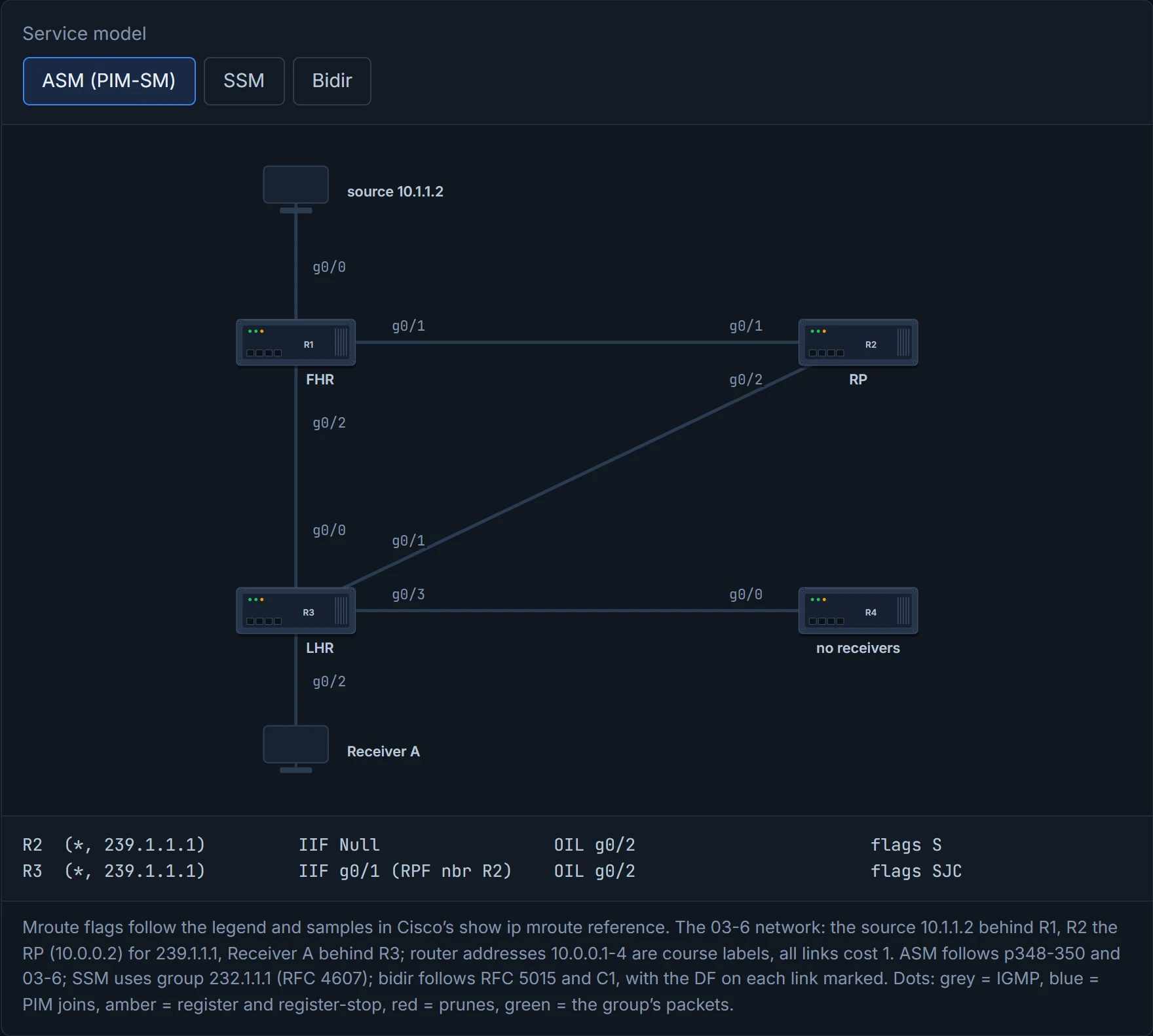
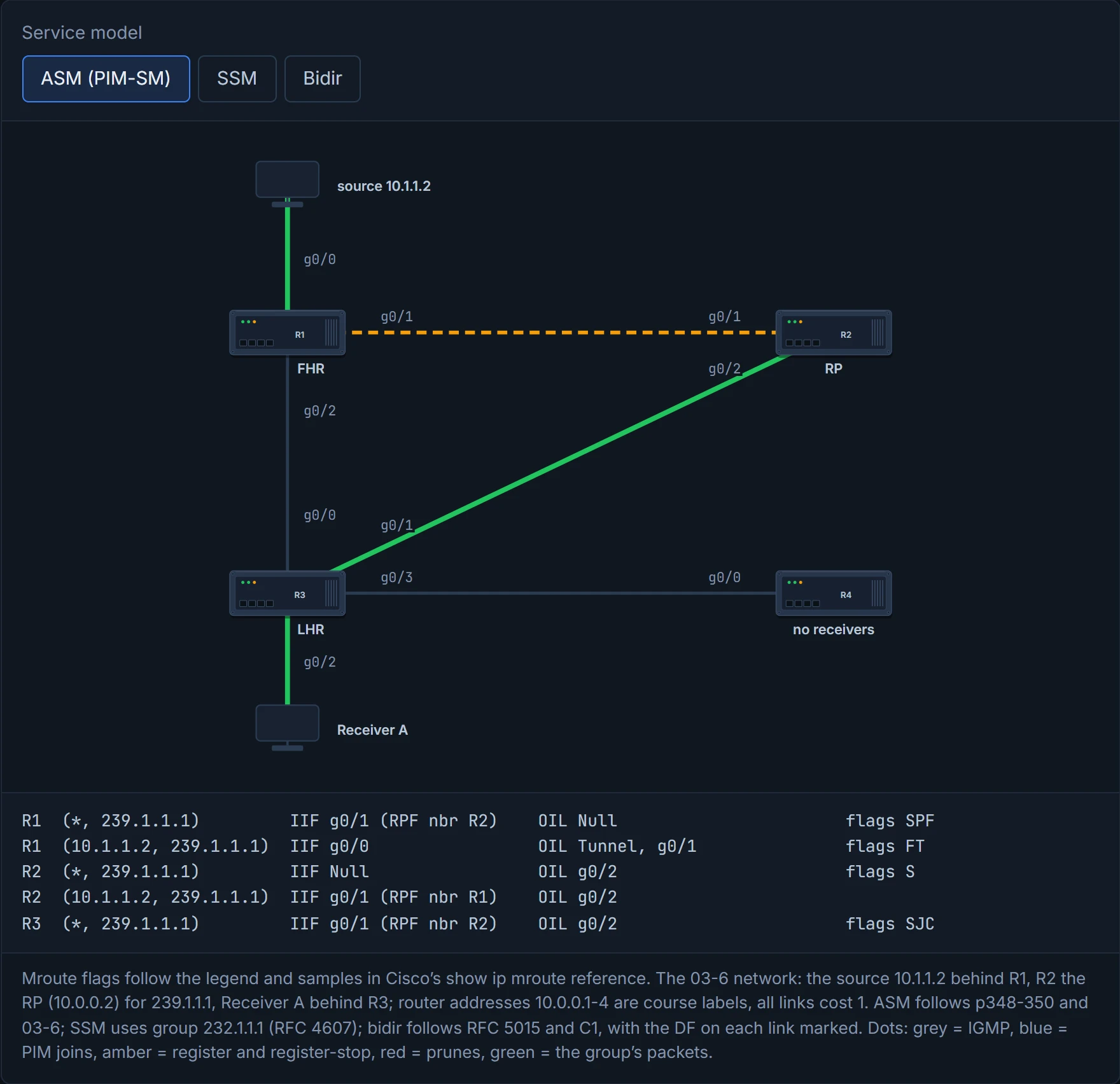
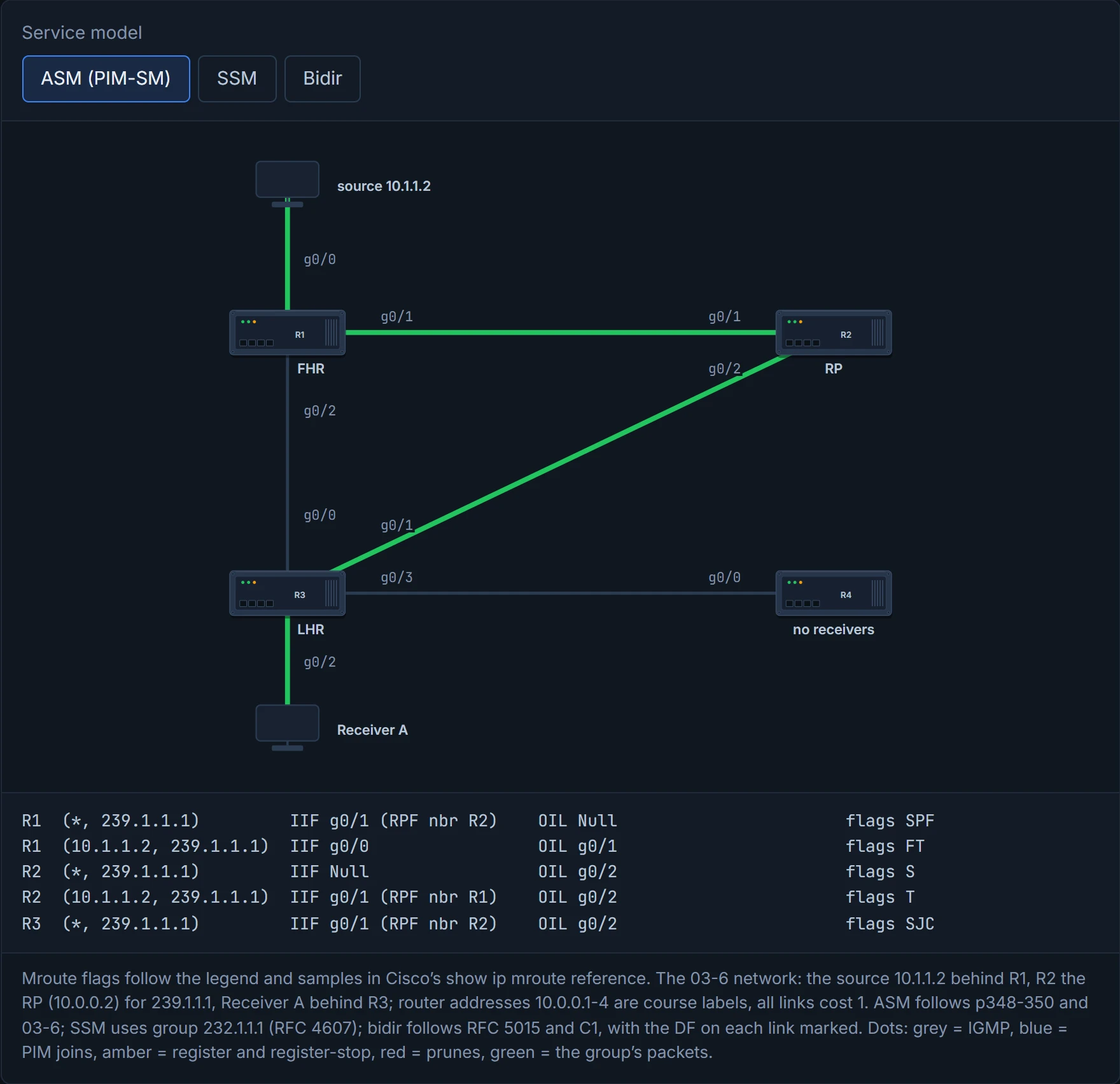
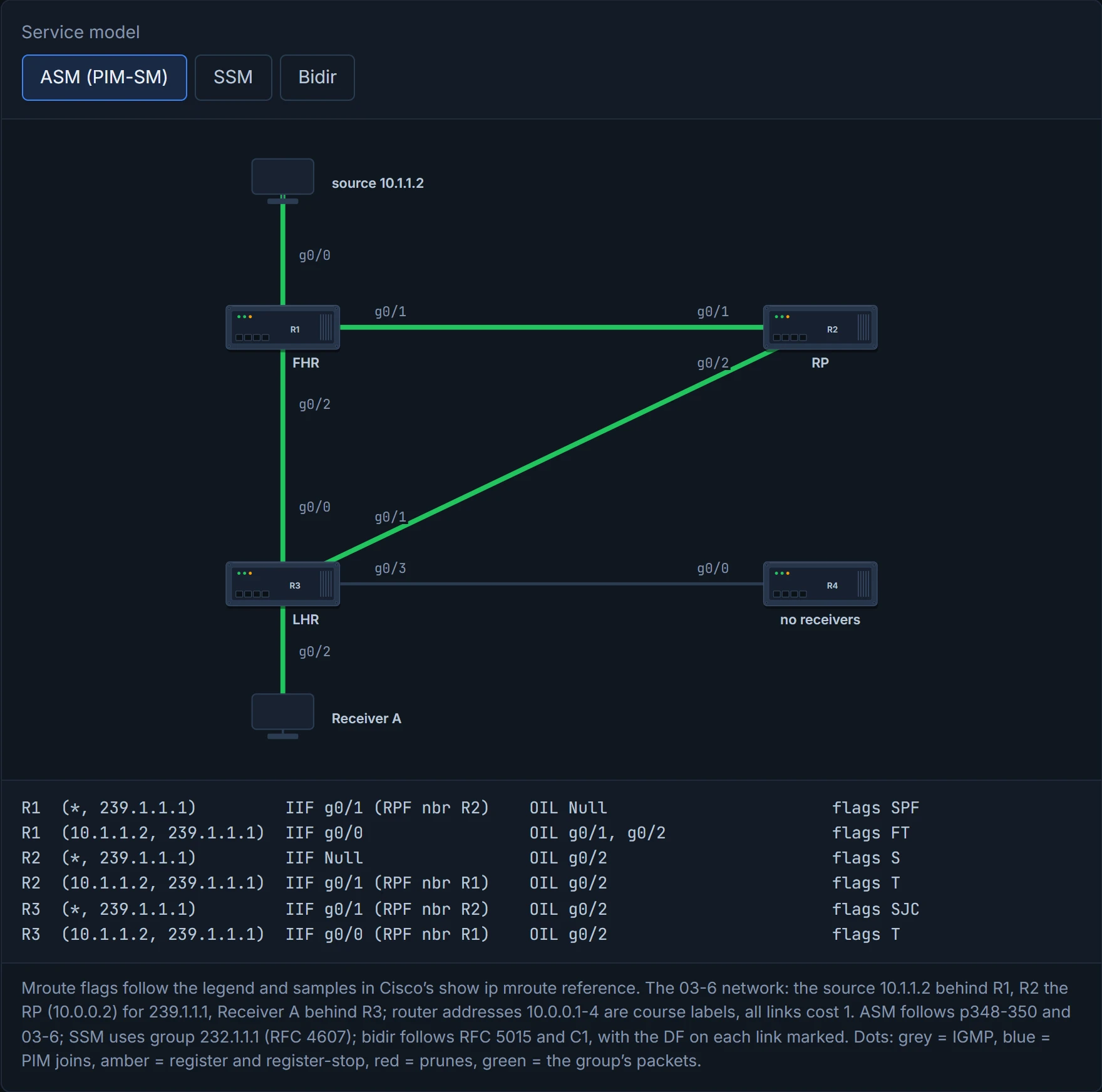
Bidir is the only multicast tree where the water flows uphill, and PIM had to elect a designated forwarder on every link to stop it flooding the valley.
Everything so far happens inside one PIM domain with its own RPs. MSDP, the Multicast Source Discovery Protocol, exists "to discover multicast sources in other PIM domains". RPs peer over TCP port 639, each peer configured explicitly, as with BGP. When a source registers with an RP, that RP sends a Source-Active (SA) message, the source, the group and the originating RP, to its MSDP peers, and repeats it every 60 seconds while the source sends. A peer accepts an SA only from its peer-RPF neighbour towards the originating RP, worked out from BGP (mesh groups are the exception, below), and floods it on; an RP with receivers for the group sends an (S,G) join towards the source, and its own last-hop routers then carry on "using standard PIM-SM procedures". It's basically like franchise branches sharing a "who's selling what today" list: each branch still runs its own shop.
MSDP's other job is inside one domain: anycast RP. Several RPs share one address, usually a loopback injected as a /32 into the IGP, so each source registers with, and each receiver joins, the nearest RP; the RPs run MSDP between their own unique addresses so each learns the others' sources. The result is shared load and fast failover: if one RP dies, the IGP just routes the anycast address to the next nearest. Anycast RP works like a shop chain with one phone number that rings whichever branch is closest. Keepalives go every 60 seconds and a session resets after 75 without one; an MSDP mesh group lets fully meshed peers accept each other's SAs without the RPF check. SSM needs none of this: no SA messages are generated or accepted in the SSM range. And MSDP is IPv4 only: RFC 3618 defines only IPv4 Source-Active messages, so IPv6 anycast RP uses PIM itself (RFC 4610) instead.
Continue the lesson
The whole lesson, with its drawings and its questions. The rest of this section and 9 more after it.