
DUAL: the backup that's already waiting, and stuck in active
DUAL keeps a backup ready before anything fails. The successor route is the lowest-metric path and its metric is the feasible distance; a neighbour's own metric to the destination is its reported distance. A backup whose reported distance is below the feasible distance is a feasible successor, and it takes over at once, with no query sent.
By Arif, founder of Daveth · Updated
The full 7 min walkthrough is in Daveth Pro (Network). See what the plan opens
What this page answers
What are feasible distance and reported distance in EIGRP?
The feasible distance is the metric of the lowest-metric path, calculated locally: 256 + 256 + 2816 = 3328 in the lesson's network. The reported distance is the distance a neighbour reports, its own metric to the destination. Read it in “The words DUAL works with, on real numbers”
What happens when an EIGRP successor fails?
Every neighbour on the failed interface goes down, and EIGRP recomputes each prefix they were successor for. Where a feasible successor exists, it becomes the successor instantly and the router sends an update, with no query. Read it in “The successor dies, and a backup is waiting”
What does the EIGRP topology table hold?
Every prefix in the autonomous system, the neighbours that advertised it, their reported distance and hop count, and the metric values: load, reliability, total delay and minimum bandwidth. show ip eigrp topology lists only successors and feasible successors. Read it in “The topology table: what EIGRP keeps in reserve”
The words DUAL works with, on real numbers
EIGRP's whole failure plan rests on a handful of terms, and they're easiest to learn on numbers you can check. Here's a sample network. R1 wants to reach 10.4.4.0/24 on R4:
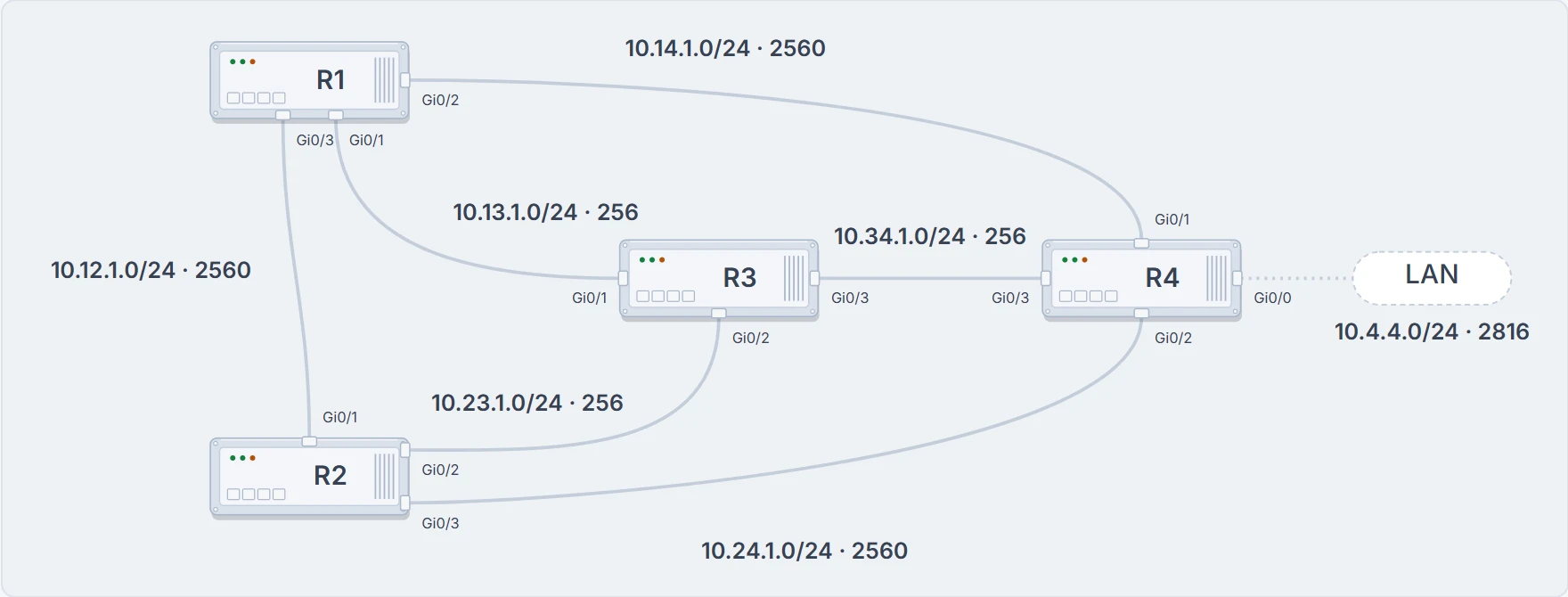
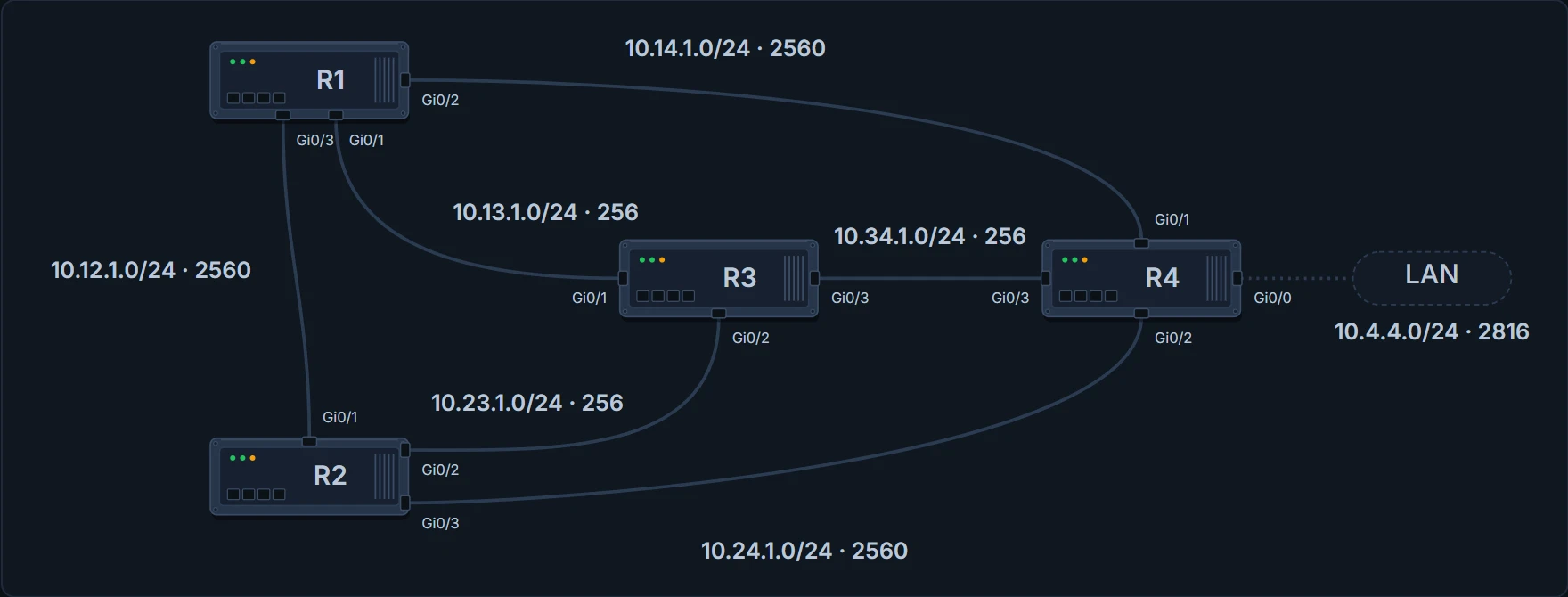
A sample network, separate from the HQ network of the earlier lessons. Each link shows its subnet and what one hop across it adds to the metric; R4's LAN, 10.4.4.0/24, starts at 2816.
- Successor route: the path with the lowest metric, here R1 → R3 → R4. The successor is its first next hop: R3.
- Feasible distance (FD): that lowest metric, calculated locally: 256 + 256 + 2816 = 3328.
- Reported distance (RD): the distance a neighbor reports to the destination, which is simply that neighbor's own FD. R3 reports 3072; R4 reports 2816.
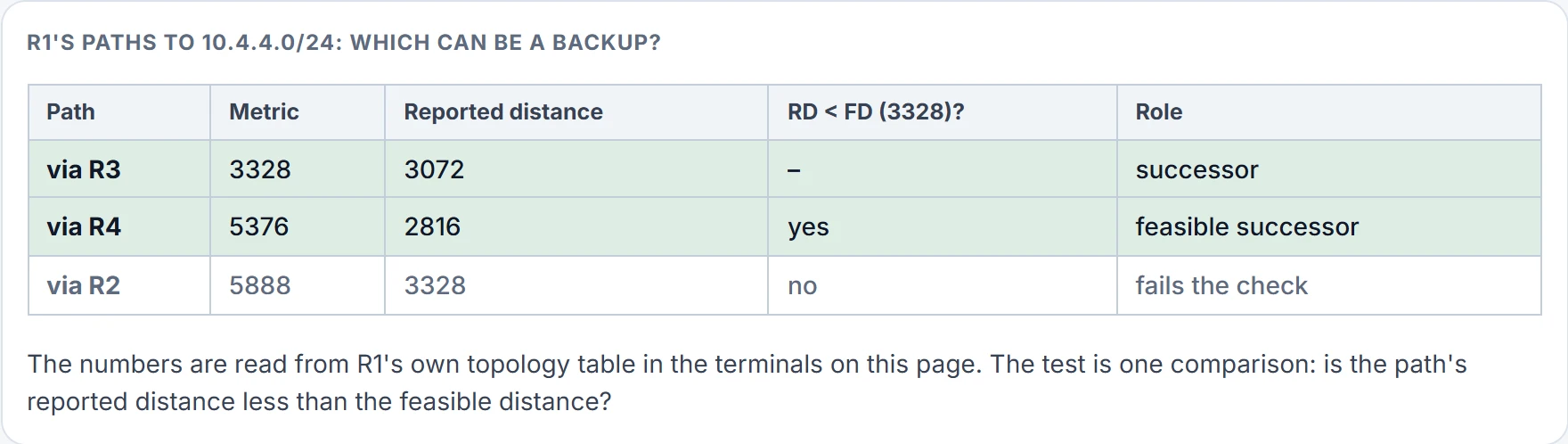
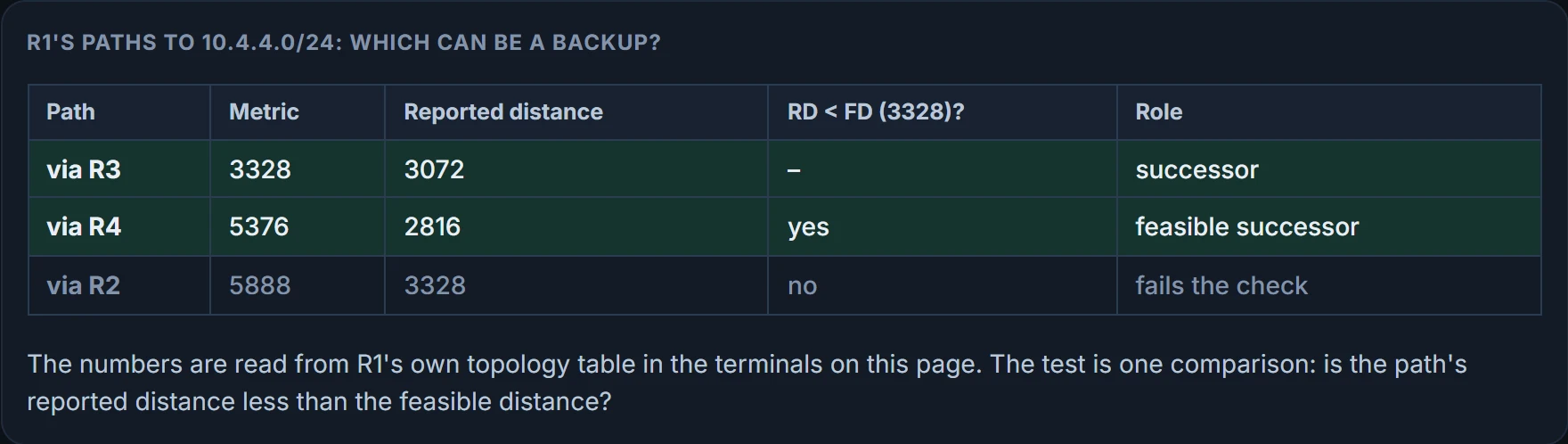
- Feasibility condition: a path can be a backup only if its RD is less than your FD. That guarantees the path doesn't loop back through you.
A path that meets the condition is a feasible successor: a backup, kept ready. Why does "RD less than FD" rule out loops? A neighbor that's already closer to the destination than you are can't be relying on you to get there. Here's R1's view of the destination:
R1# show ip eigrp topology 10.4.4.0 255.255.255.0
EIGRP-IPv4 Topology Entry for AS(100)/ID(10.14.1.1) for 10.4.4.0/24
State is Passive, Query origin flag is 1, 1 Successor(s), FD is 3328
! the feasible distance
  Descriptor Blocks:
  10.13.1.3 (GigabitEthernet0/1), from 10.13.1.3, Send flag is 0x0
      Composite metric is (3328/3072), route is Internal
      Vector metric:
        Minimum bandwidth is 1000000 Kbit
        Total delay is 30 microseconds
        Reliability is 255/255
        Load is 1/255
        Minimum MTU is 1500
        Hop count is 2
        Originating router is 10.34.1.4
  10.14.1.4 (GigabitEthernet0/2), from 10.14.1.4, Send flag is 0x0
      Composite metric is (5376/2816), route is Internal
      ! R4 reports 2816: less than 3328
      Vector metric:
        Minimum bandwidth is 1000000 Kbit
        Total delay is 110 microseconds
        Reliability is 255/255
        Load is 1/255
        Minimum MTU is 1500
        Hop count is 1
        Originating router is 10.34.1.4
R1#
R1 has three paths here. Make the call yourself before the table appears:
The topology table: what EIGRP keeps in reserve
Unlike a plain distance vector protocol, EIGRP keeps a topology table. It holds every prefix in the autonomous system, with the neighbors that advertised it, their RD and hop count, and the metric values: load, reliability, total delay and minimum bandwidth. (Each autonomous system gets its own table: a router in AS 100 and AS 200 keeps two, and passes nothing between them unless told to.)
R1# show ip eigrp topology
EIGRP-IPv4 Topology Table for AS(100)/ID(10.14.1.1)
Codes: P - Passive, A - Active, U - Update, Q - Query, R - Reply,
       r - Reply status, s - sia status
P 10.4.4.0/24, 1 successors, FD is 3328   ! P: passive, stable
        via 10.13.1.3 (3328/3072), GigabitEthernet0/1
        via 10.14.1.4 (5376/2816), GigabitEthernet0/2
P 10.12.1.0/24, 1 successors, FD is 5120
        via Connected, GigabitEthernet0/3
P 10.13.1.0/24, 1 successors, FD is 2816
        via Connected, GigabitEthernet0/1
P 10.14.1.0/24, 1 successors, FD is 5120
        via Connected, GigabitEthernet0/2
P 10.23.1.0/24, 1 successors, FD is 3072
        via 10.13.1.3 (3072/2816), GigabitEthernet0/1
        via 10.12.1.2 (5376/2816), GigabitEthernet0/3
P 10.24.1.0/24, 1 successors, FD is 5632
        via 10.13.1.3 (5632/5376), GigabitEthernet0/1
        via 10.12.1.2 (7680/5120), GigabitEthernet0/3
        via 10.14.1.4 (7680/5120), GigabitEthernet0/2
P 10.34.1.0/24, 1 successors, FD is 3072
        via 10.13.1.3 (3072/2816), GigabitEthernet0/1
        via 10.14.1.4 (5376/2816), GigabitEthernet0/2
R1#- What it shows:
show ip eigrp topologylists only successors and feasible successors. Addall-linksto see the paths that failed the feasibility condition too. - The state letter: P means passive, stable. A means active: a new path is being computed.
- The brackets after each next hop read (FD/RD) for that path. The first number is the neighbor's RD plus the metric to reach that neighbor. Only the successor's first number is the prefix's FD; for any other path it's simply what that path would cost.
- Your own networks appear too: "via Connected" for an interface's network, and "via Rstatic" for a static route redistributed into EIGRP.
R1# show ip eigrp topology all-links
EIGRP-IPv4 Topology Table for AS(100)/ID(10.14.1.1)
Codes: P - Passive, A - Active, U - Update, Q - Query, R - Reply,
       r - Reply status, s - sia status
P 10.4.4.0/24, 1 successors, FD is 3328, serno 1
        via 10.13.1.3 (3328/3072), GigabitEthernet0/1
        via 10.14.1.4 (5376/2816), GigabitEthernet0/2
        via 10.12.1.2 (5888/3328), GigabitEthernet0/3
        ! only with all-links: it failed the check
P 10.12.1.0/24, 1 successors, FD is 5120, serno 2
        via Connected, GigabitEthernet0/3
        via 10.12.1.2 (7680/5120), GigabitEthernet0/3
        via 10.14.1.4 (8192/5632), GigabitEthernet0/2
P 10.13.1.0/24, 1 successors, FD is 2816, serno 3
        via Connected, GigabitEthernet0/1
        via 10.13.1.3 (3072/2816), GigabitEthernet0/1
        via 10.12.1.2 (5632/3072), GigabitEthernet0/3
        via 10.14.1.4 (5632/3072), GigabitEthernet0/2
P 10.14.1.0/24, 1 successors, FD is 5120, serno 4
        via Connected, GigabitEthernet0/2
        via 10.14.1.4 (7680/5120), GigabitEthernet0/2
        via 10.12.1.2 (8192/5632), GigabitEthernet0/3
P 10.23.1.0/24, 1 successors, FD is 3072, serno 5
        via 10.13.1.3 (3072/2816), GigabitEthernet0/1
        via 10.12.1.2 (5376/2816), GigabitEthernet0/3
        via 10.14.1.4 (5632/3072), GigabitEthernet0/2
P 10.24.1.0/24, 1 successors, FD is 5632, serno 6
        via 10.13.1.3 (5632/5376), GigabitEthernet0/1
        via 10.12.1.2 (7680/5120), GigabitEthernet0/3
        via 10.14.1.4 (7680/5120), GigabitEthernet0/2
P 10.34.1.0/24, 1 successors, FD is 3072, serno 7
        via 10.13.1.3 (3072/2816), GigabitEthernet0/1
        via 10.14.1.4 (5376/2816), GigabitEthernet0/2
        via 10.12.1.2 (5632/3072), GigabitEthernet0/3
R1#
The best EIGRP path is only a candidate for the routing table: a source with a lower administrative distance for the same prefix wins (the first routing lesson). Once it's installed, it's the successor route, and that's what EIGRP advertises. The same check works on any numbers. In a bigger worked example, the successor has FD 2174976 and two other paths each report 2172416: is 2172416 less than 2174976? Yes, so both are feasible successors. A path whose RD isn't less than the successor's FD, equal included, appears only with all-links.
show ip eigrp topology: the successor and every feasible successor for each prefix, with each path's (FD/RD)show ip eigrp topology all-links: also the paths that failed the feasibility condition
- that the successor route is in the routing table: a more trusted source may have won (check
show ip route) - how the metric numbers are built: that's the next lesson
The successor dies, and a backup is waiting
When a link fails and its interface goes down, every neighbor on that interface goes down with it. EIGRP then recomputes every prefix for which one of those neighbors was the successor. For each one, a feasible successor, if there is one, instantly becomes the successor, and the router sends an update with its new metrics. Fail R1's link to R3, and R1 doesn't send a single query:
R1# configure terminal
R1(config)# interface GigabitEthernet0/1
R1(config-if)# shutdown
R1(config-if)# end
R1#
R1# show ip route 10.4.4.0
Routing entry for 10.4.4.0/24
  Known via "eigrp 100", distance 90, metric 5376
  ! via R4: the feasible successor, now in use
  Last update from 10.14.1.4 on GigabitEthernet0/2, 00:00:00 ago
  Routing Descriptor Blocks:
  * 10.14.1.4, from 10.14.1.4, 00:00:00 ago, via GigabitEthernet0/2
      Route metric is 5376, traffic share count is 1
R1#
5376 is exactly the via R4 metric from the table before the failure. The backup was computed, checked and waiting; all R1 had to do was use it.
Downstream routers then rerun DUAL on the new numbers, and may change their own choice. In a different example network, not the one drawn above, with small round numbers, the link between R1 and R3 fails.
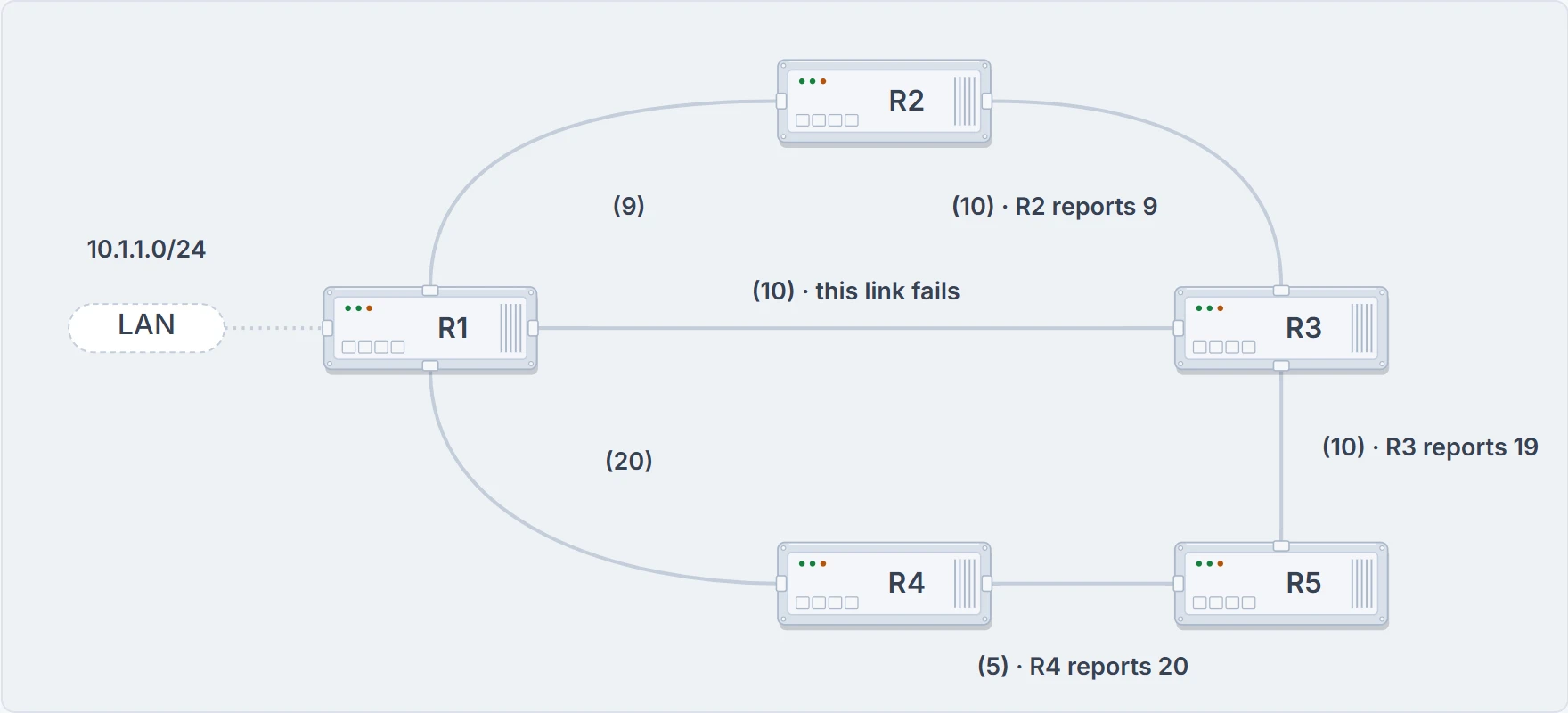
That second sample network, each link's metric in brackets, and what each router reports once the R1–R3 link has failed.
Continue the lesson
The whole lesson, with its drawings and its questions. The rest of this section and 3 more after it.