
AI, Machine Learning and Network Operations
Machine learning builds a model from data instead of from written rules. In network operations it is good at what people are slow at: watching huge amounts of telemetry, learning what normal looks like, and ranking likely causes. But a dashboard's diagnosis is an inference, a best guess on top of an observation, so an engineer tests it against the evidence before acting.
By Arif, founder of Daveth · Updated
The full 8 min walkthrough is in Daveth Pro (Network). See what the plan opens
What this page answers
How is AI used in networking?
Predictive AI flags or forecasts from patterns in telemetry, such as an access point retrying far more frames than normal; machine learning learns what normal looks like and ranks the likely causes of a change. Read it in “What machine learning does well, and where it stops”
What is machine learning?
Building a model from data instead of from rules someone wrote. In operations it watches telemetry, spots patterns and outliers, and ranks causes; its conclusions are still guesses to be checked. Read it in “What machine learning does well, and where it stops”
What the dashboard saw, and what it guessed
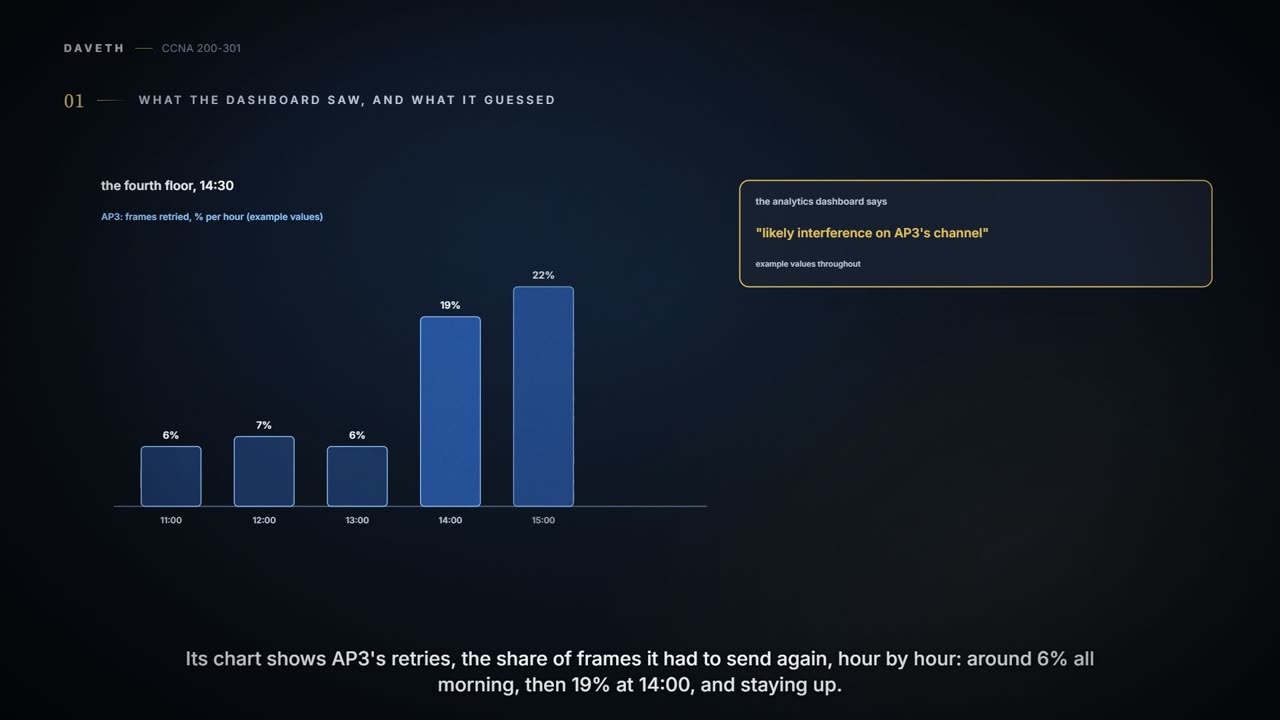
Month ten, 14:30. People on the fourth floor say the Wi-Fi has gone slow since two o'clock. The wireless analytics dashboard already has an answer: "likely interference on AP3's channel." (All the numbers on this page are example values.)
AP3: frames retried, % per hour (example values)
Only the retries. The chart is an observation: AP3 had to resend far more frames after 14:00. "Interference" is the dashboard's inference, its best guess at why, ranked from patterns it has seen before. That guess might be right. It is also exactly the kind of statement that needs testing before anyone acts on it.
The dashboard is a smart witness, not a detective with a warrant.
What machine learning does well, and where it stops
Machine learning (ML) builds a model from data instead of from rules someone wrote. In network operations it is good at what people are slow at: watching huge amounts of telemetry, learning what normal looks like, spotting patterns and outliers, and ranking the likely causes of a change. Two families of artificial intelligence (AI) show up in operations. Predictive AI flags or forecasts from patterns in data, like the dashboard noticing that AP3's retries left their usual range. Generative AI produces new content, such as a summary of the logs, an explanation, or a proposed command or API check. Both are usually built with machine learning.
Both have limits. A model is only as good as the data it learned from and the context it learned in: one trained on quiet floors may call a busy floor abnormal all day, and as the network changes, what it learned can drift out of date. It can't see anything it has no data about, such as a cable someone moved without telling anyone. And a correlation, two things happening together, isn't proof that one caused the other.
Testing the guess
The same alert, more retries on AP3, could have at least three causes, and each leaves different evidence: interference from something else on AP3's channel, a surge of clients on AP3, or a change in AP3's power (09.5): less power to the radio can mean a weaker signal and more retries. A check can make an idea less likely; on its own, one check rarely proves or disproves anything.
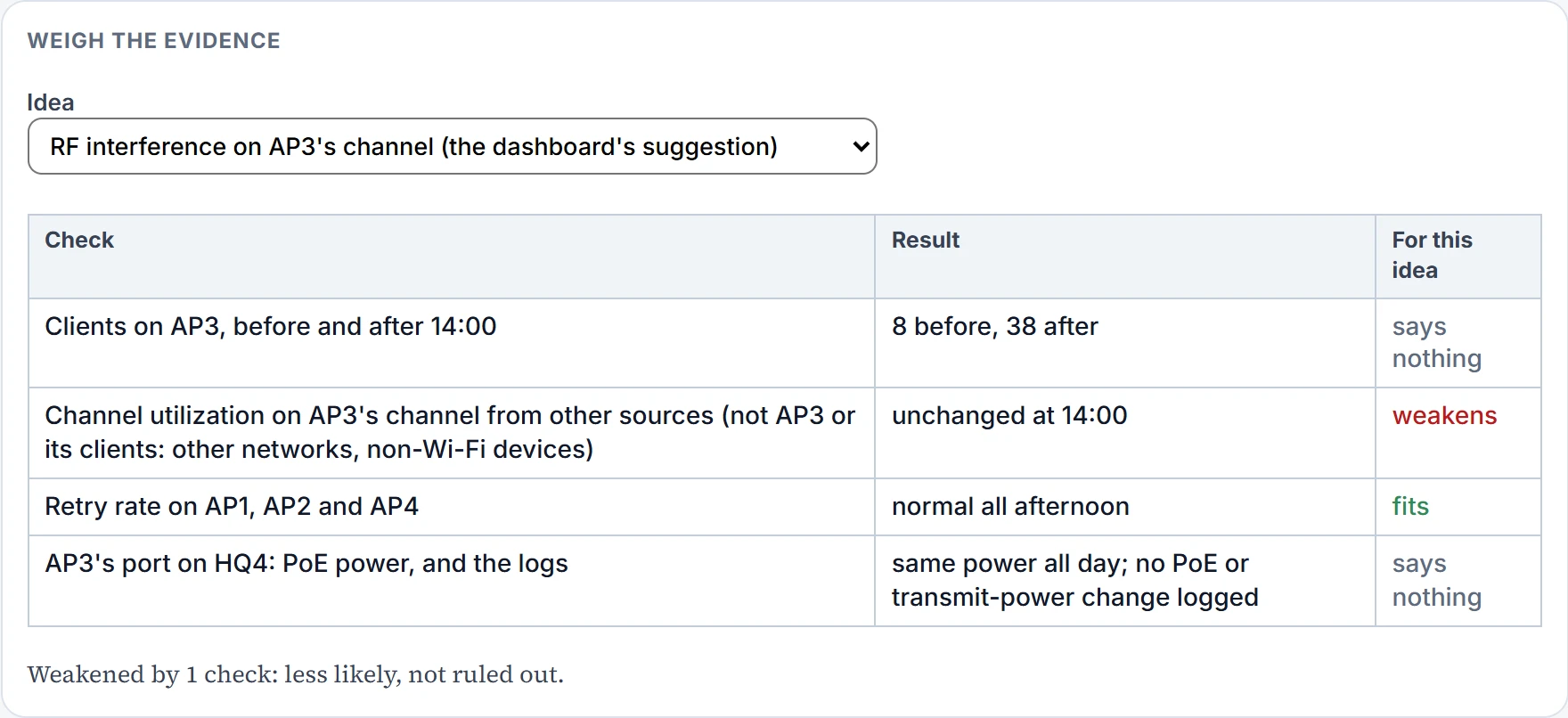
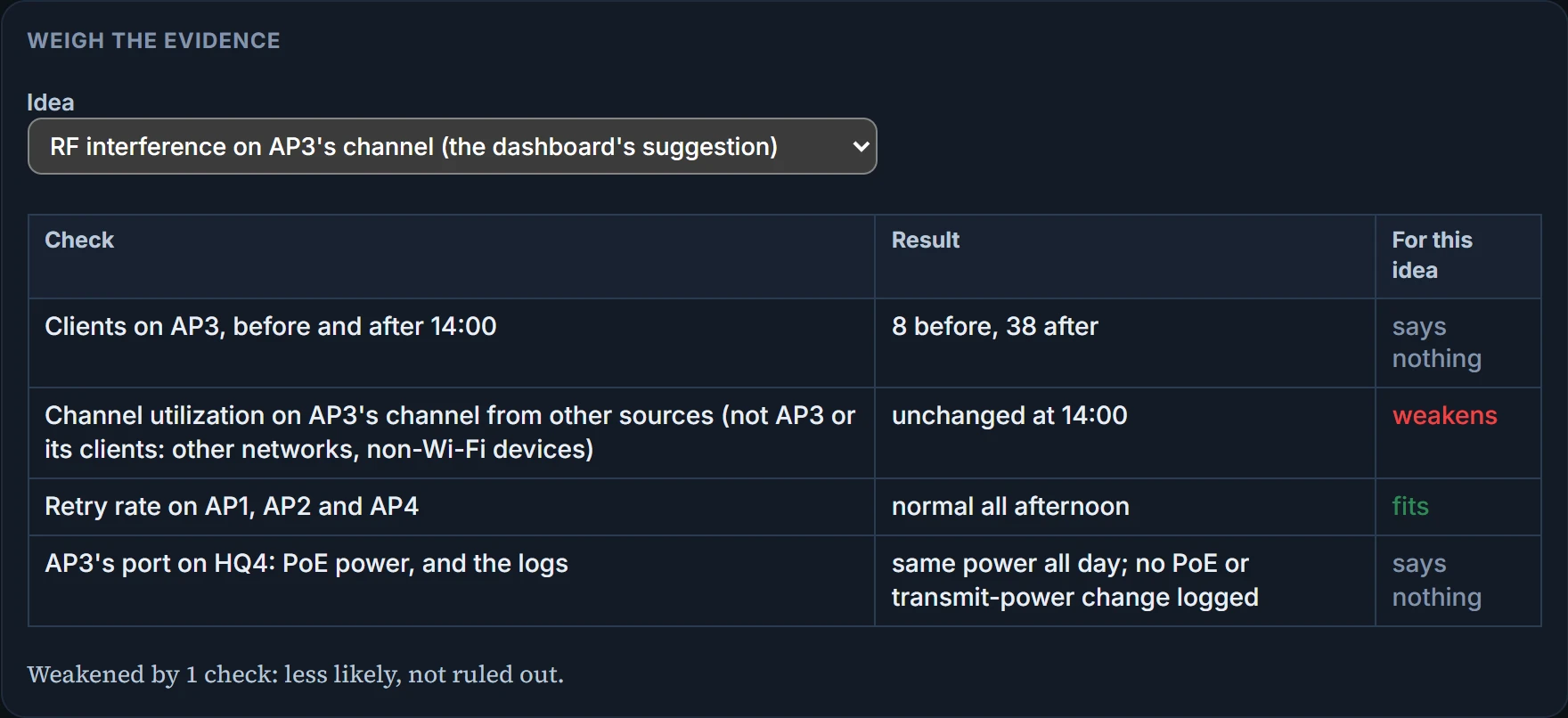
Channel utilization from other sources, next to AP3's client count. If something else were using the channel, the utilization that isn't AP3's own traffic would usually have risen; it didn't. AP3's clients went from 8 to 38 at 14:00, the neighbouring APs stayed normal (so the problem is local to AP3, whatever it is), and AP3's PoE port on the fourth-floor switch shows the same power all day. So far the evidence fits a surge of clients (a big meeting, say) best; interference and a power change look less likely, though a single measurement at the AP can't rule interference out near the clients. But a crowd arriving at 14:00 and retries rising at 14:00 is itself a correlation. The next step is to test the link: do the retries fall when the meeting ends and the clients leave? Only then deal with the load, not the channel.
| Suggestion | the dashboard: "likely interference on AP3's channel" |
|---|---|
| Observation | measured: AP3's retry rate rose from about 6% to about 20% at 14:00 |
| Test | clients on AP3, channel utilization from other sources, neighbouring APs, AP3's PoE port and logs |
| Conclusion | so far, a surge of clients fits best; interference and a power change look less likely; test the link (do retries fall when the clients leave?), then act |
Continue the lesson
The whole lesson, with its drawings and its questions. 2 more sections after the ones above.