
Cisco Software-Defined Access
In a campus fabric, access follows the group a person is in, not the address their laptop has today. A controller built for campus fabrics runs the fabric and manages traditional devices too. Instead of ever-growing ACLs, users and devices go into scalable groups, each marked with a scalable group tag, and one grid says which group may send to which.
By Arif, founder of Daveth · Updated
The full 10 min walkthrough is in Daveth Pro (Network). See what the plan opens
What this page answers
What is Cisco SD-Access?
A campus fabric run by one controller, which handles design, provisioning and policy. It ties security to groups instead of addresses: users and devices carry scalable group tags, and a grid says which group may send to which. Read it in “Groups instead of addresses”
Why do ACLs only grow?
Every request adds lines, and after a few months the lines for any one request are scattered through the list, so nobody dares remove them. Group-based policy replaces address-based lines with one grid of groups. Read it in “Why ACLs only grow”
One controller for the whole fabric
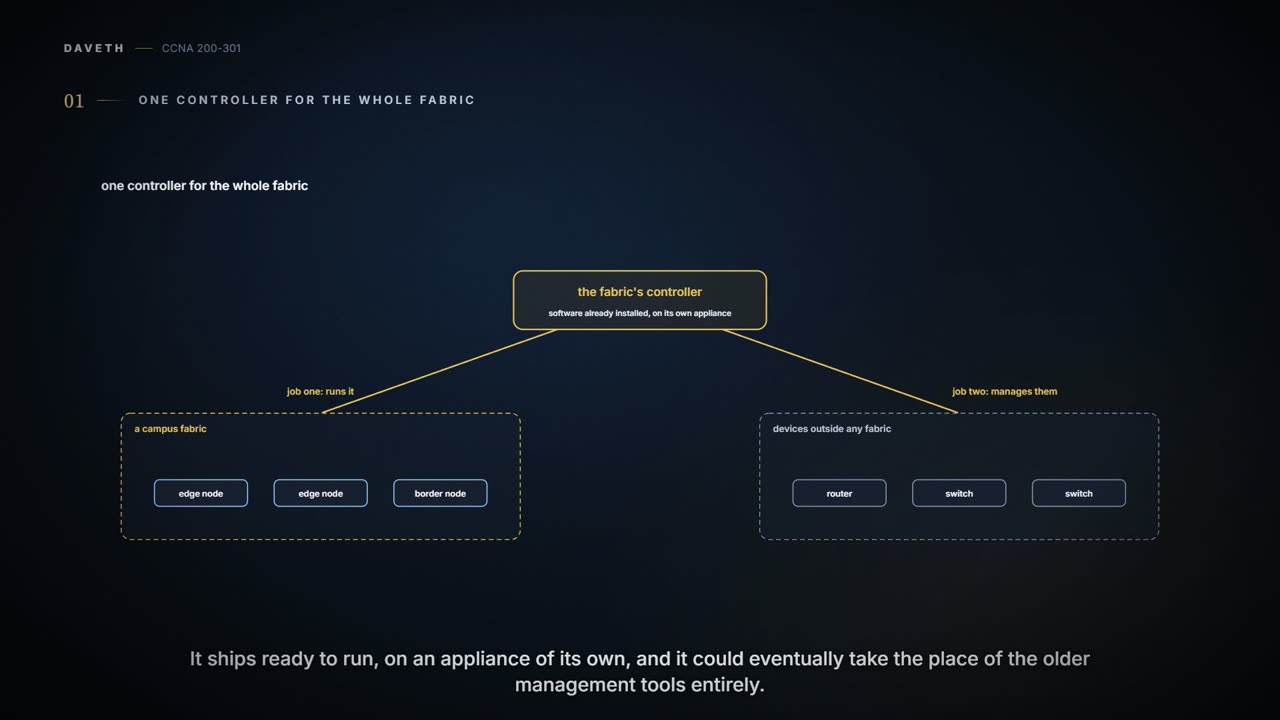
Month ten. The fabric plan (10.2) needs something to run it, and the plan's answer is a controller built for campus fabrics. It has two jobs. It is the fabric's controller, and any serious fabric needs one. And it is a management platform for traditional devices outside any fabric. It comes as software already installed on its own appliance, and it may one day replace the traditional management tools altogether. Its work runs from design and provisioning to policy and assurance: checking that the network does what was intended.
Northbound, people use its GUI and programs use its REST API, the subject of 10.4. Southbound, it speaks two groups of protocols: Telnet, SSH and SNMP for older devices and software, and NETCONF and RESTCONF for newer ones. The older protocols are there because real networks are full of older devices. Everything it does is available through that northbound API, not only through the GUI.
Why ACLs only grow
Ravi knows the problem the fabric promises to fix, because every ACL in the company started short (08.2): a request, a few lines, a permit at the end. A few months later, two more lines for a second request. After six requests the list looks like this, and the lines for any one request are no longer together:
| Line | Serves request |
|---|---|
| 1 | 1 |
| 2 | 1 |
| 3 | 1 and 5 |
| 4 | 6 |
| 5 | 3 and 5 |
| 6 | 3 |
| 7 | 4 |
| 8 | 4 and 5 |
| 9 | 4 |
| 10 | 2 |
| 11 | 2 |
| 12 | the final permit |
Lines 3, 5 and 8 serve other requests too. And a real ACL carries no such labels: the table above is a record nobody actually keeps. From the ACL alone, nobody can tell which lines are safe to delete, so nobody deletes any. ACLs only grow, every change means reading a longer list first, and working out whether a packet would get from one end of the network to the other, through every ACL on the way, gets harder with each one.
Every long ACL has one line nobody understands and everybody is afraid of.
Groups instead of addresses
The fabric ties security to groups instead, one example of the new features it adds. Users and devices go into scalable groups, each marked with a scalable group tag (SGT), and one grid says which source group may send to which destination group.
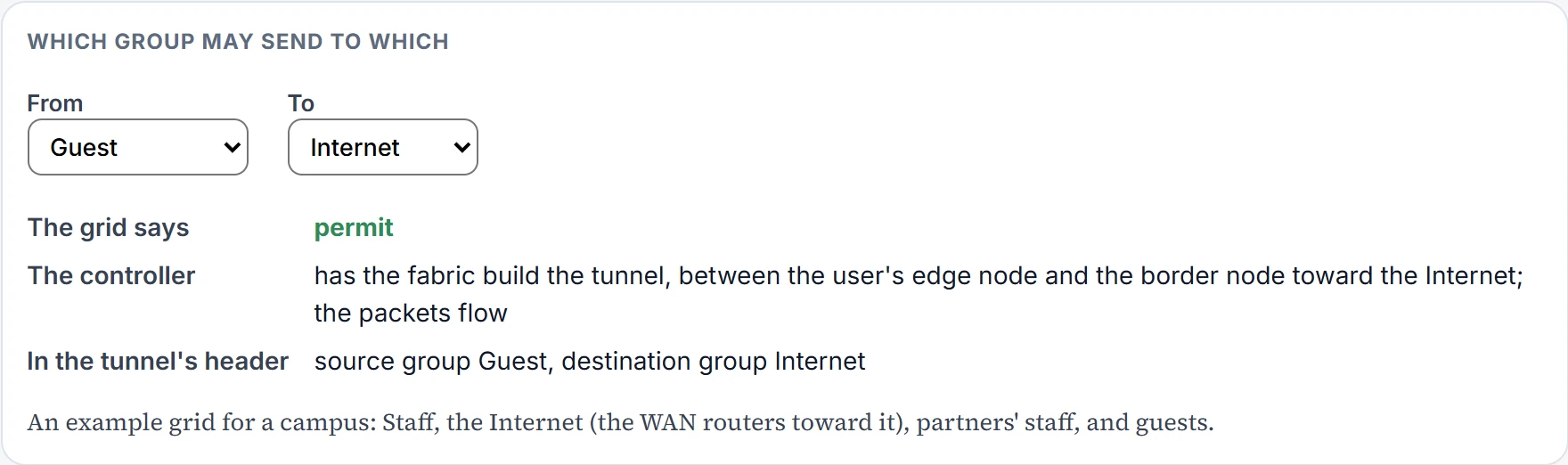
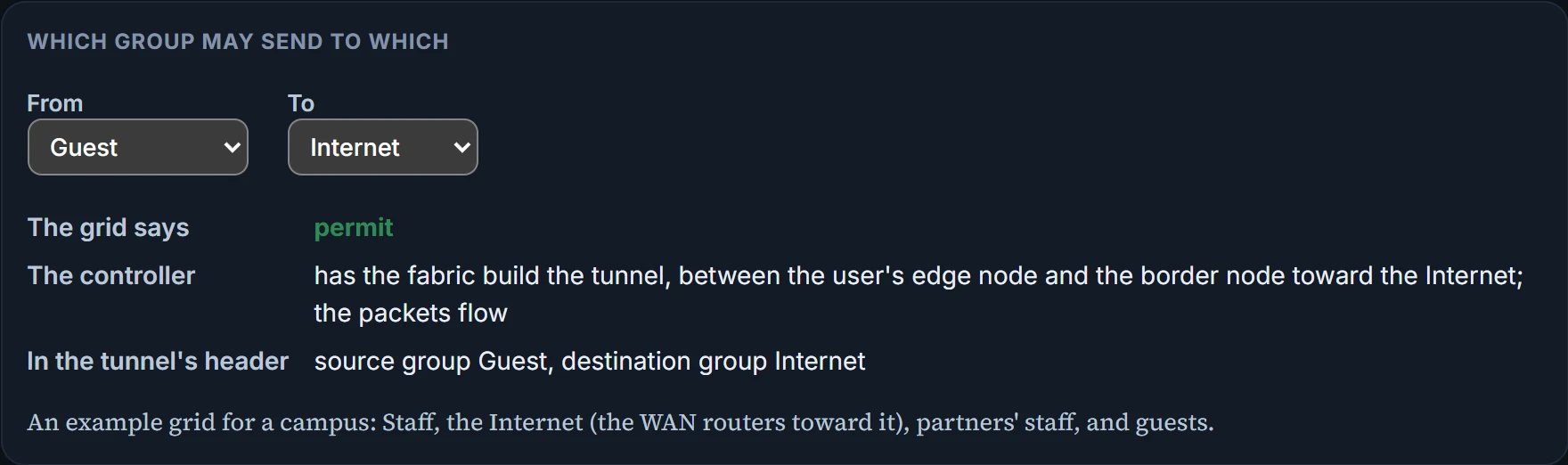
No: Guest to Staff is deny. When an endpoint's first packet heads for a new destination, the ingress edge node asks the controller. The controller works with an identity server, such as the company's RADIUS server RAD1, to find out who the user is and so which group they're in, and checks the grid. On permit, it has the edge nodes build the VXLAN tunnel; on deny, it builds none, and the packets don't flow. Traffic for destinations outside the fabric, such as the Internet group in the grid, leaves through a border node (10.2). The tunnel's VXLAN header carries the source and destination groups, which is one reason the fabric bothers with VXLAN at all.
Each policy is its own entry in the controller, set through the GUI or the API, with room for a note on why it exists, and removing one can't break another. A new requirement doesn't mean reading an existing ACL, or hunting down every ACL on every path. That is intent-based networking: the engineer states the outcome, and the controller and the devices work out the configuration. A group, though, is a label for who someone is. It isn't another VLAN, and being in one isn't a permission in itself: the grid decides.
The same grid decisions apply. The new edge node registers the user where they now are, with their new address, and the user is still in Staff, so what Staff may reach hasn't changed. No ACL named the old address, so no ACL needs editing.
You can think of an SGT as a staff badge: it goes wherever the person goes, and every reader checks the badge, not the desk. (Where it stops: a badge is something the person carries and shows; an SGT is assigned by the network, from who the user is.)
Continue the lesson
The whole lesson, with its drawings and its questions. 3 more sections after the ones above.