
LISP: separating who you are from where you are
In ordinary routing an address says both who an endpoint is and where it is, so moving means a new address and routing tables keep growing. LISP splits the two: endpoint identifiers, EIDs, say who, and routing locators, RLOCs, say where. An ingress router asks the mapping system for the RLOC of an EID on demand, much as DNS answers for names.
By Arif, founder of Daveth · Updated
The full 7 min walkthrough is in Daveth Pro (Network). See what the plan opens
What this page answers
What is LISP (Locator/ID Separation Protocol)?
A protocol that splits an address into an endpoint identifier, who the endpoint is, and a routing locator, where it is, so an endpoint can move without changing its identity. Built for the Internet's routing-table growth, it is also used in campus fabrics and data centres. Read it in “4.1 The problem LISP solves”
What do LISP map servers and map resolvers do?
ETRs register the EIDs they serve with the map server; an ITR asks the map resolver for the RLOC of an EID the first time it needs one. When they are separate boxes, the resolver passes the request to the server, which passes it to the ETR. Read it in “4.1 The problem LISP solves”
4.1 The problem LISP solves
LISP, the Location/ID Separation Protocol, was built for the Internet's routing-table growth. The guide's list: provider-independent prefixes that can't be aggregated; more-specific routes injected for inbound traffic engineering; multihoming, which needs the full table ("785,000 IPv4 routes at the time of writing"); and route churn that burns CPU and memory. It's also used in data centres, campus networks, branches, next-gen WANs and service-provider cores, for mobility, network virtualization, IoT, IPv4-to-IPv6 transition and traffic engineering. It's like a city whose every junction needs a map of every street: it works until the city grows.
785,000 routes is the kind of number that makes a small branch router wish it had stayed a switch.
The root cause: in ordinary routing, "an endpoint IP address represents the endpoint’s identity and location", so moving means a new address. LISP splits the address in two: endpoint identifiers (EIDs) say who, routing locators (RLOCs) say where; an endpoint can roam, "and the only thing that changes is their RLOC; the EID remains the same" (quiz Q7: RLOCs and EIDs). You can think of it as your mobile number and the mast your phone is using: the number follows you, and the network keeps track of which mast you're near.
The roles (Figure 16-5). Most LISP routers are xTRs, doing both edge jobs at once, like a post office counter that takes letters in and hands them out:
| Role | Does |
|---|---|
| LISP site | a site where LISP routers and EIDs live |
| LISP router | any router doing one or more of the ITR, ETR, PITR and PETR jobs |
| EID | an endpoint's address inside a LISP site (IPv4 or IPv6) |
| RLOC | the Internet- or core-facing address of an ETR (IPv4 or IPv6) |
| ITR | encapsulates packets from EIDs heading out of the site |
| ETR | de-encapsulates LISP packets for EIDs inside the site |
| xTR | does both (most LISP routers) |
| PITR | an ITR for traffic from non-LISP sites to EIDs |
| PETR | an ETR for traffic from EIDs to non-LISP sites |
| PxTR | both proxies |
| map server (MS) | learns EID-to-RLOC mappings from ETRs and stores them |
| map resolver (MR) | takes map requests from ITRs and finds the ETR that can answer, through the MS |
An MS and MR on one box is an MS/MR. Think of it as a postal forwarding service: the ETR tells the sorting office which addresses it's holding post for, and every other office asks the sorting office the first time it has post for an address it doesn't know. When the MR and MS are separate boxes, the MR passes the request to the MS, which passes it to the ETR.
ITR, ETR and xTR are one letter of meaning and two of "tunnel router", and the x is honest: an xTR is both.
The control plane "operates in a very similar manner to the Domain Name System": DNS turns a name into an IP address, LISP turns an EID into an RLOC, by asking the MR (Figure 16-6). The two even run back to back in the guide's example: host1 first asks DNS for host2.cisco.com and gets the EID 10.1.2.2, and only then does LISP find the RLOC. It's a pull model: a router asks only for what it needs, unlike the push model of BGP or OSPF, which send every route to everyone. Pulling works like a caller looking a number up when they need to call it, rather than memorising the whole phone book.
The messages and their ports, each one like a form at the post office: a registration card, a confirmation slip, an enquiry and its answer:
| Message | From → to | UDP |
|---|---|---|
| map register | ETR → MS | to 4342 |
| map notify | MS → ETR | 4342 both ways |
| map request | ITR → MR (and on to the ETR), encapsulated | to 4342, source chosen by the ITR |
| map reply | ETR (or MS) → ITR | from 4342 to the ITR's port |
| negative map reply | MR → ITR | from 4342 |
Quiz Q8 holds the two ports apart: the data plane uses UDP 4341, and 4342 is for control messages.
LISP asks a DNS-like question before it sends the first packet to an EID it doesn't know, which makes it the most polite routing protocol ever written, at least on first meetings.
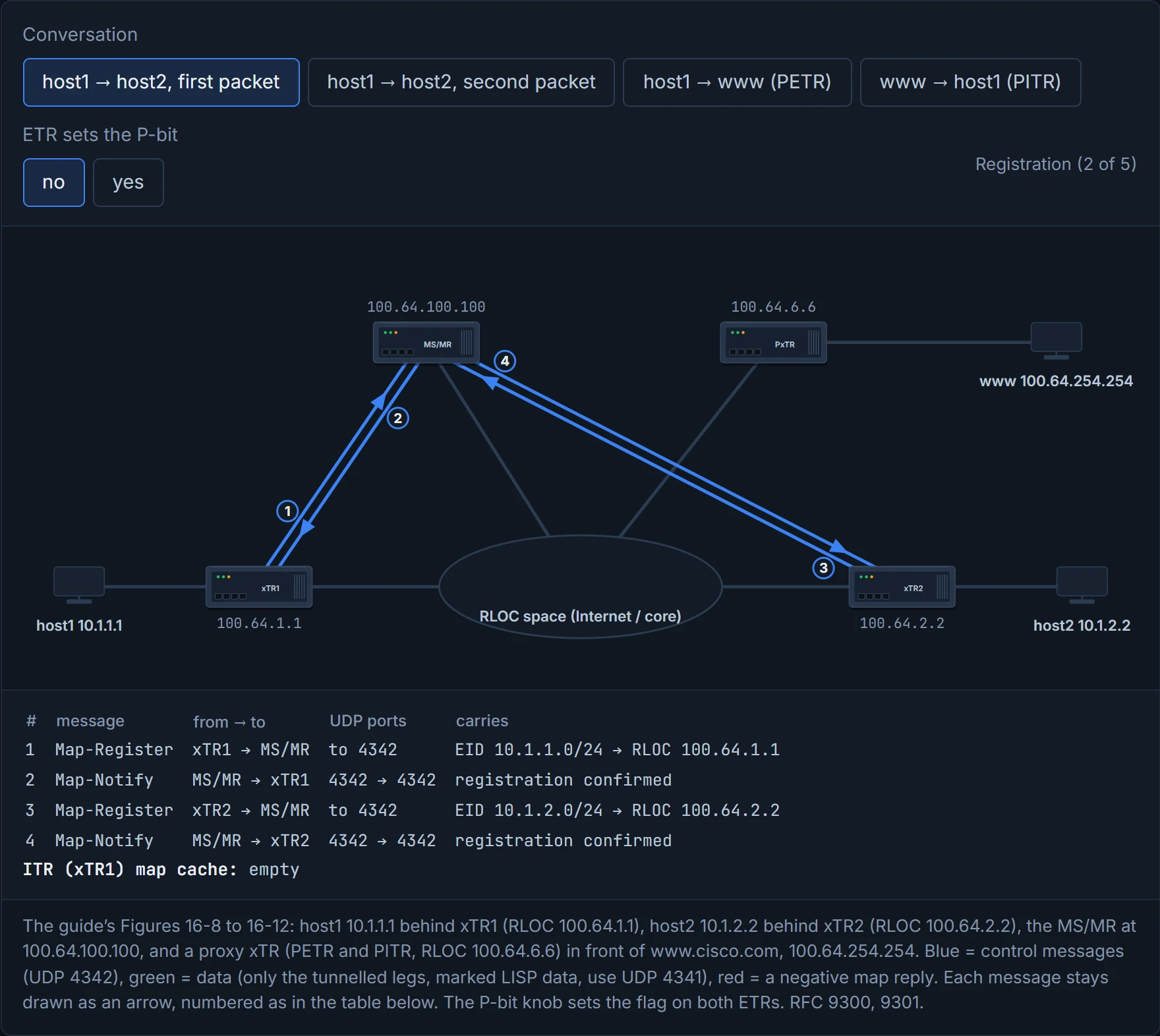
Registration. An ETR is configured with its site's EID prefixes and registers each with the MS in a map register, with its RLOC; subnets not configured as EIDs are forwarded natively. The MS confirms with a map notify; RFC 9301 sends it when the ETR asks for one (the M-bit). The ETR can also set the P-bit (proxy map reply) to have the MS answer requests for it (quiz Q9). Registration works like a change-of-address card filed before any letters arrive: the work happens before anyone needs it.
Resolution. Inside the site it's ordinary routing. At the ITR, LISP takes over only if two things hold: the destination matched nothing but the default route, and the source is a registered EID; otherwise the ITR forwards natively.
Before reading on, predict: host1 sends a packet to host2, then a second one a minute later. How many map requests does xTR1 send? D1 lets you check.
Then the ITR sends a map request (to UDP 4342) to the MR, the mapping system forwards it to the authoritative ETR, and the ETR replies (from 4342): 10.1.2.0/24 → 100.64.2.2. The ITR caches it and programs its FIB (Figure 16-9). If you've ever had post redirected, you know the idea: your local post office asks the sorting office once, writes the new address on its own list, and sends every later letter straight there. The sorting office is only asked the first time; the letters never go through it.
D1
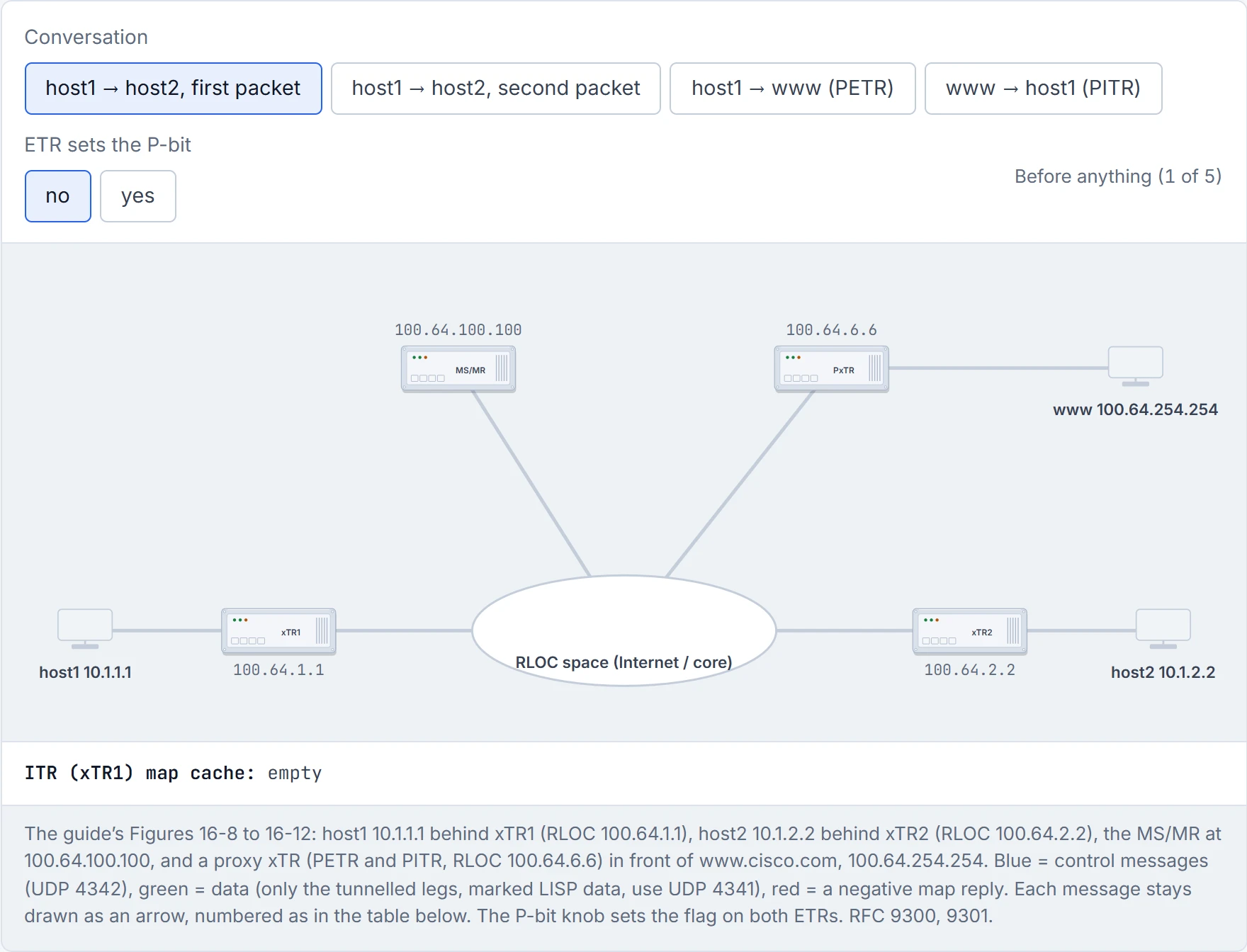
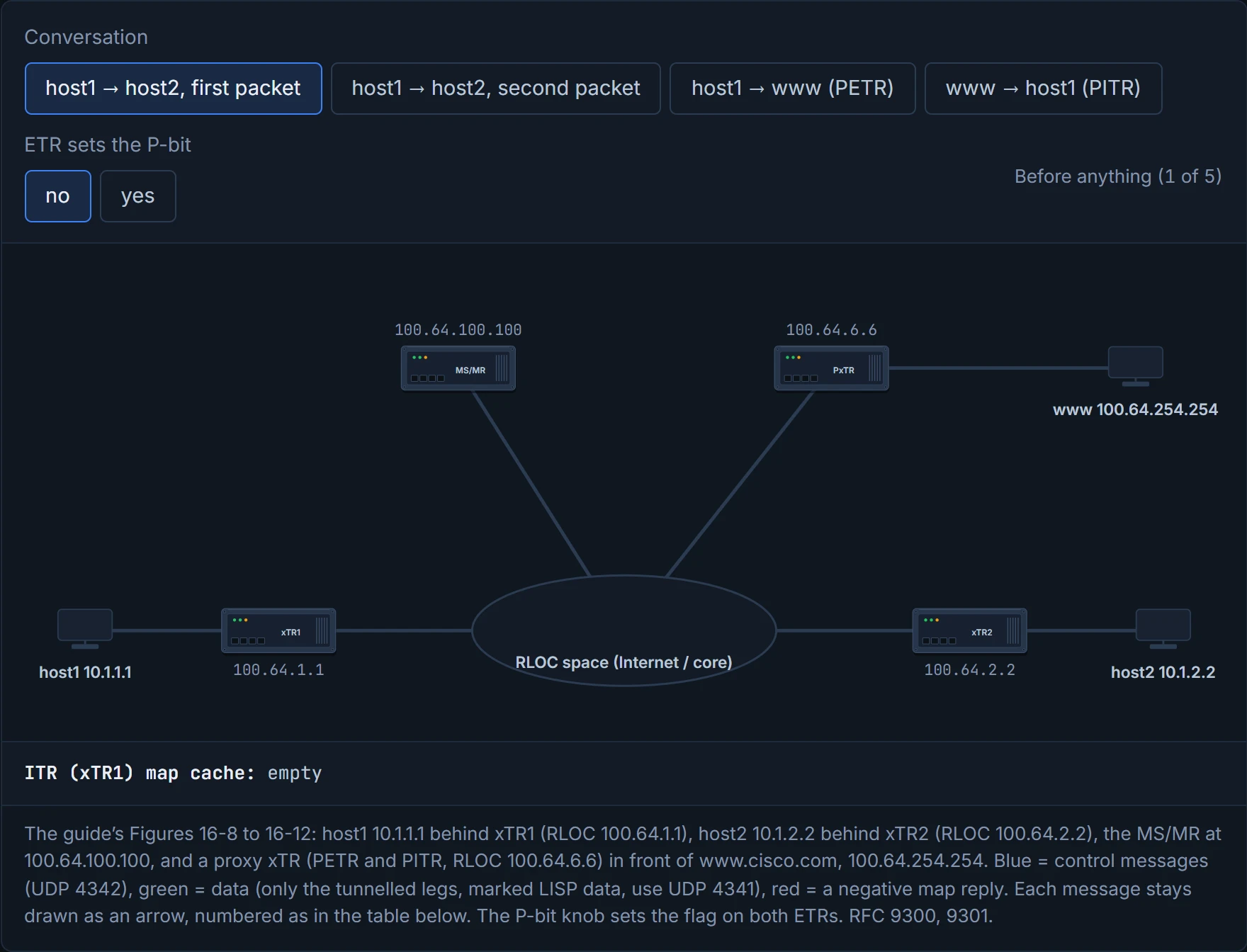
Step 1 of 5 Both ETRs are configured with their EID prefixes, but nothing has been registered and every map cache is empty.
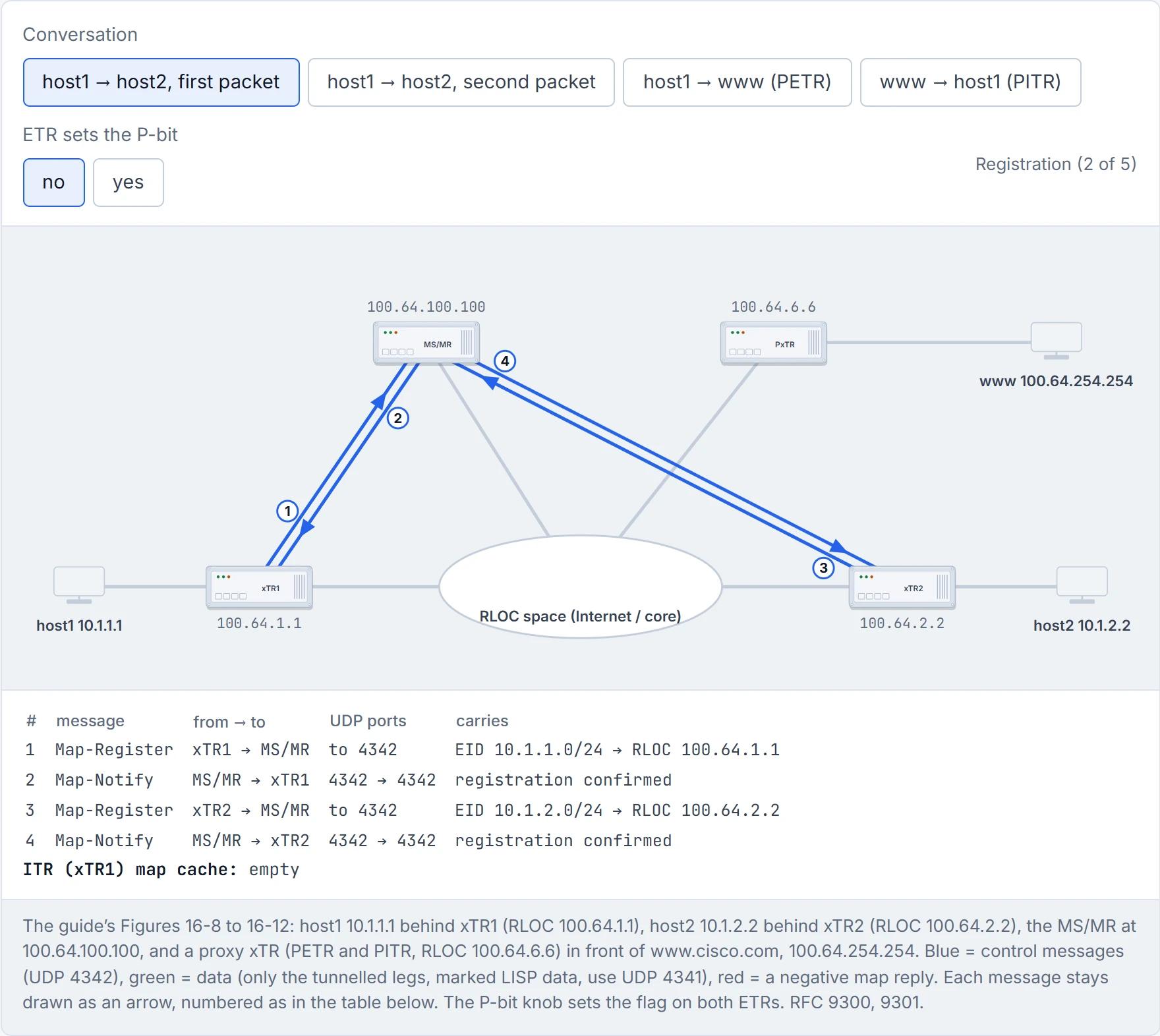
Step 2 of 5 Each ETR registers its EID prefix and its RLOC with the map server; the MS confirms with a map notify, UDP 4342 both ways (RFC 9301: when the ETR sets the M-bit). Registration happens before any traffic.
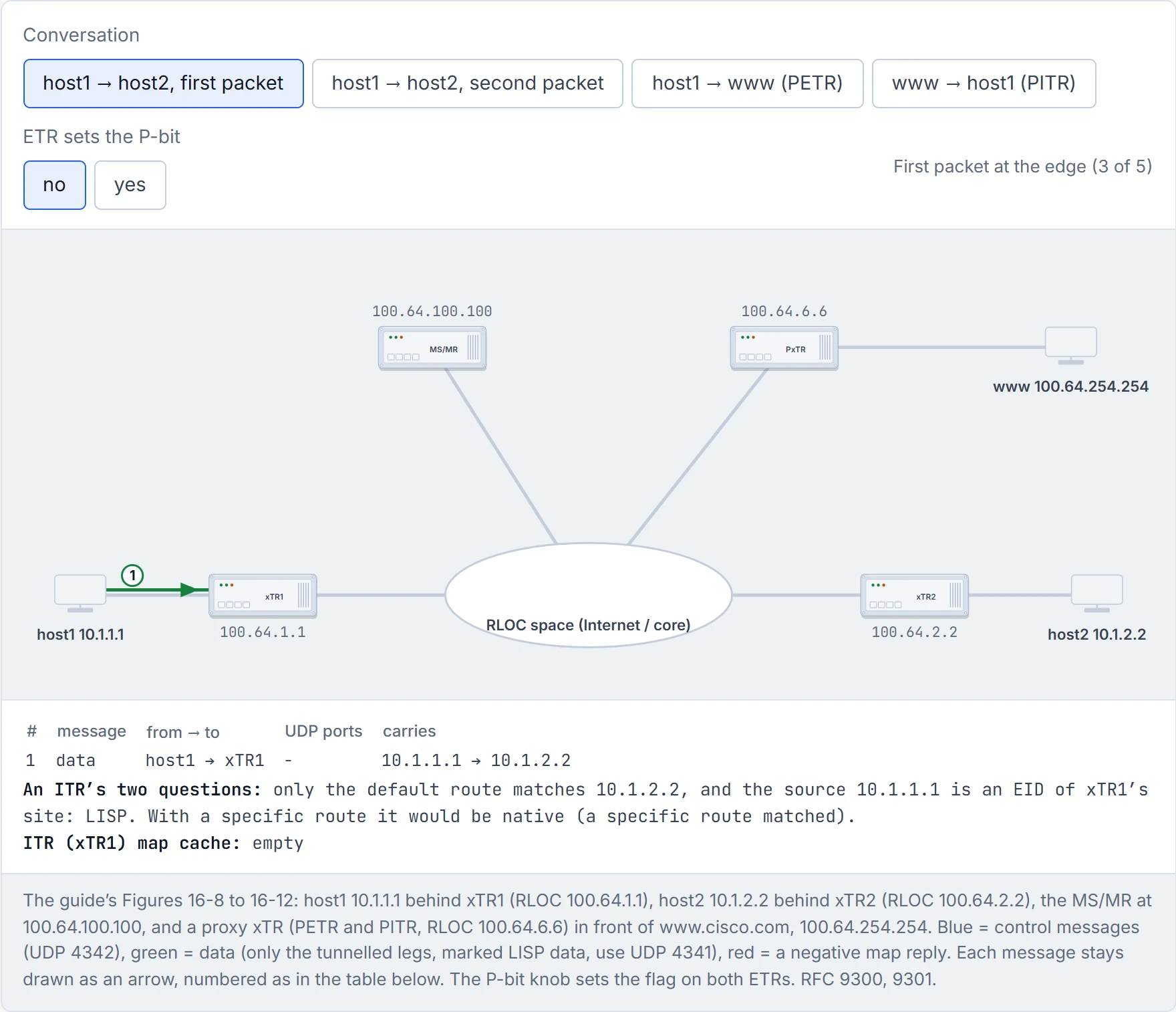
Step 3 of 5 host1 sends to its gateway, xTR1, as normal: inside the site it’s ordinary routing. At xTR1 the destination matches only the default route and the source is a registered EID, so LISP takes over.
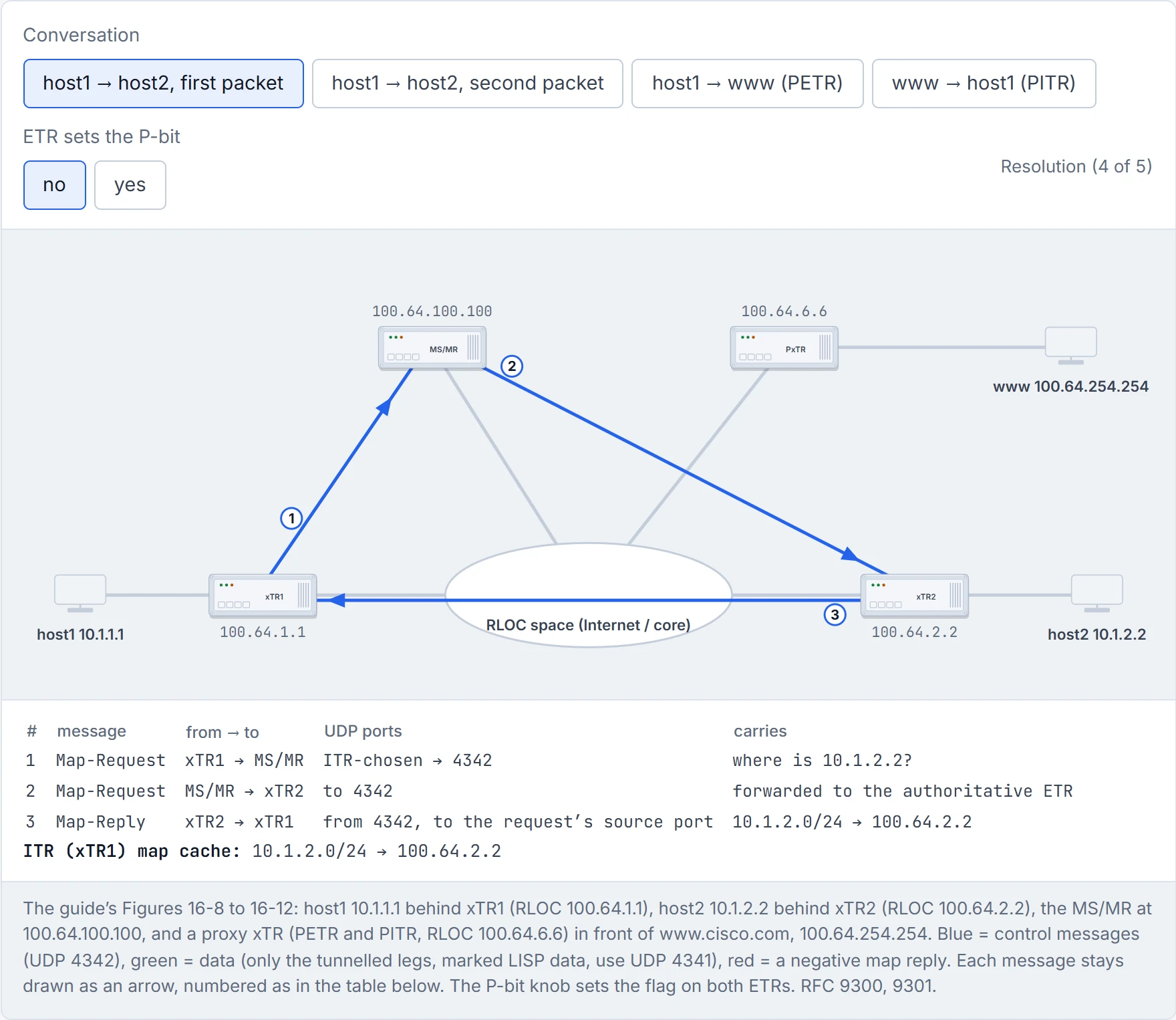
Step 4 of 5 xTR1 sends a map request (UDP 4342) to the MR; the MS forwards it to the authoritative ETR, xTR2, which answers from UDP 4342: 10.1.2.0/24 → 100.64.2.2. xTR1 caches it and programs its FIB (Figure 16-9).
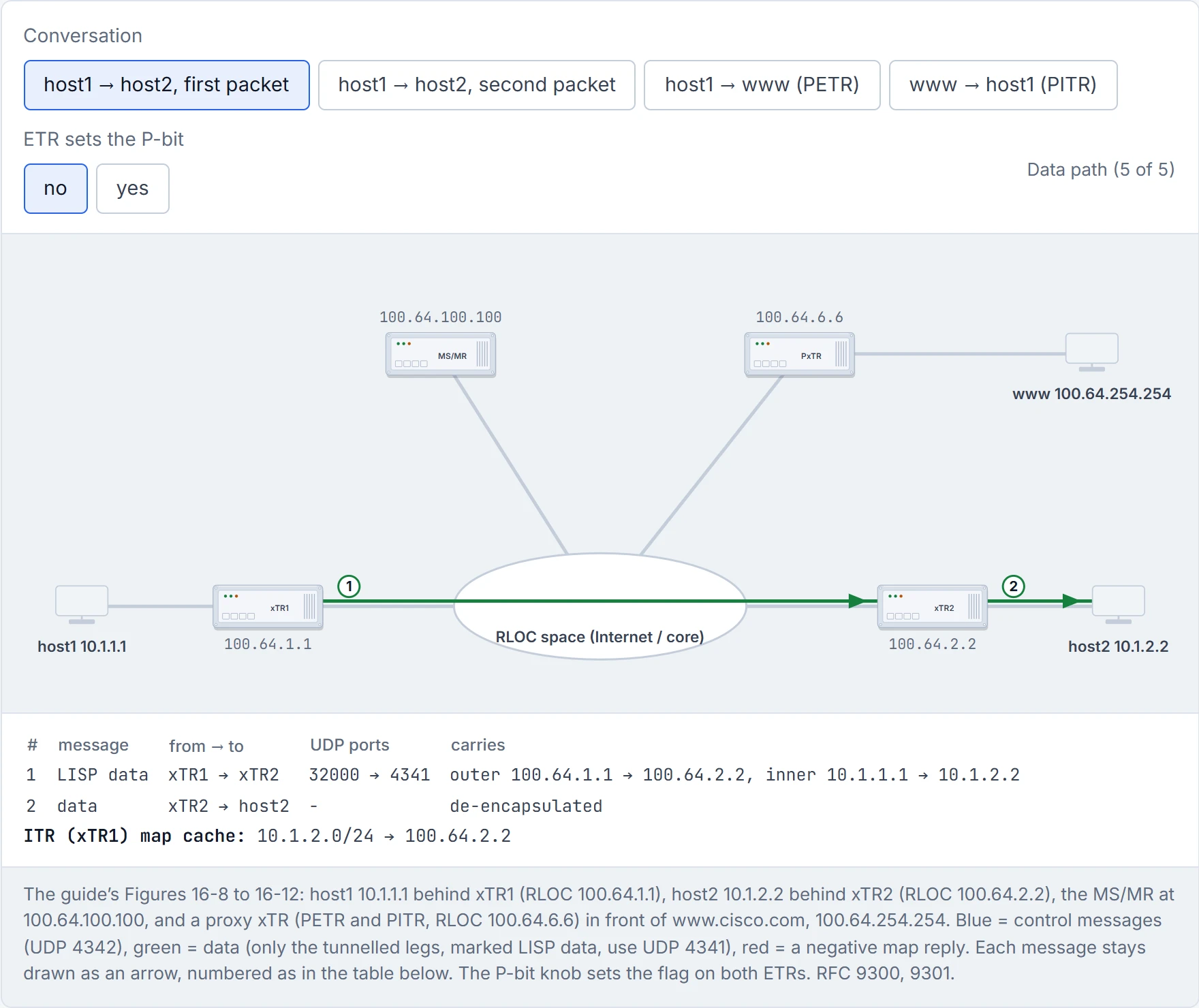
Step 5 of 5 xTR1 wraps the packet: outer 100.64.1.1 → 100.64.2.2, UDP source 32000 (chosen per flow for ECMP), destination 4341, a LISP header, then the original 10.1.1.1 → 10.1.2.2. xTR2 strips it and delivers to host2 (Figure 16-10).
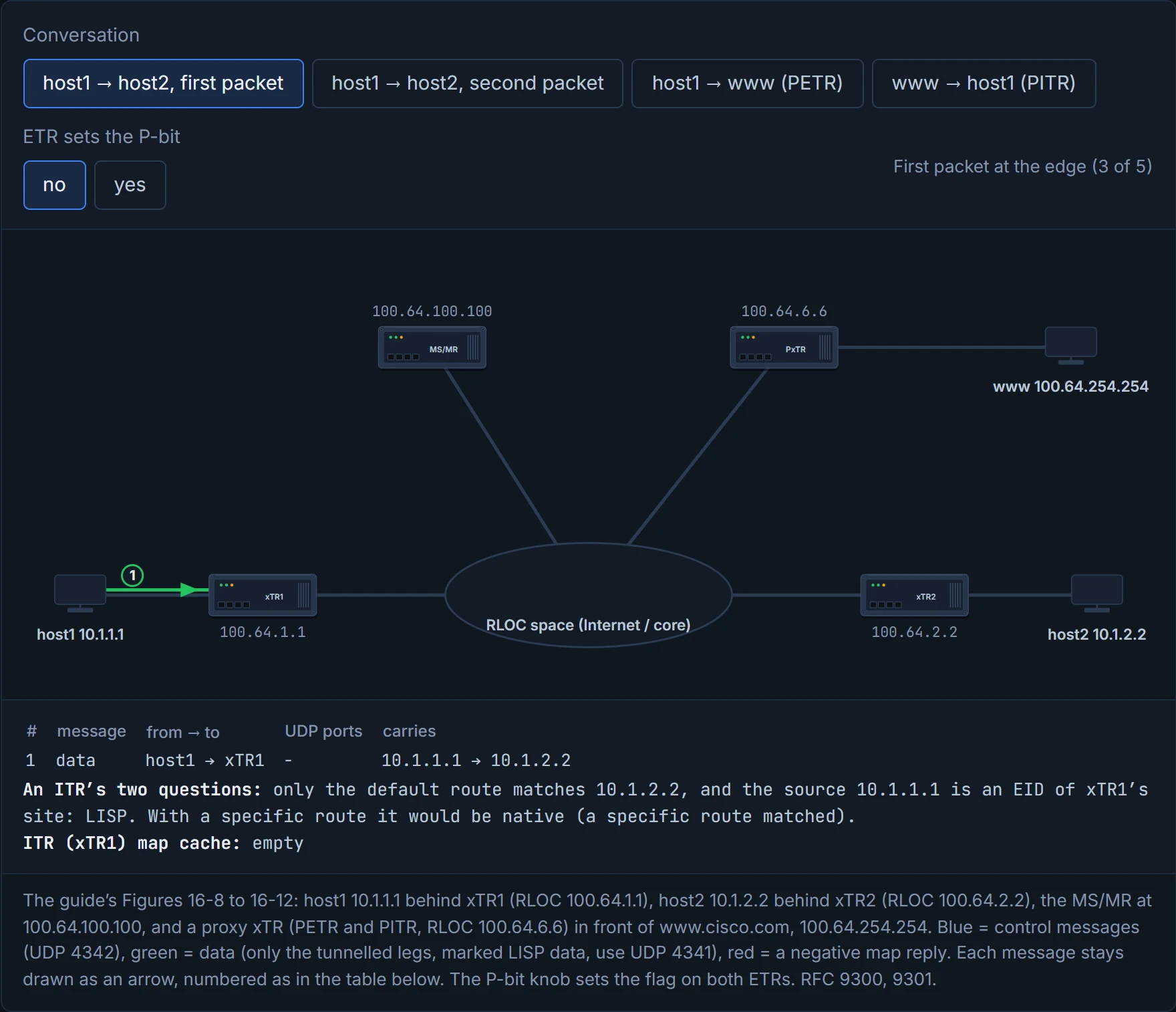
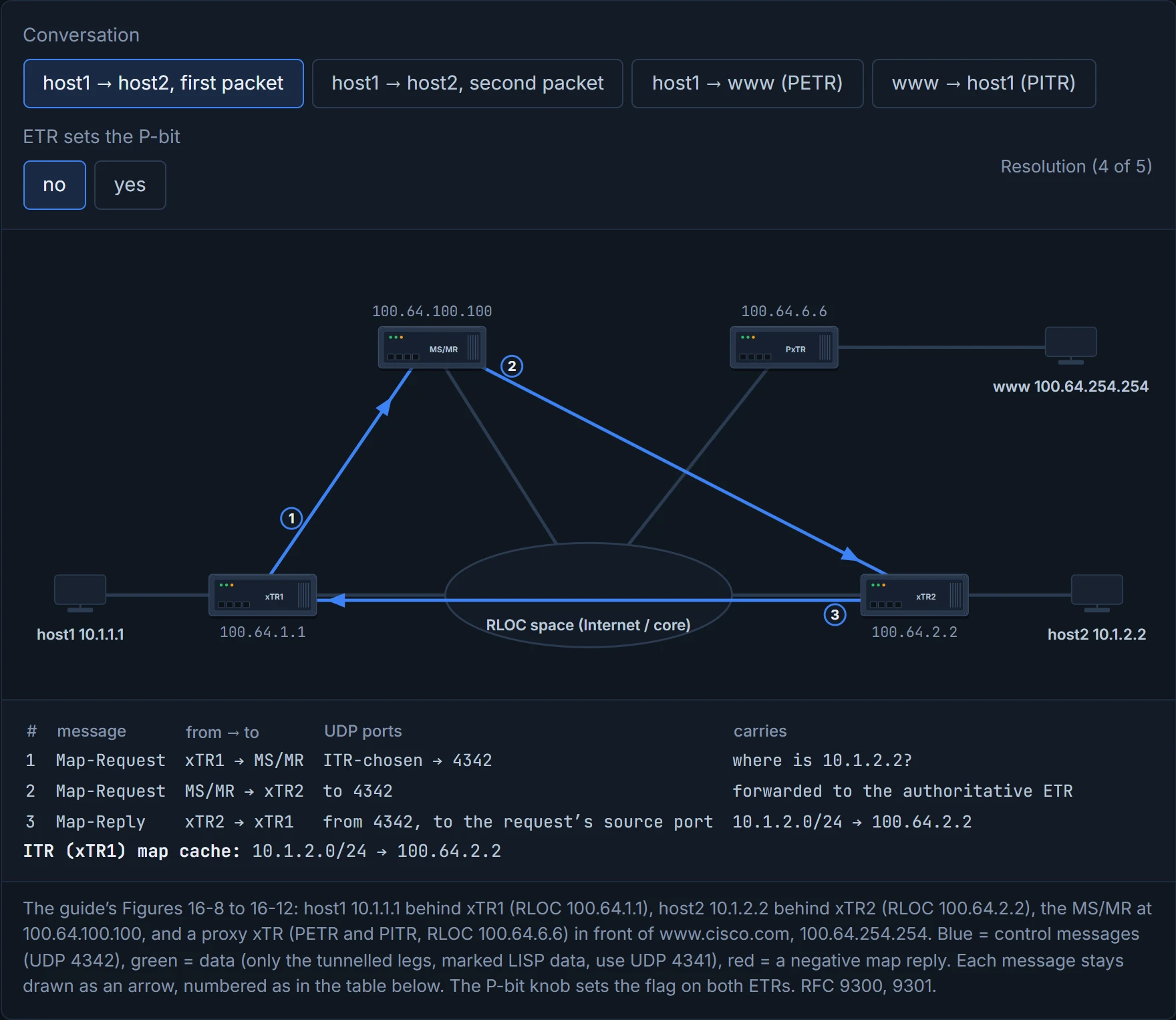
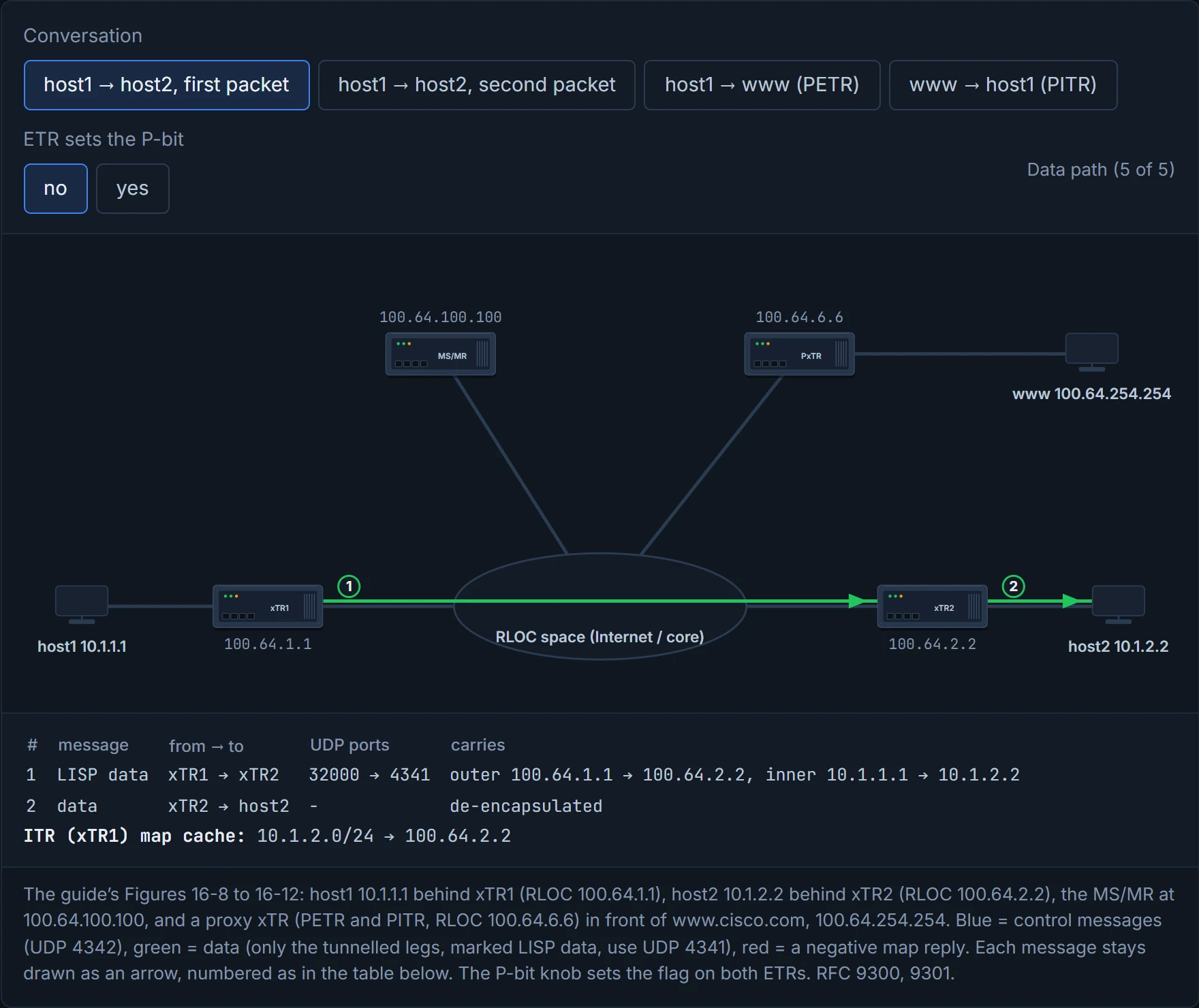
The memory hook: EID says who, RLOC says where; ask on 4342, send on 4341.
The ITR's first question is "do I have a real route for this?", and LISP only gets the job if the answer is "just the default", which is the most modest job description in networking.
The ITR wraps the EID packet in an outer IP header between RLOCs, a UDP header and a LISP header: IP-in-IP/UDP. The outer header works like the label on a parcel: the core reads only that. The packet (Figure 16-7):
| Part | Holds |
|---|---|
| outer IP header | source and destination RLOCs, protocol UDP |
| outer UDP header | destination port 4341; a source port the ITR picks per flow (typically a hash of the inner header) so ECMP paths share the load |
| LISP header | flags (N, L, E, V, I), a nonce (a random number used to check replies come from the right peer) or map version, and the 24-bit Instance ID |
| original IP header and data | the EIDs, untouched |
The Instance ID does for LISP what VRFs and MPLS VPN IDs do elsewhere: it separates overlapping or segmented address spaces (04-1), or acts as a secure boundary between organisations. In Figure 16-10 the packet from 10.1.1.1 to 10.1.2.2 leaves xTR1 as 100.64.1.1 → 100.64.2.2, UDP source 32000, destination 4341, and xTR2 strips it and delivers it. Because EIDs and RLOCs can each be IPv4 or IPv6, LISP carries all four combinations: IPv4 in IPv4, IPv6 in IPv4, IPv4 in IPv6, IPv6 in IPv6. It's a bit like a letter inside a courier's pouch: the courier reads only the pouch's label, and the letter inside keeps its own address.
Continue the lesson
The whole lesson, with its drawings and its questions. The rest of this section and 9 more after it.