
Spoke-to-spoke: phases 2 and 3, redirects and shortcuts
In Phase 1 every packet between spokes still passes through the hub. Phase 3 adds ip nhrp redirect on the hub and ip nhrp shortcut on the spokes: when the hub forwards spoke-to-spoke traffic it tells the sender there is a better path, the spoke asks NHRP for the other spoke's transport address, and a direct tunnel forms. NHRP installs the routes.
By Arif, founder of Daveth · Updated
The full 18 min walkthrough is in Daveth Pro (Network). See what the plan opens
What this page answers
What is the difference between DMVPN phase 2 and phase 3?
Both carry spoke-to-spoke traffic directly. Phase 2 has no redirect and does not allow summarization, because the next hop must be preserved. In Phase 3 the hub sends an NHRP redirect, the spoke resolves the other spoke and NHRP adds the route, so the hub can summarize. Read it in “Three lines”
How do you configure DMVPN phase 3?
Add ip nhrp redirect on the hub's tunnel and ip nhrp shortcut on each spoke's tunnel, on top of the Phase 1 configuration. Read it in “Three lines”
The same command, twice
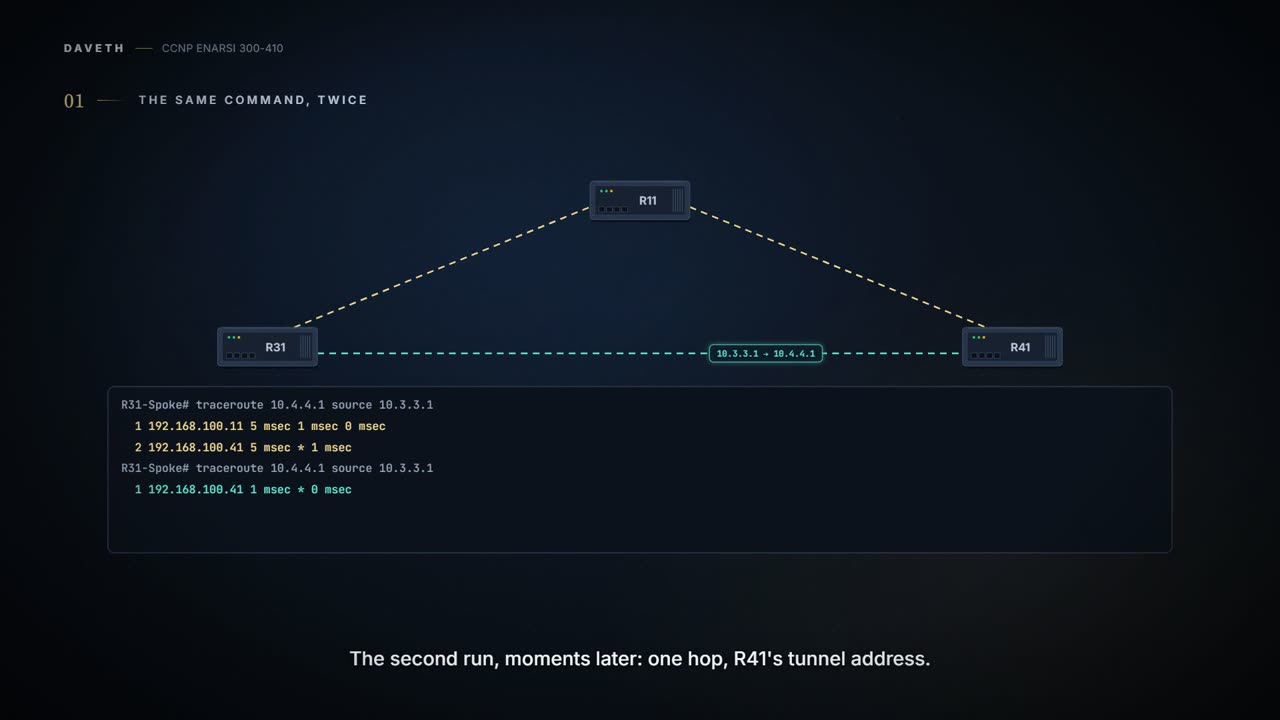
In Phase 1, a trace from R31's LAN to R41's LAN has two tunnel hops: the hub, then R41. The traceroute verifies that R31 can connect to R41, but network traffic must still pass through R11. Each spoke has its own link to the service provider, and every packet between two spokes goes to headquarters and back.
Now the same three routers a little later, after a change you'll see in a minute. One command, run twice on R31:
! Initial Packet Flow
R31-Spoke# traceroute 10.4.4.1 source 10.3.3.1
Tracing the route to 10.4.4.1
  1 192.168.100.11 5 msec 1 msec 0 msec <- This is the Hub Router (R11-Hub)
  2 192.168.100.41 5 msec * 1 msec
! Packetflow after Spoke-to-Spoke Tunnel is Established
R31-Spoke# traceroute 10.4.4.1 source 10.3.3.1
Tracing the route to 10.4.4.1
  1 192.168.100.41 1 msec * 0 msec
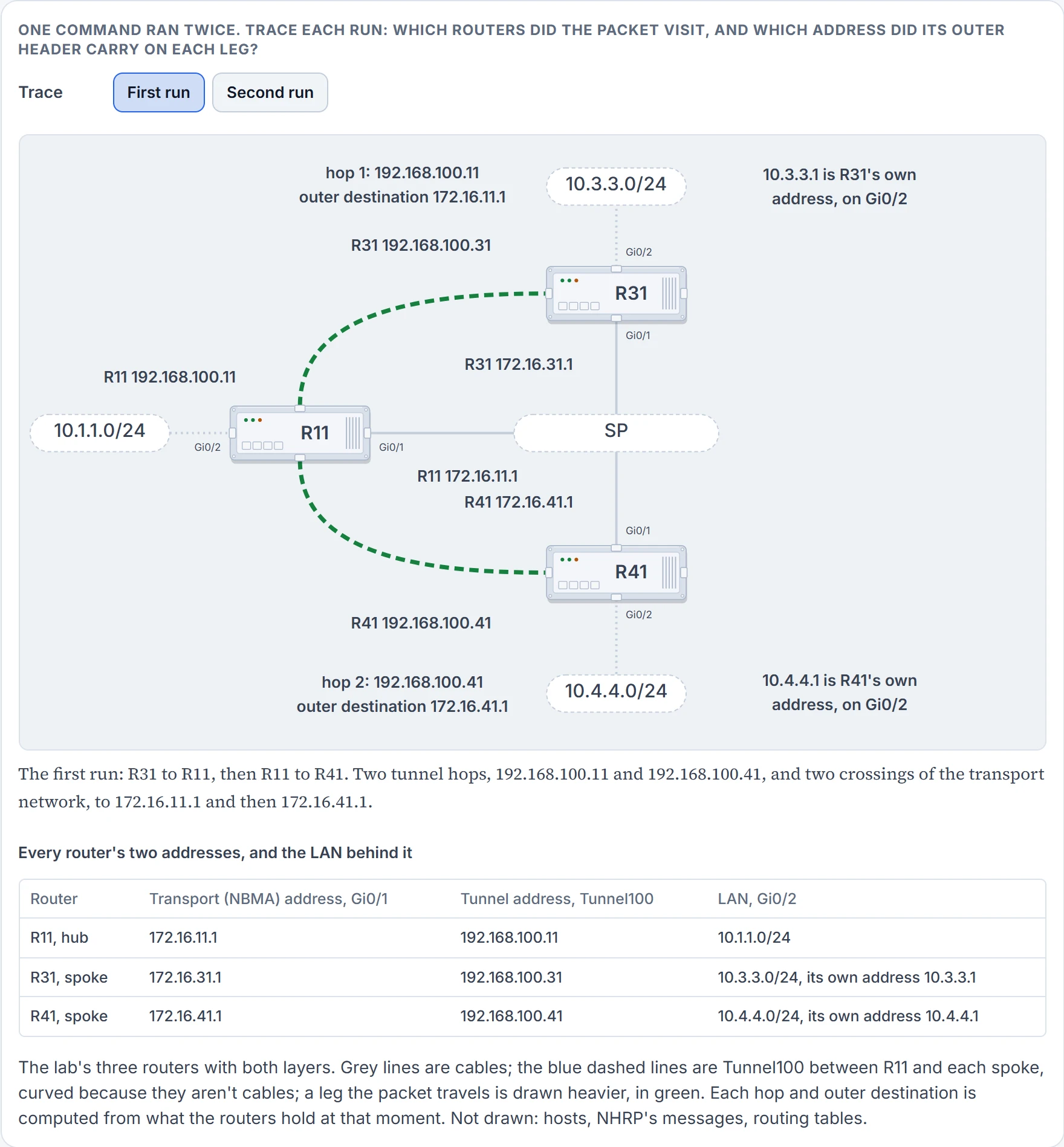
Same router, same command, same destination. The first run has two hops, 192.168.100.11 and then 192.168.100.41: the hub first, then R41. The second run has one hop, 192.168.100.41: R41 itself. Nobody typed anything on any router between the two.
One detail of the command: source 10.3.3.1. The trace is run on R31 and sourced from R31's own LAN address, and 10.4.4.1 is R41's own. This lab has no hosts, so the packets in this lesson's replay travel from one router's LAN address to the other's.
That's the lesson: what happened in the gap. Its one-sentence summary: the first packet travels across R11, but by the time a second stream of packets is sent, the spoke-to-spoke tunnel has been initialized, so that traffic flows directly between R31 and R41 on the transport and overlay networks. Both networks, note. The packet's outer header now carries R41's transport address, and the hop the trace prints is R41's tunnel address.
Why should traffic between two branches cross the country to the hub and back? In Phase 1 the answer was "because the spoke's tunnel has one destination". Here it is "it shouldn't, and after one packet it doesn't".
Three lines
Here's what changed between the last lesson's routers and these. On the hub, one line. The Phase 3 DMVPN configuration for the hub router adds the interface parameter command ip nhrp redirect; the hub's procedure has a step for it: for Phase 3, enable NHRP redirect functions by using the command ip nhrp redirect. What the line makes the hub do is the next section's subject.
On each spoke, two lines change. The Phase 3 configuration for spoke routers uses the mGRE tunnel interface and uses the command ip nhrp shortcut on the tunnel interface. The hub and one spoke:
R11-Hub
interface Tunnel100
 bandwidth 4000
 ip address 192.168.100.11 255.255.255.0
 ip mtu 1400
 ip nhrp map multicast dynamic
 ip nhrp network-id 100
 ip nhrp redirect
 ip tcp adjust-mss 1360
 tunnel source GigabitEthernet0/1
 tunnel mode gre multipoint
 tunnel key 100
R31-Spoke
interface Tunnel100
 bandwidth 4000
 ip address 192.168.100.31 255.255.255.0
 ip mtu 1400
 ip nhrp network-id 100
 ip nhrp nhs 192.168.100.11 nbma 172.16.11.1 multicast
 ip nhrp shortcut
 ip tcp adjust-mss 1360
 tunnel source GigabitEthernet0/1
 tunnel mode gre multipoint
 tunnel key 100
R41 is R31 with .41 in its address. All three routers have tunnel mode gre multipoint; R11 carries ip nhrp redirect, and R31 and R41 carry ip nhrp shortcut.
The spoke's procedure has ten steps. Eight are the last lesson's spoke: 1 and 2, create the tunnel interface and identify its source; 4 to 6, an address, NHRP with a network ID, and optionally a tunnel key, which must match for a DMVPN tunnel to be established between two routers; 8, name one or more NHSs with ip nhrp nhs nhs-address nbma nbma-address [multicast]; 9 and 10, typically an IP MTU of 1400 and a TCP MSS of 1360. Two differ: steps 3 and 7.
Step 3: configure the DMVPN tunnel as a GRE multipoint tunnel, tunnel mode gre multipoint. The tunnel destination line goes, and this is the bigger change of the two. On a spoke, use this command if data traffic can use dynamic spoke-to-spoke traffic. In DMVPN Phase 1, the spoke devices rely on the configured tunnel destination to identify where to send the encapsulated packets: one destination, typed in. A multipoint spoke, like the hub in the last lesson, can send to any transport address its NHRP cache holds. Phase 3 DMVPN uses mGRE tunnels and thereby relies on NHRP redirect and resolution request messages to identify the NBMA addresses for any destination networks.
Step 7: enable the NHRP shortcut function with ip nhrp shortcut. A shortcut, defined: the method of installing an NHRP learned route into the router's global RIB, its routing table. You'll watch it happen four sections down.
The multicast keyword stays on the NHS line: of ip nhrp map multicast nbma-address, the three-line form's version of the keyword, the rule is that it is required on multipoint GRE tunnels and not on point-to-point ones. As for ip nhrp shortcut, it is a step in the procedure, and that is the answer here and in the exam: type it.
For the designs where a router is both hub and spoke: there are no negative effects of placing ip nhrp shortcut and ip nhrp redirect on the same DMVPN tunnel interface.
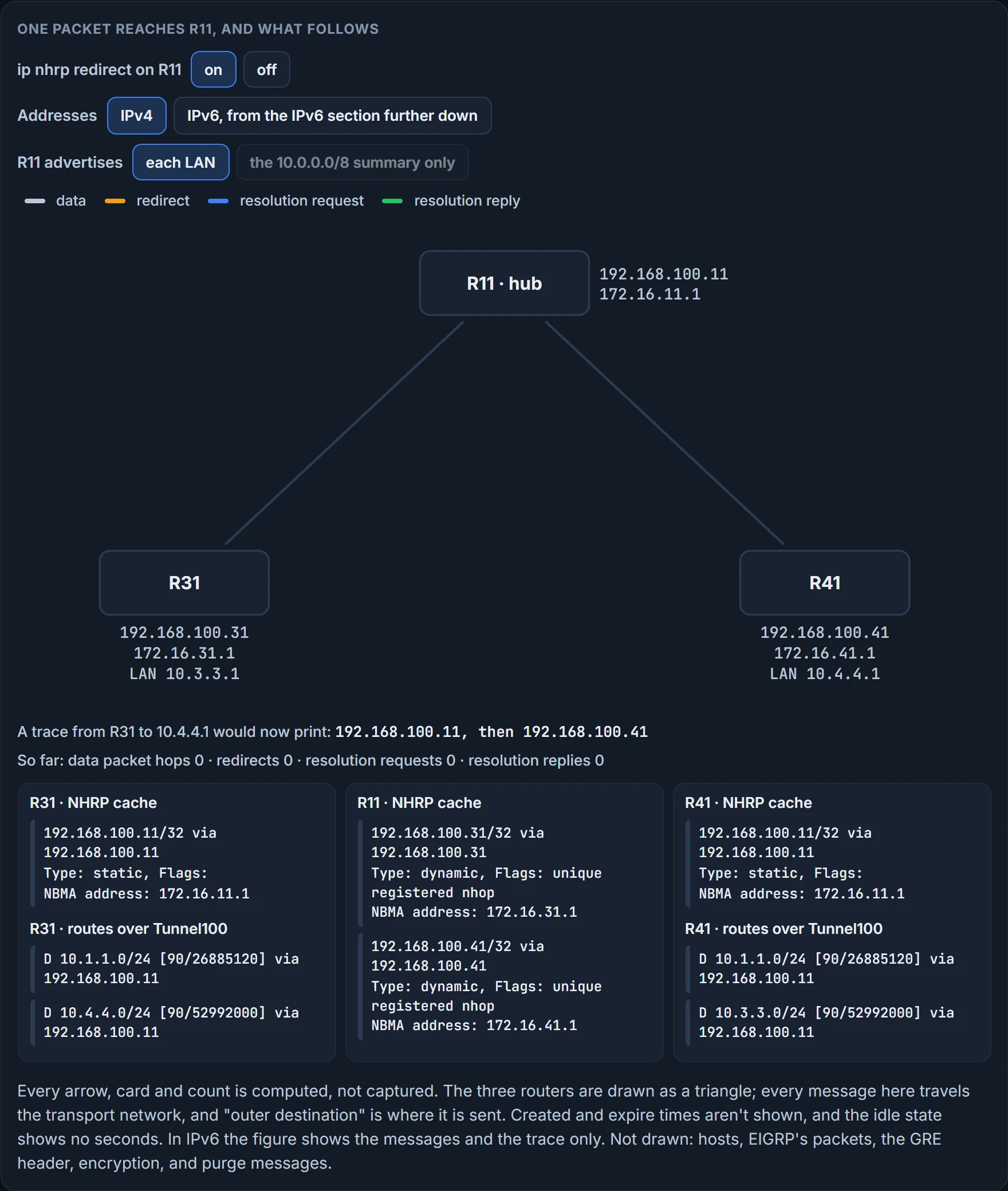
Now the part that sets up everything else. After the configuration on R11, R31 and R41 has been modified to support DMVPN Phase 3, the tunnels are established, and all the DMVPN, NHRP and routing tables look exactly as they did in the last lesson; no traffic is exchanged between R31 and R41 at this time. (One header line does differ: a multipoint spoke's show dmvpn detail reads MGRE where the Phase 1 spoke's read the hub's address.) R31's cache holds one entry, the hub. Its route to 10.4.4.0/24 still points at 192.168.100.11. Three new lines on three routers, and nothing is different.
Expect that as a true-or-false item: after a spoke registers with the hub, the hub sends communication to the spoke to establish a full mesh of tunnels with the other spokes. False. Spoke-to-spoke tunnels are formed only after the traffic between the spokes has started.
Frame one: one packet reaches the hub
Start with the trace's first probe: one packet from R31's LAN address, 10.3.3.1, to R41's, 10.4.4.1.
R31 performs a route lookup for 10.4.4.1 and finds the entry 10.4.4.0/24 with the next-hop IP address 192.168.100.11; it encapsulates the packet and forwards it to R11 out the tunnel 100 interface. Nothing new there: it's the last lesson's routing table and the last lesson's static cache entry.
The packet is at R11. It came in on Tunnel100, the interface that carries R11's one new line. Predict before the figure runs.
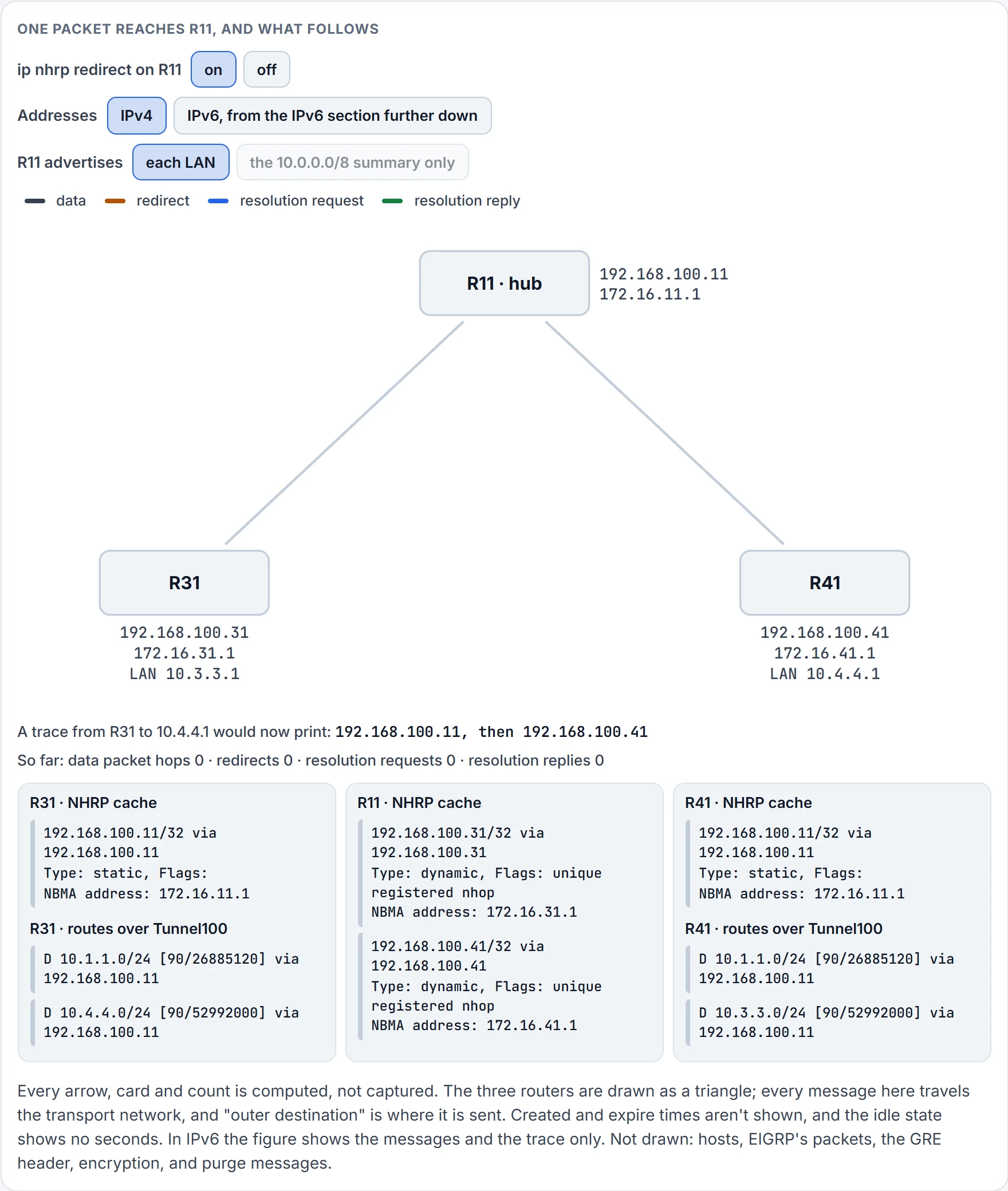
Step 1 of 4 Before any traffic. Each spoke's cache holds one entry, the hub. R31's route for 10.4.4.0/24 is D 10.4.4.0/24 [90/52992000] via 192.168.100.11.
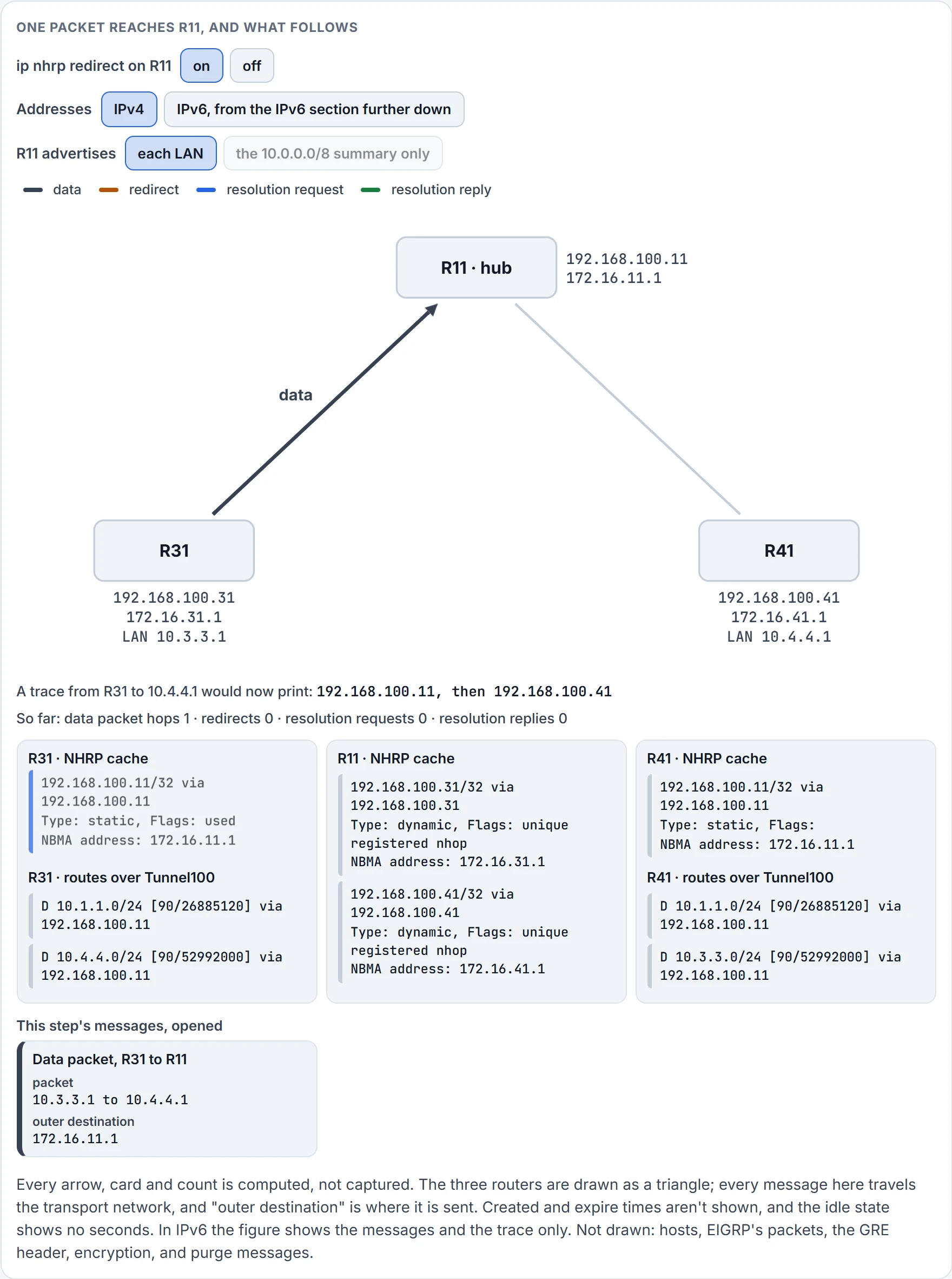
Step 2 of 4 R31 looks 10.4.4.1 up, finds a route with the next hop 192.168.100.11, and sends the packet to R11: outer destination 172.16.11.1. That's the last lesson's table and the last lesson's static entry.
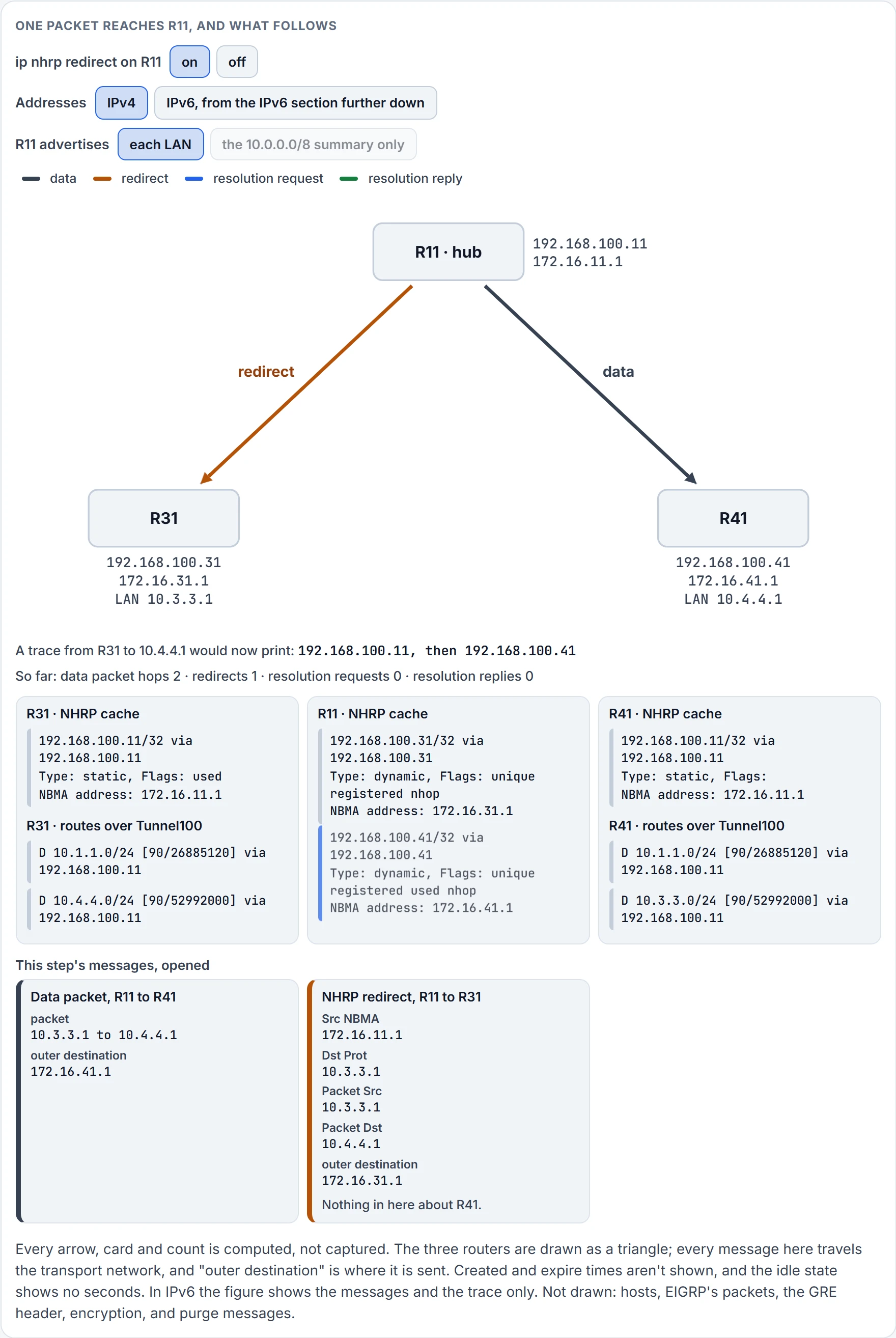
Step 3 of 4 R11 forwards the packet out of the same tunnel interface it came in on, to R41 at 172.16.41.1. And it sends a redirect to R31, which names the packet and not R41.
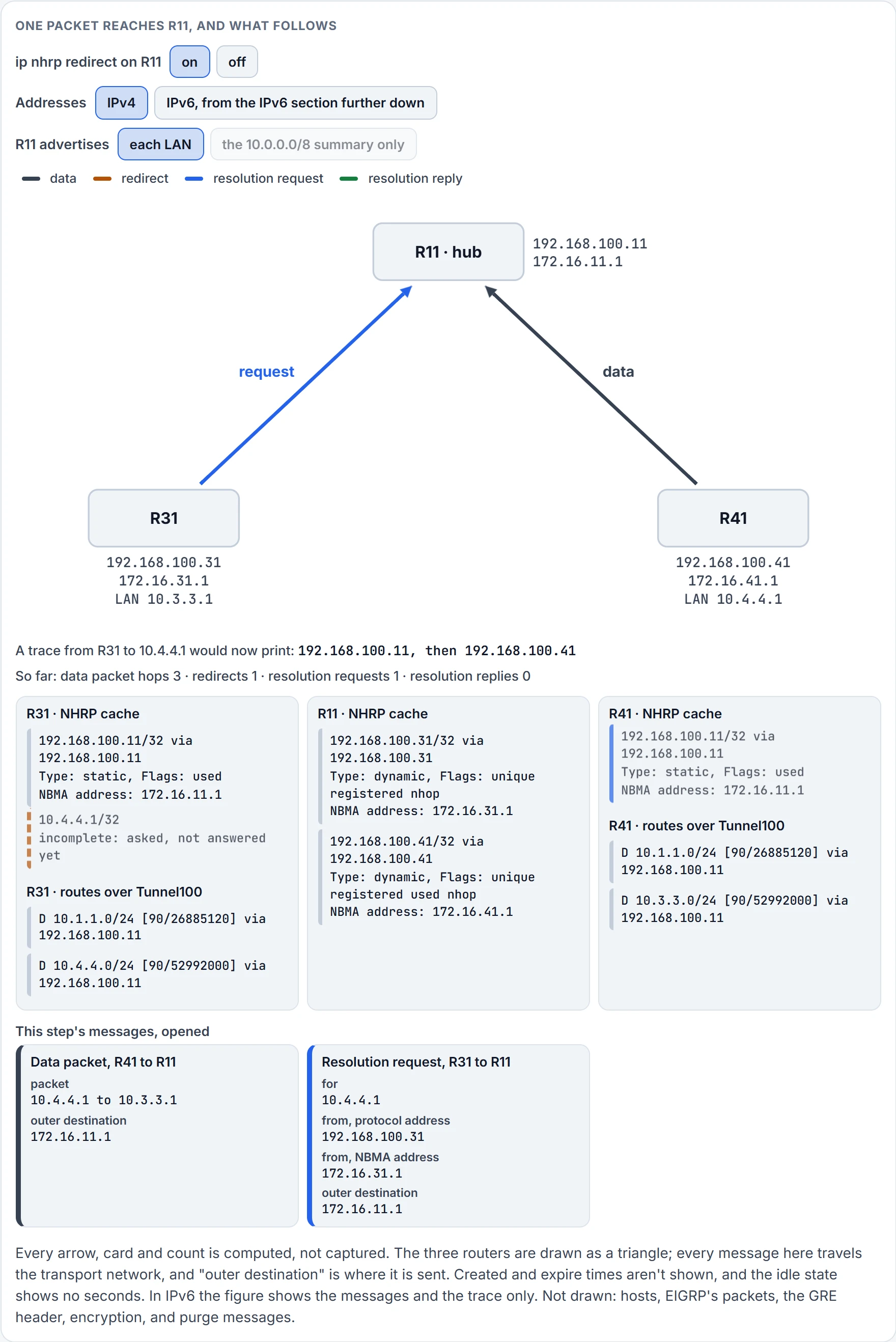
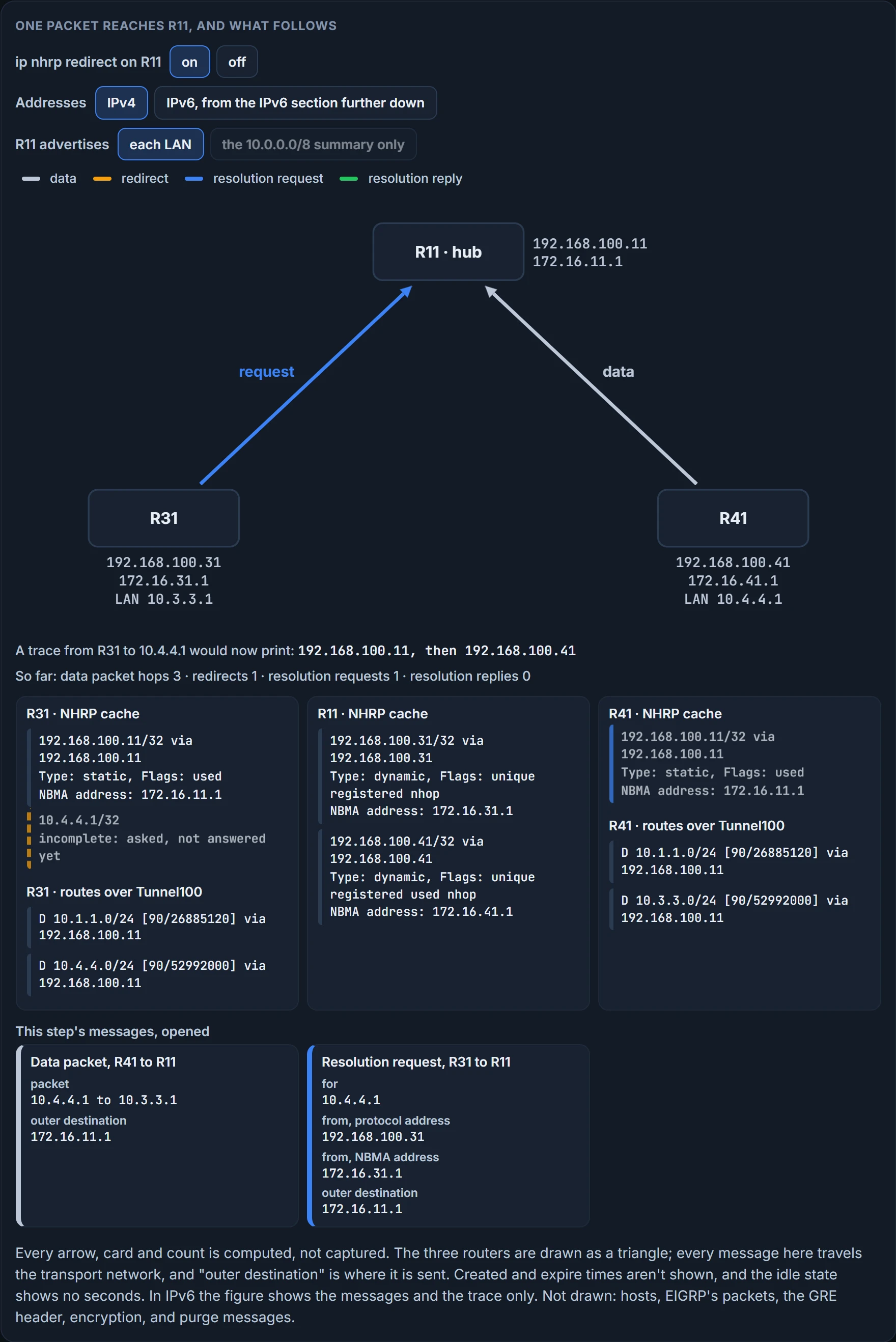
Step 4 of 4 R31 has been told its path was the long one. It sends a resolution request to R11 for 10.4.4.1, carrying its own two addresses, and holds an incomplete entry while it waits. Meanwhile R41 answers the first packet the only way it knows: by way of R11.
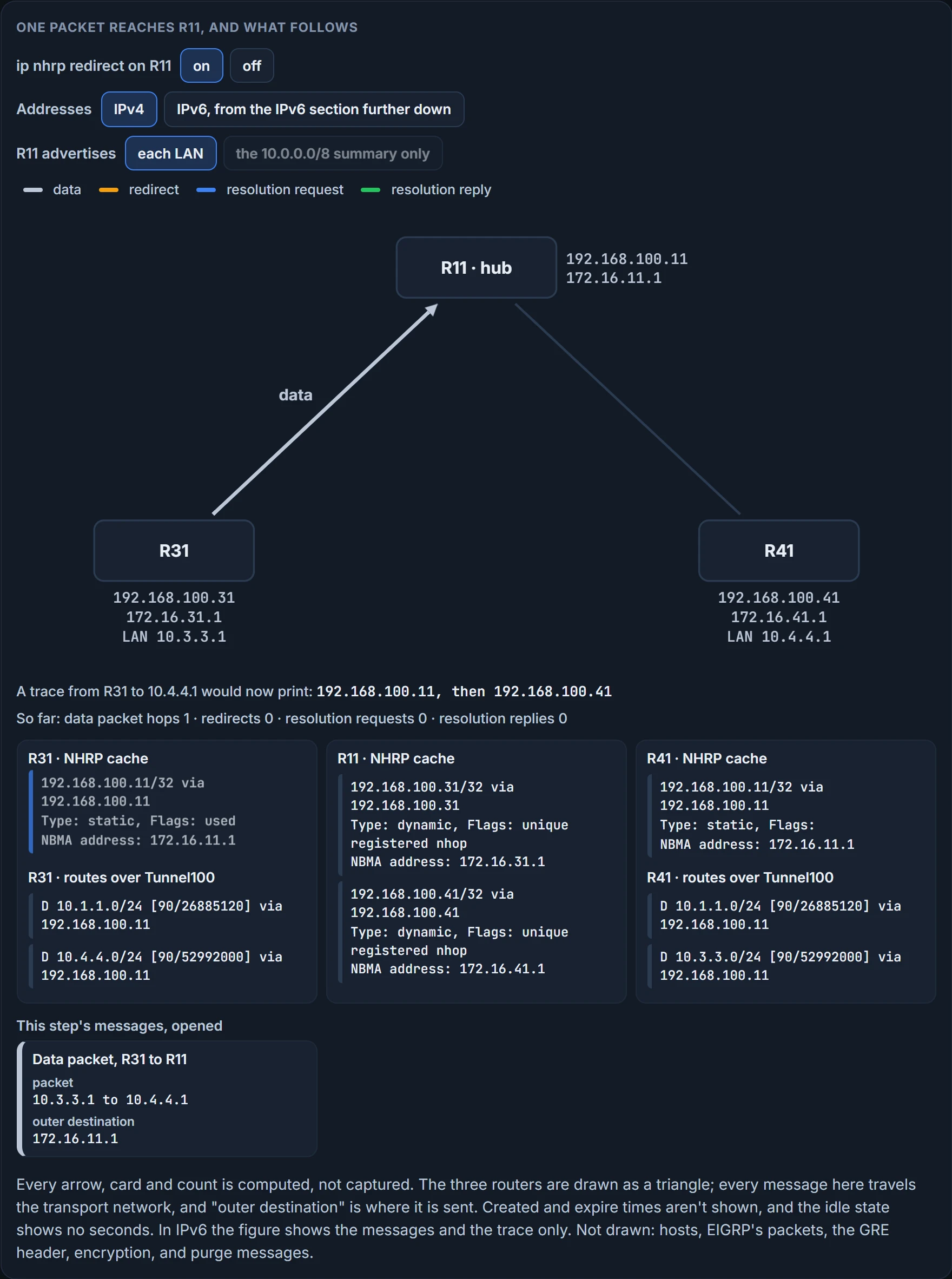
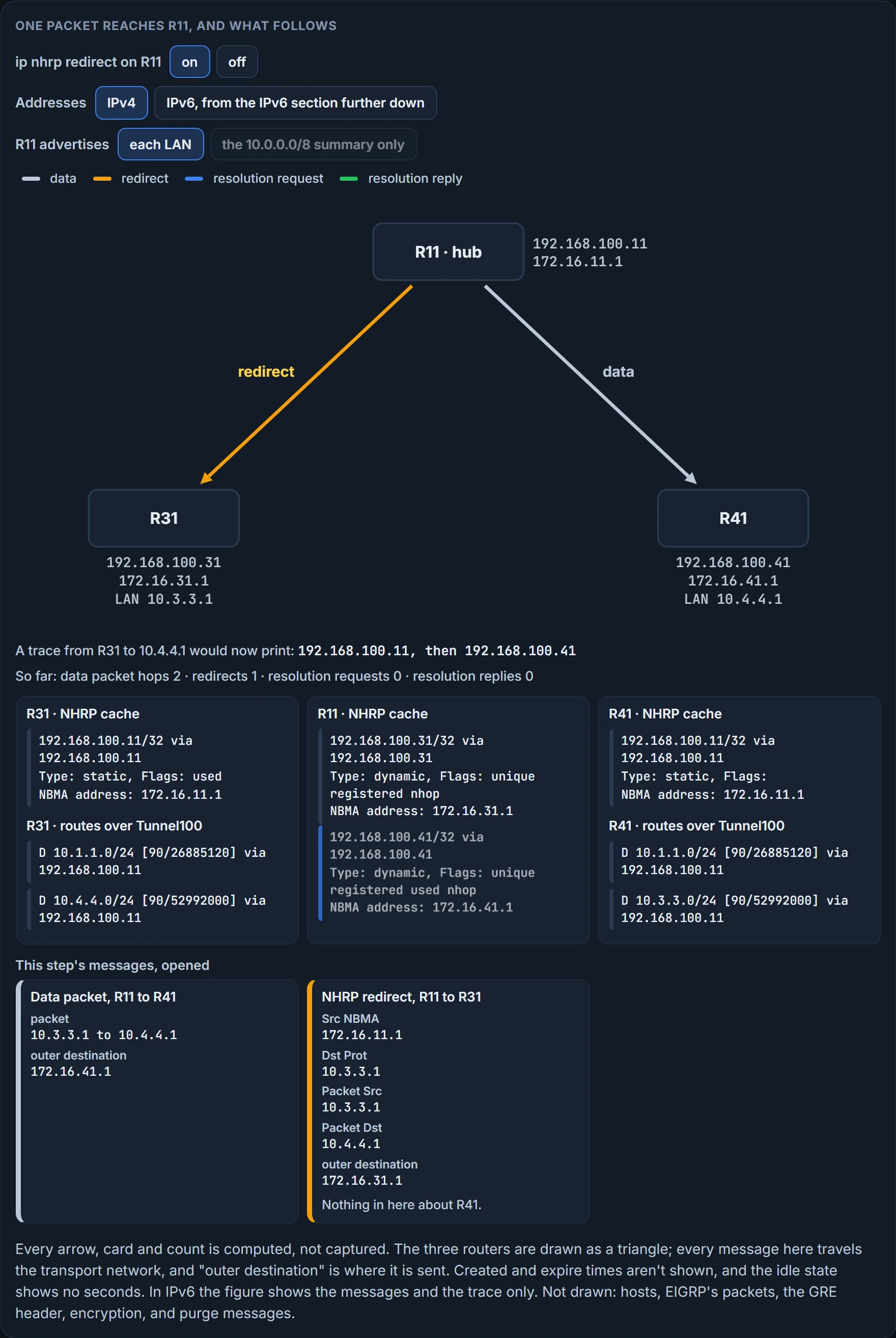
The first is the packet. R11 locates the 10.4.4.0/24 network with the next-hop IP address 192.168.100.41, checks the NHRP cache and locates the entry for 192.168.100.41/32, and forwards the packet to R41 using the NBMA IP address 172.16.41.1 found in the NHRP cache; the packet is then forwarded out the same tunnel interface. The hub does its Phase 1 job, with the row R41 registered.
The second is new. R11 has ip nhrp redirect configured on the tunnel interface and recognizes that the packet received from R31 hairpinned out of the tunnel interface. R11 sends an NHRP redirect to R31, indicating the packet source 10.3.3.1 and destination 10.4.4.1. The redirect indicates to R31 that the traffic is using a suboptimal path. The definition of the hub's line now reads as a description of what you just watched: this command checks the flow of packets on the tunnel interface and sends a redirect message to the source spoke router when it detects packets hairpinning out of the DMVPN cloud.
Both. That's the thing to get right about Phase 3: the hub doesn't hold the packet while something better is arranged, and it doesn't refuse it. It delivers the packet the long way and sends a note back saying it was the long way. One of DMVPN's listed benefits is that there is no packet loss while building dynamic on-demand spoke-to-spoke tunnels after the initial spoke-to-hub tunnels are established, and forwarding the packet the long way is how that promise can be kept. Packets keep flowing through the hub until the spoke-to-spoke tunnel has been established in both directions, and as they cross it the hub engages NHRP redirection to start the process of finding a more optimal path with spoke-to-spoke tunnels.
"Hairpinning" has a precise meaning here. It means that traffic is received and sent out an interface in the same cloud, identified by the NHRP network ID; for instance, packets that come in and go out the same tunnel interface. Here's a use for the number the last lesson called locally significant: on the hub, the network ID is what says "these interfaces are one cloud", and a packet that enters and leaves inside one cloud is a hairpin.
Look at the redirect for what it carries and what it doesn't. Its job, as NHRP's message types define it: redirect messages allow an intermediate router to notify the encapsulator, a router, that a specific network can be reached by using a more optimal path, a spoke-to-spoke tunnel. Put shorter, a redirect is an NHRP message sent toward the source spoke upon detecting the hairpinning network traffic out of the DMVPN tunnel interface. The message has four fields that matter here, and the figure opened them at step 2:
- Src NBMA: the sender's transport address, which is the hub's own, 172.16.11.1.
- Dst Prot: 10.3.3.1. The redirect is addressed to the source address of the packet that hairpinned.
- Packet Src and Packet Dst: 10.3.3.1 and 10.4.4.1, the packet the hub is talking about.
The second field is the one to notice. The redirect goes to wherever the data packet came from, which is how it finds the spoke that originated the flow. In this lab that address is R31's own.
The redirect carries one transport address, and it's the hub's, which R31 has had since it registered. What it doesn't carry is anything about R41: no tunnel address, no transport address, no name. With DMVPN Phase 3, the hub sends an NHRP redirect message to the spoke that originated the packet flow, and the redirect provides the necessary information so that the originator spoke can initiate a resolution of the destination host or network. Enough to start asking. Not the answer.
We haven't confirmed on a router, for this section: what the Dst Prot field holds when the packet came from a host behind the spoke and not from the spoke itself; and that with the redirect line removed nothing ever changes, which is what the figure computes.
Frames two to seven: R31 has to ask
R31 has been told its path is poor. It still has one entry in its cache, the hub, and no idea what R41's transport address is. NHRP has a message for exactly this. The NHRP messages provide the necessary information for the spokes to locate each other so that they can build a spoke-to-spoke DMVPN tunnel, and they also allow a spoke to locate a remote network. Resolution messages locate and provide the address resolution information of the egress router toward the destination; a resolution request is sent during the actual query, and a resolution reply provides the tunnel IP address and the NBMA IP address of the remote spoke.
R31 asks. It takes seven steps among all three devices, R11, R31 and R41, to establish a bidirectional spoke-to-spoke DMVPN tunnel, and the figure above draws the first four. You've seen steps 1 and 2. Here is step 3, and then a question, because the step after it is the one people get wrong.
Step 3. R31 receives the NHRP redirect and sends an NHRP resolution request to R11 for the 10.4.4.1 address. Inside the request, R31 provides its protocol (tunnel IP) address, 192.168.100.31, and its source NBMA address, 172.16.31.1: the question carries the asker's own two addresses. Meanwhile R41, which owns 10.4.4.1, is answering the first packet, and it is where R31 was a moment ago: it performs a route lookup for 10.3.3.1, finds 10.3.3.0/24 with the next hop 192.168.100.11, and forwards the packet to R11 out the tunnel.
Step 4. R11 does for that return packet what it did for the first one. It forwards it to R31 using the NBMA address 172.16.31.1 from its cache, recognizes that it hairpinned, and sends an NHRP redirect to R41, indicating the packet source 10.4.4.1 and destination 10.3.3.1; this one is addressed to 10.4.4.1, the return packet's source. Then the line that answers half the question: R11 forwards R31's NHRP resolution requests for the 10.4.4.1 address. Forwards. The hub has R41's row in its own cache and doesn't answer from it. It passes the question on, to R41.
Step 5. Two things from R41. Redirected in its turn, it sends its own NHRP resolution request to R11 for the 10.3.3.1 address, providing its protocol address, 192.168.100.41, and source NBMA address, 172.16.41.1. And it answers R31: R41 sends an NHRP resolution reply directly to R31, using the source information from R31's NHRP resolution request.
Directly. R41 is the one that answers, and the reply doesn't go back the way the question came. R41 has R31's transport address, because R31 put it in the question, so R41 addresses a GRE packet to 172.16.31.1 and sends it across the transport network. This reply is the first packet in three lessons that travels from one spoke's transport address to another's. The reply contains the original source information in R31's request as a method of verification, and it contains the client protocol address of 192.168.100.41 and the client NBMA address 172.16.41.1. That pair is what R31 needed.
What the answer covers: the NHRP reply is for the entire subnet rather than the specified host address. R31 asked about 10.4.4.1. R41 answers for 10.4.4.0/24, its whole LAN. One question per network, not one per host.
Step 6. R11 forwards R41's NHRP resolution requests, the ones for R31's side, on to R31, as it forwarded R31's to R41.
Step 7. R31 sends an NHRP resolution reply directly to R41, using the source information from R41's request; it contains the client protocol address 192.168.100.31 and the client NBMA address 172.16.31.1.
A spoke-to-spoke DMVPN tunnel is established in both directions after step 7 is complete, and this allows traffic to flow across the spoke-to-spoke tunnel instead of traversing the hub router.
Count what crossed. The hub handled every message except the two replies, and those were the two that mattered: each was built by the spoke that owned the answer. "Tunnel" is a generous word for what now exists. Nothing was negotiated between R31 and R41. Each holds a cache entry with the other's transport address, and each got it separately. One direction can be complete while the other isn't, and the case at the end of this page turns on that.
One thing is negotiated between two spokes, when encryption is on: if IPsec protection is configured, the IPsec tunnel is set up before the NHRP reply is sent, in step 5 and again in step 7. That belongs to the IPsec lesson.
We haven't confirmed on a router, for this section: how many resolution requests each spoke sends (the figure sends one); whether a request names the destination address, as the steps above have it, or the far spoke's tunnel address; and how the hub picks the router it forwards a request to. The next section's outputs settle the result: each spoke ends with an entry for the far network and one for the far tunnel address.
What each spoke wrote down
After step 7, read the tables. show dmvpn detail first, on R31:
Seven lines of this output are left out here: four of the legend (C - CTS Capable, # Ent, NHS Status and UpDn Time), the rule of equals signs under it, and two of the interface's header (Interface State Control and nhrp event-publisher).
R31-Spoke# show dmvpn detail
Legend: Attrb --> S - Static, D - Dynamic, I - Incomplete
          N - NATed, L - Local, X - No Socket
         T1 - Route Installed, T2 - Nexthop-override
Interface Tunnel100 is up/up, Addr. is 192.168.100.31, VRF ""
     Src./Dest. addr: 172.16.31.1/MGRE, Tunnel VRF ""
    Protocol/Transport: "multi-GRE/IP", Protect ""
IPv4 NHS:
192.168.100.11 RE NBMA Address: 172.16.11.1 priority = 0 cluster = 0
Type:Spoke, Total NBMA Peers (v4/v6): 3
# Ent  Peer NBMA Addr Peer Tunnel Add State  UpDn Tm Attrb    Target Network
----- --------------- --------------- ----- -------- ----- -----------------
    1 172.16.31.1      192.168.100.31    UP 00:00:10   DLX        10.3.3.0/24
    2 172.16.41.1      192.168.100.41    UP 00:00:10   DT2        10.4.4.0/24
      172.16.41.1      192.168.100.41    UP 00:00:10   DT1  192.168.100.41/32
    1 172.16.11.1      192.168.100.11    UP 00:00:51     S  192.168.100.11/32
In Phase 1 this spoke had one row. Now it has four, and the header says so twice: the destination reads MGRE and the transport "multi-GRE/IP", which is what a multipoint tunnel prints, and the peer count is three NBMA peers where it was one. Three of the four rows are ten seconds old.
Read the Attrb column against the legend. D is dynamic, as before. T1 is "Route Installed" and T2 is "Nexthop-override". L is Local and X is No Socket.
- The last row is the one you know: the hub, S, static. The original tunnel to R11 remains a static tunnel.
- The two rows in the middle are the new spoke-to-spoke entries, both for the peer at NBMA address 172.16.41.1, which is why the entry count beside them is 2. One has R41's LAN as its target, 10.4.4.0/24, and reads DT2. The other has R41's own tunnel address, 192.168.100.41/32, and reads DT1.
- The first row is R31 describing itself: its own NBMA address, its own tunnel address, its own LAN, DLX. The rule for reading it: the DLX entries represent the local (no-socket) routes.
R41's table is the mirror: DT2 for 10.3.3.0/24, DT1 for 192.168.100.31/32, DLX for its own 10.4.4.0/24, S for the hub.
Why would a router keep an entry about its own LAN? show ip nhrp detail answers that. R31 again:
R31-Spoke# show ip nhrp detail
10.3.3.0/24 via 192.168.100.31
  Tunnel100 created 00:01:44, expire 01:58:15
  Type: dynamic, Flags: router unique local
  NBMA address: 172.16.31.1
  Preference: 255
   (no-socket)
  Requester: 192.168.100.41 Request ID: 3
10.4.4.0/24 via 192.168.100.41
  Tunnel100 created 00:01:44, expire 01:58:15
  Type: dynamic, Flags: router rib nho
  NBMA address: 172.16.41.1
  Preference: 255
192.168.100.11/32 via 192.168.100.11
  Tunnel100 created 10:43:18, never expire
  Type: static, Flags: used
  NBMA address: 172.16.11.1
  Preference: 255
192.168.100.41/32 via 192.168.100.41
  Tunnel100 created 00:01:45, expire 01:58:15
  Type: dynamic, Flags: router used nhop rib
  NBMA address: 172.16.41.1
  Preference: 255
Take the first entry. It's the record of an answer R31 gave, and its flag local means exactly that: an entry for networks local to this router for which this router has answered an NHRP resolution request. That's step 7, written down. The last line says to whom: Requester 192.168.100.41, Request ID 3. With detail, the 10.3.3.0/24 entry on R31 and the 10.4.4.0/24 entry on R41 display a list of devices to which the router responded to resolution request packets, and the request ID they received. (no-socket) marks a mapping entry that has no associated IPsec socket and where encryption is not triggered; you don't encrypt toward your own LAN.
The L row, then, is a receipt: a spoke with a DLX row has answered somebody.
The second and fourth entries are what R31 received. Notice four flags here: router, rib, nho and nhop.
- router: the entry is from a remote router that provides access to a network or host behind the remote router. Every entry a spoke learns about another spoke has it.
- rib: the entry has a corresponding routing entry in the routing table, an associated H route.
- nho: the entry has a corresponding path that overrides the next hop for a remote network, as installed by another routing protocol.
- nhop: the flag you know, an entry for a remote next-hop address, a remote tunnel interface, and its NBMA address.
Then read them in the pairs the output prints. On 10.4.4.0/24, "router rib nho": the flag rib nho indicates that the router has found an identical route in the routing table that belongs to a different protocol, and NHRP has overridden the other protocol's next-hop entry for the network by installing a next-hop shortcut in the routing table. On 192.168.100.41/32, "router used nhop rib": the flag rib nhop indicates that the router has an explicit method to reach the tunnel IP address using an NBMA address, and has an associated route installed in the routing table. The hub's static entry now reads "used", which it didn't while the spokes only talked to the hub: the flag for an entry that was used to forward data packets within the past 60 seconds.
Put the two outputs side by side and the attribute letters stop being a code. T2 in one is nho in the other: a next hop overridden. T1 is rib without nho: a route installed. R41's cache is the mirror again, with Requester 192.168.100.31 on its own LAN's entry.
A DT1 or DT2 row proves a resolution reply from that peer arrived here and was installed, not that the peer received yours. A DLX row with its Requester proves this router answered that requester, not that the answer arrived.
Two more types of entry. incomplete is a temporary entry placed locally while an NHRP resolution request is processing: what a spoke holds between asking and being answered, the I in the legend. implicit marks an entry learned implicitly, such as from the source mapping information of a resolution request the router received or forwarded. This lesson's reading of it: a spoke that has heard another spoke's request may list that spoke's tunnel address on a plain D row, with no T1 or T2. Either way, a row carrying another spoke's NBMA address is not, by itself, an answer received.
We haven't confirmed on a router, for this section: whether a spoke prints that implicit entry, and whether its row is the plain D one.
The routing table after step 7
Both outputs said "rib". So go and look at the routing table. First, what you should expect to find there. NHRP tightly interacts with the routing and forwarding tables and installs or modifies routes in the Routing Information Base, the routing table, as necessary. In DMVPN Phase 3, NHRP installs paths in the routing table for the shortcuts it creates. What it writes there depends on what's already in the table. In the event that an entry exists with an exact match for the network and prefix length, NHRP overrides the existing next hop with a shortcut. R31 has exactly that: EIGRP's 10.4.4.0/24, the same network and the same length as what R41's reply covered.
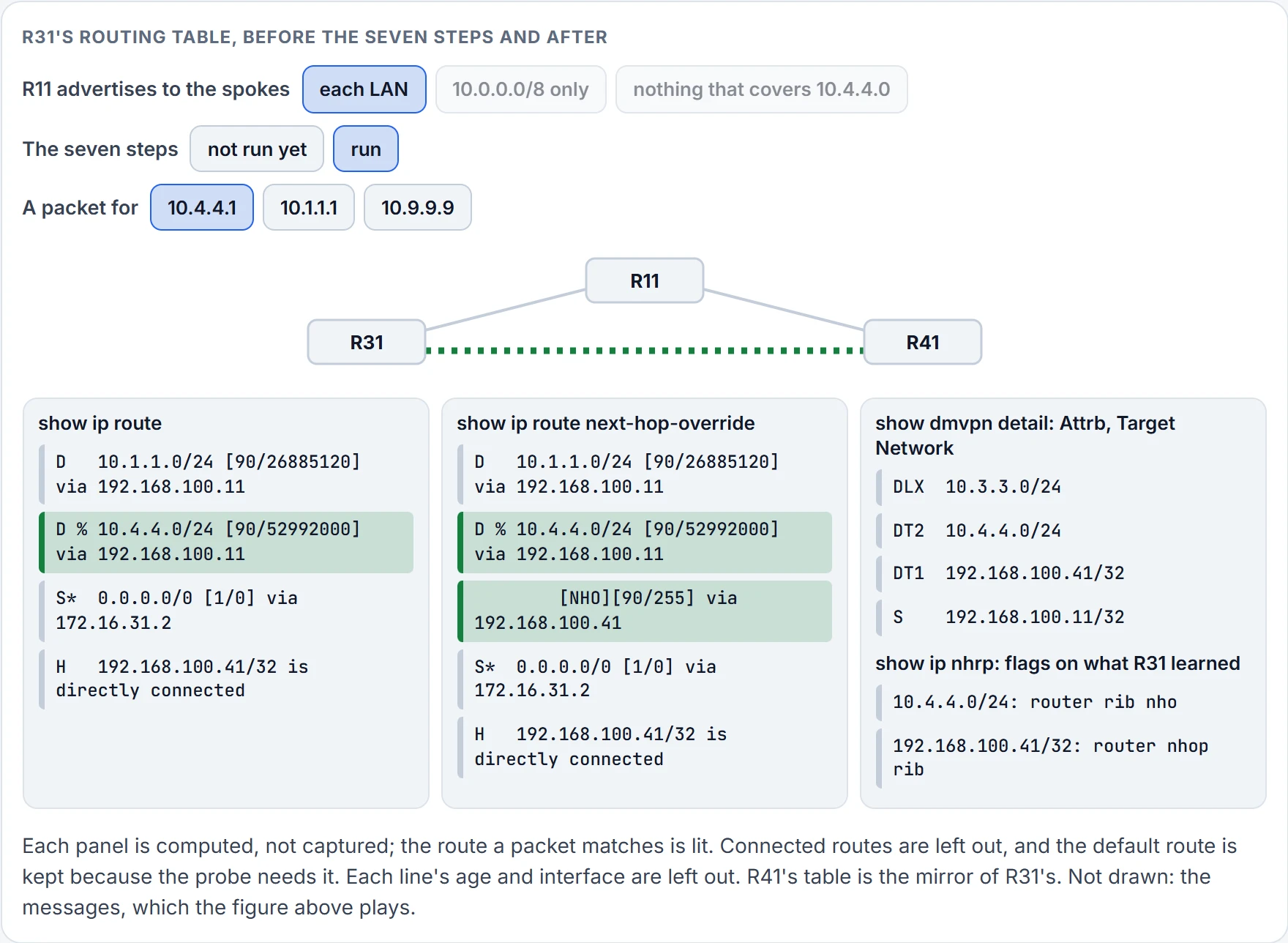
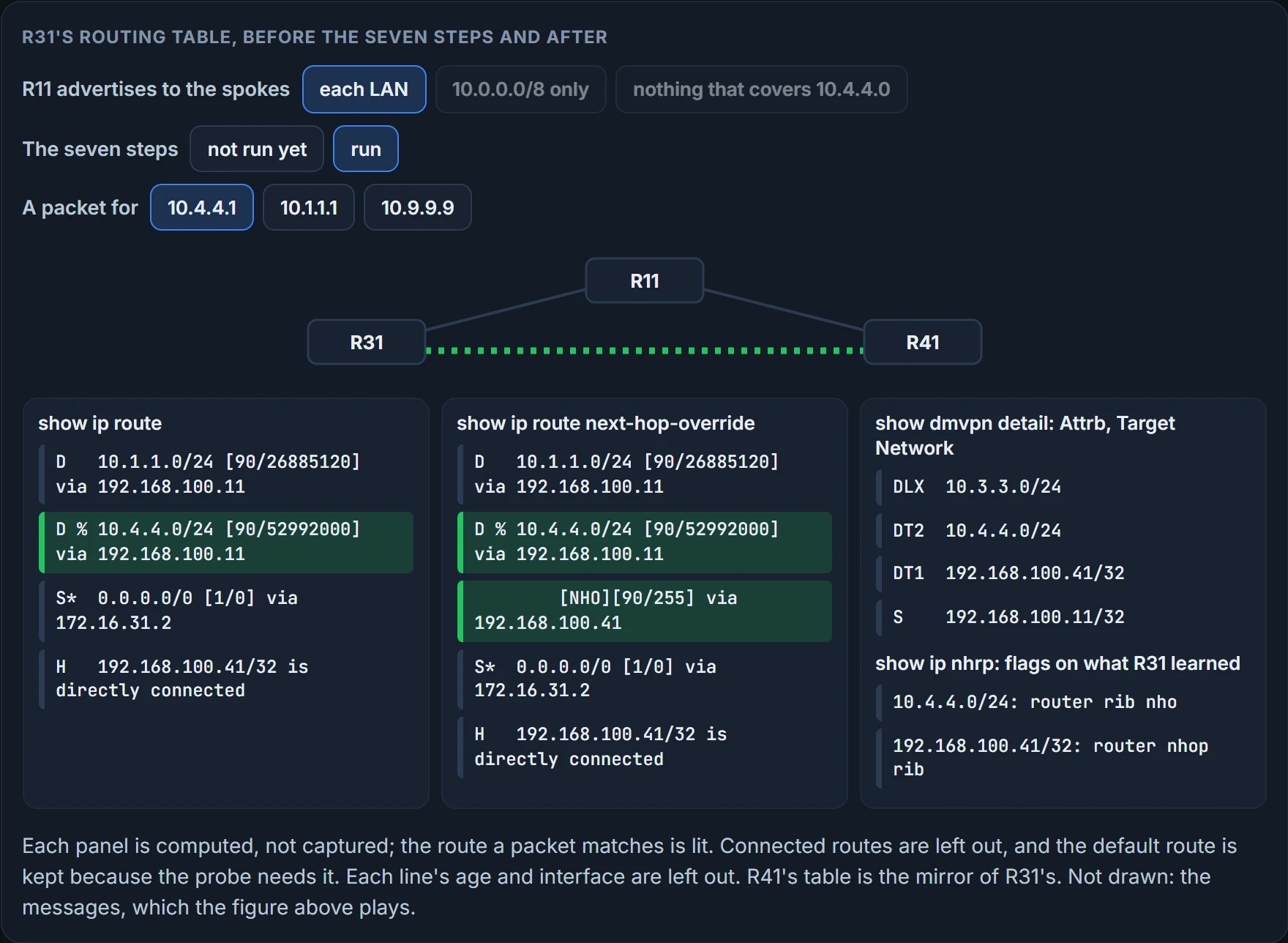
D. The lines R31 learned over the tunnel:
R31-Spoke# show ip route
D        10.1.1.0/24 [90/26885120] via 192.168.100.11, 10:44:45, Tunnel100
D %      10.4.4.0/24 [90/52992000] via 192.168.100.11, 10:44:45, Tunnel100
H        192.168.100.41/32 is directly connected, 00:03:21, Tunnel100
Read the middle line slowly, because it's the oddest line in the module. The code is D. The distance and metric are EIGRP's. The age is ten hours: EIGRP hasn't touched it. And the next hop still reads 192.168.100.11, the hub. If you stopped there you'd say nothing had happened and the second trace was impossible.
The one thing that's different is a percent sign. The original protocol is still responsible for the prefix, but overwritten next-hop addresses are indicated in the routing table by the percent sign. The legend at the top of the output says the same, "% - next hop override", beside "H - NHRP". This command prints the route's owner's opinion and marks, with one character, that the router isn't forwarding by it.
To see what it is forwarding by, there's a second form. The command show ip route next-hop-override displays the routing table with the explicit NHRP shortcuts that were added. For the same prefix on R31:
D %      10.4.4.0/24 [90/52992000] via 192.168.100.11, 10:46:38, Tunnel100
                    [NHO][90/255] via 192.168.100.41, 00:05:14, Tunnel100
There's the second line the first command hid: the NHRP shortcut, indicated by the NHO marking and shown underneath the original entry with the correct next-hop IP address, 192.168.100.41. That's the hop the second trace printed. D % proves EIGRP owns the prefix and that its next hop is not the one in use; which next hop is in use, it can't tell you. The [NHO] line proves which next hop this router forwards that prefix to, and nothing about whether the far end is reachable on the transport network.
Why keep both lines and not just replace the route? Because NHRP acts as a route producer to the RIB, but it does not function as a full routing protocol: it has no neighbors of its own to tell about anything. EIGRP still owns 10.4.4.0/24. The route is the routing protocol's; the next hop, on this one router, for now, is NHRP's.
The third line of that output is the other new entry, and that one is a route of NHRP's own. R31 installs the NHRP route to 192.168.100.41/32, and R41 installs one to 192.168.100.31/32: code H, directly connected, Tunnel100. It's the cache's nhop entry, the "explicit method to reach the tunnel IP address", showing up in the routing table.
Three places now say one thing: T2 in show dmvpn, nho in show ip nhrp, % in show ip route.
We haven't confirmed on a router, for this section: what the H line for the neighbor's /32 adds, on a subnet that is connected anyway.
The hub summarizes
Now change one thing on the hub. The summarization lesson gave the reason to do it: summarizing routes on WAN links provides stability by hiding network convergence and thereby adding scalability. On a DMVPN hub it means every spoke gets one route for everything behind the hub and behind every other spoke. It is also the way to see NHRP's interaction with the routing table when the exact route does not exist there. R11's EIGRP configuration now advertises the 10.0.0.0/8 summary prefix out tunnel 100:
R11-Hub
router eigrp GRE-OVERLAY
 address-family ipv4 unicast autonomous-system 100
  af-interface Tunnel100
   summary-address 10.0.0.0 255.0.0.0
   hello-interval 20
   hold-time 60
   no split-horizon
  exit-af-interface
  !
  topology base
  exit-af-topology
  network 10.0.0.0
  network 192.168.100.0
 exit-address-family
One line is this lesson's: summary-address 10.0.0.0 255.0.0.0, the summarization lesson's command in its usual place, under the af-interface of the tunnel the summary leaves by. The block's other three af-interface lines, hello-interval 20, hold-time 60 and no split-horizon, are about how the routing protocol behaves on the overlay, and they're the next lesson's.
Then the NHRP cache is cleared on all routers with clear ip nhrp, which removes any NHRP entries, and the tables read:
R11
D  10.0.0.0/8 is a summary, 00:28:44, Null0
D  10.3.3.0/24 [90/27392000] via 192.168.100.31, 11:18:13, Tunnel100
D  10.4.4.0/24 [90/27392000] via 192.168.100.41, 11:18:13, Tunnel100
R31
D 10.0.0.0/8 [90/26885120] via 192.168.100.11, 00:29:28, Tunnel100
R41
D 10.0.0.0/8 [90/26885120] via 192.168.100.11, 00:29:54, Tunnel100
Only the 10.0.0.0/8 summary route provides initial connectivity among all three routers. The hub holds the summary itself, pointing at Null0, and still knows each LAN by way of its spoke. R31 doesn't have a route for 10.4.4.0/24 any more. It has a /8 that points at the hub, 192.168.100.11.
Start with the frames, because they don't change. The spoke routers use the summary route for forwarding traffic until NHRP establishes the spoke-to-spoke tunnel: the packet matches the /8, goes to the hub, and hairpins. Traffic was re-initiated from 10.3.3.1 to 10.4.4.1 to initialize the spoke-to-spoke tunnels; R11 still sends the NHRP redirect for hairpinned traffic, and the pattern would complete as shown earlier, except that NHRP would install a more specific route into the routing table on R31 (10.4.4.0/24) and R41 (10.3.3.0/24). The NHRP injected route is indicated by the H entry.
R31
D  10.0.0.0/8 [90/26885120] via 192.168.100.11, 00:31:06, Tunnel100
H  10.4.4.0/24 [250/255] via 192.168.100.41, 00:00:22, Tunnel100
H  192.168.100.41/32 is directly connected, 00:00:22, Tunnel100
R41
D  10.0.0.0/8 [90/26885120] via 192.168.100.11, 00:31:24, Tunnel100
H  10.3.3.0/24 [250/255] via 192.168.100.31, 00:00:40, Tunnel100
H  192.168.100.31/32 is directly connected, 00:00:40, Tunnel100
A new line, twenty-two seconds old, that no routing protocol advertised. Both halves of Phase 3's own sentence now have an example: NHRP shortcuts modify the next-hop entry for existing routes, or add a more explicit route entry to the routing table. The last section was the first half; this is the second. The summary is untouched and has no percent sign, because nothing was overridden. Longest match does the rest: a packet for 10.4.4.1 matches the /24 and goes to R41; a packet for 10.1.1.1 matches only the /8 and goes to the hub, as it should.
Look at the bracket: [250/255]. The administrative distance of an NHRP route here is 250.
show dmvpn detail agrees. On R31, both of the new spoke-to-spoke tunnel entries are DT1, because they are new routes in the RIB. Its four rows:
    1 172.16.31.1      192.168.100.31    UP 00:01:17   DLX        10.3.3.0/24
    2 172.16.41.1      192.168.100.41    UP 00:01:17   DT1        10.4.4.0/24
      172.16.41.1      192.168.100.41    UP 00:01:17   DT1  192.168.100.41/32
    1 172.16.11.1      192.168.100.11    UP  11:21:33    S  192.168.100.11/32
If the routes had been more explicit, as they were before the summary, NHRP would have overridden the next-hop address and used a DT2 entry. From a spoke, then, DT2 against DT1 tells you whether the hub is sending specifics or a summary. About the far side's routes it tells you nothing.
Now you can say why this phase lets the hub summarize: because NHRP shortcuts install more explicit routes in the routing table, DMVPN Phase 3 supports summarization of networks at the hub while providing optimal routing between spoke routers. The spoke never needed to hear the far LAN's route from the routing protocol. It needed any route that got the first packet to the hub. The redirect did the rest, and the answer came back as a /24. Phase 3 DMVPN fully supports summarization, which should be used to minimize the number of prefixes advertised across the WAN.
One dependency. The H route lives under the summary: if the summary route is absent, NHRP cannot discover a shortcut path, and removing the covering route removes the NHRP routes learned by way of it. An H route proves NHRP added a more specific route under a less specific one, not that the less specific one will stay.
We haven't confirmed on a router, for this section: the second number in the bracket: expect 255 in the exam and don't memorise it, since the metric is tied to the cache entry's preference; and what NHRP does with its entry once a routing protocol offers the same prefix.
Continue the lesson
The whole lesson, with its drawings and its questions. 4 more sections after the ones above.