IPv6 Address Types
IPv6 addresses come in three broad kinds, by who receives a packet: unicast, multicast and anycast. Global unicast addresses are IPv6's public addresses, assigned from IANA through the registries and ISPs. Unique local addresses, beginning FD, work somewhat like private IPv4 addresses. Link-local addresses are created automatically and never leave their link.
By Arif, founder of Daveth · Updated
The full 19 min walkthrough is in Daveth Pro (Network). See what the plan opens
What this page answers
What are the IPv6 address types?
Unicast, for one interface; multicast, for a group; and anycast. Unicast addresses include global unicast, the public ones, unique local, the private-style ones, and link-local, used only on one link. Read it in “Which addresses?”
What is a unique local IPv6 address?
IPv6's private-style address, beginning FD. No registration is needed, and each organisation is meant to choose its prefix at random, so two rarely share one. Read it in “Unique local: the private-style ones”
What is an IPv6 link-local address?
A unicast address every IPv6 host and router interface creates for itself, used by overhead protocols and routing. Routers never forward a packet sent to one, so it never leaves its data link. Read it in “Link-local addresses”
Which addresses?
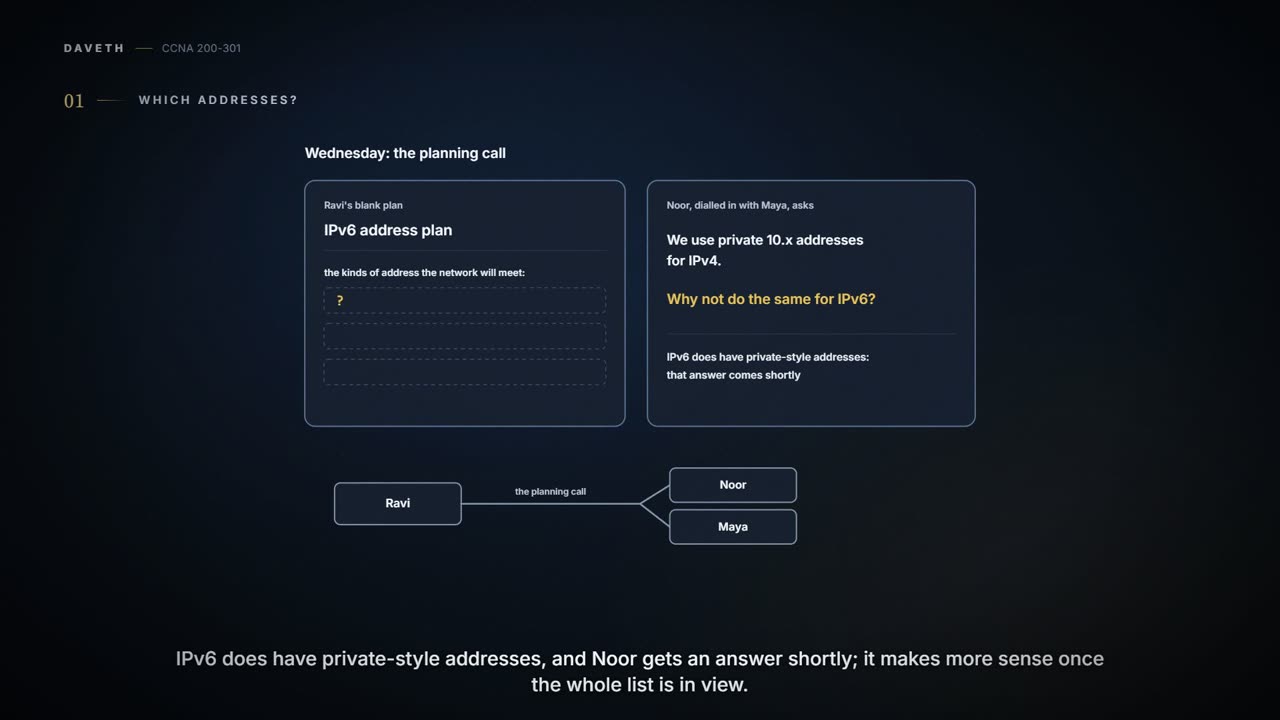
Wednesday, month five, week one. On the planning call, Ravi opens a blank IPv6 address plan and starts a list: which kinds of IPv6 address will the network meet? Noor, dialled in with Maya, asks: "We use private 10.x addresses for IPv4. Why not do the same for IPv6?"
IPv6 does have private-style addresses, and that answer comes shortly. First, the big picture. IPv6 addresses come in three broad kinds, by who receives a packet sent to them:
- Unicast: one interface. Global unicast, unique local and link-local addresses are all unicast.
- Multicast: every interface that listens for that group.
- Anycast: the nearest of several interfaces that share the address.
Global unicast: the public ones
IPv4 started with a plan to give every host a globally unique public address. There were too few, so from the 1990s companies used the private ranges from RFC 1918, either staying off the internet or reaching it through NAT (04.1). IPv6 offers two similar options.
Global unicast addresses are IPv6's public addresses. Like public IPv4 addresses, they rely on an administrative process that gives each organization its own unique block. The organization subnets that block and uses only addresses from inside it, so its addresses are unique across the globe. The company's 2001:DB8:A50::/48, assigned by the ISP, is one of these blocks.
That block, which only one organization may use, is called a global routing prefix. Every address inside the company should begin with it, and no other company should use addresses that begin with it. Very roughly, it plays the part a public Class A, B or C network, or a CIDR block, plays in IPv4. (Where it stops: no class fixes its length; the length comes with the assignment.)
The name says what it's for: internet routers can have one route for all the addresses inside the block, with no need for routes to its smaller parts. There's room for every company in the world to have one, with plenty of addresses each.
IPv6 uses the same organizations as IPv4 to hand out blocks: IANA (with ICANN), the Regional Internet Registries (RIRs) and the ISPs. In this story, the chain went like this:
- IANA allocated a large block to an RIR, for example 2001::/16: every address beginning 2001.
- The RIR allocated part of it to the ISP: 2001:DB8::/32, every address beginning with the 32 bits (8 hex digits) 2001:0DB8.
- The ISP assigned a small piece of that to the company: 2001:DB8:A50::/48, every address beginning with the 48 bits (12 hex digits) 2001:0DB8:0A50.
A lab that won't connect to the internet for a while doesn't need any of that. You can make up addresses for experiments, or use the private-style kind below.
Global unicast addresses make up most of the IPv6 address space, and the rules for which values belong to which type are deliberately more flexible than IPv4's Classes A to E. At first, IANA reserved all addresses beginning with hex 2 or 3, written as 2000::/3. Later it widened the range to everything not otherwise reserved: unique local addresses begin with FD, for example, so those aren't global unicast, but any range not set aside for something else counts. That's a huge range, but IANA doesn't assign from all over it: careful, conservative choices kept IPv4 going for over 30 years, and the same habits could make IPv6 last much longer.
The shortage that shaped IPv4's whole history, solved by adding more digits than anyone will ever type by hand. Well, almost anyone. The ISP did.
Unique local: the private-style ones
Here's Noor's answer. Unique local addresses work somewhat like private IPv4 addresses: no registration with anyone, and more than one organization might use the same ones. (Where it stops: private IPv4 ranges are one fixed set that everyone shares; each unique local prefix is meant to be chosen at random, so sharing is rare.) Companies that won't connect to the internet, or that plan to use IPv6 NAT, can use them. An engineer reads the rules in an RFC, picks some numbers, and starts assigning addresses. The rules are:
- Use FD as the first two hex digits.
- Choose a unique 40-bit global ID, which is 10 hex digits.
- Put the global ID after FD to make a 48-bit prefix, the prefix for all your addresses.
- Use the next 16 bits as a subnet field, which leaves a 64-bit interface ID: the part that identifies one interface, much as the host part of an IPv4 address does.
Choose the 10 hex digits 00 0001 0001, for example, put FD in front, and the prefix is FD00:0001:0001::/48, or FD00:1:1::/48 abbreviated. Apart from the FD and the missing registration, unique local addresses work much like global unicast ones, subnetting included. One difference: you build a unique local prefix yourself, and it's always a /48, while an assigned global routing prefix may or may not be.
To be exact, IANA reserves FC00::/7 for these, which covers addresses beginning FC and FD. But the RFC that defines them requires the eighth bit to be 1, so in practice every unique local address begins with FD.
In a lab, an easy prefix like FD00:1:1::/48 is fine. For a real company, RFC 4193 says to choose the global ID so that it's statistically unlikely anyone else has it, using the random-number method it describes. The goal is unique local addresses that are unique across the globe, even without registration. Here's why it matters. Today, a high percentage of companies use private network 10.0.0.0, so when two of them merge, the overlap makes joining their networks painful. Two companies that each chose a random unique local prefix will most likely have different ones, and the merger is much simpler.
FD00:1:1 is very easy to remember. That is exactly the problem.
So why not use unique local for everything, the way the company uses 10.x for IPv4? Reaching the internet from unique local addresses would mean IPv6 NAT, and the ISP has already assigned the company a global /48 that works on the internet as it is. So the plan gets two lines: the company's global unicast /48 for the real network, and perhaps, for Ravi's test lab, a unique local /48 with a random global ID.
Link-local addresses
Link-local addresses are a special kind of unicast address. They don't carry normal application data: overhead protocols and routing use them instead.
- Unicast, not multicast. A link-local address stands for one interface, and only that interface should process packets sent to it.
- The local link only. Routers do not forward a packet whose destination is a link-local address, so it never leaves its data link.
- Automatically generated. Every IPv6 host and router interface can create its own link-local address, which helps hosts before they have learned any other address.
- Common uses. Overhead protocols that stay on one subnet, such as NDP, which replaces ARP. And routing: routers use each other's link-local addresses as next-hop addresses, and hosts use their router's link-local address as their default gateway.
So an interface with a global unicast address has a link-local address as well. Two IPv6 addresses on one interface isn't a mistake: each one has its own job.
Link-local addresses come from FE80::/10: the first 10 bits are fixed, so the first three hex digits are FE8, FE9, FEA or FEB. Following the RFC, the next 54 bits are 0, so a link-local address should start FE80:0000:0000:0000. The second half can be calculated by rules, generated at random or configured; the details come later.
A link-local address works kind of like a phone extension inside one building: anyone in the building can dial it, and it means nothing from outside. (Where it stops: the building assigns its extensions, while a device usually creates its own link-local address; and the same values can turn up on different links, so knowing the address alone doesn't say which link it's on.)
Continue the lesson
The whole lesson, with its drawings and its questions. 4 more sections after the ones above.