
Domain Readiness Assessments
Reading a page three times makes it familiar; it does not make the skill yours. Readiness means three things: say the idea in plain words without notes, do it on a small network or on paper, and prove it with the output or calculation that confirms it. Score each of the six exam domains from 0 to 3, honestly.
By Arif, founder of Daveth · Updated
The full 8 min walkthrough is in Daveth Pro (Network). See what the plan opens
What this page answers
How do you know if you are ready for the CCNA?
For each domain, check three things: can you explain the idea without notes, can you do it on a small network or on paper, and can you show the output or calculation that proves it. Score each domain 0 to 3. Read it in “Say it, do it, prove it”
Read three times, still stuck
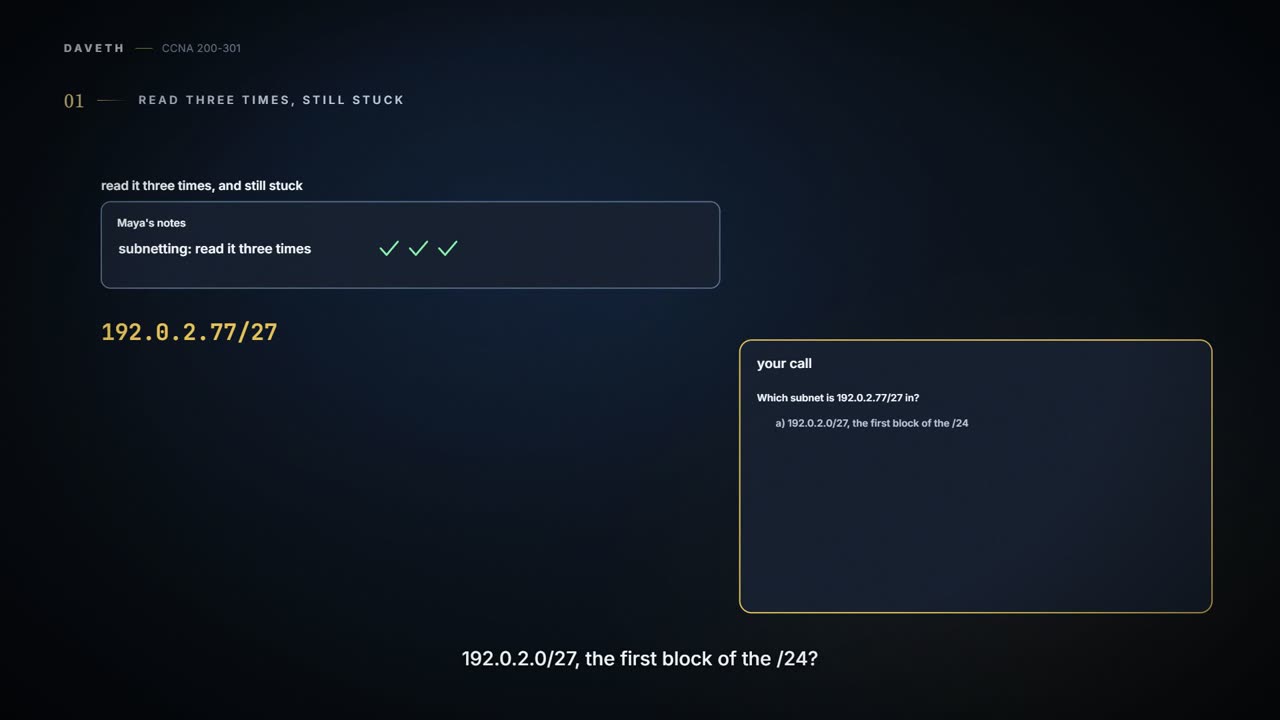
Maya's notes say "subnetting: read it three times". Then someone asks about 192.0.2.77/27, and nothing comes.
192.0.2.64/27. A /27 block is 32 addresses, so the blocks start at .0, .32, .64 and .96; 77 sits in the one from .64 to .95, and its hosts run from .65 to .94. Reading a page three times had made it familiar. It hadn't made the skill Maya's own.
The page was visited; the skill missed the bus.
Say it, do it, prove it
Readiness here means three different things. Say it: explain the idea in plain words, without notes. Do it: build or work it out on a small network or on paper. Prove it: show the output or the calculation that confirms it. A topic isn't a 2 because you liked the explanation, or because the analogy stuck.
Score each domain from 0 to 3, honestly. These scores are this course's study signal, not the exam's scoring, and they are never combined with the weights into a chance of passing.
| Score | Means you |
|---|---|
| 0 | can't yet explain the packet or the state |
| 1 | can explain it with a hint |
| 2 | can do it and verify a clean example |
| 3 | can isolate a planted fault and explain another way it could go wrong |
A domain at 2 is ready for mixed practice, the next two pages. A claim that you're ready for the real exam needs repeated 2s and 3s, under different conditions, and a practical lab someone else has looked at. If you couldn't test a domain, say so: "couldn't test it" is an honest score, and it shows as needing evidence.
Six domains, one at a time
For each domain, write your answer first; the expected answer opens only after you've written something. Then do the task, note what it proves and what it doesn't, and score yourself. Nothing you type leaves this page, and nothing is kept after you close it.
Six domains: say it, do it, prove it
1. Network Fundamentals
Say it. For 198.51.100.150/26: the subnet, its broadcast, and the host range.
Do it, prove it. Check a host's address, mask, gateway and DNS server against the plan; then find a learned MAC and the port it came in on with show mac address-table dynamic. Proves: what the host is really using, and where that MAC was learned. Doesn't prove: traffic end to end; and a port light isn't MAC evidence.
2. Network Access
Say it. VLAN 20 is in the trunk's allowed list on SW2, but not in its "allowed and active" list. What's missing?
Do it, prove it. Configure access and trunk ports for VLANs 10 and 20 across two switches; check show vlan brief, show interfaces trunk, show etherchannel summary, show spanning-tree vlan 10 and, where enabled, show lldp neighbors. Proves: port membership, what each trunk carries, the bundle's state, each port's STP role, and each link's neighbour. Doesn't prove: that VLAN 20 traffic crosses (ping across it); and a blocking port is often exactly right.
3. IP Connectivity
Say it. Routes to 10.4.0.0/16, 10.4.8.0/24 and 0.0.0.0/0. Which does 10.4.8.99 use, and what decides between two routes to the same prefix?
Do it, prove it. Configure one default, one host and one floating static route, then shut the primary path and watch the floating route appear; read show ip route and show ip ospf neighbor. Proves: which routes are installed, and each neighbour's state. Doesn't prove: every prefix a FULL neighbour should send; a missing floating route while the primary is up is expected; two DROTHERs on a shared segment rightly stay at 2WAY; and IPv6, which needs show ipv6 route.
4. IP Services
Say it. A client leases 10.10.20.21 from a DHCP server two routers away. What made that possible, and what hasn't it proved?
Do it, prove it. Check the lease, gateway and DNS options, then test a name lookup on its own; match inside local to inside global in show ip nat translations after real traffic; with show ntp associations and show logging, tell an NTP client from a server and a message's severity from its facility. Proves: the lease, an active translation, where the clock syncs, what was logged. Doesn't prove: DNS working (test it separately), or return traffic; and an empty table before any traffic is normal for dynamic NAT and PAT.
5. Security Fundamentals
Say it. Someone changed a router's configuration yesterday. Which A of AAA lets you prove who it was?
Do it, prove it. Sign in as a limited user and try a change; read an ACL top down with its implicit deny, check its direction with show ip interface, and count hits with show ip access-lists; check snooping trust and DAI validation separately. Proves: that the limit holds, which explicit line matched and which way the ACL faces, which ports are trusted. Doesn't prove: traffic you didn't test; the implicit deny shows no hits, so an explicit deny is what shows a denial; and a denial can be exactly what the policy wants.
6. Automation and Programmability
Say it. Which HTTP method fits each: read a list of VLANs; create a new VLAN; change one field of a VLAN; remove a VLAN?
Do it, prove it. Decode one JSON object and array; send a GET and a PATCH in 11.11's panel and read the status and body; compare a declarative configuration tool's change with its record of intended state; for an AI suggestion, name the telemetry, the guess, and the next safe check. Proves: what the data says and what the API answered. Doesn't prove: that a controller or an AI tool is right about the live network.
| Domain | Your score | Next |
|---|---|---|
| Network Fundamentals | not scored yet | |
| Network Access | not scored yet | |
| IP Connectivity | not scored yet | |
| IP Services | not scored yet | |
| Security Fundamentals | not scored yet | |
| Automation and Programmability | not scored yet |
When all six have a score, read the summary. Anything under 2 names the lessons to revisit, and "couldn't test it" stays open until you can.
Continue the lesson
The whole lesson, with its drawings and its questions. The rest of this section and 2 more after it.