
CCNA Practice Exam 1
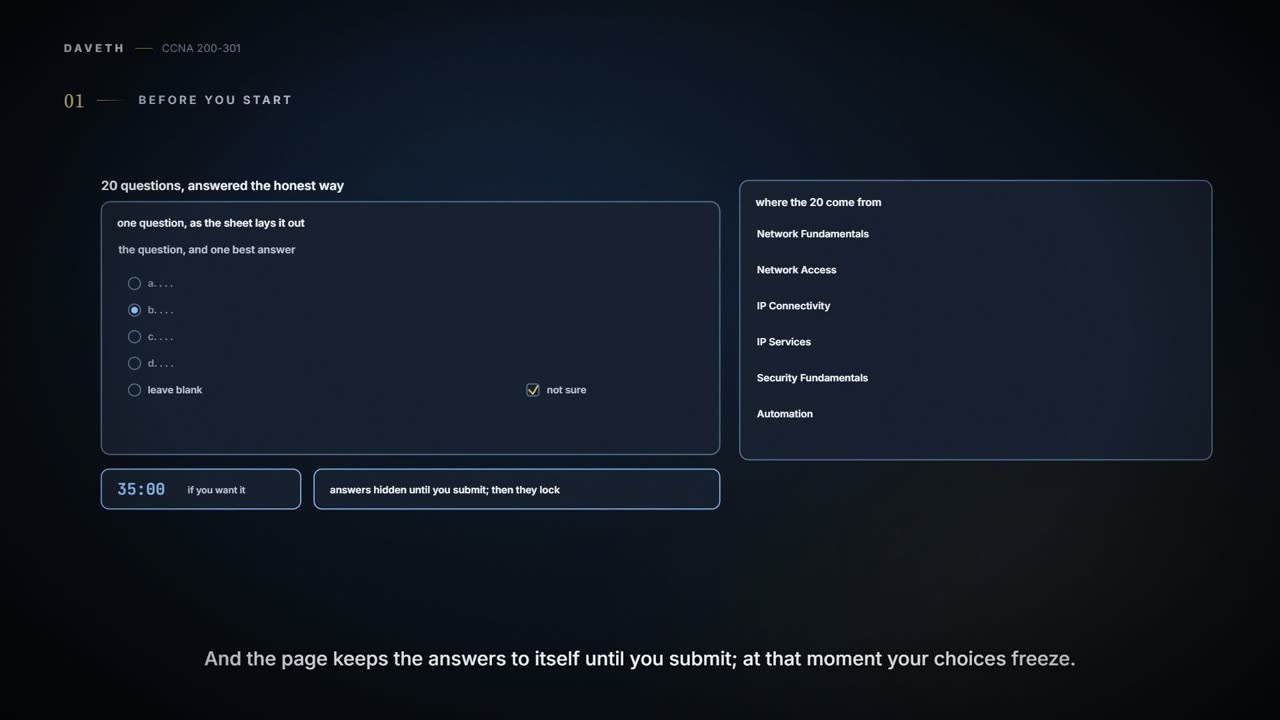
Twenty CCNA practice questions, one best answer each, written for this course rather than copied from the exam. Take them without notes the first time, with an optional 35-minute clock. Leave a question blank rather than guess, or mark it not sure, so a lucky guess does not pass for knowledge.
By Arif, founder of Daveth · Updated
The full 6 min walkthrough is in Daveth Pro (Network). See what the plan opens
Before you start
One best answer each, and no notes the first time. There's a 35-minute clock if you want to practise pace, and no clock if you'd rather not. You can leave any question blank rather than guess, and tick "not sure" beside an answer, so a lucky guess doesn't pass for knowledge.
These questions were written for this course; they aren't the exam's, and they don't copy anyone else's. Nothing about the answers appears until you submit, and then your answers lock.
A wrong answer is a packet trace: it shows where the thinking turned. (Where it stops: unlike a trace, finding the turn isn't the fix; you still have to repair the reasoning.)
The exam
20 questions, 35 minutes if you want the clock
- Network Fundamentals Host 192.0.2.77/27 belongs to which subnet? a. 192.0.2.64/27 b. 192.0.2.0/27 c. 192.0.2.32/27 d. 192.0.2.96/27 leave blank not sure
- Network Fundamentals A switch receives a frame for an unknown destination MAC in VLAN 10. What does it do? a. Drops it, since the MAC table has no entry b. Floods it out every port, in every VLAN c. Floods it out every other eligible port in VLAN 10 d. Sends it only toward the default gateway leave blank not sure
- Network Fundamentals Which pattern fits a duplex mismatch best? a. CRC errors on both ends, and no collisions anywhere b. The link stays down/down on both ends c. Input errors only when the port runs at 10 Mbps d. Late collisions on the half-duplex end; CRC errors and runts on the other leave blank not sure
- Network Fundamentals Which of these is an IPv6 link-local unicast address? a. 2001:db8::1 b. fe80::1 c. ff02::1 d. fd00::1 leave blank not sure
- Network Access A PC in VLAN 20 on SW1 reaches other VLAN 20 hosts on SW1, but none on SW2. Which check first tests whether VLAN 20 crosses between the switches? a. show vlan brief on SW1 b. show mac address-table on SW2 c. show interfaces trunk, on either switch d. show spanning-tree vlan 20 on SW1 leave blank not sure
- Network Access Two EtherChannel member ports allow different VLANs. What should you expect? a. The mismatched member stays out of the bundle, or the bundle is err-disabled b. LACP copies the allowed list from one member to the other c. The bundle forms, and only routing over it is affected d. STP blocks every VLAN on both switches until it is fixed leave blank not sure
- Network Access In a stable Rapid PVST+ VLAN, which switch is the root? a. The switch with the highest MAC address b. The switch with the fastest access port c. The switch that is also the default gateway d. The switch with the lowest bridge ID leave blank not sure
- Network Access Which port setting suits an ordinary PC in VLAN 20? a. switchport mode trunk, with native vlan 20 b. switchport mode access, with access vlan 20 c. switchport mode dynamic desirable d. no switchport, with an IP address on the port leave blank not sure
- IP Connectivity Routes: 10.4.0.0/16 via A, 10.4.8.0/24 via B, and 0.0.0.0/0 via C. Which does 10.4.8.99 use? a. A b. All three, load balanced c. B d. C leave blank not sure
- IP Connectivity OSPF neighbours are FULL, but R1 has no route to R2's server subnet. Which evidence helps most next? a. R2's OSPF-enabled interfaces, and show ip route ospf on R1 b. show ip ospf neighbor on R1 again, in case FULL was wrong c. The OSPF process numbers on both routers d. The hello and dead timers on the transit link leave blank not sure
- IP Connectivity A floating static route should have what administrative distance, compared with the preferred route? a. Lower b. Higher c. The same d. Zero leave blank not sure
- IP Connectivity What is R1's static route to ::/0 for? a. Traffic to one IPv6 host b. All IPv4 traffic with no other route c. Traffic to link-local addresses only d. Any IPv6 destination with no better match leave blank not sure
- IP Connectivity OSPF elects a DR and a BDR on which network type? a. Broadcast (and NBMA) multiaccess b. Point-to-point c. Loopback d. Point-to-multipoint leave blank not sure
- IP Services A client gets its address and gateway by DHCP, and pings by address work, but name lookups fail. What do you check first? a. The switch cabling, since a lease can still arrive over a failing cable b. The default gateway, in case the pings took another path c. The DNS server option, and whether that server answers d. The DHCP pool, in case it ran out of addresses leave blank not sure
- IP Services After traffic, a NAT entry shows 10.10.10.20 translated to 198.51.100.20. Which is the inside local address? a. 198.51.100.20, the address outside hosts see b. The server's outside global address c. The server's outside local address d. 10.10.10.20, the host's own address leave blank not sure
- Security Fundamentals An extended ACL permits all IP traffic on a line above an SSH deny. What happens to matching SSH? a. It's denied, because deny lines always win b. It's permitted, by the first match c. Every line is checked, and the most specific wins d. It's permitted, and the deny line logs it leave blank not sure
- Security Fundamentals In a simple network, which switch port should normally be trusted for DHCP snooping? a. Every port that has a DHCP client on it b. Any port with PoE enabled c. The port toward the real DHCP server d. Every access port in the snooped VLAN leave blank not sure
- Security Fundamentals A user proves who they are, then receives limited rights. Which step decides the rights? a. Authentication b. Accounting c. Encryption d. Authorization leave blank not sure
- Automation and Programmability An API GET for /devices/7 returns JSON and HTTP 200. What does that prove? a. The API answered with its record b. The device's physical link is healthy right now c. The device's configuration was changed d. The data in the reply is up to date leave blank not sure
- Automation and Programmability A dashboard's AI suggests "RF interference" after retries rise. What should the engineer do next? a. Treat the suggestion as the root cause and fix it b. Check RF and client evidence, and test other causes c. Change every access point's channel at once d. Turn the AI feature off and rely on user reports leave blank not sure
Continue the lesson
The whole lesson, with its drawings and its questions. The rest of this section and 2 more after it.